Fasting Rules
 Meat
Abstain
 Fish
Allowed
 Dairy
Abstain
 Oil
Allowed
 Wine
Allowed
Saints & Commemorations
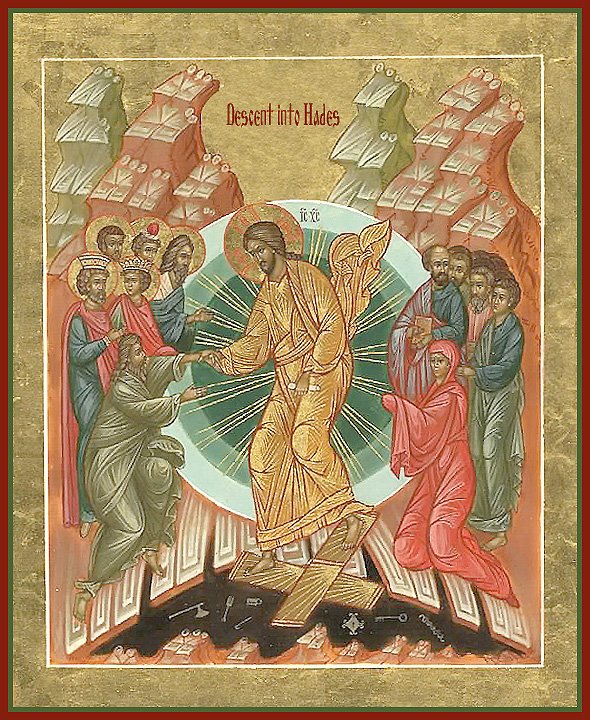
Leavetaking of Pascha / Forefeast of Ascension
On Wednesday of the sixth week of Pascha, we celebrate the Leavetaking of the Feast. While most Feasts have their Leavetaking on the eighth day, Pascha, the Feast of Feasts, has its Leavetaking on the thirty-ninth day. The fortieth day is the Feast of the Lord’s Ascension, which marks the end of the Lord’s physical presence on earth. He
On Wednesday of the sixth week of Pascha, we celebrate the Leavetaking of the Feast. While most Feasts have their Leavetaking on the eighth day, Pascha, the Feast of Feasts, has its Leavetaking on the thirty-ninth day. The fortieth day is the Feast of the Lord’s Ascension, which marks the end of the Lord’s physical presence on earth. He does not abandon us, however. He has promised to be with us always, even until the end of the age (MT 20:28). As we sing in the Kontakion for Ascension, “Thou didst ascend in glory, O Christ our God, not being parted from those who love Thee, but remaining with them and crying: I am with you and no one will be against you.” There is a similar thought expressed in the Troparion for the Dormition: “In falling asleep, you did not forsake the world, O Theotokos.”
The services today are celebrated just as on the day of Pascha itself. The daily readings from Holy Scripture, of course, will differ. After the Dismissal at Liturgy, the paschal hymns are no longer sung. The prayer “O Heavenly King” is not said or sung until Pentecost.The Winding Sheet (Plaschanitsa) is taken from the altar and is put in its proper place. Even though today is a Wednesday, fish, wine, and oil are permitted.
Today we also commemorate the Finding of the Icon of the Mother of God “Of the Meeting” in Kalamata in the Peloponnesus.
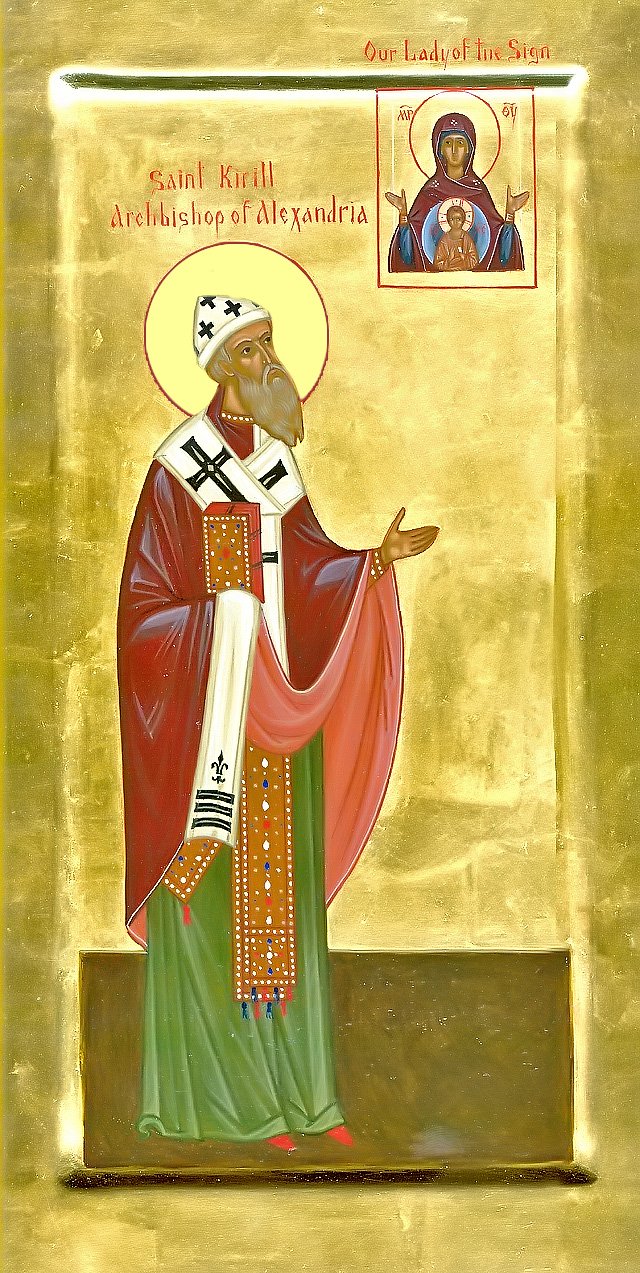
St Cyril of Alexandria
Saint Cyril, Archbishop of Alexandria, a distinguished champion of Orthodoxy and a great teacher of the Church, came from an illustrious and pious Christian family. He studied the secular sciences, including philosophy, but most of all he strove to acquire knowledge of the Holy Scriptures and the truths of the Christian Faith.
Saint Cyril, Archbishop of Alexandria, a distinguished champion of Orthodoxy and a great teacher of the Church, came from an illustrious and pious Christian family. He studied the secular sciences, including philosophy, but most of all he strove to acquire knowledge of the Holy Scriptures and the truths of the Christian Faith. In his youth Cyril entered the monastery of Macarius in the Nitreia hills, where he stayed for six years. Theophilus (385-412), the Patriarch of Alexandria, ordained him as a deacon, numbered him among the clergy and entrusted him to preach.
Upon the death of Patriarch Theophilus, Cyril was unanimously chosen to the patriarchal throne of the Alexandrian Church. He led the struggle against the spread of the Novatian heresy in Alexandria, which taught that any Christian who had fallen away from the Church during a time of persecution, could not be received back into it.
Cyril, seeing the futility of admonishing the heretics, sought their expulsion from Alexandria. The Jews appeared a greater danger for the Church, repeatedly causing riots, accompanied by the brutal killing of Christians. The saint long contended with them. In order to wipe out the remnants of paganism, the saint cast out devils from an ancient pagan temple and built a church on the spot, and the relics of the Holy Unmercenaries Cyrus and John were transferred into it. A more difficult struggle awaited the saint with the emergence of the Nestorian heresy.
Nestorius, a presbyter of the Antiochian Church, was chosen in 428 to the see of Constantinople and there he was able to spread his heretical teaching against the dogma about the uncommingled union of two natures in the Person of the Lord Jesus Christ. Nestorius called the Mother of God not the Theotokos, but rather Christotokos or “Birth-giver of Christ,” implying that she gave birth not to God, but only to the man Christ. The holy Patriarch Cyril repeatedly wrote to Nestorius and pointed out his error, but Nestorius continued to persevere in it. Then the saint sent out epistles against Nestorianism to the clergy of Constantinople and to the holy emperor Theodosius the Younger (408-450), denouncing the heresy. Cyril wrote also to other Churches, to Pope Celestine and to the other Patriarchs, and even to monks of several monasteries, warning of the emergence of a dangerous heresy.
Nestorius started an open persecution against the Orthodox. In his presence one of his partisans, Bishop Dorotheus, pronounced an anathema against anyone who would call the Most Holy Virgin Mary the Theotokos.
Nestorius hated Cyril and brought out against him every kind of slander and fabrication, calling him a heretic. The saint continued to defend Orthodoxy with all his powers. The situation became so aggravated, that it became necessary to call an Ecumenical Council, which convened in the city of Ephesus in the year 431. At the Council 200 bishops arrived from all the Christian Churches. Nestorius, awaiting the arrival of Bishop John of Antioch and other Syrian bishops, did not agree to the opening of the Council. But the Fathers of the Council began the sessions with Cyril presiding. Having examined the teaching of Nestorius, the Council condemned him as a heretic. Nestorius did not submit to the Council, and Bishop John opened a “robber council”, which decreed Cyril a heretic. The unrest increased. By order of the emperor, Patriarch Cyril of Alexandria and Archbishop Memnon of Ephesus were locked in prison, and Nestorius was deposed.
Soon Saints Cyril and Memnon were freed, and the sessions of the Council continued. Nestorius, not submitting himself to the determinations of the Council, was deprived of priestly rank. By order of the emperor he was sent to the faraway place Sasim in the Libyan wilderness, where he died in grievous torments. His tongue, having blasphemed the Mother of God, was overtaken by punishment -- in it there developed worms. Even Bishop John of Antioch and the remaining Syrian bishops signed the decrees of the Council of Ephesus.
Cyril guided the Alexandrian Church for 32 years, and towards the end of his life the flock was cleansed of heretics. Gently and cautiously Cyril approached anyone, who by their own simpleness and lack of knowledge, fell into false wisdom. There was a certain Elder, an ascetic of profound life, who incorrectly considered the Old Testament Priest Melchizedek to be the Son of God. Cyril prayed for the Lord to reveal to the Elder the correct way to view the righteous one. After three days the Elder came to Cyril and said that the Lord had revealed to him that Melchizedek was a mere man.
Cyril learned to overcome his prejudice against the memory of the great John Chrysostom (November 13). Theophilus, the Patriarch of Alexandria, and uncle of Cyril, was an antagonist of John, and presided in a council in judgment of him. Cyril thus found himself in a circle antagonistic to John Chrysostom, and involuntarily acquired a prejudice against him. Isidore of Pelusium (February 4) repeatedly wrote to Cyril and urged him to include the name of the great Father of the Church into the diptychs of the saints, but Cyril would not agree.
Once in a dream he saw a wondrous temple, in which the Mother of God was surrounded by a host of angels and saints, in whose number was John Chrysostom. When Cyril wanted to approach the All-Holy Lady and venerate her, John Chrysostom would not let him. The Theotokos asked John to forgive Cyril for having sinned against him through ignorance. Seeing that John hesitated, the Mother of God said, “Forgive him for my sake, since he has labored much for my honor, and has glorified me among the people calling me Theotokos.” John answered, “By your intercession, Lady, I do forgive him,” and then he embraced Cyril with love.
Cyril repented that he had maintained anger against the great saint of God. Having convened all the Egyptian bishops, he celebrated a solemn feast in honor of John Chrysostom.
Cyril died in the year 444, leaving behind many works. In particular, the following ought to be mentioned: commentaries On the Gospel of Luke, On the Gospel of John, On the Epistles of the Apostle Paul to the Corinthians and to the Hebrews; also an Apologia in Defense of Christianity against the Emperor Julian the Apostate (361-363). Of vast significance are his Five Books against Nestorius; a work on the Most Holy Trinity under the title Thesaurus, written against Arius and Eunomios. Also two dogmatic compositions on the Most Holy Trinity, distinguished by a precise exposition of the Orthodox teaching on the Procession of the Holy Spirit. Cyril wrote Against Anthropomorphism for several Egyptians, who through ignorance depicted God in human form. Among Cyril’s works are also the Discussions, among which is the moving and edifying Discourse on the Exodus of the Soul, inserted in the Slavonic “Following Psalter”.
Today we commemorate the repose of this great Father of the Church. He is also remembered on January 18, the date of his flight from Alexandria.
Troparion - Tone 1
With all reverence let us praise a light of the world, / the great orator and champion of the Mother of God. / For by his fiery teachings / he burned up the heresy of Nestorius; / therefore, let us cry out to him: / “Divine Cyril, intercede with Christ to strengthen the Orthodox Faith.”
Kontakion - Tone 6
You have openly poured out upon us the depth of the teachings of theology, / drawing from the well-springs of the Savior; / you drowned heresies / and saved your flock unharmed from triple waves. / Blessed and venerable Cyril, / you are shown to be a guide for all lands, revealing things divine
Ven. Kirill of Belozersk
He was born in Moscow in 1337, and took up the monastic life while young. Though he desired a life of strict silence and solitude, he was made abbot of the Simonov Monastery against his will. After a few years, obeying a revelation from the most holy Theotokos, he left his abbacy and went to the wilderness of Belozersk (White Lake) to live as a hermit.
He was born in Moscow in 1337, and took up the monastic life while young. Though he desired a life of strict silence and solitude, he was made abbot of the Simonov Monastery against his will. After a few years, obeying a revelation from the most holy Theotokos, he left his abbacy and went to the wilderness of Belozersk (White Lake) to live as a hermit. Others gathered there to live under his guidance, and in time the community became the Monastery of Belozersk. Saint Kyril was sought from far off as a staretz, or spiritual father, and was granted gifts of wonderworking. His humility was remarkable, as the following story shows.
Once one of his monks conceived a terrible hatred for Kyril, which tormented him for a whole year. Finally the monk worked up the courage to reveal his hatred to Kyril himself. Though the monk was full of shame and remorse at his malicious passion, Kyril comforted him and said, ‘All the others are in error about me; only you have perceived my unworthiness.’ Saint Kyril then forgave the man and sent him away with his blessing.
Saint Kyril reposed in peace in 1427, at the age of ninety.
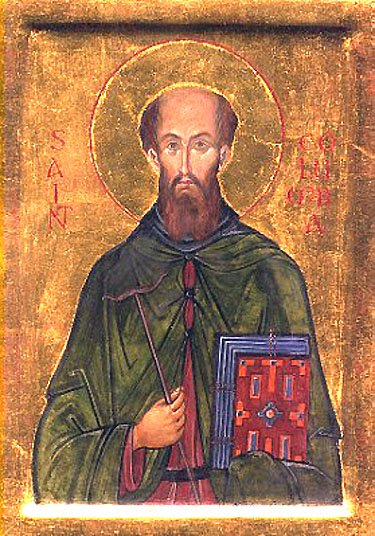
St Columba of Iona (597)
Saint Columba (or Colum Cille, "the dove of the Church") was of noble birth, a member of the powerful Ui Néill clan, which traced its descent to Niall of the Nine Hostages, who died around the year 450. His parents were Fedelmid mac Ferguso and Eithne. Although it is difficult to determine the date of Saint Columba's birth with any degree of certainty, it is believed that he was born in County Donegal on December 7, 521.
Saint Columba (or Colum Cille, "the dove of the Church") was of noble birth, a member of the powerful Ui Néill clan, which traced its descent to Niall of the Nine Hostages, who died around the year 450. His parents were Fedelmid mac Ferguso and Eithne. Although it is difficult to determine the date of Saint Columba's birth with any degree of certainty, it is believed that he was born in County Donegal on December 7, 521.
His parents may have been pagans, and named their son Crimthann. He was brought up by a foster-father, according to the custom of that time, a priest named Cruithnechan. We do not know what happened in Saint Columba's life from the time he completed his studies until his departure from Ireland in 563. He may have been baptized with the name Colum, which later became Columba (dove). Some sources state that after being ordained as a priest, Saint Columba preached in Ireland, and established monasteries at Derry and Durrow. It is said that he also founded one hundred churches.
Saint Adomnan, who wrote the Life of Saint Columba, or Colum Cille, the dove of the Church (circa 521- 597), says (I: 7) that the Saint left Ireland two years after the Battle of Cúl Dreimhne (561), supposedly for causing the deaths of so many men. Adomnan does not explain why the Saint blamed himself. However, in a different Life of Saint Columba it is stated that there was a dispute between Saints Columba and Finnian of Moville (September 10), concerning the ownership of a copy of Saint Jerome’s Latin Vulgate version of the Bible (some sources say it was a Psalter). The dispute involved the ownership of the copy. Saint Finnian claimed that the copy was his, since he owned the original manuscript. Saint Columba maintained that the copy was his, since he had copied the original. The High King Diarmait mac Cerbaill, who was a pagan, decided in favor of Finnian. He said, "To every cow belongs her calf, therefore to every book belongs its copy."
The Saint is said to have been so angry that he stirred up his relatives of the Uí Néill clan to make war against the High King. The Battle of Cúl Dreimhne led to the loss of many Christian lives. In his remorse, Saint Columba decided that he must gain as many souls for Christ as had been slain on the battlefield.
Adomnan also mentions the Synod of Teltown in County Meath (III:3) which met in 562, one year after the battle, and one year before Saint Columba left Ireland. He declares that "Saint Columba was excommunicated for some trivial and quite excusable offenses by a Synod which, as eventually became known, had acted wrongly. The Saint himself came to the assembly that had been convoked against him."
When Saint Brendan of Birr (November 29) saw Saint Columba approaching at a distance, after the Synod had excommunicated him in absentia, he ran out to meet him, kissing him with reverence. When the members of the Synod saw this they criticized him, saying, "Why did you get up to kiss a man who has been excommunicated?” Saint Brendan replied, “If you had seen what the Lord has deigned to reveal to me today, concerning this chosen one whom you refuse to honor, you would never have excommunicated him. For God does not excommunicate in accordance with your erroneous judgement, but instead, He glorifies him more and more."
Then they became incensed and said that they should like to know just how God had glorified Saint Columba, whom they had excommunicated, as they asserted, with good reason. Saint Brendan replied, "I saw a very bright column of light going before the man of God, whom you despise, and holy angels as his companions traveling over the plain." After hearing this, the Synod dropped the charges and honored Saint Columba with much reverence.
In 563, Saint Columba left Ireland, saying that he wished to be a pilgrim for Christ. Taking twelve companions with him, the Saint settled on the island of Iona, off the southwestern coast of Mull. He prayed that God would permit him to live there for thirty years more, and then call him to the heavenly Kingdom. It is not known whether the island was inhabited when they arrived, but there is archaeological evidence of prehistoric occupation.
After building cells and a chapel, the monks began a period of missionary activity, proclaiming the Gospel, making converts, and founding churches. They sailed to other islands, and even went inland in their labors to bring people to Christ. As a result, Iona became an important center of Christianity for northern England and Scotland. By 574, Abbot Columba had at least one dependency on the island of Hinba. There were others on the various islands, all under the authority of Iona. Saint Columba also maintained ties with his churches in Ireland and people in other places.
There is an account of Saint Columba anointing Aedan mac Gabrain in 574 to succeed King Conall as the King of Dalriada, just as King Saul and King David had been anointed by Samuel. Some regard this as the first time in European history that Christian ritual was used to consecrate a King. There is much debate on the significance of this event, although Saint Columba did have a special relationship with the ruling dynasty of Dalriada.
Adomnan has not written a Saint's Life according to the traditional pattern. Rather than presenting a continuous narrative from birth to death, he describes Saint Columba's prophetic revelations in Book I; his miracles of power in Book II; and his visions of angels in Book III.
In Book III:22, Adomnan relates how Saint Columba beheld the angels who had come to receive his soul in the thirtieth year after his arrival on Iona. Suddenly he raised his eyes to Heaven, and he was filled with great joy and gladness. Then, a moment later, his joy had turned to sorrow. Two monks stood outside his hut when this occurred, and they asked him about it. He told them to go in peace, and not to ask him to tell them the cause of his gladness, nor of his sorrow. They fell to the ground with profuse tears and begged him to reveal what he had been told.
Seeing their distress, the holy Elder said, "Because I love you, I do not wish to grieve you. First, you must promise not to betray to anyone, as long as I am alive, the mystery that you seek to know."
After they had given their word, Saint Columba said that day was exactly thirty years since he had begun to live "in pilgrimage in Britain." He had asked God to call him to Heaven at the end of thirty years. That is why he seemed so glad. He had seen the angels who had been sent to separate his soul from his body, but now they seemed to be delayed. They were waiting on a rock across the Sound from Iona. It was as if they wished to accomplish their task, but they were not permitted to come any closer. Soon they would return to Heaven. Even though he desired to go with them, the prayers of many churches had caused this change in plans. "Even though I do not wish it, I must remain in this flesh four years longer. This sorrowful delay is the cause of my great distress today."
Then the holy Abbot predicted that at the end of four years, he would die suddenly, and without pain, when the angels would come for him again, and he would depart to the Lord. That is precisely what happened.
In April of 597, on the radiant Feast of Christ's Resurrection, Saint Columba was longing to depart from this life in order to be with Him. God would have granted his wish right then, but he did not want to turn the paschal joy of his disciples into sorrow, and so his death was delayed for the sake of the monks.
In May, as the brethren were working on the western side of Iona, Saint Columba was taken there in a cart, for he was then an old man of seventy-five. He began to speak to them of his approaching death, so that they would be prepared. When he told them how his death had been merely postponed in April, they became very sorrowful. The Saint tried to console them as much as he could. Then he looked toward the east and blessed the island, and those who dwelt there. A few days later, during the Sunday liturgy, Saint Columba looked up and his face became suffused with joy and exultation. Only he could see the angel hovering over them inside the church. Then the angel passed right through the roof of the church, leaving no trace of his passing.
When the monks noticed the Elder looking upward they asked him why he seemed so happy. He told them that an angel had been sent to recover a loan, and had been watching and blessing them during the service.
None of the monks understood what sort of loan the angel had been sent to recover, but Saint Columba was referring to his soul, which the angel would take sometime between the following Saturday evening and Sunday morning.
At the end of the week, on Saturday, Saint Columba and his servant Diarmait went to bless the nearest barn. The venerable Elder said that he was glad to know that the monks would have enough bread to last for a year, in case he had to "go away somewhere." Diarmait was saddened by his words and said, "Father, this year you have made us sad too often by speaking frequently about your passing."
Saint Columba said that he would speak more plainly about his departure if Diarmait promised not to tell anyone until after he had reposed. When Diarmait had given his word, the Saint explained that the Sabbath is a day of rest, and on this Saturday he would go the way of his fathers. "I shall go to the Lord when He calls me, in the middle of this night. The Lord Himself has revealed this to me."
At these words, Diarmait began to weep. Then they started back to the monastery, but Saint Columba had to stop and rest when they reached the halfway point. Later, a cross was set up on that spot and set in a millstone. Then a white horse, which used to carry pails of milk to the monastery, came and placed its head on the Saint's bosom. Tears fell from its eyes, and the horse mourned like a person. Diarmait would have driven the horse away, but the Elder stopped him saying, "Leave him alone! Let him who loves us pour out the tears of bitterest mourning here at my breast. Behold, though you have a man's rational soul, you would not know of my departure if I hadn't told you just now. According to His will, the Creator has revealed to this brute and unreasoning animal that his master is going away." Then he blessed the horse as it turned away.
When he returned to the monastery, Saint Columba went to his hut to copy some Psalms. He copied as far as Psalm 33/34:10: "The rich have become poor and hungry; but those who seek the Lord diligently shall not want any good thing." Then he said, "Here at the end of the page I must stop. Let Baithene write what follows."
When he finished writing, Saint Columba went to church for Vespers, and then he returned to his lodging and rested on his bed. Instead of a bed of straw, he always slept upon bare rock, with a stone for his pillow. Then he gave his last instructions to Diarmait, commanding the brethren to love one another, and to follow the example of the Holy Fathers. He continued, "God, Who strengthens the good, will help you, and I, dwelling with Him, shall intercede for you."
When the bell rang for the Midnight Office, Saint Columba hastened to the church before the others, and then he knelt before the altar in prayer. Diarmait, following at a distance, saw the church filled with angelic light around the Saint. As he reached the door, the light vanished, although some of the brethren had seen it as well. Diarmait entered the church and called out in a tearful voice, "Father, where are you?"
The lamps carried by the brethren had not yet been brought into the church. Feeling his way in the dark, Diarmait found the Elder lying before the altar. Raising him a little, he sat by his side and cradled his head on his bosom. The other monks related that before Saint Columba's soul had left his body, he opened his eyes and looked about with joy and gladness upon his face, for he saw angels coming to meet him. Diarmait held up the Saint's right hand to bless the monks. The venerable Father, as much as he could, also moved his hand to bless the brethren, though he was unable to speak. Then at once his soul departed.
Two men had separate visions of the Saint's soul being carried to Heaven by angels. Lugaid mac Tailchain, "a just man and a sage," told a man named Fergnae of his vision. Although Lugaid had never been to Iona, he saw it, in the Spirit, bathed in a bright light. He beheld the radiance of countless angels who had been sent to carry the Saint's soul to Heaven, accompanied by the sweetest songs of the angelic hosts.
Another soldier of Christ, Ernene moccu Fir Roide had a vision at the same hour. When he was an old man, he related it to Adomnan, who was then a young man. Ernene and some other men were fishing in the River Finn, when suddenly, the entire sky lit up. Looking toward the east, they saw a fiery pillar rising upwards and lighting the area like the summer sun at Noon. When the pillar passed out of sight, the darkness returned once more.
After Saint Columba's blessed repose, the Matins hymns were chanted, and his body was carried from the church to his lodging. For three days and nights, the funeral rites were performed in a manner befitting one of his honor and rank. His holy relics were wrapped in linen and placed in the grave with due reverence, from which he shall rise in bright, and everlasting light.
The following miracle is mentioned in Book I:1. In the year 634, at Heavenfield in Northumbria, on the eve of a battle, Saint Columba appeared to Saint Oswald (August 5), revealing his name to the King. He promised to help Saint Oswald, ordering him to march on his enemy Cadwallon that night. He said that the enemy would be put to flight, and that Cadwallon would be delivered into King Oswald's hands. Failbe, the eighth Abbot of Iona, told Adomnan of this vision, swearing that he had the story from the lips of Saint Oswald himself.
Troparion - Tone 5
By your God-inspired life / you embodied both the mission and the dispersion of the Church, / most glorious Father Columba. / Using your repentance and voluntary exile, / Christ our God raised you up as a beacon of the True Faith, / an apostle to the heathen and an indicator of the Way of salvation. / Wherefore O holy one, cease not to intercede for us / that our souls may be saved.
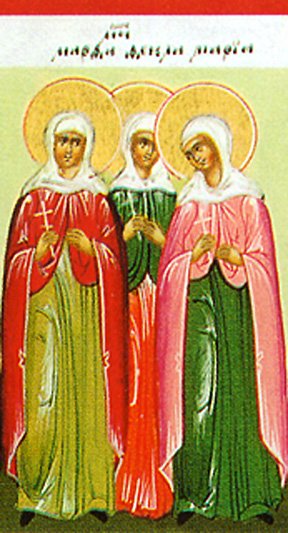
5 Nuns beheaded in Persia: Thecla, Mariamne, Martha, Mary, & Enmatha
During the time of the Persian king Saphor II (ca. 330 A.D.), a priest by the name of Paul was living near the village of Aza. He was wealthy and a lover of money, and he had with him five women who had consecrated their virginity to God. Saints Thekla, Mariamne, Martha, Maria, and Ennatha were adorned with the splendor of virtues.
During the time of the Persian king Saphor II (ca. 330 A.D.), a priest by the name of Paul was living near the village of Aza. He was wealthy and a lover of money, and he had with him five women who had consecrated their virginity to God. Saints Thekla, Mariamne, Martha, Maria, and Ennatha were adorned with the splendor of virtues. They were wealthy, and they entrusted their Spiritual Father with all their money. The greedy man prayed and chanted the Psalms with them, but he kept their money for himself.
When they learned that the priest Paul was rich, the Persians threatened to kill him and the five virgins if he did not deny Christ and give them some of his treasure. Since he preferred earthly riches, he accepted the Persian religion. The holy virgins said that they would rather suffer torture and death than deny Christ. Paul beheaded the women with a sword when they refused to follow his treacherous example. He did not enjoy his wealth for very long, however. The Persians drowned him the following evening in order to obtain all of the money. The holy virgins received their incorruptible crowns of glory from Christ in the year 346.
The five Virgin Martyrs are also commemorated on September 26.
Troparion - Tone 1
As reasonable lambs, you were guided by Christ, the Chief Shepherd, / along the path of martyrdom. / You finished your course and kept the faith; / therefore, honored Thecla, Mariamne, Martha, Mary, and Ennatha, / with joyful hearts, we magnify Christ today, as we honor your holy memory!
Scripture Readings
☩Epistle
Acts 18:22-28
22
And when he had landed at Cesarea, and gone up, and saluted the church, he went down to Antioch.
23
And after he had spent some time there, he departed, and went over all the country of Galatia and Phrygia in order, strengthening all the disciples.
24
And a certain Jew named Apollos, born at Alexandria, an eloquent man, and mighty in the scriptures, came to Ephesus.
25
This man was instructed in the way of the Lord; and being fervent in the spirit, he spake and taught diligently the things of the Lord, knowing only the baptism of John.
26
And he began to speak boldly in the synagogue: whom when Aquila and Priscilla had heard, they took him unto them, and expounded unto him the way of God more perfectly.
27
And when he was disposed to pass into Achaia, the brethren wrote, exhorting the disciples to receive him: who, when he was come, helped them much which had believed through grace:
28
For he mightily convinced the Jews, and that publickly, shewing by the scriptures that Jesus was Christ.
☩Gospel
John 12:36-47
36
While ye have light, believe in the light, that ye may be the children of light. These things spake Jesus, and departed, and did hide himself from them.
37
But though he had done so many miracles before them, yet they believed not on him:
38
That the saying of Esaias the prophet might be fulfilled, which he spake, Lord, who hath believed our report? and to whom hath the arm of the Lord been revealed?
39
Therefore they could not believe, because that Esaias said again,
40
He hath blinded their eyes, and hardened their heart; that they should not see with their eyes, nor understand with their heart, and be converted, and I should heal them.
41
These things said Esaias, when he saw his glory, and spake of him.
42
Nevertheless among the chief rulers also many believed on him; but because of the Pharisees they did not confess him, lest they should be put out of the synagogue:
43
For they loved the praise of men more than the praise of God.
44
Jesus cried and said, He that believeth on me, believeth not on me, but on him that sent me.
45
And he that seeth me seeth him that sent me.
46
I am come a light into the world, that whosoever believeth on me should not abide in darkness.
47
And if any man hear my words, and believe not, I judge him not: for I came not to judge the world, but to save the world.
Liturgical data sourced from OCA.org and orthocal.info