Fasting Rules
 Meat
Allowed
 Fish
Allowed
 Dairy
Allowed
 Oil
Allowed
 Wine
Allowed
Saints & Commemorations
Trans. Rel. Theodore Stratelates
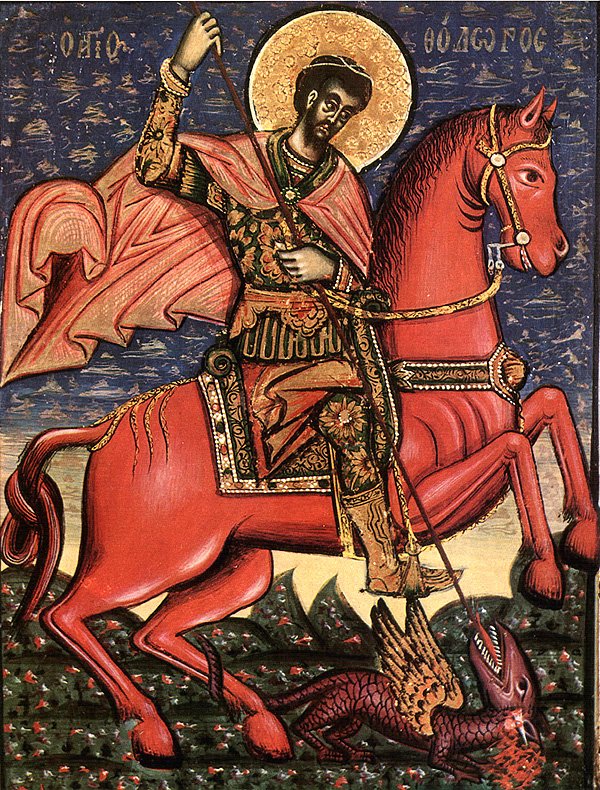
The Holy Great Martyr Theodore Stratelates suffered for Christ in Heraklea on February 8, 319. At the time of his sufferings the holy Great Martyr Theodore ordered his servant Varus to bury his body on the estate of his parents in Euchaita. The transfer of the relics of the Great Martyr Theodore took place on June 8, 319.
The Holy Great Martyr Theodore Stratelates suffered for Christ in Heraklea on February 8, 319. At the time of his sufferings the holy Great Martyr Theodore ordered his servant Varus to bury his body on the estate of his parents in Euchaita. The transfer of the relics of the Great Martyr Theodore took place on June 8, 319.
On this day we also recall a miracle of the icon of the Great Martyr Theodore in a church dedicated to him at a place called Karsat, near Damascus. A group of Saracens had turned this church into their residence. There was a fresco on the wall depicting Theodore. One of the Saracens shot an arrow into the icon of the Great Martyr. From the saint’s face, where the arrow had stuck into the wall, blood flowed before the eyes of everyone. A short while later, the Saracens who had settled in the church killed each other. Accounts of this miracle are given by Saints [or, “by the holy Fathers”] Anastasius of Mt. Sinai (April 20) and John of Damascus (December 4).
Troparion - Tone 4
Truly enlisted with the King of Heaven, / you became an outstanding general for Him, passion-bearer Theodore; / you armed yourself wisely with the weapons of faith / and conquered hordes of demons, revealing yourself as a victorious athlete. / Therefore, in faith we always call you blessed.
Kontakion - Tone 2
With the word of God as a spear in your hand, / in courage of soul and armed with faith, / you vanquished the enemy, O Theodore, glory of martyrs; / with them you unceasingly pray to Christ God for us all.
St Ephraim, Patriarch of Antioch (545)
Saint Ephraim, Patriarch of Antioch, a Syrian, was a military general under the emperors Anastasius (491-518) and Justin (518-527). The saint was distinguished for his virtue, piety, and compassion for all the destitute.
In the year 526 the Lord punished Antioch for Christians falling into the heresies of Nestorius and Eutyches: an earthquake destroyed this magnificent city.
Saint Ephraim, Patriarch of Antioch, a Syrian, was a military general under the emperors Anastasius (491-518) and Justin (518-527). The saint was distinguished for his virtue, piety, and compassion for all the destitute.
In the year 526 the Lord punished Antioch for Christians falling into the heresies of Nestorius and Eutyches: an earthquake destroyed this magnificent city. A large number of the inhabitants perished. Patriarch Euphrasios was crushed beneath a fallen column.
The emperor summoned Ephraim to oversee the restoration of the ruined city. Among the workers was a bishop who left his see for unknown reasons. He predicted to Ephraim his election to the patriarchal throne and asked him not to abandon deeds of charity, and to struggle firmly against the heretics. In the year 527 Ephraim was indeed elected to the patriarchal throne. He governed his flock firmly and wisely by the example of his life. He also defended it against heretical teachings through his sermons and letters.
The following event gives some idea of his faith. Near Herakleia was a stylite practicing asceticism, who had fallen into heresy. Learning about the ascetic, Ephraim went to him and urged him to be reunited to the Orthodox Church. The stylite was not agreeable. He decided to frighten the patriarch and he offered to kindle a large bonfire, so that they both might enter the fire. The bonfire was set, but the stylite did not dare to go into it. The patriarch prayed to the Lord Jesus Christ to show that his was the correct faith and, removing his omophorion, he put it in the bonfire. After three hours the firewood was consumed, but the omophorion of the saint was taken out unharmed. The stylite was converted from his heresy and reunited to the Church.
Ephraim fell asleep in the Lord in the year 545 AD.
Among his labors, Ephraim defended the teaching of the Orthodox Church on the union of two natures, the divine and the human, in the Person of our Lord Jesus Christ.
Troparion - Tone 4
In truth you were revealed to your flock as a rule of faith, / an image of humility and a teacher of abstinence; / your humility exalted you; / your poverty enriched you. / Hierarch Father Ephraim, / entreat Christ our God / that our souls may be saved.
Our Holy Mother Melania the Elder (410)
She was a wealthy and noble lady, born in Spain. Her husband and two of her children died and, seeing the vanity of worldly things, she travelled to Egypt to visit the monks at Nitria. She gave away most of her great wealth to the needy, and to Egyptian Christians being persecuted by the Arians. It is said that in three days she fed some 5,000 people.
She was a wealthy and noble lady, born in Spain. Her husband and two of her children died and, seeing the vanity of worldly things, she travelled to Egypt to visit the monks at Nitria. She gave away most of her great wealth to the needy, and to Egyptian Christians being persecuted by the Arians. It is said that in three days she fed some 5,000 people. When the Orthodox in Egypt were exiled to Palestine, she went with them to Jerusalem, where she built a convent for virgins; she entered the convent herself, and reposed there in 410. Her grand-daughter, Melania the Younger, is commemorated on December 31.
St Zosimas, monk, of Phoenicia (Syria) (6th c.)
He labored in asceticism at a monastery near Tyre. Through his exceptional purity of life, he was granted the gift of prophecy. He foresaw the destruction of Antioch by earthquake and, like Abraham pleading for Sodom, prostrated himself on the ground and prayed that the city not be completely destroyed.
He labored in asceticism at a monastery near Tyre. Through his exceptional purity of life, he was granted the gift of prophecy. He foresaw the destruction of Antioch by earthquake and, like Abraham pleading for Sodom, prostrated himself on the ground and prayed that the city not be completely destroyed. Once he was traveling in a remote place and a lion attacked and killed his mule. He commanded the lion to serve him in the mule’s place; the lion immediately took up Zosimas’ pack and carried it to Caesarea, where Zosimas released it. St Zosimas reposed in peace.
Scripture Readings
☩Epistle
Acts 17:19-28
19
And they took him, and brought him unto Areopagus, saying, May we know what this new doctrine, whereof thou speakest, is?
20
For thou bringest certain strange things to our ears: we would know therefore what these things mean.
21
(For all the Athenians and strangers which were there spent their time in nothing else, but either to tell, or to hear some new thing.)
22
Then Paul stood in the midst of Mars’ hill, and said, Ye men of Athens, I perceive that in all things ye are too superstitious.
23
For as I passed by, and beheld your devotions, I found an altar with this inscription, TO THE UNKNOWN GOD. Whom therefore ye ignorantly worship, him declare I unto you.
24
God that made the world and all things therein, seeing that he is Lord of heaven and earth, dwelleth not in temples made with hands;
25
Neither is worshipped with men’s hands, as though he needed any thing, seeing he giveth to all life, and breath, and all things;
26
And hath made of one blood all nations of men for to dwell on all the face of the earth, and hath determined the times before appointed, and the bounds of their habitation;
27
That they should seek the Lord, if haply they might feel after him, and find him, though he be not far from every one of us:
28
For in him we live, and move, and have our being; as certain also of your own poets have said, For we are also his offspring.
☩Gospel
John 12:19-36
19
The Pharisees therefore said among themselves, Perceive ye how ye prevail nothing? behold, the world is gone after him.
20
And there were certain Greeks among them that came up to worship at the feast:
21
The same came therefore to Philip, which was of Bethsaida of Galilee, and desired him, saying, Sir, we would see Jesus.
22
Philip cometh and telleth Andrew: and again Andrew and Philip tell Jesus.
23
And Jesus answered them, saying, The hour is come, that the Son of man should be glorified.
24
Verily, verily, I say unto you, Except a corn of wheat fall into the ground and die, it abideth alone: but if it die, it bringeth forth much fruit.
25
He that loveth his life shall lose it; and he that hateth his life in this world shall keep it unto life eternal.
26
If any man serve me, let him follow me; and where I am, there shall also my servant be: if any man serve me, him will my Father honour.
27
Now is my soul troubled; and what shall I say? Father, save me from this hour: but for this cause came I unto this hour.
28
Father, glorify thy name. Then came there a voice from heaven, saying, I have both glorified it, and will glorify it again.
29
The people therefore, that stood by, and heard it, said that it thundered: others said, An angel spake to him.
30
Jesus answered and said, This voice came not because of me, but for your sakes.
31
Now is the judgment of this world: now shall the prince of this world be cast out.
32
And I, if I be lifted up from the earth, will draw all men unto me.
33
This he said, signifying what death he should die.
34
The people answered him, We have heard out of the law that Christ abideth for ever: and how sayest thou, The Son of man must be lifted up? who is this Son of man?
35
Then Jesus said unto them, Yet a little while is the light with you. Walk while ye have the light, lest darkness come upon you: for he that walketh in darkness knoweth not whither he goeth.
36
While ye have light, believe in the light, that ye may be the children of light. These things spake Jesus, and departed, and did hide himself from them.
Liturgical data sourced from OCA.org and orthocal.info