Fasting Rules
 Meat
Allowed
 Fish
Allowed
 Dairy
Allowed
 Oil
Allowed
 Wine
Allowed
Saints & Commemorations
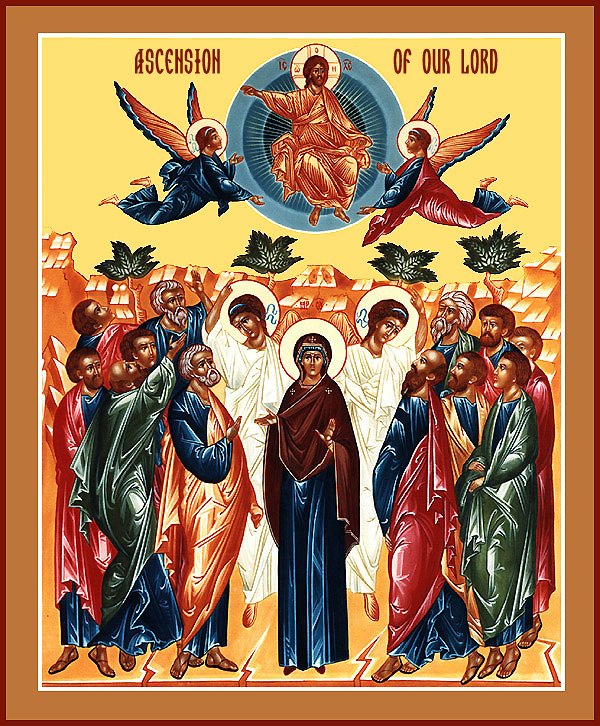
Ascension of the Lord
“AND ASCENDED INTO HEAVEN....”
V. Rev. George Florovsky, D.D.
“I ascend unto My Father and your Father, and to My God, and Your God” (John 20:17).
In these words the Risen Christ described to Mary Magdalene the mystery of His Resurrection. She had to carry this mysterious message to His disciples, “as they mourned and wept” (Mark 16:10). The discipl
“AND ASCENDED INTO HEAVEN....”
V. Rev. George Florovsky, D.D.
“I ascend unto My Father and your Father, and to My God, and Your God” (John 20:17).
In these words the Risen Christ described to Mary Magdalene the mystery of His Resurrection. She had to carry this mysterious message to His disciples, “as they mourned and wept” (Mark 16:10). The disciples listened to these glad tidings with fear and amazement, with doubt and mistrust. It was not Thomas alone who doubted among the Eleven. On the contrary, it appears that only one of the Eleven did not doubt—Saint John, the disciple “whom Jesus loved.” He alone grasped the mystery of the empty tomb at once: “and he saw, and believed” (John 20:8). Even Peter left the sepulcher in amazement, “wondering at that which was come to pass” (Luke 24:12).
The disciples did not expect the Resurrection. The women did not, either. They were quite certain that Jesus was dead and rested in the grave, and they went to the place “where He was laid,” with the spices they had prepared, “that they might come and anoint Him.” They had but one thought: “Who shall roll away the stone from the door of the sepulcher for us?” (Mark 16:1-3; Luke 24:1). And therefore, on not finding the body, Mary Magdalene was sorrowful and complained: “They have taken away my Lord, and I know not where they have laid Him” (John 20:13). On hearing the good news from the angel, the women fled from the sepulchre in fear and trembling: “Neither said they anything to any man, for they were afraid” (Mark 16:8). And when they spoke no one believed them, in the same way as no one had believed Mary, who saw the Lord, or the disciples as they walked on their way into the country, (Mark 16:13), and who recognized Him in the breaking of bread. “And afterward He appeared unto the Eleven as they sat at meat, and upbraided them with their unbelief and hardness of heart, because they believed not them who had seen Him after He was risen” (Mark 16:10-14).
From whence comes this “hardness of heart” and hesitation? Why were their eyes so “holden,” why were the disciples so much afraid of the news, and why did the Easter joy so slowly, and with such difficulty, enter the Apostles’ hearts? Did not they, who were with Him from the beginning, “from the baptism of John,” see all the signs of power which He performed before the face of the whole people? The lame walked, the blind saw, the dead were raised, and all infirmities were healed. Did they not behold, only a week earlier, how He raised by His word Lazarus from the dead, who had already been in the grave for four days? Why then was it so strange to them that the Master had arisen Himself? How was it that they came to forget that which the Lord used to tell them on many occasions, that after suffering and death He would arise on the third day?
The mystery of the Apostles’ “unbelief” is partly disclosed in the narrative of the Gospel: “But we trusted that it had been He which should have redeemed Israel,” with disillusionment and complaint said the two disciples to their mysterious Companion on the way to Emmaus (Luke 24:21). They meant: He was betrayed, condemned to death and crucified. The news of the Resurrection brought by the women only “astonished” them. They still wait for an earthly triumph, for an exernal victory. The same temptation possesses their hearts, which first prevented them from accepting “the preaching of the Cross” and made them argue every time the Saviour tried to reveal His mystery to them. “Ought not Christ to have suffered these things and to enter into His glory?” (Luke 24:26). It was still difficult to understand this.
He had the power to arise, why did He allow what that had happened to take place at all? Why did He take upon Himself disgrace, blasphemy and wounds? In the eyes of all Jerusalem, amidst the vast crowds assembled for the Great Feast, He was condemned and suffered a shameful death. And now He enters not into the Holy City, neither to the people which beheld His shame and death, nor to the High Priests and elders, nor to Pilate—so that He might make their crime obvious and smite their pride. Instead, He sends His disciples away to remote Galilee and appears to them there. Even much earlier the disciples wondered, “How is it that Thou wilt manifest Thyself unto us, and not unto the world?” (John 14:22). Their wonder continues, and even on the day of His glorious Ascension the Apostles question the Lord, “Lord, wilt Thou at this time restore again the kingdom to Israel?” (Acts 1:6). They still did not comprehend the meaning of His Resurrection, they did not understand what it meant that He was “ascending” to the Father. Their eyes were opened but later, when “the promise of the Father” had been fulfilled.
In the Ascension resides the meaning and the fullness of Christ’s Resurrection.
The Lord did not rise in order to return again to the fleshly order of life, so as to live again and commune with the disciples and the multitudes by means of preaching and miracles. Now he does not even stay with them, but only “appears” to them during the forty days, from time to time, and always in a miraculous and mysterious manner. “He was not always with them now, as He was before the Resurrection,” comments Saint John Chrysostom. “He came and again disappeared, thus leading them on to higher conceptions. He no longer permitted them to continue in their former relationship toward Him, but took effectual measures to secure these two objects: That the fact of His Resurrection should be believed, and that He Himself should be ever after apprehended to be greater than man.” There was something new and unusual in His person (cf. John 21:1-14). As Saint John Chrysostom says, “It was not an open presence, but a certain testimony of the fact that He was present.” That is why the disciples were confused and frightened. Christ arose not in the same way as those who were restored to life before Him. Theirs was a resurrection for a time, and they returned to life in the same body, which was subject to death and corruption—returned to the previous mode of life. But Christ arose for ever, unto eternity. He arose in a body of glory, immortal and incorruptible. He arose, never to die, for “He clothed the mortal in the splendor of incorruption.” His glorified Body was already exempt from the fleshly order of existence. “It is sown in corruption, it is raised in incorruption. It is sown in dishonor, it is raised in glory. It is sown in weakness, it is raised in power. It is sown a natural body, it is raised a spiritual body” (I Cor. 15:42-44). This mysterious transformation of human bodies, of which Saint Paul was speaking in the case of our Lord, had been accomplished in three days. Christ’s work on earth was accomplished. He had suffered, was dead and buried, and now rose to a higher mode of existence. By His Resurrection He abolished and destroyed death, abolished the law of corruption, “and raised with Himself the whole race of Adam.” Christ has risen, and now “no dead are left in the grave” (cf. The Easter Sermon of Saint John Chrysostom). And now He ascends to the Father, yet He does not “go away,” but abides with the faithful for ever (cf. The Kontakion of Ascension). For He raises the very earth with Him to heaven, and even higher than any heaven. God’s power, in the phrase of Saint John Chrysostom, “manifests itself not only in the Resurrection, but in something much stronger.” For “He was received up into heaven, and sat on the right hand of God” (Mark 16:19).
And with Christ, man’s nature ascends also.
“We who seemed unworthy of the earth, are now raised to heaven,” says Saint John Chrysostom. “We who were unworthy of earthly dominion have been raised to the Kingdom on high, have ascended higher than heaven, have came to occupy the King’s throne, and the same nature from which the angels guarded Paradise, stopped not until it ascended to the throne of the Lord.” By His Ascension the Lord not only opened to man the entrance to heaven, not only appeared before the face of God on our behalf and for our sake, but likewise “transferred man” to the high places. “He honored them He loved by putting them close to the Father.” God quickened and raised us together with Christ, as Saint Paul says, “and made us sit together in heavenly places in Christ Jesus” (Ephes. 2:6). Heaven received the inhabitants of the earth. “The First fruits of them that slept” sits now on high, and in Him all creation is summed up and bound together. “The earth rejoices in mystery, and the heavens are filled with joy.”
“The terrible ascent....” Terror-stricken and trembling stand the angelic hosts, contemplating the Ascension of Christ. And trembling they ask each other, “What is this vision? One who is man in appearance ascends in His body higher than the heavens, as God.”
Thus the Office for the Feast of the Ascension depicts the mystery in a poetical language. As on the day of Christ’s Nativity the earth was astonished on beholding God in the flesh, so now the Heavens do tremble and cry out. “The Lord of Hosts, Who reigns over all, Who is Himself the head of all, Who is preeminent in all things, Who has reinstated creation in its former order—He is the King of Glory.” And the heavenly doors are opened: “Open, Oh heavenly gates, and receive God in the flesh.” It is an open allusion to Psalms 24:7-10, now prophetically interpreted. “Lift up your heads, Oh ye gates, and be lifted up, ye everlasting doors, and the King of Glory shall come in. Who is this King of glory? The Lord strong and mighty....” Saint Chrysostom says, “Now the angels have received that for which they have long waited, the archangels see that for which they have long thirsted. They have seen our nature shining on the King’s throne, glistening with glory and eternal beauty.... Therefore they descend in order to see the unusual and marvelous vision: Man appearing in heaven.”
The Ascension is the token of Pentecost, the sign of its coming, “The Lord has ascended to heaven and will send the Comforter to the world”
For the Holy Spirit was not yet in the world, until Jesus was glorified. And the Lord Himself told the disciples, “If I go not away, the Comforter will not come unto you” (John 16:7). The gifts of the Spirit are “gifts of reconciliation,” a seal of an accomplished salvation and of the ultimate reunion of the world with God. And this was accomplished only in the Ascension. “And one saw miracles follow miracles,” says Saint John Chrysostom, “ten days prior to this our nature ascended to the King’s throne, while today the Holy Ghost has descended on to our nature.” The joy of the Ascension lies in the promise of the Spirit. “Thou didst give joy to Thy disciples by a promise of the Holy Spirit.” The victory of Christ is wrought in us by the power of the Holy Spirit.
“On high is His body, here below with us is His Spirit. And so we have His token on high, that is His body, which He received from us, and here below we have His Spirit with us. Heaven received the Holy Body, and the earth accepted the Holy Spirit. Christ came and sent the Spirit. He ascended, and with Him our body ascended also” (Saint John Chrysostom). The revelation of the Holy Trinity was completed. Now the Spirit Comforter is poured forth on all flesh. “Hence comes foreknowledge of the future, understanding of mysteries, apprehension of what is hidden, distribution of good gifts, the heavenly citizenship, a place in the chorus of angels, joy without end, abiding in God, the being made like to God, and, highest of all, the being made God!” (Saint Basil, On the Holy Spirit, IX). Beginning with the Apostles, and through communion with them—by an unbroken succession—Grace is spread to all believers. Through renewal and glorification in the Ascended Christ, man’s nature became receptive of the spirit. “And unto the world He gives quickening forces through His human body,” says Bishop Theophanes. “He holds it completely in Himself and penetrates it with His strength, out of Himself; and He likewise draws the angels to Himself through the spirit of man, giving them space for action and thus making them blessed.” All this is done through the Church, which is “the Body of Christ;” that is, His “fullness” (Ephesians 1:23). “The Church is the fulfillment of Christ,” continues Bishop Theophanes, “perhaps in the same way as the tree is the fulfillment of the seed. That which is contained in the seed in a contracted form receives its development in the tree.”
The very existence of the Church is the fruit of the Ascension. It is in the Church that man’s nature is truly ascended to the Divine heights. “And gave Him to be Head over all things” (Ephesians 1:22). Saint John Chrysostom comments: “Amazing! Look again, whither He has raised the Church. As though He were lifting it up by some engine, He has raised it up to a vast height, and set it on yonder throne; for where the Head is, there is the body also. There is no interval of separation between the Head and the body; for were there a separation, then would the one no longer be a body, nor would the other any longer be a Head.” The whole race of men is to follow Christ, even in His ultimate exaltation, “to follow in His train.” Within the Church, through an acquisition of the Spirit in the fellowship of Sacraments, the Ascension continues still, and will continue until the measure is full. “Only then shall the Head be filled up, when the body is rendered perfect, when we are knit together and united,” concludes Saint John Chrysostom.
The Ascension is a sign and token of the Second Coming. “This same Jesus, which is taken up from you into heaven, shall so come in like manner as ye have seen Him go into heaven” (Acts 1:11).
The mystery of God’s Providence will be accomplished in the Return of the Risen Lord. In the fulfillment of time, Christ’s kingly power will be revealed and spread over the whole of faithful mankind. Christ bequeathes the Kingdom to the whole of the faithful. “And I appoint unto you a Kingdom as My Father has appointed unto me. That ye may eat and drink at My table in My Kingdom, and sit on thrones judging the twelve tribes of Israel” (Luke 22:29-30). Those who followed Him faithfully will sit with Him on their thrones on the day of His coming. “To him that overcomes will I grant to sit with Me in My throne, even as I also overcame, and am set down with My Father in His throne” (Rev. 3:21). Salvation will be consummated in the Glory. “Conceive to yourself the throne, the royal throne, conceive the immensity of the privilege. This, at least if we chose, might more avail to startle us, yea, even than hell itself” (Saint John Chrysostom).
We should tremble more at the thought of that abundant Glory which is appointed unto the redeemed, than at the thought of the eternal darkness. “Think near Whom Thy Head is seated....” Or rather, Who is the Head. In very truth, “wondrous and terrible is Thy divine ascension from the mountain, O Giver of Life.” A terrible and wondrous height is the King’s throne. In face of this height all flesh stands silent, in awe and trembling. “He has Himself descended to the lowest depths of humiliation, and raised up man to the height of exaltation.”
What then should we do? “If thou art the body of Christ, bear the Cross, for He bore it” (Saint John Chrysostom).
“With the power of Thy Cross, Oh Christ, establish my thoughts, so that I may sing and glorify Thy saving Ascension.”
Originally published in Saint Vladimir’s Seminary Quarterly, Vol. 2 # 3, 1954.
Troparion - Tone 4
O Christ God, You have ascended in Glory, / granting joy to Your disciples by the promise of the Holy Spirit. / Through the blessing they were assured / that You are the Son of God, / the Redeemer of the world!
Kontakion - Tone 6
When You had fulfilled the dispensation for our sake, / and united earth to heaven: / You ascended in glory, O Christ our God, / not being parted from those who love You, / but remaining with them and crying: / “I am with you and no one will be against you!”
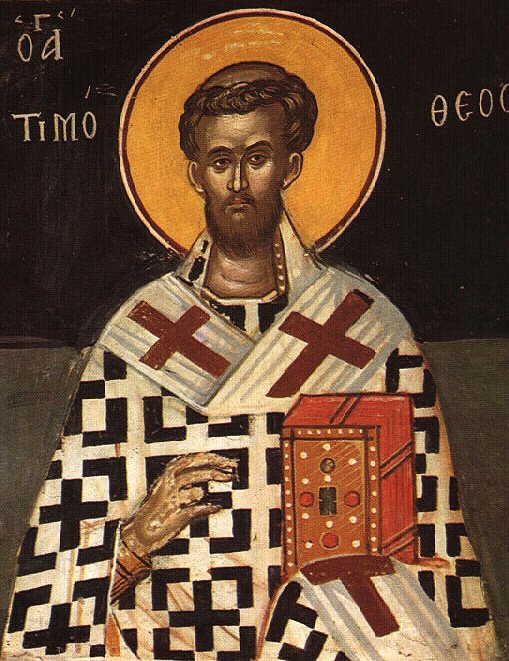
Hieromartyr Timothy, Bishop of Prusa
The Hieromartyr Timothy, Bishop of Prusa (Bithynia), received from the Lord the gift of wonderworking because of his purity and sanctity of life. At Prusa he converted many pagans to the faith in Christ. The emperor Julian the Apostate (361-363), upon hearing about Saint Timothy, had him locked up in prison, but even there also the saint continued to preach the Gospel.
The Hieromartyr Timothy, Bishop of Prusa (Bithynia), received from the Lord the gift of wonderworking because of his purity and sanctity of life. At Prusa he converted many pagans to the faith in Christ. The emperor Julian the Apostate (361-363), upon hearing about Saint Timothy, had him locked up in prison, but even there also the saint continued to preach the Gospel. Julian forbade him to teach about Jesus Christ, but the saint continued to spread the Christian Faith. Finally, the emperor gave orders to behead the saint. His holy relics were afterwards transferred to Constantinople.
Troparion - Tone 1
By sharing in the ways of the Apostles, / you became a successor to their throne. / Through the practice of virtue, / you found the way to divine contemplation, O divinely inspired one; / by rightly dividing the word of truth without error, / you defended the Faith, even to the shedding of your blood. / O Hieromartyr Timothy entreat Christ God to save our souls.
Kontakion - Tone 4
As one who lived piously among Hierarchs and who underwent martyrdom, / O divinely-wise one, / you abolished the sacrifices of idolatry and showed yourself to be a protector of your flock. / Therefore, we cry fervently to you: / “By your intercessions, deliver us from all misfortunes, O Timothy our Father.”
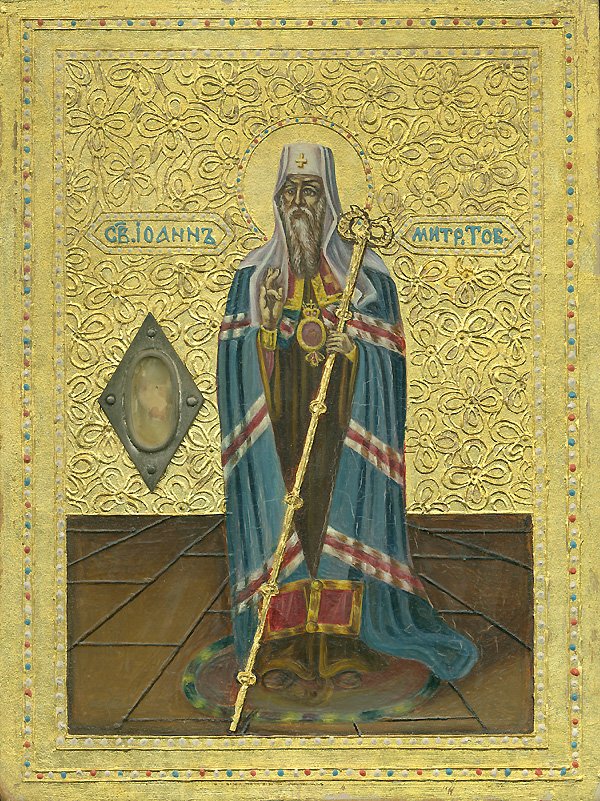
St John Maximovitch, Metropolitan of Tobolsk
Saint John, Metropolitan of Tobolsk and All Siberia, the Wonderwonder, in the world was named John Maximovitch, and he was born in the city of Nezhino in 1651. His father Maxim Vasil’evich and mother Euphrosynē had seven sons, of which John was the eldest. Upon his completion of the Kiev-Mogilyansk College (afterwards the Kiev Spiritual Academy), the future hierarch emerged from it as a teacher of the Latin language. Th
Saint John, Metropolitan of Tobolsk and All Siberia, the Wonderwonder, in the world was named John Maximovitch, and he was born in the city of Nezhino in 1651. His father Maxim Vasil’evich and mother Euphrosynē had seven sons, of which John was the eldest. Upon his completion of the Kiev-Mogilyansk College (afterwards the Kiev Spiritual Academy), the future hierarch emerged from it as a teacher of the Latin language. Thereafter, in 1680, he accepted monasticism at the Kiev Caves monastery and became absorbed in inner spiritual activity. With the general consent of the brethren, the young monk was given the obedience of preaching. From this period he demonstrated an exceptional eloquence. He attached a special significance to inner religious knowledge. The chief theme of his life can be defined at a stroke as, “How ought man to conform his will with the will of God?” He developed this theme both in his preachings, and in his subsequent missionary service. In answer to it appeared the work, published towards the end of his long ascetic life, and entitled “Heliotropion” or “Sunflower,” or “Conforming the Human Will to the Divine Will.” Of the many works of the holy Fathers of the Orthodox Church, this work gives a very thorough answer to this great question of Christian soteriology.
In 1688 they sent him on a mission to Moscow. There he was appointed by Patriarch Joachim (1674-1690) as vicar of the Briansk-Svensk monastery, which was then under the Kiev Caves Lavra.
Saint Theodosius, Archbishop of Chernigov, in 1695 shortly before his own death (February 5) appointed Hieromonk John as Archimandrite of the Chernigov Eletsk monastery, and designated him as his successor as bishop. (Saint John revered the memory of Saint Theodosius, believing in the power of his prayerful intercession before the Lord. Because of his faith, he received healing from a serious illness through the prayers of Saint Theodosius. At the very height of the sickness, Saint Theodosius appeared to him and said, “Serve tomorrow, you will be well.” On the following day Saint John, completely well and to the amazement of everyone, served the Divine Liturgy. This miracle of Saint John’s healing marked the beginning of the veneration of Saint Theodosius as a grace-bearing saint of God.)
On January 10, 1697 Patriarch Adrian of Moscow and All Rus (1690-1700) consecrated Archimandrite John as Bishop of Chernigov, in the Dormition cathedral of the Moscow Kremlin.
Upon entering into the administration of the diocese, Bishop John created a Collegium near the archbishop’s cathedral, similar to the Kiev Academy, which the saint intended should serve as an “Athens at Chernigov,” a school of pious enlightenment.
In view of its high level of theological education and training, Saint John’s school received wide renown. In essence, this was the first seminary in Russia. Seminaries on the model of this one began opening in other dioceses of the Russian Church.
The saint also later opened a printing press, at which he and his successors published many works of spiritual and moral content.
The life of Saint John was illumined by lofty virtues, and especially humility. It is reflected also in his works, “The Moral-Didactic Reflector” (Chernigov, 1703 and 1707); “The Alphabet, with Rhymes Added” (1705); “The Virgin Mother of God” (1707); “The Theatre, or Moral-Didactic Disgrace” (1708); “Excursus on Psalm 50” (Chernigov, 1708); “Excursus on the “Our Father” and “The Eight Gospel Beatitudes” (1709); “The Royal Way of the Cross” (Chernigov, 1709); “Thoughts on God to the Benefit of Right-Belief” (1710 and 1711); “Synaxarion Commemoration on the Victory of Poltava” (1710); “The Pilgrim” (in manuscript); “Spiritual Thoughts” (Moscow, 1782).
At Chernigov in 1714 the saint also first published his chief work, written in the Latin language. It was a peculiarity of the graduates of the Kiev school was that they wrote their works in classical Latin. Professor I. A. Maximovich in 1888 translated the “Heliotropion” into the modern Russian language and published it at first in parts in the “Chernigov Diocesan Newsletter”, and later on in a separate book (Kiev, 1896). With his name is connected also “The Latin-Greek-Russian Lexicon.”
Saint John was known to have connections with Mount Athos. He had a special interest in the fate of Russian inhabitants on the Holy Mountain, and sent them substantial material aid during these difficult years. His archbishopal grammota to the Russian monastery of Saint Panteleimon has been preserved, and it testifies to his concern for those on Mount Athos.
On August 14, 1711, after his elevation to the dignity of metropolitan, Saint John arrived at the see of Tobolsk and All Siberia. The saint concerned himself constantly with the enlightening of his diocese. There he continued with his work, started at Chernigov. He improved the school which had been opened by his predecessor, the renowned missionary Metropolitan Philotheus (Leschinsky, + 1727), and he continued the apostolic preaching among the pagans of Siberia, converting many thousands to Christ. In 1714 Saint John set off to Peking to head a mission with Archimandrite Hilarion (Lezhaisky). At Tobolsk he again undertook publishing activity, using the printing press he set up at Chernigov. To this time belongs also the publication by Metropolitan John of the “Heliotropion” in the Slavonic-Russian language (1714), so that the Siberians could also understand it.
The chronicler describes the life of the saint in Siberia: “He was quiet and unpretentious, graciously considerate, sympathetic to the poor, and merciful.” He often helped people secretly, and sometimes in the garb of a simple monk, he would bring generous alms to the homes of the needy saying, “Accept this in the Name of Jesus Christ.” His home at Tobolsk was always open to all those in need of help or a word of comfort. Even on the day he died, June 10, 1715, after Divine Liturgy Saint John had set up a dining-hall at his home for the clergy and the impoverished, and he himself served at table. Later on, having taken his leave of everyone, the saint withdrew to his chambers. When the church bells rang for Vespers, he died at prayer on his knees. The saint was buried in the chapel of Saint John Chrysostom at the Tobolsk Dormition-Sophia cathedral.
Saint John has long been venerated in Siberia. In light of numerous miracles and the longstanding local veneration of Saint John, in 1916 the Church established the all-Russian celebration of the saint on June 10, the day of repose.
Saint John’s memory is fervently kept by Siberians and by all the believing Russian people. He at present rests in the Tobolsk cathedral of the Protection of the Mother of God. The service to him was republished, with the blessing of His Holiness Patriarch Alexis I, by Metropolitan Bartholomew (Gorodtsov) in 1947 at the city of Novosibirsk.
Troparion - Tone 8
Instructor of piety, nourisher of orphans, helper of the afflicted, / unmercenary physician of the sick, speedy helper of suffering souls, / fervent intercessor with the Lord for all. / O Hierarch Father John, entreat Christ God to save our souls.
Kontakion - Tone 2
You were shown as a light for those in the darkness of ignorance, / a comforter of widows and orphans, / and a wondrous physician of the infirm, / instructor of children and youths, most radiant joy for parents. / O Hierarch Father John, pray to Christ God to grant our country confirmation in the Faith; / victory to our armies over our enemies, and great mercy to His people.
Hieromartyr Timothy, bishop of Prusa (362)
“For his great spiritual purity, God gave him the gift of wonderworking, and he healed all manner of diseases and pains among the people. During the reign of the evil Emperor Julian, who had renounced Christ, holy Timothy was thrown into prison. The faithful visited him there to listen to the wise teaching of their bishop. W
“For his great spiritual purity, God gave him the gift of wonderworking, and he healed all manner of diseases and pains among the people. During the reign of the evil Emperor Julian, who had renounced Christ, holy Timothy was thrown into prison. The faithful visited him there to listen to the wise teaching of their bishop. When this came to the Emperor’s ears, he commanded that the executioner behead the Saint in the prison. This was in 362, and his soul entered into Paradise while his relics remained, full of miraculous power, to help the people and declare the power of the Lord.” (Prologue [adapted])
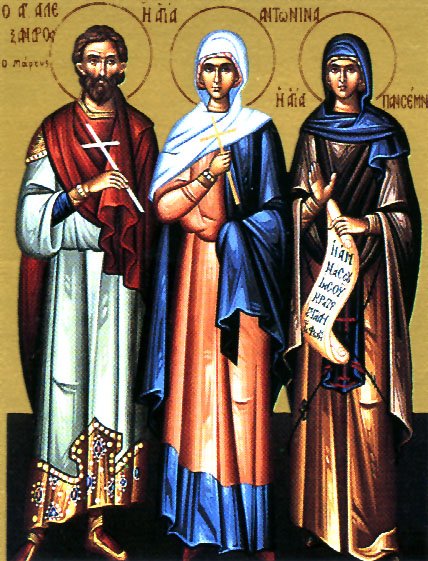
Theophanes & Pansemne of Antioch
Saint Theophanes of Antioch was the son of pagans. At a youthful age he entered into marriage, but after three years his wife died. Saint Theophanes then came to believe in Christ and accepted Baptism. He gave up everything and began to live beyond the city in a manner of self-denial. He zealously taught the keeping of the commandments of God to everyone who came to him.
Saint Theophanes of Antioch was the son of pagans. At a youthful age he entered into marriage, but after three years his wife died. Saint Theophanes then came to believe in Christ and accepted Baptism. He gave up everything and began to live beyond the city in a manner of self-denial. He zealously taught the keeping of the commandments of God to everyone who came to him. He exhorted people to lead a pure and chaste life, and he condemned the debauchery of the people of Antioch. When Saint Theophanes learned about a certain profligate woman, Pansemne, who was caught up in the snares of the devil, he wanted to save her. Knowing how difficult it would be to fulfill such an intention, and conscious of his own infirmity, Saint Theophanes prayed and he besought the Lord to help him save the sinful woman.
Finally, the saint dressed up in fine clothing, took along much gold and then went to Pansemne. The monk gave her the gold and he asked her to forsake the dissolute life to marry him. Pansemne happily consented and gave him her word to become his wife. The sole condition which Saint Theophanes set for Pansemne was that she should accept Baptism. Because of the attractive marriage offer, Pansemne consented. In preparing her to accept Baptism, Saint Theophanes instructed her in the Christian Faith. He explained that the truth of God does not tolerate sin and corruption, but that the love of God is gracious to those that repent.
Having accepted Baptism, Saint Pansemne by the grace of God was completely reborn as a person. She distributed all the riches that she had acquired through profligacy, and she settled into a hut beside the cell of the monk and began to live the life of an ascetic. After 22 months she died on the very same day as the monk (+ 369).
Troparion - Tone 8
By a flood of tears you made the desert fertile, / and your longing for God brought forth fruits in abundance. / By the radiance of miracles you illumined the whole universe! / O holy Theophanes and Pansemne, pray to Christ our God to save our souls!
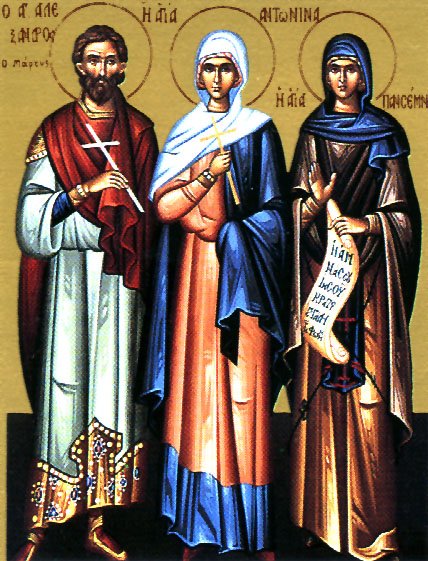
Holy Martyrs Alexander and Antonina (313)
The Holy Martyrs Alexander and Antonina the Virgin. Saint Antonina was from the city of Krodamos (Asia Minor). She was arrested for being a Christian, and was brought before the governor Festus. He urged her to worship the pagan gods, promising to make her a priestess of the goddess Artemis. But the saint bravely confessed Christ, and she urged the governor to renounce the worship of demons in the form of idols.
The Holy Martyrs Alexander and Antonina the Virgin. Saint Antonina was from the city of Krodamos (Asia Minor). She was arrested for being a Christian, and was brought before the governor Festus. He urged her to worship the pagan gods, promising to make her a priestess of the goddess Artemis. But the saint bravely confessed Christ, and she urged the governor to renounce the worship of demons in the form of idols. Festus gave orders to strike the saint on the face and lock her up in prison.
The martyr spent all her time at prayer, she ate and drank nothing, but then she heard the voice of God, “Antonina, fortify yourself with food and be brave, for I am with you.” When they led her before the governor again, the martyr continued to stand up for the Christian Faith and to denounce the pagans.
The governor decided to give the holy virgin over for defilement by soldiers, but the Lord inspired one of them, Saint Alexander, to save the holy virgin. He sought permission to go in to her on the pretext that he might be able to convince her to obey the governor’s will. Saint Alexander then suggested that she put on his military attire and flee. Saint Antonina was afraid, but the Lord ordered her to agree.
No one recognized her dressed as a soldier, and she walked out of prison. The soldiers sent by Festus found Saint Alexander alone in the cell. He would not respond to the questions of the governor, and so he was tortured and mercilessly beaten. Through the inspiration of the Lord Jesus Christ, Saint Antonina also came to stand before Festus.
Soldiers cut off their hands, then they smeared them with pitch and threw them into a pit where a fire was burning. When the fire went out, they threw snakes into the pit, so that Christians would not be able to gather up the bones of the martyrs. Returning home, Festus became numb, and was able neither to eat nor to drink. He died after seven days of terrible torment.
Sts Alexander and Antonina were martyred on May 3, 313. In the Prologue their memory is listed under June 10. The relics of the saints were transferred to Constantinople and placed in the Maximov monastery.
Troparion - Tone 4
Your holy martyrs Alexander and Antonina, O Lord, / through their sufferings have received incorruptible crowns from You, our God. / For having Your strength, they laid low their adversaries, / and shattered the powerless boldness of demons. / Through their intercessions, save our souls!
Hieromartyr Metrophanes, first Chinese priest, and the Chinese New Martyrs of the Boxer Uprising (1900)
“The Holy Martyrs of China were native Chinese Orthodox Christians brought up in piety at the Russian Orthodox Mission in Peking, which had been founded in 1685. During the Boxer Rebellion of 1900 against the foreign powers occupying China, native Chinese Christians were commanded by the Boxers to renounce Christianity or be tortured to death. T
“The Holy Martyrs of China were native Chinese Orthodox Christians brought up in piety at the Russian Orthodox Mission in Peking, which had been founded in 1685. During the Boxer Rebellion of 1900 against the foreign powers occupying China, native Chinese Christians were commanded by the Boxers to renounce Christianity or be tortured to death. Two hundred and twenty-two members of the Peking Mission, led by their priest Metrophanes Tsi-Chung and his family, refused to deny Christ, and were deemed worthy of a martyric death.” ( Great Horologion)
Scripture Readings
☩Epistle
Acts 1:1-12
1
The former treatise have I made, O Theophilus, of all that Jesus began both to do and teach,
2
Until the day in which he was taken up, after that he through the Holy Ghost had given commandments unto the apostles whom he had chosen:
3
To whom also he shewed himself alive after his passion by many infallible proofs, being seen of them forty days, and speaking of the things pertaining to the kingdom of God:
4
And, being assembled together with them, commanded them that they should not depart from Jerusalem, but wait for the promise of the Father, which, saith he, ye have heard of me.
5
For John truly baptized with water; but ye shall be baptized with the Holy Ghost not many days hence.
6
When they therefore were come together, they asked of him, saying, Lord, wilt thou at this time restore again the kingdom to Israel?
7
And he said unto them, It is not for you to know the times or the seasons, which the Father hath put in his own power.
8
But ye shall receive power, after that the Holy Ghost is come upon you: and ye shall be witnesses unto me both in Jerusalem, and in all Judea, and in Samaria, and unto the uttermost part of the earth.
9
And when he had spoken these things, while they beheld, he was taken up; and a cloud received him out of their sight.
10
And while they looked stedfastly toward heaven as he went up, behold, two men stood by them in white apparel;
11
Which also said, Ye men of Galilee, why stand ye gazing up into heaven? this same Jesus, which is taken up from you into heaven, shall so come in like manner as ye have seen him go into heaven.
12
Then returned they unto Jerusalem from the mount called Olivet, which is from Jerusalem a sabbath day’s journey.
☩Gospel
Luke 24:36-53
36
And as they thus spake, Jesus himself stood in the midst of them, and saith unto them, Peace be unto you.
37
But they were terrified and affrighted, and supposed that they had seen a spirit.
38
And he said unto them, Why are ye troubled? and why do thoughts arise in your hearts?
39
Behold my hands and my feet, that it is I myself: handle me, and see; for a spirit hath not flesh and bones, as ye see me have.
40
And when he had thus spoken, he shewed them his hands and his feet.
41
And while they yet believed not for joy, and wondered, he said unto them, Have ye here any meat?
42
And they gave him a piece of a broiled fish, and of an honeycomb.
43
And he took it, and did eat before them.
44
And he said unto them, These are the words which I spake unto you, while I was yet with you, that all things must be fulfilled, which were written in the law of Moses, and in the prophets, and in the psalms, concerning me.
45
Then opened he their understanding, that they might understand the scriptures,
46
And said unto them, Thus it is written, and thus it behoved Christ to suffer, and to rise from the dead the third day:
47
And that repentance and remission of sins should be preached in his name among all nations, beginning at Jerusalem.
48
And ye are witnesses of these things.
49
And, behold, I send the promise of my Father upon you: but tarry ye in the city of Jerusalem, until ye be endued with power from on high.
50
And he led them out as far as to Bethany, and he lifted up his hands, and blessed them.
51
And it came to pass, while he blessed them, he was parted from them, and carried up into heaven.
52
And they worshipped him, and returned to Jerusalem with great joy:
53
And were continually in the temple, praising and blessing God. Amen.
Liturgical data sourced from OCA.org and orthocal.info