Fasting Rules
 Meat
Allowed
 Fish
Allowed
 Dairy
Allowed
 Oil
Allowed
 Wine
Allowed
Saints & Commemorations
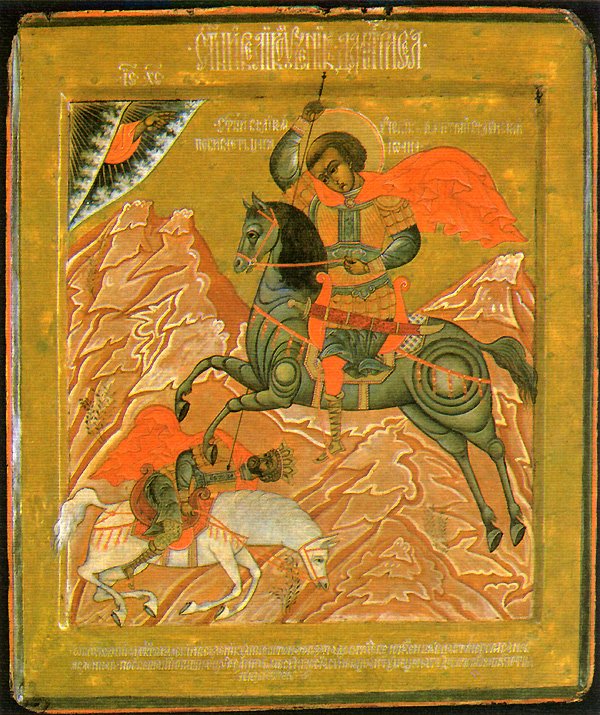
Memorial (Demetrius) Saturday
In the spiritual experience of the Russian Church, veneration of the holy Great Martyr Demetrius of Thessalonica is closely linked with the memory of the defense of the nation and Church by the Great Prince of Moscow, Demetrius of the Don (May 19).
Saint Demetrius of the Don smashed the military might of the Golden Horde at the Battle of Kulikovo Field on September 8, 1380 (the Feast of the Nativity of the Most Holy Theotokos), set between the Rivers Don and Nepryadva.
In the spiritual experience of the Russian Church, veneration of the holy Great Martyr Demetrius of Thessalonica is closely linked with the memory of the defense of the nation and Church by the Great Prince of Moscow, Demetrius of the Don (May 19).
Saint Demetrius of the Don smashed the military might of the Golden Horde at the Battle of Kulikovo Field on September 8, 1380 (the Feast of the Nativity of the Most Holy Theotokos), set between the Rivers Don and Nepryadva. The Battle of Kulikovo, for which the nation calls him Demetrius of the Don, became the first Russian national deed, rallying the spiritual power of the Russian nation around Moscow. The “Zadonschina,” an inspiring historic poem written by the priest Sophronius of Ryazem (1381), is devoted to this event.
Prince Demetrius of the Don was greatly devoted to the holy Great Martyr Demetrius. In 1380, on the eve of the Battle of Kulikovo, he solemnly transferred from Vladimir to Moscow the most holy object in the Dimitriev cathedral of Vladimir: the icon of the Great Martyr Demetrius of Thessalonica, painted on a piece of wood from the saint’s grave. A chapel in honor of the Great Martyr Demetrius was built at Moscow’s Dormition Cathedral.
The Saint Demetrius Memorial Saturday was established for the churchwide remembrance of the soldiers who fell in the Battle of Kulikovo. This memorial service was held for the first time at the Trinity-Saint Sergius monastery on October 20, 1380 by Saint Sergius of Radonezh, in the presence of Great Prince Demetrius of the Don. It is an annual remembrance of the heroes of the Battle of Kulikovo, among whom are the schemamonks Alexander (Peresvet) and Andrew (Oslyab).
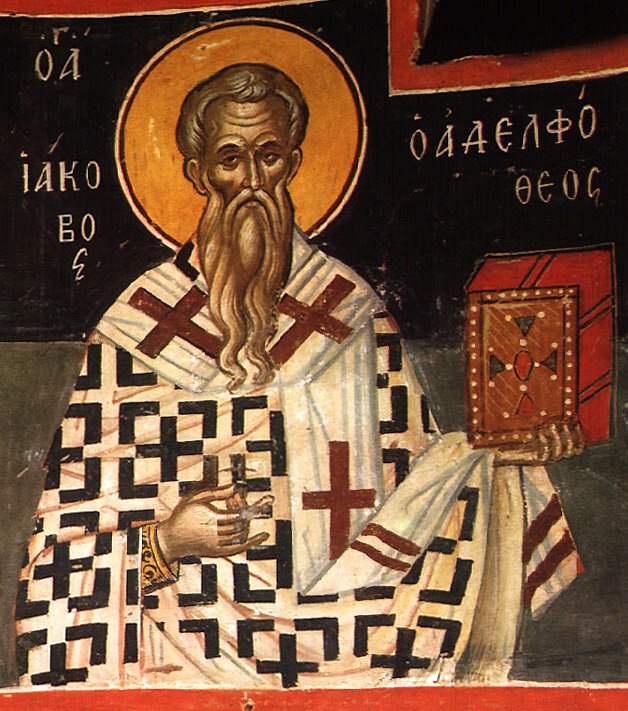
Holy Apostle James, Brother of the Lord
The Holy Apostle James, the Brother of God (Adelphótheos) was the son of the Righteous Joseph before he was betrothed to the Most Holy Theotokos. Tradition says that Joseph had other sons with his first wife. Thus, James was called the Lord's brother. Saint James had been a Nazirite, a man or woman consecrated to God for a limited time.
The Holy Apostle James, the Brother of God (Adelphótheos) was the son of the Righteous Joseph before he was betrothed to the Most Holy Theotokos. Tradition says that Joseph had other sons with his first wife. Thus, James was called the Lord's brother. Saint James had been a Nazirite, a man or woman consecrated to God for a limited time. During the period of consecration the Nazirites vowed to to abstain from wine and other intoxicating beverages, they could not cut their hair, and all contact with a corpse was forbidden (Numbers 6:1-21).
When the Savior began to proclaim the Kingdom of God, Saint James believed in Christ and became His Apostle. Later, he was chosen as the first Bishop of Jerusalem.
Saint James presided over the Council of Jerusalem and his word was decisive (Acts 15). In his thirty years as bishop, Saint James converted many Jews to Christianity. Angered by this, the Pharisees and the Scribes plotted together to kill the holy bishop. They led him up on the pinnacle of the Jerusalem Temple and asked him what he thought of Jesus. The holy Apostle bore witness that Christ is the Messiah, which was not the response the Pharisees were expecting. Enraged, the Jewish leaders threw him off the roof. He did not die at once, but gathering his final strength, he prayed to the Lord for his enemies while they were stoning him. Saint James’ martyrdom occurred about 63 A.D.
The holy Apostle James composed a Divine Liturgy, which formed the basis of the Liturgies of Saints Basil the Great and John Chrysostom. The Church has preserved an Epistle of Saint James, one of the books of the New Testament. In it Saint James advises: "Let every man be swift to hear, slow to speak, and slow to wrath" James 1:19) and "Be doers of the word, and not just hearers, deceiving yourselves" (James 1:22).
In 1853, Patriarch Hierótheos of Alexandria sent a portion of the relics of Saint James to Moscow.
The Church distinguishes between the Holy Apostle James the Brother of God, Saint James the son of Zebedee (April 30), and Saint James the son of Alphaeus (October 9).
Saint James the Apostle is also commemorated on the Sunday after the Nativity of Christ, with the Prophet-King David and Saint Joseph the Betrothed.
Troparion - Tone 4
As the Lord’s disciple you received the Gospel, O Just one;1 / as a martyr you have unfailing courage; / as the Brother of the Lord, you have boldness; / as a hierarch, you are able to intercede. / Entreat Christ God that our souls may be saved.1 Hegesippus writes in the fifth book of his Commentaries: “After the Apostles, James the Brother of the Lord, surnamed the Just, was made head of the Church at Jerusalem.”
Kontakion - Tone 4
As the Lord’s disciple you received the Gospel, O Just one;1 / as a martyr you have unfailing courage; / as the Brother of the Lord, you have boldness; / as a hierarch, you are able to intercede. / Entreat Christ God that our souls may be saved.
Our Righteous Father Ignatius, Patriarch of Constantinople
Saint Ignatius, Patriarch of Constantinople (847-857; 867-877), in the world Nicetas, was of imperial lineage. When his father, the emperor Michael I (811-813), was deposed from the imperial throne by Leo the Armenian (813-820), the fifteen-year-old youth Ignatius was imprisoned in a monastery. Life in the monastery strengthened Saint Ignatius in faith and in piety.
Saint Ignatius, Patriarch of Constantinople (847-857; 867-877), in the world Nicetas, was of imperial lineage. When his father, the emperor Michael I (811-813), was deposed from the imperial throne by Leo the Armenian (813-820), the fifteen-year-old youth Ignatius was imprisoned in a monastery. Life in the monastery strengthened Saint Ignatius in faith and in piety. Soon he was made igumen of the monastery, and later he was chosen Patriarch of Constantinople.
When Michael III (855-867) ascended the throne he was still a minor, so the country was actually governed by his uncle, Bardas, an impious and unchaste man. Patriarch Ignatius urged Bardas to forsake his sinful life and when he refused, Ignatius boldly denounced him for his iniquity.
Bardas attempted to force Saint Ignatius to tonsure the holy Empress Theodora, mother of the emperor, in order to remove her from governance of the realm. Patriarch Ignatius did not consent to this, and also publicly excommunicated Bardas. Bardas had Ignatius tortured for fifteen days to force him to resign, and then they sent him into exile. When the new emperor came to power, Saint Ignatius was recalled from prison and was Patriarch for another ten years. He died in the year 877 in a monastery.
Troparion - Tone 4
In truth you were revealed to your flock as a rule of faith, / an image of humility and a teacher of abstinence; / your humility exalted you; / your poverty enriched you. / Hierarch Father Ignatius, / entreat Christ our God / that our souls may be saved.
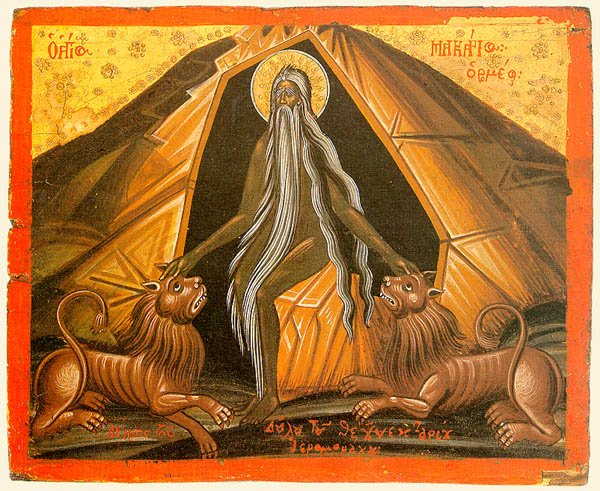
Saint Macarius the Roman of Mesopotamia (?)
One day, the cave where holy ascetic Makarios lived was found by three monks from the Monastery of Saint Asclepius in Mesopotamia. Sergius, Hyginos and Theophilos had left the monastery in order to wander through the world, seeking a sign from God which would be beneficial for their salvation. Suddenly, as they approached the cave, they noticed a marvelous fragrance issuing forth from it.
One day, the cave where holy ascetic Makarios lived was found by three monks from the Monastery of Saint Asclepius in Mesopotamia. Sergius, Hyginos and Theophilos had left the monastery in order to wander through the world, seeking a sign from God which would be beneficial for their salvation. Suddenly, as they approached the cave, they noticed a marvelous fragrance issuing forth from it. Then they saw an old man walking toward them, covered only by his hair and a beard which reached his knees. He threw himself to the ground and remained there for several minutes, until he was sure the three strangers were not really demons. When he was satisfied that he was not experiencing some sort of delusion, he invited them into his cave. The oldest monk asked him to relate his story, which he did.
Saint Makarios told them that he was born in Rome and was the son of a wealthy Senator named John. When he was old enough to be married, his parents betrothed him against his will. There was a celebration following the wedding, but instead of entering the bridal chamber, he fled to the home of a pious widow, where he spent seven days secretly weeping and entreating God to help him. When he left her house, Makarios met a well-dressed old man of noble demeanor. This man ordered Makarios to accompany him. Makarios did follow him for three years, until one day they came to a cave, and then the old man vanished. He appeared to Makarios in a dream soon afterward and revealed that he was the Archangel Raphael, who had guided Tobias in his travels. Before he vanished, the Archangel entrusted him to God’s mercy.
Soon after he first moved into the cave, Makarios saw a most beautiful young woman standing before him, who said that she also had fled from an unwanted marriage in Rome. In spite of his caution, Saint Makarios did not have sufficient discernment to escape the devil’s snare, and so he allowed the girl to spend the night in his cave. For the first time in his life, he was assaulted by the fiery darts of carnal desire, and he sinned with the girl. Suddenly she disappeared, and the devil rejoiced because he had tempted the ascetic to sin.
At that moment Saint Makarios realized the seriousness of his fall. Weeping bitterly, he decided to leave the cave and find another place where he might do penance. Along the way, the Archangel Raphael appeared to him once again and urged him to return. He told him that God would hear his prayers if he remained in the cave. So he went back and subjected his flesh to severe fasting, vigils and absolute self-denial for many years, so that he might recover the purity of his soul in order to contemplate God.
After he had edified the three brethren with the story of his struggles, Saint Makarios sent them on their way in peace. His sin was very great, but so was his repentance; therefore, he fell asleep in the Lord in the presence of the angels and the saints.
The precise date of the saint’s repose is not known, but it was probably at the end of the fourth century, or the beginning of the fifth.
Troparion - Tone 8
By a flood of tears you made the desert fertile, / and your longing for God brought forth fruits in abundance. / By the radiance of miracles you illumined the whole universe! / O our holy father Macarius, pray to Christ our God to save our souls!
Scripture Readings
☩Epistle
1 Corinthians 15:39-45
39
All flesh is not the same flesh: but there is one kind of flesh of men, another flesh of beasts, another of fishes, and another of birds.
40
There are also celestial bodies, and bodies terrestrial: but the glory of the celestial is one, and the glory of the terrestrial is another.
41
There is one glory of the sun, and another glory of the moon, and another glory of the stars: for one star differeth from another star in glory.
42
So also is the resurrection of the dead. It is sown in corruption; it is raised in incorruption:
43
It is sown in dishonour; it is raised in glory: it is sown in weakness; it is raised in power:
44
It is sown a natural body; it is raised a spiritual body. There is a natural body, and there is a spiritual body.
45
And so it is written, The first man Adam was made a living soul; the last Adam was made a quickening spirit.
☩Gospel
Luke 7:1-10
1
Now when he had ended all his sayings in the audience of the people, he entered into Capernaum.
2
And a certain centurion’s servant, who was dear unto him, was sick, and ready to die.
3
And when he heard of Jesus, he sent unto him the elders of the Jews, beseeching him that he would come and heal his servant.
4
And when they came to Jesus, they besought him instantly, saying, That he was worthy for whom he should do this:
5
For he loveth our nation, and he hath built us a synagogue.
6
Then Jesus went with them. And when he was now not far from the house, the centurion sent friends to him, saying unto him, Lord, trouble not thyself: for I am not worthy that thou shouldest enter under my roof:
7
Wherefore neither thought I myself worthy to come unto thee: but say in a word, and my servant shall be healed.
8
For I also am a man set under authority, having under me soldiers, and I say unto one, Go, and he goeth; and to another, Come, and he cometh; and to my servant, Do this, and he doeth it.
9
When Jesus heard these things, he marvelled at him, and turned him about, and said unto the people that followed him, I say unto you, I have not found so great faith, no, not in Israel.
10
And they that were sent, returning to the house, found the servant whole that had been sick.
Liturgical data sourced from OCA.org and orthocal.info