Fasting Rules
 Meat
Abstain
 Fish
Abstain
 Dairy
Abstain
 Oil
Abstain
 Wine
Abstain
Saints & Commemorations
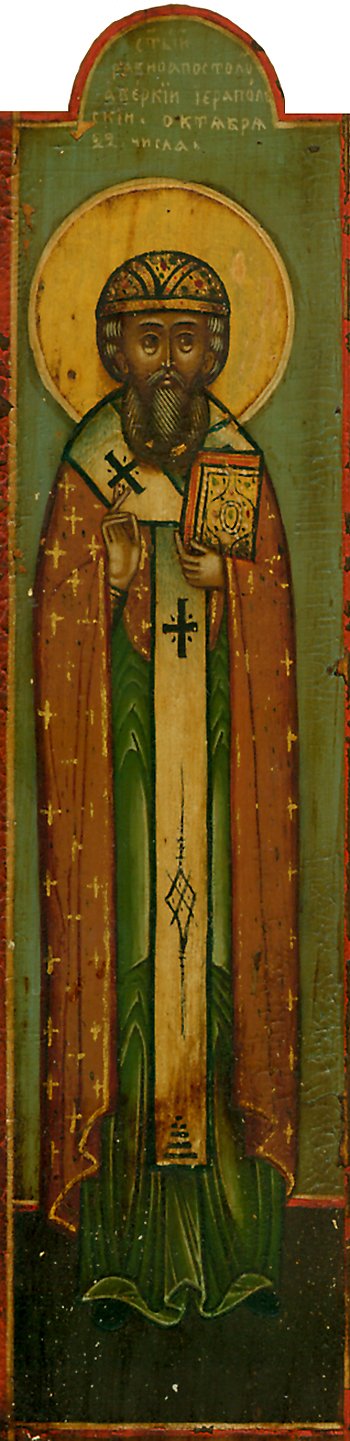
St Abercius, Equal-to-the-Apostles
The Holy Hierarch Averkios of Hieropolis lived in Phrygia during the second century. The city of Hieropolis was inhabited by many pagans and very few Christians. The Saint prayed to the Lord for the salvation of their souls, and that they might be numbered among God’s chosen flock. An Angel appeared and bade Saint Averkios to destroy the idols in the pagan temple. H
The Holy Hierarch Averkios of Hieropolis lived in Phrygia during the second century. The city of Hieropolis was inhabited by many pagans and very few Christians. The Saint prayed to the Lord for the salvation of their souls, and that they might be numbered among God’s chosen flock. An Angel appeared and bade Saint Averkios to destroy the idols in the pagan temple. He obeyed this command with zeal. Hearing that the idol-worshippers wanted to kill him, the Saint went to a place where people had gathered and openly denounced the failure of the pagans when they attempted to seize him.
At that moment three demon-possessed youths in the crowd cried out. The people were dumbfounded as the Hierarch expelled demons from them by his prayers. Seeing the youths restored to normal, the people of Hieropolis asked Saint Averkios to instruct them in the Christian Faith, and then they received Holy Baptism.
After this Saint Averkios went to the surrounding cities and villages, healing the sick and preaching the Kingdom of God. With his preaching he made the rounds of Syria, Cilicia, Mesopotamia, he also visited Rome. Everywhere he went he converted multitudes of people to Christ. For many years he guarded the Church against heretics, confirming Christians in the Faith, and setting the prodigal upon the path of righteousness. He also healed the sick and proclaimed the glory of Christ. Because of his great works, Saint Averkios is called an “Equal of the Apostles.”
Saint Averkios returned home to Hieropolis, where he soon rested from his labors. After his repose, many miracles took place at his tomb. He wrote his own epitaph, and it was carved on his tombstone, which is now in the Lateran Museum.
The skull of Saint Averkios is located in the Monastery of Most Pure Theotokos on the island of Andros. Fragments from the Holy Relic of Saint Averkios are also found in the Monasteries of Karakalou on the Holy Mountain, at Proussos in Evritania, and Phaneromeni in Salamis.
Troparion - Tone 4
You appeared to your flock as a rule of faith, / an Image of humility and a teacher of abstinence. / Because of your lowliness, Heaven was opened to you; / because of your poverty, riches were granted to you. / O Holy Bishop Averkios, entreat Christ God to save our souls.
Kontakion - Tone 8
You emulated the zeal of the Apostles / and shone forth like a morning star, / and your works revealed your God-given power: / you guided the erring to God, / O Hierarch Averkios.
Venerable Lot of Egypt (5th c.)
Saint Lot was a wise ascetic of the desert who reposed in peace in the early fifth century. Some of his sayings are to be found in the "Paradise of the Fathers," which describes the life of the anchorites, recluses, monks, coenobites and ascetic Fathers of the deserts of Egypt compiled by Saint Athanasios of Alexandria, Saint Palladius, Bishop of Helenopolis, Saint Jerome and others.
Saint Lot was a wise ascetic of the desert who reposed in peace in the early fifth century. Some of his sayings are to be found in the "Paradise of the Fathers," which describes the life of the anchorites, recluses, monks, coenobites and ascetic Fathers of the deserts of Egypt compiled by Saint Athanasios of Alexandria, Saint Palladius, Bishop of Helenopolis, Saint Jerome and others.
Saint Nikodemos (Νikόdēmos) of the Holy Mountain writes: "In the Paradise of the Fathers, it is said that Saint Lot asked Abba Joseph of Panephysis the following question: 'Abba, as much as I am able, I pray a little, fast a little, study, and keep silent. According to my strength, I keep my mind free of evil thoughts. What else should I do?' "
Then Abba Joseph stood up and lifted his hands to heaven. And - O the miracle - the ten fingers of his hands became like ten lit candles, then he said to Abba Lot. "Strive, if you will, so that in prayer you may become entirely like a flame."
In Greek usage Abba Lot is commemorated on October 22. He is also commemorated with the Holy God-bearing Fathers who shone forth in the ascetic life, on Cheesefare Saturday at Matins (Ode 4 of the Canon).
Troparion - Tone 1
You were shown as a citizen of the desert, / an Angel in the flesh, and a wonderworker, O our God-bearing Father Lot. / Through fasting, vigil, and prayer you obtained heavenly gifts, / and you healed the sick and the souls of those who have recourse to you with faith. / Glory to Him Who gave you strength.Glory to Him Who crowned you. / Glory to Him Who, through you, works healings for all.
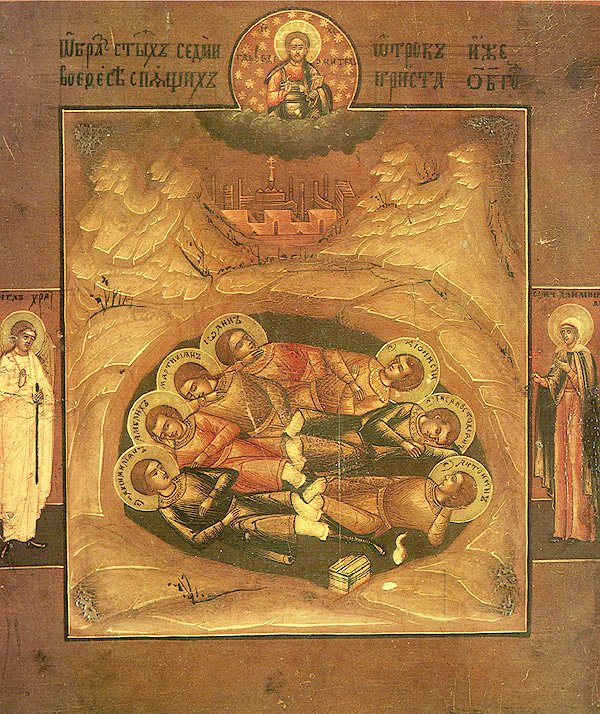
Holy Seven Youths of Ephesus
The Seven Youths of Ephesus: Maximilian, Iamblicus, Martinian, John, Dionysius, Exacustodianus (Constantine) and Antoninus, lived in the third century. Saint Maximilian was the son of the Ephesus city administrator, and the other six youths were sons of illustrious citizens of Ephesus. The youths were friends from childhood, and all were in military service together.
The Seven Youths of Ephesus: Maximilian, Iamblicus, Martinian, John, Dionysius, Exacustodianus (Constantine) and Antoninus, lived in the third century. Saint Maximilian was the son of the Ephesus city administrator, and the other six youths were sons of illustrious citizens of Ephesus. The youths were friends from childhood, and all were in military service together.
When the emperor Decius (249-251) arrived in Ephesus, he commanded all the citizens to offer sacrifice to the pagan gods. Torture and death awaited anyone who disobeyed. The seven youths were denounced by informants, and were summoned to reply to the charges. Appearing before the emperor, the young men confessed their faith in Christ.
Their military belts and insignia were quickly taken from them. Decius permitted them to go free, however, hoping that they would change their minds while he was off on a military campaign. The youths fled from the city and hid in a cave on Mount Ochlon, where they passed their time in prayer, preparing for martyrdom.
The youngest of them, Saint Iamblicus, dressed as a beggar and went into the city to buy bread. On one of his excursions into the city, he heard that the emperor had returned and was looking for them. Saint Maximilian urged his companions to come out of the cave and present themselves for trial.
Learning where the young men were hidden, the emperor ordered that the entrance of the cave be sealed with stones so that the saints would perish from hunger and thirst. Two of the dignitaries at the blocked entrance to the cave were secret Christians. Desiring to preserve the memory of the saints, they placed in the cave a sealed container containing two metal plaques. On them were inscribed the names of the seven youths and the details of their suffering and death.
The Lord placed the youths into a miraculous sleep lasting almost two centuries. In the meantime, the persecutions against Christians had ceased. During the reign of the holy emperor Theodosius the Younger (408-450) there were heretics who denied that there would be a general resurrection of the dead at the Second Coming of our Lord Jesus Christ. Some of them said, “How can there be a resurrection of the dead when there will be neither soul nor body, since they are disintegrated?” Others affirmed, “The souls alone will have a restoration, since it would be impossible for bodies to arise and live after a thousand years, when even their dust would not remain.” Therefore, the Lord revealed the mystery of the Resurrection of the Dead and of the future life through His seven saints.
The owner of the land on which Mount Ochlon was situated, discovered the stone construction, and his workers opened up the entrance to the cave. The Lord had kept the youths alive, and they awoke from their sleep, unaware that almost two hundred years had passed. Their bodies and clothing were completely undecayed.
Preparing to accept torture, the youths once again asked Saint Iamblicus to buy bread for them in the city. Going toward the city, the youth was astonished to see a cross on the gates. Hearing the name of Jesus Christ freely spoken, he began to doubt that he was approaching his own city.
When he paid for the bread, Iamblicus gave the merchant coins with the image of the emperor Decius on it. He was detained, as someone who might be concealing a horde of old money. They took Saint Iamblicus to the city administrator, who also happened to be the Bishop of Ephesus. Hearing the bewildering answers of the young man, the bishop perceived that God was revealing some sort of mystery through him, and went with other people to the cave.
At the entrance to the cave the bishop found the sealed container and opened it. He read upon the metal plaques the names of the seven youths and the details of the sealing of the cave on the orders of the emperor Decius. Going into the cave and seeing the saints alive, everyone rejoiced and perceived that the Lord, by waking them from their long sleep, was demonstrating to the Church the mystery of the Resurrection of the Dead.
Soon the emperor himself arrived in Ephesus and spoke with the young men in the cave. Then the holy youths, in sight of everyone, lay their heads upon the ground and fell asleep again, this time until the General Resurrection.
The emperor wanted to place each of the youths into a jeweled coffin, but they appeared to him in a dream and said that their bodies were to be left upon the ground in the cave. In the twelfth century the Russian pilgrim Igumen Daniel saw the holy relics of the seven youths in the cave.
There is a second commemoration of the seven youths on August 4. According to one tradition, which entered into the Russian PROLOGUE (of Saints’ Lives), the youths fell asleep for the second time on this day. The Greek MENAION of 1870 says that they first fell asleep on August 4, and woke up on October 22.
There is a prayer of the Seven Sleepers of Ephesus in the GREAT BOOK OF NEEDS (Trebnik) for those who are ill and cannot sleep. The Seven Sleepers are also mentioned in the service for the Church New Year, September 1.
Troparion - Tone 4
Your holy martyrs, O Lord, / through their sufferings have received their incorruptible crowns from You, our God. / For having Your strength, they laid low their adversaries, / and shattered the powerless boldness of demons. / Through their intercessions, save our souls!
Kontakion - Tone 4
Those who renounced the perishing comforts of this world, / preferring the eternal things of Heaven, / were incorrupt after death and rose from the dead / and buried the snares of the devils! / O Faithful, let us then honor them, singing a hymn of praise to Christ!
Scripture Readings
☩Epistle
Ephesians 6:18-24
18
Praying always with all prayer and supplication in the Spirit, and watching thereunto with all perseverance and supplication for all saints;
19
And for me, that utterance may be given unto me, that I may open my mouth boldly, to make known the mystery of the gospel,
20
For which I am an ambassador in bonds: that therein I may speak boldly, as I ought to speak.
21
But that ye also may know my affairs, and how I do, Tychicus, a beloved brother and faithful minister in the Lord, shall make known to you all things:
22
Whom I have sent unto you for the same purpose, that ye might know our affairs, and that he might comfort your hearts.
23
Peace be to the brethren, and love with faith, from God the Father and the Lord Jesus Christ.
24
Grace be with all them that love our Lord Jesus Christ in sincerity. Amen. Written from Rome unto the Ephesians by Tychicus.
☩Gospel
Luke 10:1-15
1
After these things the Lord appointed other seventy also, and sent them two and two before his face into every city and place, whither he himself would come.
2
Therefore said he unto them, The harvest truly is great, but the labourers are few: pray ye therefore the Lord of the harvest, that he would send forth labourers into his harvest.
3
Go your ways: behold, I send you forth as lambs among wolves.
4
Carry neither purse, nor scrip, nor shoes: and salute no man by the way.
5
And into whatsoever house ye enter, first say, Peace be to this house.
6
And if the son of peace be there, your peace shall rest upon it: if not, it shall turn to you again.
7
And in the same house remain, eating and drinking such things as they give: for the labourer is worthy of his hire. Go not from house to house.
8
And into whatsoever city ye enter, and they receive you, eat such things as are set before you:
9
And heal the sick that are therein, and say unto them, The kingdom of God is come nigh unto you.
10
But into whatsoever city ye enter, and they receive you not, go your ways out into the streets of the same, and say,
11
Even the very dust of your city, which cleaveth on us, we do wipe off against you: notwithstanding be ye sure of this, that the kingdom of God is come nigh unto you.
12
But I say unto you, that it shall be more tolerable in that day for Sodom, than for that city.
13
Woe unto thee, Chorazin! woe unto thee, Bethsaida! for if the mighty works had been done in Tyre and Sidon, which have been done in you, they had a great while ago repented, sitting in sackcloth and ashes.
14
But it shall be more tolerable for Tyre and Sidon at the judgment, than for you.
15
And thou, Capernaum, which art exalted to heaven, shalt be thrust down to hell.
Liturgical data sourced from OCA.org and orthocal.info