Fasting Rules
 Meat
Allowed
 Fish
Allowed
 Dairy
Allowed
 Oil
Allowed
 Wine
Allowed
Saints & Commemorations
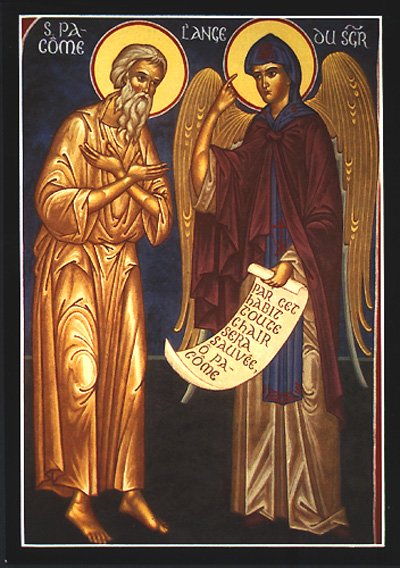
Ven. Pachomius the Great
Saint Pachomius the Great was both a model of desert dwelling, and with Saints Anthony the Great (January 17), Macarius the Great (January 19), and Euthymius the Great (January 20), a founder of the cenobitic monastic life in Egypt.
Saint Pachomius was born in the third century in the Thebaid (Upper Egypt).
Saint Pachomius the Great was both a model of desert dwelling, and with Saints Anthony the Great (January 17), Macarius the Great (January 19), and Euthymius the Great (January 20), a founder of the cenobitic monastic life in Egypt.
Saint Pachomius was born in the third century in the Thebaid (Upper Egypt). His parents were pagans who gave him an excellent secular education. From his youth he had a good character, and he was prudent and sensible.
When Pachomius reached the age of twenty, he was called up to serve in the army of the emperor Constantine (apparently, in the year 315). They put the new conscripts in a city prison guarded by soldiers. The local Christians fed the soldiers and took care of them.
When the young man learned that these people acted this way because of their love for God, fulfilling His commandment to love their neighbor, this made a deep impression upon his pure soul. Pachomius vowed to become a Christian. Pachomius returned from the army after the victory, received holy Baptism, moved to the lonely settlement of Shenesit, and began to lead a strict ascetic life. Realizing the need for spiritual guidance, he turned to the desert-dweller Palamon. He was accepted by the Elder, and he began to follow the example of his instructor in monastic struggles.
Once, after ten years of asceticism, Saint Pachomius made his way through the desert, and halted at the ruins of the former village of Tabennisi. Here he heard a Voice ordering him to start a monastery at this place. Pachomius told the Elder Palamon of this, and they both regarded the words as a command from God.
They went to Tabennisi and built a small monastic cell. The holy Elder Palamon blessed the foundations of the monastery and predicted its future glory. But soon Palamon departed to the Lord. An angel of God then appeared to Saint Pachomius in the form of a schemamonk and gave him a Rule of monastic life. Soon his older brother John came and settled there with him.
Saint Pachomius endured many temptations and assaults from the Enemy of the race of man, but he resisted all temptations by his prayer and endurance.
Gradually, followers began to gather around Saint Pachomius. Their teacher impressed everyone by his love for work, which enabled him to accomplish all kinds of monastic tasks. He cultivated a garden, he conversed with those seeking guidance, and he tended to the sick.
Saint Pachomius introduced a monastic Rule of cenobitic life, giving everyone the same food and attire. The monks of the monastery fulfilled the obediences assigned them for the common good of the monastery. Among the various obediences was copying books. The monks were not allowed to possess their own money nor to accept anything from their relatives. Saint Pachomius considered that an obedience fulfilled with zeal was greater than fasting or prayer. He also demanded from the monks an exact observance of the monastic Rule, and he chastized slackers.
His sister Maria came to see Saint Pachomius, but the strict ascetic refused to see her. Through the gate keeper, he blessed her to enter upon the path of monastic life, promising his help with this. Maria wept, but did as her brother had ordered. The Tabennisi monks built her a hut on the opposite side of the River Nile. Nuns also began to gather around Maria. Soon a women’s monastery was formed with a strict monastic Rule provided by Saint Pachomius.
The number of monks at the monastery grew quickly, and it became necessary to build seven more monasteries in the vicinity. The number of monks reached 7,000, all under the guidance of Saint Pachomius, who visited all the monasteries and administered them. At the same time Saint Pachomius remained a deeply humble monk, who was always ready to comply with and accept the words of each brother.
Severe and strict towards himself, Saint Pachomius had great kindness and condescension toward the deficiencies of spiritually immature monks. One of the monks was eager for martyrdom, but Saint Pachomius turned him from this desire and instructed him to fulfill his monastic obedience, taming his pride, and training him in humility.
Once, a monk did not heed his advice and left the monastery. He was set upon by brigands, who threatened him with death and forced him to offer sacrifice to the pagan gods. Filled with despair, the monk returned to the monastery. Saint Pachomius ordered him to pray intensely night and day, keep a strict fast and live in complete solitude. The monk followed his advice, and this saved his soul from despair.
The saint taught his spiritual children to avoid judging others, and he himself feared to judge anyone even in thought.
Saint Pachomius cared for the sick monks with special love. He visited them, he cheered the disheartened, he urged them to be thankful to God, and put their hope in His holy will. He relaxed the fasting rule for the sick, if this would help them recover their health. Once, in the saint’s absence, the cook did not prepare any cooked food for the monks, assuming that the brethren loved to fast. Instead of fulfilling his obedience, the cook plaited 500 mats, something which Saint Pachomius had not told him to do. In punishment for his disobedience, all the mats prepared by the cook were burned.
Saint Pachomius always taught the monks to rely only upon God’s help and mercy. It happened that there was a shortage of grain at the monastery. The saint spent the whole night in prayer, and in the morning a large quantity of bread was sent to the monastery from the city, at no charge. The Lord granted Saint Pachomius the gift of wonderworking and healing the sick.
The Lord revealed to him the future of monasticism. The saint learned that future monks would not have such zeal in their struggles as the first generation had, and they would not have experienced guides. Prostrating himself upon the ground, Saint Pachomius wept bitterly, calling out to the Lord and imploring mercy for them. He heard a Voice answer, “Pachomius, be mindful of the mercy of God. The monks of the future shall receive a reward, since they too shall have occasion to suffer the life burdensome for the monk.”
Toward the end of his life Saint Pachomius fell ill from a pestilence that afflicted the region. His closest disciple, Saint Theodore (May 17), tended to him with filial love. Saint Pachomius died around the year 348 at the age of fifty-three, and was buried on a hill near the monastery.
Troparion - Tone 5
As a pastor of the Chief Shepherd, O Father Pakhomios, / you guided flocks of monks into the heavenly sheepfold, / where you learned about the Schema and way of life which is fitting for ascetics. / Having taught this to the monks, / now you rejoice with them in the heavenly abodes.
Kontakion - Tone 2
Since you lived the life of the Angels while in the body, / you were also deemed worthy of their glory, O God-bearer Pakhomios. / Now you stand with them before the throne of God, / interceding that divine forgiveness may be granted to all.
Slain Crown Prince Dimitry of Moscow
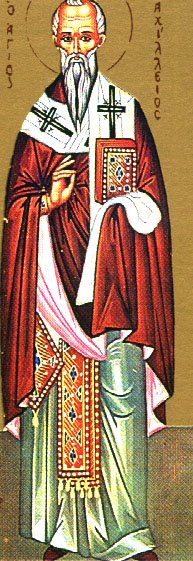
Our Father among the Saints Achillius, Bishop of Larissa (330)
Saint Achilles, Bishop of Larissa, lived during the fourth century, during the reign of Saint Constantine the Great. Glorified for his holiness of life and erudition, he was made Bishop of Larissa in Thessaly.
Saint Achilles participated in the First Ecumenical Council, where he boldly denounced the heretic Arius.
Saint Achilles, Bishop of Larissa, lived during the fourth century, during the reign of Saint Constantine the Great. Glorified for his holiness of life and erudition, he was made Bishop of Larissa in Thessaly.
Saint Achilles participated in the First Ecumenical Council, where he boldly denounced the heretic Arius. In his city he strove to promote Christianity, destroyed idolatrous pagan temples, and he built and adorned churches.
Saint Achilles had the gift of healing sickness, especially demonic possession, and he worked many miracles. The saint died peacefully in about the year 330. His relics have remained in Prespa, in today's Republic of Macedonia, since 978.
Troparion - Tone 4
In truth you were revealed to your flock as a rule of faith, / an image of humility and a teacher of abstinence; / your humility exalted you; / your poverty enriched you. / Hierarch Father Achilles, / entreat Christ our God / that our souls may be saved.
Scripture Readings
☩Epistle
Acts 5:21-33
21
And when they heard that, they entered into the temple early in the morning, and taught. But the high priest came, and they that were with him, and called the council together, and all the senate of the children of Israel, and sent to the prison to have them brought.
22
But when the officers came, and found them not in the prison, they returned, and told,
23
Saying, The prison truly found we shut with all safety, and the keepers standing without before the doors: but when we had opened, we found no man within.
24
Now when the high priest and the captain of the temple and the chief priests heard these things, they doubted of them whereunto this would grow.
25
Then came one and told them, saying, Behold, the men whom ye put in prison are standing in the temple, and teaching the people.
26
Then went the captain with the officers, and brought them without violence: for they feared the people, lest they should have been stoned.
27
And when they had brought them, they set them before the council: and the high priest asked them,
28
Saying, Did not we straitly command you that ye should not teach in this name? and, behold, ye have filled Jerusalem with your doctrine, and intend to bring this man’s blood upon us.
29
Then Peter and the other apostles answered and said, We ought to obey God rather than men.
30
The God of our fathers raised up Jesus, whom ye slew and hanged on a tree.
31
Him hath God exalted with his right hand to be a Prince and a Saviour, for to give repentance to Israel, and forgiveness of sins.
32
And we are his witnesses of these things; and so is also the Holy Ghost, whom God hath given to them that obey him.
33
When they heard that, they were cut to the heart, and took counsel to slay them.
☩Gospel
John 6:14-27
14
Then those men, when they had seen the miracle that Jesus did, said, This is of a truth that prophet that should come into the world.
15
When Jesus therefore perceived that they would come and take him by force, to make him a king, he departed again into a mountain himself alone.
16
And when even was now come, his disciples went down unto the sea,
17
And entered into a ship, and went over the sea toward Capernaum. And it was now dark, and Jesus was not come to them.
18
And the sea arose by reason of a great wind that blew.
19
So when they had rowed about five and twenty or thirty furlongs, they see Jesus walking on the sea, and drawing nigh unto the ship: and they were afraid.
20
But he saith unto them, It is I; be not afraid.
21
Then they willingly received him into the ship: and immediately the ship was at the land whither they went.
22
The day following, when the people which stood on the other side of the sea saw that there was none other boat there, save that one whereinto his disciples were entered, and that Jesus went not with his disciples into the boat, but that his disciples were gone away alone;
23
(Howbeit there came other boats from Tiberias nigh unto the place where they did eat bread, after that the Lord had given thanks:)
24
When the people therefore saw that Jesus was not there, neither his disciples, they also took shipping, and came to Capernaum, seeking for Jesus.
25
And when they had found him on the other side of the sea, they said unto him, Rabbi, when camest thou hither?
26
Jesus answered them and said, Verily, verily, I say unto you, Ye seek me, not because ye saw the miracles, but because ye did eat of the loaves, and were filled.
27
Labour not for the meat which perisheth, but for that meat which endureth unto everlasting life, which the Son of man shall give unto you: for him hath God the Father sealed.
Liturgical data sourced from OCA.org and orthocal.info