Today

Fasting Rules

Meat not allowed Meat Abstain
Fish not allowed Fish Abstain
Dairy not allowed Dairy Abstain
Oil allowed Oil Allowed
Wine allowed Wine Allowed

☦ Saints & Commemorations

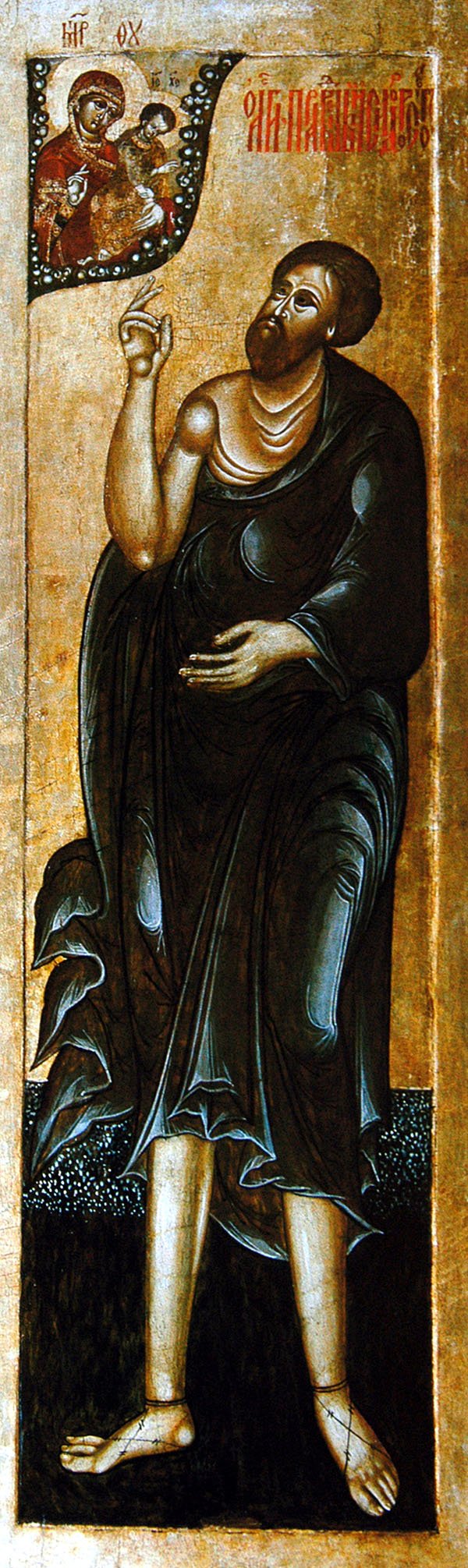
Ven. Isidore, Fool-for-Christ of Rostov

Ven. Isidore, Fool-for-Christ of Rostov

Saint Isidore Tverdislov (“Constant of Word”), Fool-for-Christ, Wonderworker of Rostov. He was born in Germany of rich parents. From his youth, he led “an unsullied life and had a compassionate understanding.” Leaving his parental home and “desiring the Kingdom of God,” Saint Isidore distributed his wealth to the poor. Taking up t Saint Isidore Tverdislov (“Constant of Word”), Fool-for-Christ, Wonderworker of Rostov. He was born in Germany of rich parents. From his youth, he led “an unsullied life and had a compassionate understanding.” Leaving his parental home and “desiring the Kingdom of God,” Saint Isidore distributed his wealth to the poor. Taking up the staff of a wanderer, he visited many lands and cities. He was raised in Catholicism, and it is not known where he accepted the holy Orthodox Faith. Finally, he arrived in Russia and decided to live in Rostov. Here Saint Isidore, “in filth and snow and rain and cold” and “enduring every outrage,” settled in a rickety wooden hut that he himself had made. He chose a foolish manner of life for the sake of Christ, which Saint Paul describes in his Epistle (1 Cor.4:10-13). Saint Isidore spent all his time at unceasing prayer, not allowing himsetlf much sleep or rest. “He stood at all night vigil and praise” to dedicate his body “everlastingly to God.” By day the blessed one made the rounds of the city, acting like a fool. “Like Job of old in his patience,” Blessed Isidore, while still alive, was “an earthly angel and a heavenly man,” “a compassionate soul, and pure of thought, and vigilant heart and faith unassailed, and true love without pretense.” During his life he received the grace to work miracles. Saint Isidore reposed in the year 1474. They learned of his death only when, passing by his hut, they noticed a special fragrance. At the place of his burial in the city of Rostov the church of the Ascension of the Lord was built, in which his relics rest in a crypt as a source of miracles to the present day. Blessed Isidore is termed “Tverdislov” [“Constant of Word”] since he spoke constantly. [The title “Tverdislov” seems unique to Saint Isidore. This supplemental account of him is from Bulgakov’s Nastolnaya Kniga (1900).]

Troparion - Tone 4

Enlightened by Divine grace, O godly-wise one, / with great chastity and patience you completed the course of your temporal life well. / Therefore, after death, the purity of your life was revealed; / for you pour forth the grace of healing to those who hasten to your holy tomb with faith. / O Blessed Isidore, pray to Christ God for the salvation of our souls.

Kontakion - Tone 8

O Saint Isidore, you were called from the earthly abodes to the eternal, / preserving your body unharmed even after death, / for you lived your life in chastity and purity, O Blessed one, / without defiling your body. / Boldly entreat Christ God for the salvation of our souls.

Martyr Isidore of Chios (251)

A devout Christian from his early youth, he was kidnapped from his native Chios and impressed into the army. When he openly confessed himself a Christian, his commander ordered him to make sacrifice to the gods. When he resolutely refused, the commander ordered him to be beaten with iron flails, then had his tongue cut out. A devout Christian from his early youth, he was kidnapped from his native Chios and impressed into the army. When he openly confessed himself a Christian, his commander ordered him to make sacrifice to the gods. When he resolutely refused, the commander ordered him to be beaten with iron flails, then had his tongue cut out. But even without a tongue, Isidore was miraculously enabled to speak, and clearly proclaimed the name of Christ. At the same moment, the commander was struck mute. The commander then ordered by signs that Isidore be beheaded. Isidore went to his death rejoicing and praising God. This occurred during the persecutions of the Emperor Decius.

Our Holy Father Serapion the Sindonite (5th c.)
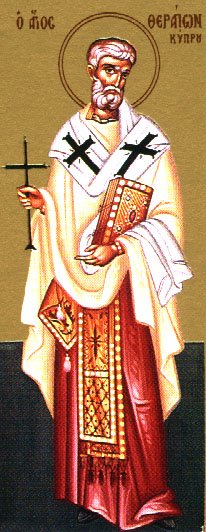
“ ‘Sindon’ means ‘linen cloth,’ and this saint was called ‘the Sindonite’ because he covered his naked body only with a linen cloth. He carried the Gospels in his hand. Serapion lived like the birds, with no roof and no cares, moving from one place to another. He gave his linen cloth to a poor wretch who was shivering with cold, and himself remained completely naked. When someone “ ‘Sindon’ means ‘linen cloth,’ and this saint was called ‘the Sindonite’ because he covered his naked body only with a linen cloth. He carried the Gospels in his hand. Serapion lived like the birds, with no roof and no cares, moving from one place to another. He gave his linen cloth to a poor wretch who was shivering with cold, and himself remained completely naked. When someone asked him: ‘Serapion, who made you naked?’, he indicated the Gospels and said: ‘This!’ But, after that, he gave away the Gospels also for the money needed by a man who was being hounded to prison by a creditor in debt. [note: Gospel books were all hand-written, and were uncommon and valuable.] At one time in Athens, he did not eat for four days, having nothing, and began to cry out with hunger. When the Athenian philosophers asked him what he was shouting about, he replied: ‘There were three to whom I was in debt: two have quietened down, but the third is still tormenting me. The first creditor is carnal lust, who has tormented me from my youth; the second is love of money, and the third is the stomach. The first two have left me alone, but the third one still torments me.’ The philosophers gave him some gold to buy bread. He went to a baker, bought a single loaf, put down all the gold and went out. He went peacefully to the Lord in old age, in the 5th century.” (Prologue)
Holy Hieromartyr Therapontus

Holy Hieromartyr Therapontus

No information available at this time.

Troparion - Tone 4

By sharing in the ways of the Apostles, / you became a successor to their throne. / Through the practice of virtue, you found the way to divine contemplation, O inspired one of God; / by teaching the word of truth without error, you defended the Faith, / even to the shedding of your blood. / Hieromartyr Therapontus, entreat Christ God to save our souls.

Leontius, Patriarch of Jerusalem

Saint Leontios was from Tiberioupolis in Phrygia and was born to wealthy and devout parents around the second half of the XII century. When he was 15-17 years old, his father reposed, so he left his birthplace and studied under a pious priest, then he went to Ptelidίon Monastery of the Mother of God, where he was tonsured as a monk. Saint Leontios was from Tiberioupolis in Phrygia and was born to wealthy and devout parents around the second half of the XII century. When he was 15-17 years old, his father reposed, so he left his birthplace and studied under a pious priest, then he went to Ptelidίon Monastery of the Mother of God, where he was tonsured as a monk. Later he went to Constantinople and became associated with the Metropolitan of Tiberias, to whom he submitted himself. After following his Elder, who was returning to his diocese, they sailed to Patmos to worship at the Monastery of Saint John the Theologian. He started for Cyprus, but God's will led him back to Patmos. There, under the spiritual guidance of Igoumen Theoktistos (Theóktistos), a man experienced in spiritual matters, he became an example of brotherly love and humility. When Igoumen Theoktistos reposed, Leontios was chosen to succeed him, by unanimous decision of the monks. Saint Leontios visited the island of Crete for the material needs of the monastery. The Monastery of the Holy Apostle and Evangelist John had a base on Crete, within the ancient city of Aptera, and above the Turkish fortress of Isdezin (Kalami), which was then a dependency of the Patmos Monastery. Taking care of the Monastery's affairs, Saint Leontios went to Constantinople. There he won the respect and esteem of Emperor Manuel Komnenos (1143-1180) who proposed that he become a Bishop in Russia or Cyprus, but Saint Leontius declined out of humility. But when he was offered the throne of Jerusalem, Leontios could not refuse and he became Patriarch of Jerusalem in 1170, at a time when that Church was being tested by the domination of the Latins. Because of the control he exercised over the new Emperor Andronikos Komnenos, Saint Leontios was exiled, and he reposed at a ripe old age on May 14, 1190. He is commemorated on Patmos and in Jerusalem on May 14. His Church Service was published in Jerusalem in 1912. Saint Leontios was Patriarch of Jerusalem from 1223-1261, according to Saint Gregory Palamas (November 14) and Theodore, a monk of Constantinople. This Life was translated from Greek into the Russian language in an abridged form. It was translated a second time more fully by Saint Νikodemos (Νikόdēmos) of the Holy Mountain (July 14), who says the Patriarch's death actually occurred in 1175.

Troparion - Tone 4

The truth of things revealed you to your flock as a rule of faith, / a model of meekness, and a teacher of temperance. / Therefore, through humility, you attained the heights; / and through poverty, riches. / O Hierarch Leontios our Father, entreat Christ God that our souls may be saved.

Kontakion - Tone 2

Podoben: “You sought the heights...”) O Hierarch Leontios, / divine thunder, spiritual trumpet, planter of faith and pruner of heresies, great favorite of the Trinity, as you stand before God with the Angels, / pray unceasingly for all of us.

Scripture Readings

☩Epistle

Acts 5:1-11

1 But a certain man named Ananias, with Sapphira his wife, sold a possession,
2 And kept back part of the price, his wife also being privy to it, and brought a certain part, and laid it at the apostles’ feet.
3 But Peter said, Ananias, why hath Satan filled thine heart to lie to the Holy Ghost, and to keep back part of the price of the land?
4 Whiles it remained, was it not thine own? and after it was sold, was it not in thine own power? why hast thou conceived this thing in thine heart? thou hast not lied unto men, but unto God.
5 And Ananias hearing these words fell down, and gave up the ghost: and great fear came on all them that heard these things.
6 And the young men arose, wound him up, and carried him out, and buried him.
7 And it was about the space of three hours after, when his wife, not knowing what was done, came in.
8 And Peter answered unto her, Tell me whether ye sold the land for so much? And she said, Yea, for so much.
9 Then Peter said unto her, How is it that ye have agreed together to tempt the Spirit of the Lord? behold, the feet of them which have buried thy husband are at the door, and shall carry thee out.
10 Then fell she down straightway at his feet, and yielded up the ghost: and the young men came in, and found her dead, and, carrying her forth, buried her by her husband.
11 And great fear came upon all the church, and upon as many as heard these things.

☩Gospel

John 5:30-6:2

30 I can of mine own self do nothing: as I hear, I judge: and my judgment is just; because I seek not mine own will, but the will of the Father which hath sent me.
31 If I bear witness of myself, my witness is not true.
32 There is another that beareth witness of me; and I know that the witness which he witnesseth of me is true.
33 Ye sent unto John, and he bare witness unto the truth.
34 But I receive not testimony from man: but these things I say, that ye might be saved.
35 He was a burning and a shining light: and ye were willing for a season to rejoice in his light.
36 But I have greater witness than that of John: for the works which the Father hath given me to finish, the same works that I do, bear witness of me, that the Father hath sent me.
37 And the Father himself, which hath sent me, hath borne witness of me. Ye have neither heard his voice at any time, nor seen his shape.
38 And ye have not his word abiding in you: for whom he hath sent, him ye believe not.
39 Search the scriptures; for in them ye think ye have eternal life: and they are they which testify of me.
40 And ye will not come to me, that ye might have life.
41 I receive not honour from men.
42 But I know you, that ye have not the love of God in you.
43 I am come in my Father’s name, and ye receive me not: if another shall come in his own name, him ye will receive.
44 How can ye believe, which receive honour one of another, and seek not the honour that cometh from God only?
45 Do not think that I will accuse you to the Father: there is one that accuseth you, even Moses, in whom ye trust.
46 For had ye believed Moses, ye would have believed me: for he wrote of me.
47 But if ye believe not his writings, how shall ye believe my words?
1 After these things Jesus went over the sea of Galilee, which is the sea of Tiberias.
2 And a great multitude followed him, because they saw his miracles which he did on them that were diseased.

Liturgical data sourced from OCA.org and orthocal.info