Fasting Rules
 Meat
Abstain
 Fish
Abstain
 Dairy
Abstain
 Oil
Allowed
 Wine
Allowed
Saints & Commemorations
Sunday of Orthodoxy
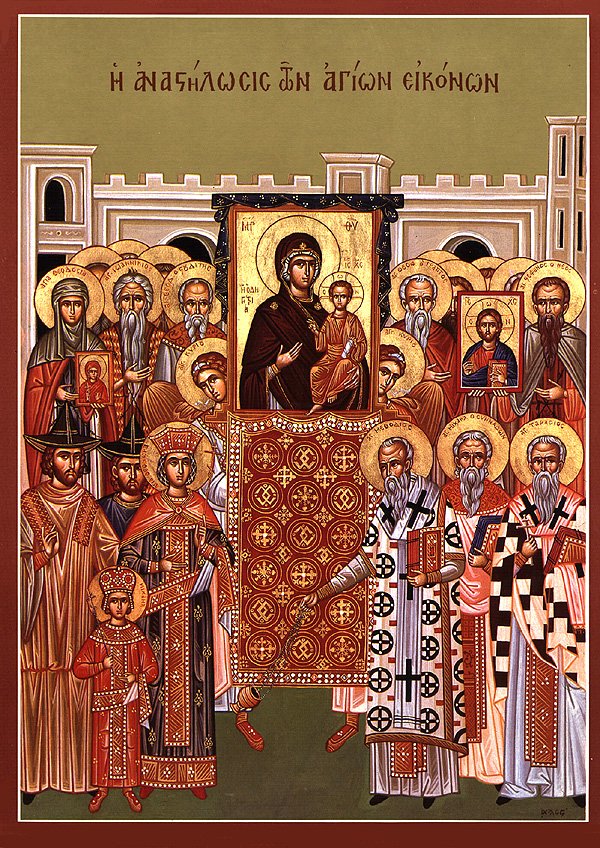
The first Sunday of Great Lent is called the Sunday of Orthodoxy because it commemorates the restoration of the Holy Icons and the triumph of the Orthodox Faith against the terrible heresy of the Iconoclasts, i.e. those heretics who refused to honor the Holy Icons. For more than a hundred years the Church was disturbed by the evil doctrine of iconoclasm.
The first Sunday of Great Lent is called the Sunday of Orthodoxy because it commemorates the restoration of the Holy Icons and the triumph of the Orthodox Faith against the terrible heresy of the Iconoclasts, i.e. those heretics who refused to honor the Holy Icons. For more than a hundred years the Church was disturbed by the evil doctrine of iconoclasm.
The first Emperor to persecute the Church was Leo the Isaurian, and the last was Theophilos, the spouse of Saint Theodora (February 11), who reigned after her husband's death and re-established Orthodoxy in the time of Patriarch Methodios (June 14). Empress Theodora proclaimed publicly that we do not kiss the Icons as a sign of worship, nor do we honor them as "gods," but as images of their prototypes.
In the year 843, on the first Sunday of the Fast, Saint Theodora and her son, Emperor Michael, venerated the Holy Icons together with the clergy and the people. Since that time this event has been commemorated every year, because it was definitively determined that we do not worship the Icons, but we honor and glorify all the Saints who are depicted on them. We worship only the Triune God: the Father, the Son and the Holy Spirit, and no one else, neither a Saint, nor an Angel.
Originally, the Holy Prophets Moses, Aaron, and Samuel were commemorated on this Sunday. The Alleluia verses appointed for today’s Liturgy reflect this older usage.
Troparion - Tone 2
We venerate Your most pure image, O Good One, / and ask forgiveness of our transgressions, O Christ God. / Of Your own will You were pleased to ascend the Cross in the flesh / to deliver Your creatures from bondage to the enemy. / Therefore with thanksgiving we cry aloud to You: / You have filled all with joy, O our Savior, / by coming to save the world.
Kontakion - Tone 8
No one could describe the Word of the Father; / but when He took flesh from you, O Theotokos, He accepted to be described, / and restored the fallen image to its former state by uniting it to divine beauty. / We confess and proclaim our salvation in word and images.
St James the Confessor of Catania
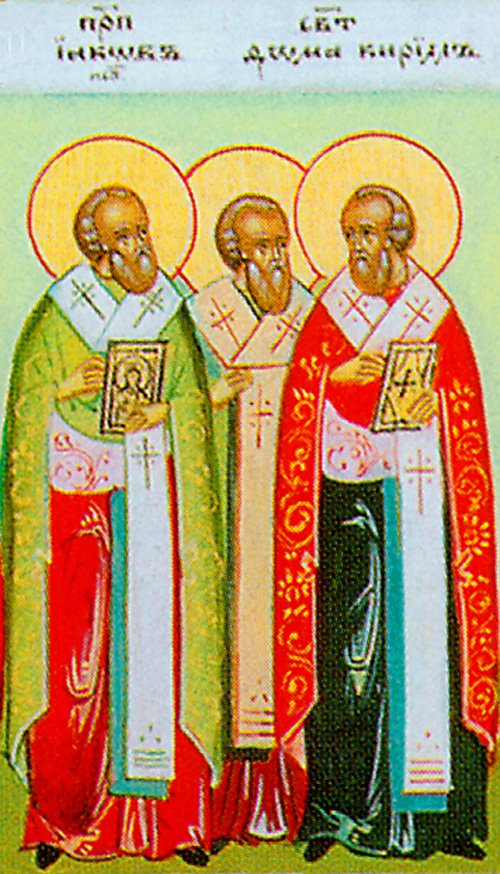
Saint James, Bishop and Confessor was inclined toward the ascetic life from his early years. Saint James left the world and entered the Studite monastery, where he was tonsured. He led a strict life, full of works, fasting and prayer. Pious and well-versed in Holy Scripture, Saint James was elevated to the bishop’s throne of Catania (Sicily).
Saint James, Bishop and Confessor was inclined toward the ascetic life from his early years. Saint James left the world and entered the Studite monastery, where he was tonsured. He led a strict life, full of works, fasting and prayer. Pious and well-versed in Holy Scripture, Saint James was elevated to the bishop’s throne of Catania (Sicily).
During the reign of the iconoclast emperor Constantine V Copronymos (741-775), Saint James was repeatedly urged not to venerate the holy icons. They exhausted him in prison, starved him, and beat him, but he bravely endured all these torments. Saint James died in exile.
Troparion - Tone 5
Shining forth with purity, you rightly divided the inspired Word of truth / as a Hierarch and a minister of God the Word. / By your virtuous struggle you revealed and confirmed the grace granted to you, O James, / instructing all to venerate the Icon of the Savior, / with Whom you intercede for us all.
Kontakion - Tone 8
You excelled in the gifts of the priesthood, O Confessor, / and through your labors You became illustrious in confessing the Faith. / Since you are a fruitful branch of Christ the True Vine, / grant the new wine of forgiveness and salvation to those who cry to you: “Rejoice, O Father James!”
Our Holy Father Serapion (366)
Saint Serapion lived in Egypt during the fourth century. He is known as “the Sindonite” because he wore only rough linen clothing (sindona). From the time of his youth he lived like the birds of the air (Matthew 6:26). He had no shelter, and for several days at a time he would eat no food, because he did not have money to buy bread. Whe
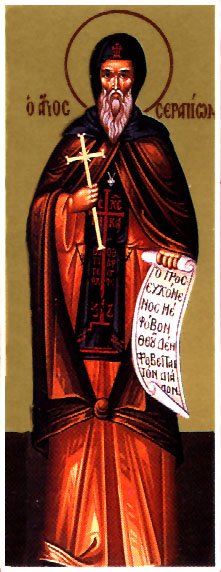
Saint Serapion lived in Egypt during the fourth century. He is known as “the Sindonite” because he wore only rough linen clothing (sindona). From the time of his youth he lived like the birds of the air (Matthew 6:26). He had no shelter, and for several days at a time he would eat no food, because he did not have money to buy bread. When he saw a beggar shivering from the cold, he gave him his sindon, and was left half-naked. He proved to be a prime example of philanthropy and mercy, distributing his own wealth, and whatever his faithful visitors gave him for himself, to the poor. Then he became a monk and lived in the desert of Sketis. He was dedicated to spreading the Word of God in many different ways.
Once he fell into the hands of a bandit, and by his powers of persuasion he managed to turn the tables on him, and made this robber a servant of God. He also managed to convert the Manichean heretic Lakedaimon to Orthodoxy.
A certain Greek philosopher, who wanted to test the monk’s honesty, gave him a gold coin and began to watch him. The Saint went to a bread merchant, took one loaf and gave the gold coin to the merchant, walking away with no idea of the coin’s value.
Saint Serapion led many people to the path of salvation in special ways. Once he sold himself into slavery to a Greek actor who wanted to convert to Christ. The actor was astonished by the righteous one’s holy life, and so he believed and was baptized with his family. He implored Saint Serapion to remain with him, not as a slave, but as a mentor and friend. The monk left, however, without taking the money that was offered to him.
Departing for Rome, Saint Serapion boarded a ship, but did not pay the sailors anything for his passage. At first, they began to reproach him for this, but when they saw that the Elder did not eat anything for five days, they began to feed him for the sake of God, and thereby fulfilled the commandment of the Lord. In Rome, the monk continued to travel, going from house to house, having nothing, gathering only spiritual riches for himself and for his neighbor.
Later he was made Bishop of Thmuis in Lower Egypt. He had been a disciple of Saint Anthony the Great (January 17), and later he wrote A Letter on the Death of Saint Anthony . He was also a friend and supporter of Saint Athanasios of Alexandria (January 18 & May 2). At the end of the nineteenth century a collection of liturgical texts, ascribed to Saint Serapion, was discovered.
In the end he returned to his beloved desert, where he reposed peacefully in deep old age in the year 370, an example for all the monks.
Troparion - Tone 4
In truth you were revealed to your flock as a rule of faith, / an image of humility and a teacher of abstinence; / your humility exalted you; / your poverty enriched you. / Hierarch Father Serapion, / entreat Christ our God / that our souls may be saved.
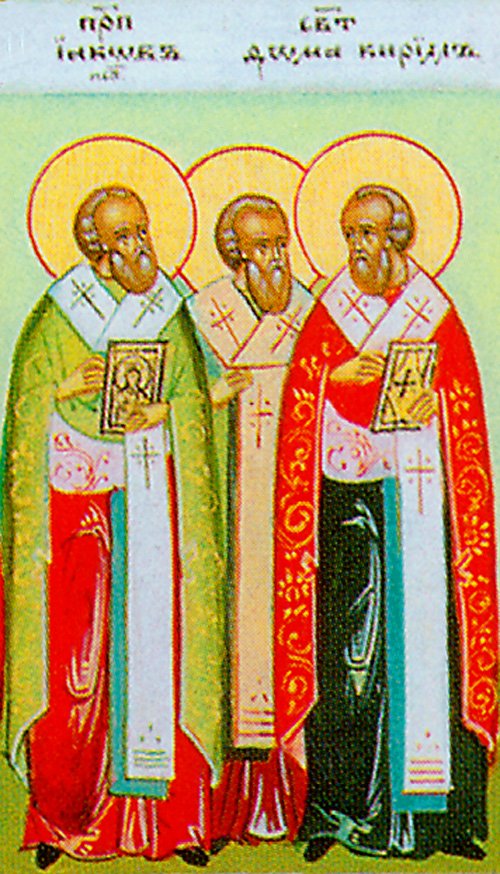
Thomas I, Patriarch of Constantinople
Saint Thomas, Patriarch of Constantinople, was at first a deacon, and later under the holy Patriarch John IV the Faster (582-595) he was made “sakellarios” [sacristan] in the Great Church (Hagia Sophia). After the death of holy Patriarch Cyriacus (595-606), Saint Thomas was elevated to the Patriarchal throne in 607. The
Saint Thomas, Patriarch of Constantinople, was at first a deacon, and later under the holy Patriarch John IV the Faster (582-595) he was made “sakellarios” [sacristan] in the Great Church (Hagia Sophia). After the death of holy Patriarch Cyriacus (595-606), Saint Thomas was elevated to the Patriarchal throne in 607. The saint concerned himself in every possible way about the spiritual needs of his flock.
During the patriarchate of Saint Thomas, an ominous portent appeared in the land of Galatia (Asia Minor). The heavy crosses which were carried during church processions began to shake and to strike against each other. The clairvoyant Elder, Saint Theodore Sykeotes (April 22), explained the meaning of this portent. He said that discords and disasters awaited the Church, and the state was in danger of barbarian invasion. Hearing this, the saint became terrified and asked Saint Theodore to pray that God would take his soul before these predictions were fulfilled.
After the death of the holy Patriarch Thomas in 610, disorders started in the Church. Saint Thomas’s successor, Patriarch Sergius (610-638), fell into the Monothelite heresy. Through God’s dispensation, war broke out with Persia, which proved grievous for Byzantium. The Greek regions of Asia Minor were completely devastated, Jerusalem fell, and the Life-Creating Cross of the Lord was captured and taken to Persia. Thus, all the misfortunes portended by the miracle during the church procession came to pass.
Troparion - Tone 4
In truth you were revealed to your flock as a rule of faith, / an image of humility and a teacher of abstinence; / your humility exalted you; / your poverty enriched you. / Hierarch Father Thomas, / entreat Christ our God / that our souls may be saved.
St James the Confessor, Bishop of the Studion
His birthplace and the place of his episcopate are unknown. He was a monk of the Studion monastery in Constantinople, and a disciple of St Theodore the Studite. As a bishop he was severely persecuted by the iconoclasts in the time of the Emperor Constantine Copronymus, enduring hunger, imprisonment and mocking, thus earning the title “Confessor.” Saint Theodore wrote a homily in honor of him.
Scripture Readings
☩Epistle
Hebrews 11:24-26, 32-12:2
24
By faith Moses, when he was come to years, refused to be called the son of Pharaoh’s daughter;
25
Choosing rather to suffer affliction with the people of God, than to enjoy the pleasures of sin for a season;
26
Esteeming the reproach of Christ greater riches than the treasures in Egypt: for he had respect unto the recompence of the reward.
32
And what shall I more say? for the time would fail me to tell of Gedeon, and of Barak, and of Samson, and of Jephthae; of David also, and Samuel, and of the prophets:
33
Who through faith subdued kingdoms, wrought righteousness, obtained promises, stopped the mouths of lions,
34
Quenched the violence of fire, escaped the edge of the sword, out of weakness were made strong, waxed valiant in fight, turned to flight the armies of the aliens.
35
Women received their dead raised to life again: and others were tortured, not accepting deliverance; that they might obtain a better resurrection:
36
And others had trial of cruel mockings and scourgings, yea, moreover of bonds and imprisonment:
37
They were stoned, they were sawn asunder, were tempted, were slain with the sword: they wandered about in sheepskins and goatskins; being destitute, afflicted, tormented;
38
(Of whom the world was not worthy:) they wandered in deserts, and in mountains, and in dens and caves of the earth.
39
And these all, having obtained a good report through faith, received not the promise:
40
God having provided some better thing for us, that they without us should not be made perfect.
1
Wherefore seeing we also are compassed about with so great a cloud of witnesses, let us lay aside every weight, and the sin which doth so easily beset us, and let us run with patience the race that is set before us,
2
Looking unto Jesus the author and finisher of our faith; who for the joy that was set before him endured the cross, despising the shame, and is set down at the right hand of the throne of God.
☩Gospel
John 1:43-51
43
The day following Jesus would go forth into Galilee, and findeth Philip, and saith unto him, Follow me.
44
Now Philip was of Bethsaida, the city of Andrew and Peter.
45
Philip findeth Nathanael, and saith unto him, We have found him, of whom Moses in the law, and the prophets, did write, Jesus of Nazareth, the son of Joseph.
46
And Nathanael said unto him, Can there any good thing come out of Nazareth? Philip saith unto him, Come and see.
47
Jesus saw Nathanael coming to him, and saith of him, Behold an Israelite indeed, in whom is no guile!
48
Nathanael saith unto him, Whence knowest thou me? Jesus answered and said unto him, Before that Philip called thee, when thou wast under the fig tree, I saw thee.
49
Nathanael answered and saith unto him, Rabbi, thou art the Son of God; thou art the King of Israel.
50
Jesus answered and said unto him, Because I said unto thee, I saw thee under the fig tree, believest thou? thou shalt see greater things than these.
51
And he saith unto him, Verily, verily, I say unto you, Hereafter ye shall see heaven open, and the angels of God ascending and descending upon the Son of man.
Liturgical data sourced from OCA.org and orthocal.info