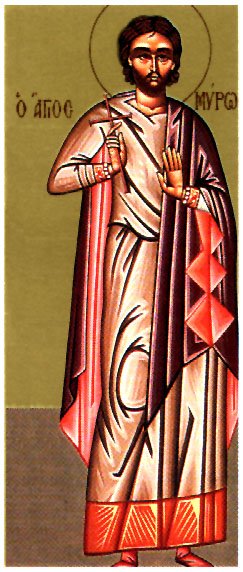
Your holy martyr Myron, O Lord, / through his suffering has received an incorruptible crown from You, our God. / For having Your strength, he laid low his adversaries, / and shattered the powerless boldness of demons. / Through his intercessions, save our souls!
Kontakion - Tone 2
You appeared as a bright star announcing Christ with your radiance, / which is repulsive to this world, O Martyr Myron; / extinguishing the allure of false gods, / you enlighten the faithful, / always interceding for us all.
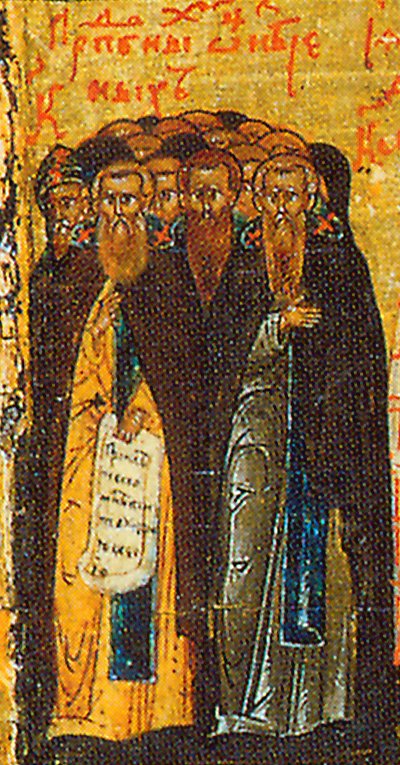
Holy Fathers Slain at St Sabbas Monastery
Saints John, Sergius, Patrick and others were slain in the Monastery of Saint Savva. During the VIII century the area around Jerusalem was subjected to frequent incursions by the Saracens. The monastery of Saint Chariton was devastated and fell into ruin. Twice the Saracens tried to plunder the Lavra of Saint Savva the Sanctified, but God’s Providence protected the monastery. B
Saints John, Sergius, Patrick and others were slain in the Monastery of Saint Savva. During the VIII century the area around Jerusalem was subjected to frequent incursions by the Saracens. The monastery of Saint Chariton was devastated and fell into ruin. Twice the Saracens tried to plunder the Lavra of Saint Savva the Sanctified, but God’s Providence protected the monastery. But the third time the Saracens came to plunder the monastery the monks would have been able to escape the barbarians by going to Jerusalem, but they decided not to forsake the place where they had sought salvation for so many years.
On March 13, the Saracens broke into the monastery and demanded all the valuables. The monks told them that there was nothing in the monastery but a meager supply of food and old clothing. Then the Saracens began shooting arrows at the monks.
Thirteen men were killed and many wounded, and monastery cells were set afire. The Saracens intended to torch the monastery church, but seeing a throng of people in the distance, they mistook this for an army sent from Jerusalem. The Saracens managed to get away, carrying off the little they were able to plunder. After the enemy fled, Father Thomas, an experienced physician, began to help those who remained alive.
On Great Thursday, March 20, the Saracens again descended upon the Lavra with a larger force and started to beat the monks. The survivors were driven into the church, where they were tortured in order to force them to reveal where any treasure might be hidden. The monastery was surrounded, so no one could save himself by fleeing. The barbarians seized Saint John, a young monk, who had cared for vagrants. They beat him savagely, then they cut the sinews of his hands and feet and dragged him over stones by his feet, which tore the skin from the martyr’s back.
The keeper of the Church vessels, Saint Sergius, hid them and attempted to flee, but he was captured and beheaded. Several of the monks nevertheless managed to hide themselves outside the monastery in a cave, but they were spotted by a sentry on a hill, and they ordered everyone to come out. Inside the cave Saint Patrick whispered to the brethren with him, “Fear not, I will go alone and meet my death. Meanwhile, sit and pray.”
The Saracens asked whether there was anyone else in the cave, and Patrick said that he was alone. They led him to the Lavra, where the captives awaited their fate. The Saracens demanded of them a ransom of 4,000 gold pieces and the sacred vessels. The monks were not able to give such a ransom. Then they led them into the cave of Saint Savva inside the monastery walls. They lit a fire on which they piled up dung in front of the entrance to the cave, hoping to suffocate the monks with the poisonous fumes. Eighteen men perished in the cave, among whom were Saints John and Patrick. The Saracens continued to torture those who were still alive, but got nothing out of them. Finally, they left the monastery.
Later, on the night of Great Friday, the monks hidden in the hills returned to the Lavra, they took up the bodies of the murdered Fathers to the church and buried them there.
The barbarians who plundered the monastery were punished by God. They were stricken with a sudden illness, and they all perished. Their bodies were devoured by wild beasts.
The Saints commemorated today should not be confused with other martyrs of the Saint Savva Lavra, who suffered in 610, and are commemorated on May 16. The two dates reflect separate attacks on the monastery at different times. History tells us that barbarians raided Saint Savva Lavra on several occasions.
Troparion - Tone 4
As chosen and holy lambs of the Savior, / you were gathered together in wise Savva’s flock from many lands. / You were put to death by the cruelty of the barbarians / and you departed joyfully to the heavenly fold. / As righteous athletes you now pray for our souls.
Kontakion - Tone 4
You openly disdained the pleasure of earthly and corruptible things, / choosing instead a life in the desert. / You despised the beautiful things of this world / together with the food that passes away. / Therefore, all-blessed ones, you were counted worthy of the Kingdom of heaven, / where you rejoice with the choirs of martyrs and ascetics. / As we honor your memory, / we earnestly cry out to you: / deliver us, O Fathers, from tribulations!
St Photine the Samaritan Woman (66)
See her commemoration on February 26.
St Theodore Tyro (the Recruit), Great-martyr
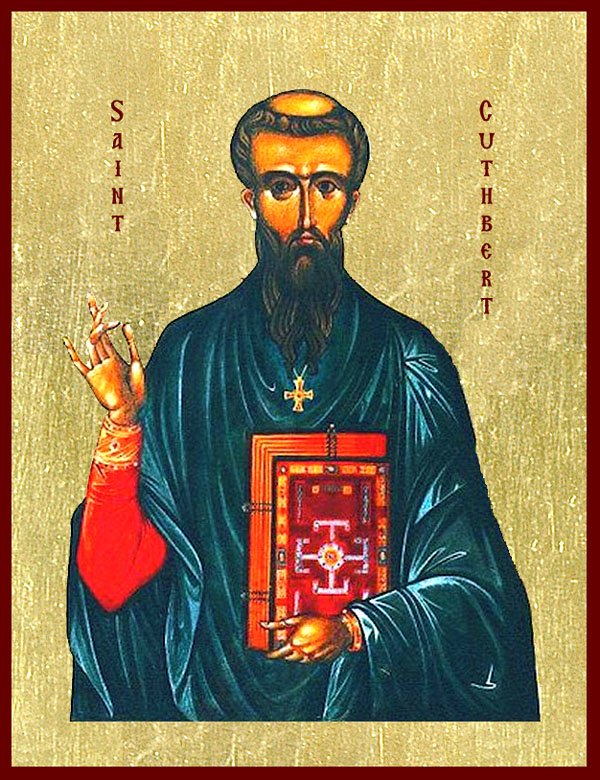
St Cuthbert the Wonderworker, Bishop of Lindisfarne (687)
Saint Cuthbert, the wonderworker of Britain, was born in Northumbria around 634. Very little information has come down to us about Cuthbert’s early life, but there is a remarkable story of him when he was eight.
As a child, Cuthbert enjoyed games and playing with other children. He could beat anyone his own age, and even some who were older, at running, jumping, wrestling, and other exercises. O
Saint Cuthbert, the wonderworker of Britain, was born in Northumbria around 634. Very little information has come down to us about Cuthbert’s early life, but there is a remarkable story of him when he was eight.
As a child, Cuthbert enjoyed games and playing with other children. He could beat anyone his own age, and even some who were older, at running, jumping, wrestling, and other exercises. One day he and some other boys were amusing themselves by standing on their heads with their feet up in the air. A little boy who was about three years old chided Cuthbert for his inappropriate behavior. “Be sensible,” he said, “and give up these foolish pranks.”
Cuthbert and the others ignored him, but the boy began to weep so piteously that it was impossible to quiet him. When they asked him what the matter was, he shouted, “O holy bishop and priest Cuthbert, these unseemly stunts in order to show off your athletic ability do not become you or the dignity of your office.” Cuthbert immediately stopped what he was doing and attempted to comfort the boy.
On the way home, he pondered the meaning of those strange words. From that time forward, Cuthbert became more thoughtful and serious.This incident reveals Saint Cuthbert as God’s chosen vessel (2 Tim. 2:20-21), just like Samuel, David, Jeremiah, John the Baptist, and others who, from an early age, were destined to serve the Lord.
On another occasion, he was suffering from an injured knee. It was quite swollen and the muscles were so contracted that he limped and could scarcely place his foot on the ground. One day a handsome stranger of noble bearing, dressed in white, rode up on horseback to the place where Cuthbert was sitting in the sun beside the house. The stranger asked courteously if the boy would receive him as a guest. Cuthbert said that if only he were not hampered by his injuries, he would not be slow to offer hospitality to his guest.
The man got down from his horse and examined Cuthbert’s knee, advising him to cook up some wheat flour with milk, and to spread the warm paste on his sore knee. After the stranger had gone, it occurred to him that the man was really an angel who had been sent by God. A few days later, he was completely well. From that time forward, as Saint Cuthbert revealed in later years to a few trusted friends, he always received help from angels whenever he prayed to God in desperate situations.
In his prose Life of Saint Cuthbert, Saint Bede of Jarrow (May 27) reminds skeptics that it is not unknown for an angel to appear on horseback, citing 2 Maccabees 11:6-10 and 4 Maccabees 4:10.
While the saint was still young, he would tend his master’s sheep in the Lammermuir hills south of Edinburgh near the River Leader. One night while he was praying, he had a vision of angels taking the soul of Saint Aidan (August 31) to heaven in a fiery sphere. Cuthbert awakened the other shepherds and told them what he had seen. He said that this must have been the soul of a holy bishop or some other great person. A few days later they learned that Bishop Aidan of Lindisfarne had reposed at the very hour that Cuthbert had seen his vision.
As an adult, Saint Cuthbert decided to give up his life in the world and advanced to better things. He entered the monastery at Melrose in the valley of the Tweed, where he was received by the abbot Saint Boisil (February 23). Saint Cuthbert was accepted into the community and devoted himself to serving God. His fasting and vigils were so extraordinary that the other monks marveled at him. He often spent entire nights in prayer, and would not eat anything for days at a time.
Who can describe his angelic life, his purity or his virtue? Much of this is known only to God, for Saint Cuthbert labored in secret in order to avoid the praise of men.
A few years later, Saint Eata (October 26) chose some monks of Melrose to live at the new monastery at Ripon. Among them was Saint Cuthbert. Both Eata and Cuthbert were expelled from Ripon and sent back to Melrose in 661 because they (and some other monks) refused to follow the Roman calculation for the date of Pascha. The Celtic Church, which followed a different, older reckoning, resisted Roman practices for a long time. However, in 664 the Synod of Whitby determined that the Roman customs were superior to those of the Celtic Church, and should be adopted by all. Saint Bede discusses this question in his HISTORY OF THE ENGLISH CHURCH AND PEOPLE (Book III, 25).
Saint Cuthbert was chosen to be abbot of Melrose after the death of Saint Boisil, guiding the brethren by his words and by his example. He made journeys throughout the surrounding area to encourage Christians and to preach the Gospel to those who had never heard it. Sometimes he would be away from the monastery for a month at a time, teaching and preaching. He also worked many miracles, healing the sick and freeing those who were possessed by demons.
In 664, Cuthbert went with Saint Eata to Lindisfarne, and extended his territory to include the inhabitants of Northumberland and Durham. Soon Saint Eata appointed Cuthbert as prior of Lindisfarne (Holy Island). At that time both monasteries were under the jurisdiction of Saint Eata. While at Lindisfarne, Saint Cuthbert continued his habit of visiting the common people in order to inspire them to seek the Kingdom of Heaven.
Though some of the monks prefered their negligent way of life to the monastic rule, Saint Cuthbert gradually brought them around to a better state of mind. At first he had to endure many arguments and insults, but eventually he brought them to obedience through his patience and gentle admonition. He had a great thirst for righteousness, and so he did not hesitate to correct those who did wrong. However, his gentleness made him quick to forgive those who repented. When people confessed to him, he often wept in sympathy with their weakness. He also showed them how to make up for their sins by doing their penances himself.
Saint Cuthbert was a true father to his monks, but his soul longed for complete solitude, so he went to live on a small island (Saint Cuthbert’s Isle), a short distance from Lindisfarne. After gaining victory over the demons through prayer and fasting, the saint decided to move even farther away from his fellow men. In 676, he retired to Inner Farne, an even more remote location. Saint Cuthbert built a small cell which could not be seen from the mainland. A few yards away, he built a guest house for visitors from Lindisfarne. Here he remained for nearly nine years.
A synod at Twyford, with the holy Archbishop Theodore (September 19) presiding, elected Cuthbert Bishop of Hexham in 684. Letters and messengers were sent to inform him of the synod’s decision, but he refused to leave his solitude. King Ecgfrith and Bishop Trumwine (February 10) went to him in person, entreating him in Christ’s name to accept. At last, Saint Cuthbert came forth and went with them to the synod. With great reluctance, he submitted to the will of the synod and accepted the office of bishop. Almost immediately, he exchanged Sees with Saint Eata, and became Bishop of Lindisfarne while Saint Eata went to Hexham.
Bishop Cuthbert remained as humble as he had been before his consecration, avoiding finery and dressing in simple clothing. He fulfilled his office with dignity and graciousness, while continuing to live as a monk. His virtue and holiness of life only served to enhance the authority of his position.
His life as Bishop of Lindisfarne was quite similar to what it had been when he was prior of that monastery. He devoted himself to his flock, preaching and visiting people throughout his diocese, casting out demons, and healing all manner of diseases. He served as a bishop for only two years, however.
Once, Saint Cuthbert was invited to Carlisle to ordain seven deacons to the holy priesthood. The holy priest Hereberht was living in solitude on an island in that vicinity. Hearing that his spiritual friend Cuthbert was staying at Carlisle, he went to see him in order to discuss spiritual matters with him. Saint Cuthbert told him that he should ask him whatever he needed to ask, for they would not see one another in this life again. When he heard that Saint Cuthbert would die soon, Hereberht fell at his feet and wept. By God’s dispensation, the two men would die on the very same day.
Though he was only in his early fifties, Saint Cuthbert felt the time of his death was approaching. He laid aside his archpastoral duties, retiring to the solitude of Inner Farne shortly after the Feast of the Lord’s Nativity in 686 to prepare himself. He was able to receive visitors from Lindisfarne at first, but gradually he weakened and was unable to walk down to the landing stage to greet them.
His last illness came upon him on February 27, 687. The pious priest Herefrith (later the abbot of Lindisfarne) came to visit him that morning. When he was ready to go back, he asked Saint Cuthbert for his blessing to return. The saint replied, “Do as you intend. Get into your boat and return safely home.”
Saint Cuthbert also gave Father Herefrith instructions for his burial. He asked to be laid to rest east of the cross that he himself had set up. He told him where to find a stone coffin hidden under the turf. “Put my body in it,” he said, “and wrap it in the cloth you will find there.” The cloth was a gift from Abbess Verca, but Saint Cuthbert thought it was too fine for him to wear. Out of affection for her, he kept it to be used as his winding sheet.
Father Herefrith wanted to send some of the brethren to look after the dying bishop, but Saint Cuthbert would not permit this. “Go now, and come back at the proper time.”
When Herefrith asked when that time might be, Saint Cuthbert replied, “When God wishes. He will show you.”
Herefrith returned to Lindisfarne and told the brethren to pray for the ailing Cuthbert. Storms prevented the brethren from returning to Inner Farne for five days. When they did land there, they found the saint sitting on the beach by the guest house. He told them he had come out so that when they arrived to take care of him they would not have to go to his cell to find him. He had been sitting there for five days and nights, eating nothing but onions. He also revealed that during those five days he had been more severely assailed by demons than ever before.
This time, Saint Cuthbert consented to have some of the brethren attend him. One of these was his personal servant, the priest Bede. He asked particularly for the monk Walhstod to remain with him to help Bede take care of him. Father Herefrith returned to Lindisfarne and informed the brethren of Cuthbert’s wish to be buried on his island.
Herefrith and the others, however, wanted to bury him in their church with proper honor. Therefore, Herefrith went back to Cuthbert and asked for permission to do this. Saint Cuthbert said that he wanted to be buried there at the site of his spiritual struggles, and he pointed out that the peace of the brethren would be disturbed by the number of pilgrims who would come to Lindisfarne to venerate his tomb.
Herefrith insisted that they would gladly endure the inconvenience out of love for Cuthbert. Finally, the bishop agreed to be buried in the church on Lindisfarne so the monks would always have him with them, and they would also be able to decide which outsiders would be allowed to visit his tomb.
Saint Cuthbert grew weaker and weaker, so the monks carried him back into his cell. No one had ever been inside, so they paused at the door and asked that at least one of them be permitted to see to his needs. Cuthbert asked for Wahlstod to come in with him. Now Wahlstod had suffered from dysentery for a long time. Even though he was sick, he agreed to care for Cuthbert. As soon as he touched the holy bishop, his illness left him. Although he was sick and dying, Saint Cuthbert healed his servant Wahlstod. Remarkably, the holy man’s spiritual power was not impaired by his bodily weakness. About three o’clock in the afternoon Wahlstod came out and announced that the bishop wanted them to come inside.
Father Herefrith asked Cuthbert if he had any final instructions for the monks. He spoke of peace and harmony, warning them to be on guard against those who fostered pride and discord. Although he encouraged them to welcome visitors and offer them hospitality, he also admonished them to have no dealings with heretics or with those who lived evil lives. He told them to learn the teachings of the Fathers and put them into practice, and to adhere to the monastic rule which he had taught them.
After passing the evening in prayer, Saint Cuthbert sat up and received Holy Communion from Father Herefrith. He surrendered his holy soul to God on March 20, 687at the time appointed for the night office
Eleven years later, Saint Cuthbert’s tomb was opened and his relics were found to be incorrupt. In the ninth century, the relics were moved to Norham, then back to Lindisfarne. Because of the threat of Viking raids, Saint Cuthbert’s body was moved from place to place for seven years so that it would not be destroyed by the invaders.
Saint Cuthbert’s relics were moved to Chester-le-Street in 995. They were moved again because of another Viking invasion, and then brought to Durham for safekeeping. Around 1020 the relics of Saints Bede (May 27), Aidan (August 31), Boisil (February 23), Aebbe (August 25), Eadberht (May 6), Aethilwald (February 12), and other saints associated with Saint Cuthbert were also brought to Durham.
The tomb was opened again on August 24, 1104, and the incorrupt and fragrant relics were placed in the newly-completed cathedral. Relics of the other saints mentioned above were placed in various places around the church. The head of Saint Oswald of Northumbria (August 5), however, was left in Saint Cuthbert’s coffin.
In 1537 three commissioners of King Henry VIII came to plunder the tomb and desecrate the relics. Saint Cuthbert’s body was still incorrupt, and was later reburied. The tomb was opened again in 1827. A pile of bones was found in the outer casket, probably the relics of the various saints which had been collected seven centuries before, then replaced after the Protestant commissioners had completed their work.
In the inner casket was a skeleton wrapped in a linen shroud and five robes. In the vestments a gold and garnet cross was found, probably Saint Cuthbert’s pectoral cross. Also found were an ivory comb, a portable wood and silver altar, a stole (epitrachilion), pieces of a carved wooden coffin, and other items. These may be seen today in the Dean and Chapter library of Durham Cathedral. The tomb was opened again in 1899, and a scientific examination determined that the bones were those of a man in his fifties, Cuthbert’s age when he died.
Today Saint Cuthbert’s relics (and the head of Saint Oswald) lie beneath a simple stone slab on the site of the original medieval shrine in the Chapel of the Nine Altars, and Saint Bede’s relics rest at the other end of the cathedral. The relics and the treasures in the Library make Durham an appropriate place for pilgrims to visit.
Troparion - Tone 3
While still in your youth, you laid aside all worldly cares, / and took up the sweet yoke of Christ, / and you were shown forth in truth to be nobly radiant in the grace of the Holy Spirit. / Therefore, God established you as a rule of faith and shepherd of His radiant flock, / Godly-minded Cuthbert, converser with angels and intercessor for men.
Kontakion - Tone 1
Having surpassed your brethren in prayers, fasting and vigils, / you were found worthy to entertain an angel in the form of a pilgrim; / and having shown forth with humility as a bright lamp set on high, / you received the gift of working wonders. / And now as you dwell in the Heavenly Kingdom, our righteous Father Cuthbert, / intercede with Christ our God that our souls may be saved.
Scripture Readings
☩Epistle
Hebrews 1:1-12
1
God, who at sundry times and in divers manners spake in time past unto the fathers by the prophets,
2
Hath in these last days spoken unto us by his Son, whom he hath appointed heir of all things, by whom also he made the worlds;
3
Who being the brightness of his glory, and the express image of his person, and upholding all things by the word of his power, when he had by himself purged our sins, sat down on the right hand of the Majesty on high;
4
Being made so much better than the angels, as he hath by inheritance obtained a more excellent name than they.
5
For unto which of the angels said he at any time, Thou art my Son, this day have I begotten thee? And again, I will be to him a Father, and he shall be to me a Son?
6
And again, when he bringeth in the firstbegotten into the world, he saith, And let all the angels of God worship him.
7
And of the angels he saith, Who maketh his angels spirits, and his ministers a flame of fire.
8
But unto the Son he saith, Thy throne, O God, is for ever and ever: a sceptre of righteousness is the sceptre of thy kingdom.
9
Thou hast loved righteousness, and hated iniquity; therefore God, even thy God, hath anointed thee with the oil of gladness above thy fellows.
10
And, Thou, Lord, in the beginning hast laid the foundation of the earth; and the heavens are the works of thine hands:
11
They shall perish; but thou remainest; and they all shall wax old as doth a garment;
12
And as a vesture shalt thou fold them up, and they shall be changed: but thou art the same, and thy years shall not fail.
☩Gospel
Mark 2:23-3:5
23
And it came to pass, that he went through the corn fields on the sabbath day; and his disciples began, as they went, to pluck the ears of corn.
24
And the Pharisees said unto him, Behold, why do they on the sabbath day that which is not lawful?
25
And he said unto them, Have ye never read what David did, when he had need, and was an hungred, he, and they that were with him?
26
How he went into the house of God in the days of Abiathar the high priest, and did eat the shewbread, which is not lawful to eat but for the priests, and gave also to them which were with him?
27
And he said unto them, The sabbath was made for man, and not man for the sabbath:
28
Therefore the Son of man is Lord also of the sabbath.
1
And he entered again into the synagogue; and there was a man there which had a withered hand.
2
And they watched him, whether he would heal him on the sabbath day; that they might accuse him.
3
And he saith unto the man which had the withered hand, Stand forth.
4
And he saith unto them, Is it lawful to do good on the sabbath days, or to do evil? to save life, or to kill? But they held their peace.
5
And when he had looked round about on them with anger, being grieved for the hardness of their hearts, he saith unto the man, Stretch forth thine hand. And he stretched it out: and his hand was restored whole as the other.
 Meat
Abstain
 Fish
Abstain
 Dairy
Abstain
 Oil
Allowed
 Wine
Allowed