Fasting Rules
 Meat
Allowed
 Fish
Allowed
 Dairy
Allowed
 Oil
Allowed
 Wine
Allowed
Saints & Commemorations
St Leo, Bishop of Catania
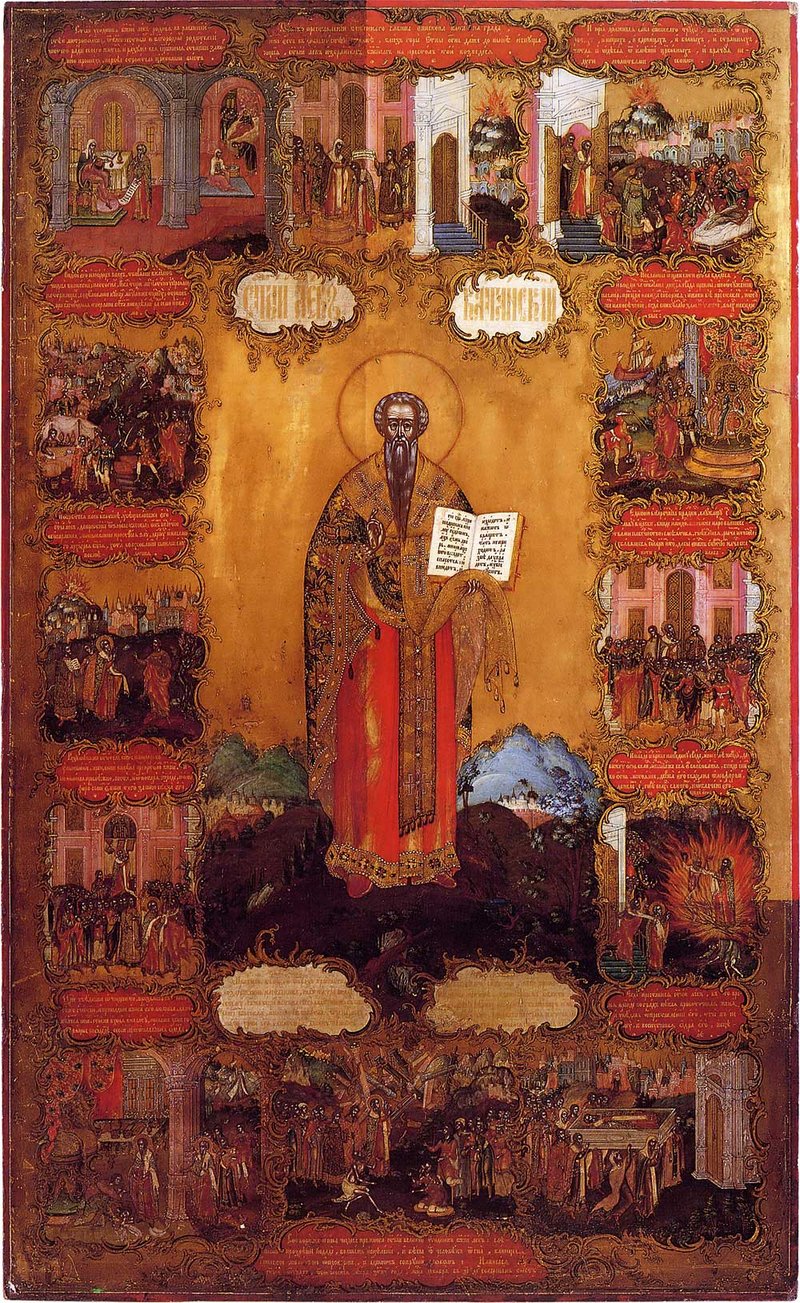
Saint Leo was born in Ravenna, Italy, of pious and noble parents. He was famed for his benevolence and charity, as well as his Christian love for the poor and wanderers. After completing his studies, he was ordained as a priest at Ravenna, and later, because of his purity and his most spiritual life, he was consecrated as Bishop of Catania in Sicily.
Saint Leo was born in Ravenna, Italy, of pious and noble parents. He was famed for his benevolence and charity, as well as his Christian love for the poor and wanderers. After completing his studies, he was ordained as a priest at Ravenna, and later, because of his purity and his most spiritual life, he was consecrated as Bishop of Catania in Sicily. He became the protector of orphans and widows, teaching and shepherding his flock.
The Saint was also distinguished for his struggles against heretics, whom he defeated and shamed, not only by his words, but also through his writings. The Lord honored him with the charisms of healing people from various diseases, and of working miracles.
During Saint Leo's episcopate, there was a sorcerer named Heliódoros who lived in Catania and deceived people with his fraudulent miracles. He was once a Christian, but then he denied the Savior and became a servant of the devil. Saint Leo urged Heliódoros to refrain from his evil deeds and return to God, but all in vain. One day Heliódoros audaciously entered the church where the bishop was performing the Divine Services, and tried to create a disturbance, sowing confusion and temptation with his sorcery.
Seeing the people beset by demons under the sorcerer's spell, Saint Leo knew that the time for meek exhortation had passed. He came out of the altar and tied his omophorion around the sorcerer's neck, leading him out of the church and into the city square. There he forced Heliódoros to confess all his wicked deeds. Then he commanded that a fire be lit, and jumped into the flames with the sorcerer. There they stood until Heliódoros was consumed by the fire. Saint Leo, by God's grace, remained unharmed. This miracle brought the Hierarch great renown during his lifetime, therefore, the Saint was invited to visit Constantinople by Emperors Leo IV (775 - 780) and Constantine VI (780 - 798), where he received many honors. Saint Leo reposed peacefully in 785.
After his death, a woman with an issue of blood received healing at his grave. The Saint's body was placed in the church of the holy Martyr Lucy (December 13), which he himself had built. Later on, his relics were transferred to the church of Saint Martin, the Bishop of Tours (November 11) in Rome.
Troparion - Tone 1
You were shown forth as a resplendent priest, / a teacher of godliness and a wonderworker, blessed hierarch Leo; / by the light of heavenly virtue you were enriched with the power of the Spirit, / and heal the souls and bodies of those who hasten to you. / Glory to Christ who has glorified you! / Glory to Him who has crowned you! / Glory to Him who through you works healing for all!
Kontakion - Tone 2
With hymns of praise let us crown Leo, / who was consecrated to the Lord from early childhood; / he received grace while still a babe in swaddling clothes. / He is a brightly shining star in the Church: / its valiant defender and firm support!
St Bessarion the Great, wonder-worker of Egypt (466)
“An Egyptian by birth, Abba Bessarion was initiated into the angelic life by Saint Anthony the Great. He later became a disciple of Saint Macarius, the founder of Scetis (19 Jan.), and then set out to lead the life of a wanderer, borne hither and thither by Providence like a bird by the wind. All his wealth lay in the Gospel, which he always had in his hand. L
“An Egyptian by birth, Abba Bessarion was initiated into the angelic life by Saint Anthony the Great. He later became a disciple of Saint Macarius, the founder of Scetis (19 Jan.), and then set out to lead the life of a wanderer, borne hither and thither by Providence like a bird by the wind. All his wealth lay in the Gospel, which he always had in his hand. Living in the open air, he patiently endured all weathers, untroubled by care for a dwelling or for clothing. Fortified by the strength of the faith, he thus remained untouched by all the passions of the flesh.
“On coming to a monastery where the brethren led the common life, he would sit weeping at the gate. A brother once offered him hospitality and asked why he was distressed. ‘I cannot live under a roof, until I have regained the wealth of my house,’ he replied, meaning the heavenly inheritance lost since Adam. ‘I am afflicted, in danger of death every day, and without rest because of my huge misfortunes, which oblige me ever to travel on in order to finish my course.’
“He wandered for forty years without ever lying down to sleep, and he spent all of forty days and forty nights standing wide awake in a thorn bush. One winter’s day, he was walking through a village when he came upon a dead man. Without hesitation, he took off his own coat and covered the body. A little further on, he gave his tunic to a poor man who was shivering in the cold. An army officer, who happened to be passing, saw the naked ascetic and wanted to know who had stripped him of his clothing. ‘He did!’ replied Bessarion, holding up the Gospel Book. On another occasion, he met with a poor man and, having nothing to give him in alms, he hurried to the market in order to sell his Gospel Book. On his disciple’s asking him where the Book was, he replied cheerfully, ‘I have sold it in obedience to the words which I never cease to hear: Go, sell what you possess and give to the poor‘ (Matt. 19:21).
“Through this evangelic way of life he became a chosen vessel of Grace, and God wrought many miracles through him. One day, for example, he made sea water sweet through the sign of the Cross, to quench his disciple’s thirst. When the latter wanted to keep some for the remainder of the journey, he prevented him, saying, ‘God is here, God is everywhere!’ At another time, having stood for two weeks in prayer with hands raised to heaven, he brought about rain enough to fill a thirsty brother’s coat. Then there was the time when he stopped the sun from setting until he reached the cell of an elder whom he wished to meet; and the time when he walked across the waters of a river. Through these and many other wonders wrought by the Saint, God showed, as He did with Moses, Joshua and Elias, that He grants His servants mastery even over natural phenomena. Through the power of Christ, he raised a paralytic, drove out demons and showed himself truly to be a ‘god’ upon the earth.
“When, having reached his goal, he was at the point of regaining that dwelling in heaven which he had sought throughout his wanderings, he said to those about him, ‘The monk ought, like the cherubim, to be all eye.’
“In answer to a brother who asked what a monk living in community ought to do, he replied: ‘Keep silence and do not measure yourself.’ Indeed, this is how even in the midst of people one can obtain the grace of the great anchorites.” (Synaxarion)
Thirty-four Holy Martyrs of the Monastery of Valaam (1578)
In the course of its centuries-old history, Valaam Monastery, located near the border of Great Novgorod with Sweden, was repeatedly ravaged by the Swedes. The latter were attracted both by a desire for profit and by a desire to plant the Latin faith in the surrounding lands.
Under King Gustav Vasa (1523-1560), the Reformation took place in Sweden.
In the course of its centuries-old history, Valaam Monastery, located near the border of Great Novgorod with Sweden, was repeatedly ravaged by the Swedes. The latter were attracted both by a desire for profit and by a desire to plant the Latin faith in the surrounding lands.
Under King Gustav Vasa (1523-1560), the Reformation took place in Sweden. During the reign of his son John III, a military detachment of Lutheran converts, who, according to St. Ignatius (Brianchaninov), " still breathed a fanatical predilection for their newborn faith," pursued the Orthodox King, crossed the ice from the mainland to the island and attacked the Monastery. February 20, 1578 " 18 old men and 16 novices were martyred for their steadfastness in the Orthodox Faith." Their names with the note "beaten by the Germans on Valaam elders and servants" were entered into the Synodikon, which later ended up in Vasiliev Monastery: Hieromonk Titus, Schema-monk Tikhon, Monk Gelasios, Monk Sergius, Monk Barlaam, Monk Savva, Monk Konon, Monk Sylvester, Monk Cyprian, Monk Pimen, Monk John, Monk Samon, Monk Jonah, Monk David, Monk Cornelius, Monk Niphon, Monk Athanasios, Monk Serapion, Monk Barlaam, the novices Athanasios, Anthony, Luke, Leóntios, Thomas, Dionysios, Philip, Ignatius, Basil, Pakhomios, Basil, Theophilos, John, Theodore, and John.
According to legend, in the XIX century, one of the Valaam monks near the Hermitage of Igoumen Nazarius was vouchsafed a vision of some unknown black-robed monks: "they marched in two rows from a green grove flooded with sunlight and sang the ancient Znamenny funeral hymns. They walked with their hands folded on their breasts, but their appearance was bright, and their eyes revealed an unspeakable meekness. Only when the procession approached the monk did he see that all the black robes were sprinkled with blood and covered with wounds. Where they passed, the grass was not bent. They disappeared just as they had appeared, into the green thicket, and the quiet echoes of the funeral hymns were in the air for a long time."
With the blessing of Igoumen Damascene, every year on February 20, the day of the martyrdom of the 34 monks, Valaam Monastery served the Divine Liturgy "for their eternal rest," and the cathedral panikhida was also sung.
At the Jubilee Council of Bishops of the Russian Orthodox Church, held on August 13-16, 2000, the 34 Monastic Martyrs were canonized for Church-wide veneration.
Troparion - Tone 4
O God of our Fathers, / ever dealing with us according to Your compassion, take not Your mercy from us, / but direct our lives in peace / through the prayers of Your Monastic Martyrs.
Kontakion - Tone 2
Passing unharmed through a multitude of storms, / and receiving the gift of miracles, / you drowned your bodiless Enemies in the streams of your tears, / O Divinely-wise Monastic Martyrs; / now, having received the gift of miracles, / pray unceasingly for all of us.
Scripture Readings
☩Epistle
2 Timothy 2:11-19
11
It is a faithful saying: For if we be dead with him, we shall also live with him:
12
If we suffer, we shall also reign with him: if we deny him, he also will deny us:
13
If we believe not, yet he abideth faithful: he cannot deny himself.
14
Of these things put them in remembrance, charging them before the Lord that they strive not about words to no profit, but to the subverting of the hearers.
15
Study to shew thyself approved unto God, a workman that needeth not to be ashamed, rightly dividing the word of truth.
16
But shun profane and vain babblings: for they will increase unto more ungodliness.
17
And their word will eat as doth a canker: of whom is Hymeneus and Philetus;
18
Who concerning the truth have erred, saying that the resurrection is past already; and overthrow the faith of some.
19
Nevertheless the foundation of God standeth sure, having this seal, The Lord knoweth them that are his. And, Let every one that nameth the name of Christ depart from iniquity.
☩Gospel
Luke 18:2-8
2
Saying, There was in a city a judge, which feared not God, neither regarded man:
3
And there was a widow in that city; and she came unto him, saying, Avenge me of mine adversary.
4
And he would not for a while: but afterward he said within himself, Though I fear not God, nor regard man;
5
Yet because this widow troubleth me, I will avenge her, lest by her continual coming she weary me.
6
And the Lord said, Hear what the unjust judge saith.
7
And shall not God avenge his own elect, which cry day and night unto him, though he bear long with them?
8
I tell you that he will avenge them speedily. Nevertheless when the Son of man cometh, shall he find faith on the earth?
Liturgical data sourced from OCA.org and orthocal.info