Fasting Rules
 Meat
Allowed
 Fish
Allowed
 Dairy
Allowed
 Oil
Allowed
 Wine
Allowed
Saints & Commemorations
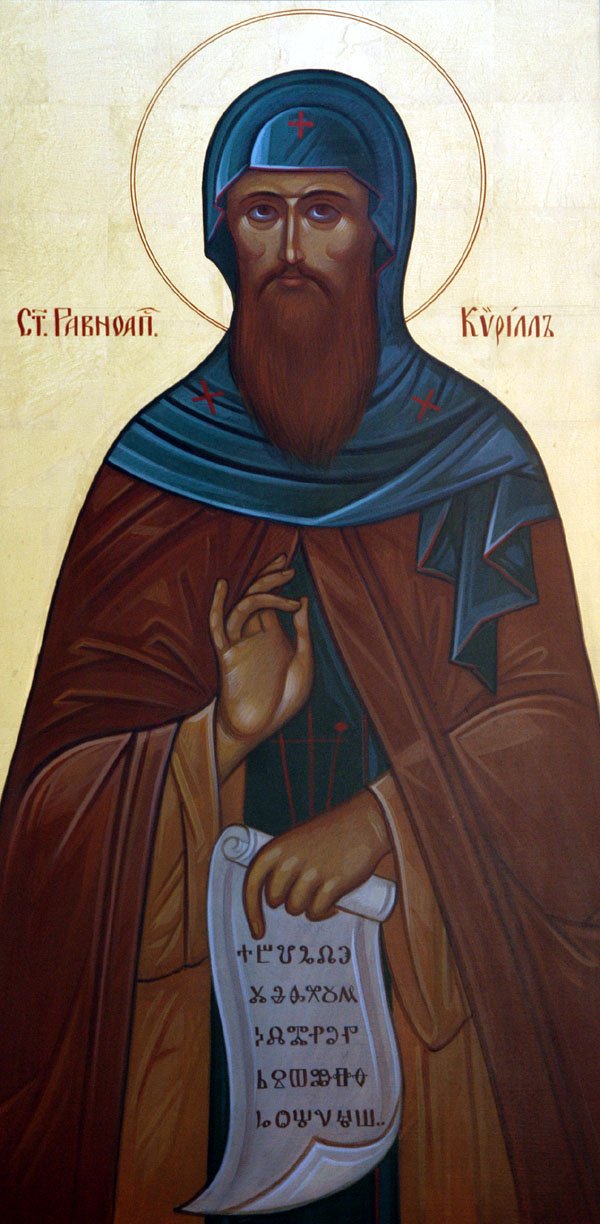
St Cyril, Teacher of the Slavs
Saint Cyril Equal of the Apostles, Teacher of the Slavs (Constantine in the schema), and his older brother Methodius (April 6), were Slavs, born in Macedonia in the city of Thessalonica.
Saint Cyril received the finest of educations, and from the age of fourteen he was raised with the son of the emperor.
Saint Cyril Equal of the Apostles, Teacher of the Slavs (Constantine in the schema), and his older brother Methodius (April 6), were Slavs, born in Macedonia in the city of Thessalonica.
Saint Cyril received the finest of educations, and from the age of fourteen he was raised with the son of the emperor. Later, he was ordained as a priest. Upon his return to Constantinople, he worked as a librarian of the cathedral church, and as a professor of philosophy. Saint Cyril successfully held debates with iconoclast heretics and with Moslems.
Yearning for solitude, he went to Mount Olympos to his older brother Methodius, but his solitude lasted only a short while. Both brothers were sent by the emperor Michael on a missionary journey to preach Christianity to the Khazars in the year 857. Along the way they stopped at Cherson and discovered the relics of the Hieromartyr Clement of Rome (November 25).
Arriving at the territory of the Khazars, the holy brothers spoke with them about the Christian Faith. Persuaded by the preaching of Saint Cyril, the Khazar prince together with all his people accepted Christianity. The grateful prince wanted to reward the preachers with rich presents, but they refused this and instead asked the prince to free and send home with them all the Greek captives. Saint Cyril returned to Constantinople together with 200 such captives set free.
In the year 862 began the chief exploit of the holy brothers. At the request of Prince Rostislav, the emperor sent them to Moravia to preach Christianity in the Slavic language. Saints Cyril and Methodius by a revelation from God compiled a Slavonic alphabet and translated the Gospel, Epistles, the Psalter and many Service books into the Slavonic language. They introduced divine services in Slavonic.
The holy brothers were then summoned to Rome at the invitation of the Roman Pope. Pope Adrian received them with great honor, since they brought with them the relics of the Hieromartyr Clement. Sickly by nature and in poor health, Saint Cyril soon fell ill from his many labors, and after taking the schema, he died in the year 869 at the age of forty-two. Before his death, he expressed his wish for his brother to continue the Christian enlightenment of the Slavs. Saint Cyril was buried in the Roman church of Saint Clement, whose own relics also rest there, brought to Italy from Cherson by the Enlighteners of the Slavs.
Troparion - Tone 4
Wisdom was your sister from birth; / you loved her, O voice of God, as a pure virgin / who adorned your soul and mind as a precious jewel, / so revealing you, O blessed man, to be another Cyril: / Wise in name and understanding!
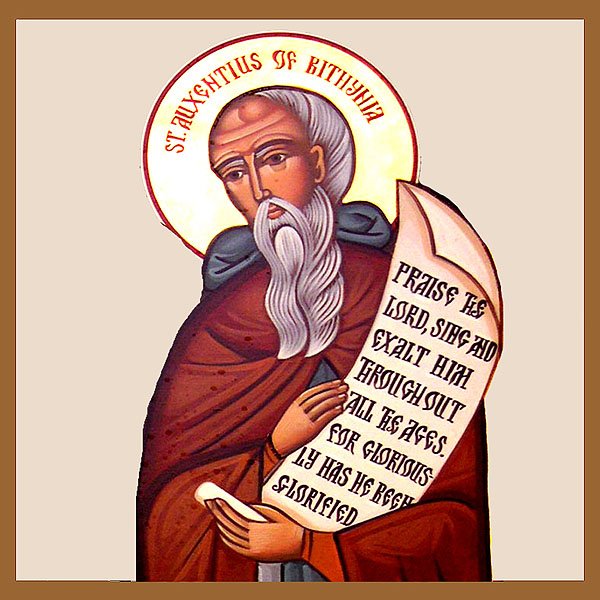
Our Holy Father Auxentius (470)
Saint Auxentius, by origin a Syrian, served at the court of the emperor Theodosius the Younger (418-450). He was known as a virtuous, learned and wise man, and he was, moreover, a friend of many of the pious men of his era.
Distressed by worldly vanity, Saint Auxentius was ordained to the holy priesthood, and then received monastic tonsure.
Saint Auxentius, by origin a Syrian, served at the court of the emperor Theodosius the Younger (418-450). He was known as a virtuous, learned and wise man, and he was, moreover, a friend of many of the pious men of his era.
Distressed by worldly vanity, Saint Auxentius was ordained to the holy priesthood, and then received monastic tonsure. After this he went to Bithynia and found a solitary place on Mount Oxia, not far from Chalcedon, and there he began the life of a hermit (this mountain was afterwards called Mt. Auxentius). The place of the saint’s efforts was discovered by shepherds seeking their lost sheep. They told others about him, and people began to come to him for healing. Saint Auxentius healed many of the sick and the infirm in the name of the Lord.
In the year 451 Saint Auxentius was invited to the Fourth Ecumenical Council at Chalcedon, where he denounced the Eutychian and Nestorian heresies. Familiar with Holy Scripture and learned in theology, Saint Auxentius easily bested those opponents who disputed with him. After the end of the Council, Saint Auxentius returned to his solitary cell on the mountain. With his spiritual sight he saw the repose of Saint Simeon the Stylite (459) from a great distance.
Saint Auxentius died about the year 470, leaving behind him disciples and many monasteries in the region of Bithynia. He was buried in the Monastery of Saint Hypatius at Rufiananas, Syria.
Troparion - Tone 1
O citizen of the desert and angel in the body, / you were shown to be a wonderworker, our God-bearing Father Auxentios; / through fasting, vigil, and prayer, you received heavenly gifts, / healing the sick, and the souls of those who run to you with faith. / Glory to Him Who strengthened you. / Glory to Him Who crowned you. / Glory to Him Who, through you, works healing for all!
Kontakion - Tone 6
Delighting in abstinence, O divinely wise one, / since you curbed the desires of the flesh, / your faith was seen to increase; / and you blossomed as a plant in the midst of Paradise, / most sacred Father Auxentios.
What Happened to Valentine's Day?
On February 14 the Roman church commemorates two Saints named Valentinus, both martyred in Rome at different times (one was a bishop in Italy). Both are also saints of the Orthodox Church, but are commemorated on July 30 and October 24. As for chocolates, flowers, cards, etc., the Encyclopedia Britannica says: “St Valentine’s day as a lovers’ festival… has no relation to the saint or to any incident in his life. These c
On February 14 the Roman church commemorates two Saints named Valentinus, both martyred in Rome at different times (one was a bishop in Italy). Both are also saints of the Orthodox Church, but are commemorated on July 30 and October 24. As for chocolates, flowers, cards, etc., the Encyclopedia Britannica says: “St Valentine’s day as a lovers’ festival… has no relation to the saint or to any incident in his life. These customs seem rather to be connected either with the pagan Roman festival of the Lupercalia which took place in the middle of February, or with the spring season in general.”
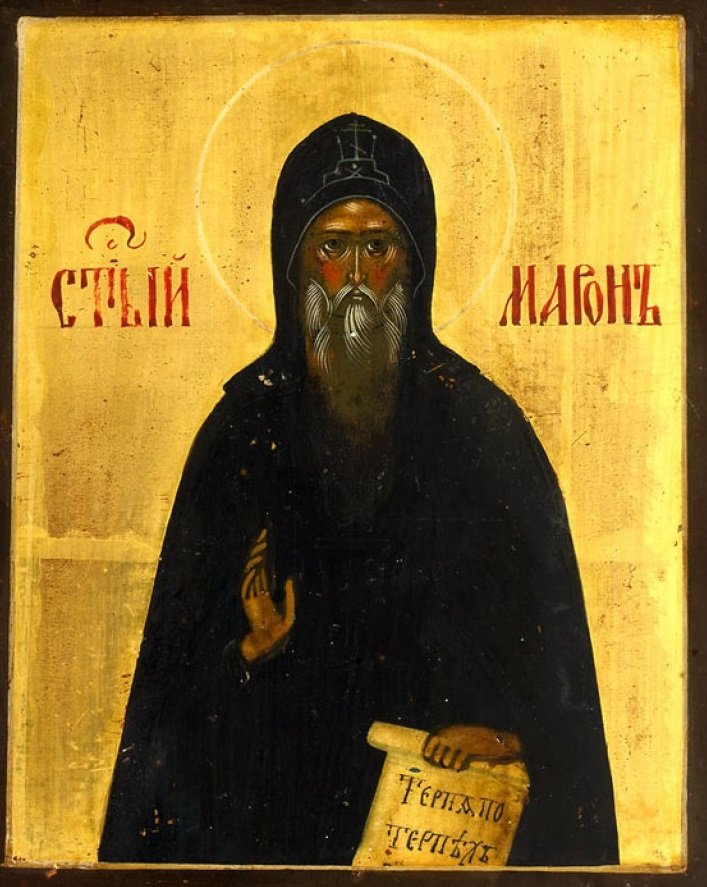
Venerable Maron the Hermit of Syria (ca. 423)
Saint Maron was born in the fourth century near the city of Cyrrhus in Syria. He spent almost all his time beneath the open sky in prayer, vigil, ascetical works and strict fasting. He obtained from God the gift of healing the sick and casting out demons. He counselled those who turned to him for advice to be temperate, to be concerned for their salvation, and to guard against avarice and anger.
Saint Maron was born in the fourth century near the city of Cyrrhus in Syria. He spent almost all his time beneath the open sky in prayer, vigil, ascetical works and strict fasting. He obtained from God the gift of healing the sick and casting out demons. He counselled those who turned to him for advice to be temperate, to be concerned for their salvation, and to guard against avarice and anger.
Saint Maron, a friend of Saint John Chrysostom, died before 423 at an advanced age.
Some of Saint Maron’s disciples were James the Hermit (November 26), Limnius (February 23), and Domnina (March 1). Saint Maron founded many monasteries around Cyrrhus, and converted a pagan temple near Antioch into a Christian church.
Troparion - Tone 8
By a flood of tears you made the desert fertile, / and your longing for God brought forth fruits in abundance. / By the radiance of miracles you illumined the whole universe! / O our holy father Maron, pray to Christ our God to save our souls!
Scripture Readings
☩Epistle
1 Timothy 4:9-15
9
This is a faithful saying and worthy of all acceptation.
10
For therefore we both labour and suffer reproach, because we trust in the living God, who is the Saviour of all men, specially of those that believe.
11
These things command and teach.
12
Let no man despise thy youth; but be thou an example of the believers, in word, in conversation, in charity, in spirit, in faith, in purity.
13
Till I come, give attendance to reading, to exhortation, to doctrine.
14
Neglect not the gift that is in thee, which was given thee by prophecy, with the laying on of the hands of the presbytery.
15
Meditate upon these things; give thyself wholly to them; that thy profiting may appear to all.
☩Gospel
Luke 19:1-10
1
And Jesus entered and passed through Jericho.
2
And, behold, there was a man named Zaccheus, which was the chief among the publicans, and he was rich.
3
And he sought to see Jesus who he was; and could not for the press, because he was little of stature.
4
And he ran before, and climbed up into a sycomore tree to see him: for he was to pass that way.
5
And when Jesus came to the place, he looked up, and saw him, and said unto him, Zaccheus, make haste, and come down; for to day I must abide at thy house.
6
And he made haste, and came down, and received him joyfully.
7
And when they saw it, they all murmured, saying, That he was gone to be guest with a man that is a sinner.
8
And Zaccheus stood, and said unto the Lord; Behold, Lord, the half of my goods I give to the poor; and if I have taken any thing from any man by false accusation, I restore him fourfold.
9
And Jesus said unto him, This day is salvation come to this house, forsomuch as he also is a son of Abraham.
10
For the Son of man is come to seek and to save that which was lost.
Liturgical data sourced from OCA.org and orthocal.info