Fasting Rules
 Meat
Allowed
 Fish
Allowed
 Dairy
Allowed
 Oil
Allowed
 Wine
Allowed
Saints & Commemorations
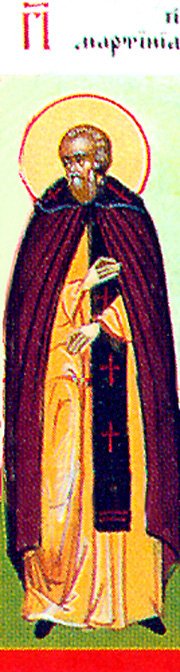
Ven. Martinian of Caesarea
Saint Martinian went to live in the wilderness at the age of eighteen, not far from the city of Caesarea in Palestine. For twenty-five years, he devoted himself to ascetic deeds and silence, and he was granted the gift of healing illnesses and casting out demons. However, the Enemy of the human race would not stop troubling the holy ascetic with various temptations.
Saint Martinian went to live in the wilderness at the age of eighteen, not far from the city of Caesarea in Palestine. For twenty-five years, he devoted himself to ascetic deeds and silence, and he was granted the gift of healing illnesses and casting out demons. However, the Enemy of the human race would not stop troubling the holy ascetic with various temptations.
One day a prostitute overheard some citizens of Caesarea speaking of Saint Martinian's virtuous life, so she asked them why they were amazed by it. She said that he went to live in the desert because he could not endure the temptations of the flesh in the city. Furthermore, she made a wager with them that she could topple this pillar of virtue with her beauty and seduce him.
She came to him one night, dressed in shabby clothes, pretending that she had lost her way in the storm, and asking for shelter. Reluctantly, the saint allowed her to enter his cell, because he did not wish to be the cause of her death. He went into the inner room of his cell, telling her she would have to leave in the morning. After chanting Psalms according to his Rule, he went to sleep on the floor, but he was disturbed by carnal thoughts. Meanwhile, the wicked guest opened the bag she had been carrying and changed into her beautiful clothes and adorned herself with jewels.
When morning came, Saint Martinian came out to send the woman away. Though he was tempted by the woman’s beauty, he was determined not to fall into sin. Lighting a fire, he stepped into it, saying, “You want me to burn with temptation, but I will not give in to it. Instead, I choose to burn in this fire in order to preserve my purity and to escape the unquenchable fires of Hell."
The woman was astonished at the lengths Saint Martinian was willing to go, and she realized how evil she was. She repented and asked the saint to guide her onto the way of salvation. He told her to go to Bethlehem, and enter the convent founded by Saint Paula (January 26). There she lived as a nun for twelve years in strict asceticism until her blessed repose. The woman’s name was Zoe.
After his burns healed, Saint Martinian went to an uninhabited rocky island, and lived on it under the open sky for several years, nourished by the provisions brought by a certain sailor from time to time. In return the monk wove baskets for him.
One day a ship was wrecked by a powerful storm, and a woman named Photina floated to the island on pieces of the wreckage Saint Martinian helped her to survive on the island. “Remain here,” he told her, “for I am leaving you bread and water, and in two months a boat will come and return you to the mainland."
Saint Martinian refused to stay on the island with the woman, believing that it would be better to drown than to burn with lust. He jumped into the sea and swam away, and a pair of dolphins carried him to dry land. Thereafter, Saint Martinian led the life of a wanderer. Later, he came to Athens and fell ill. Sensing the approach of death, he went into a church and lay upon the floor. God revealed to the Bishop of Athens who Saint Martinian was, and the hierarch buried his body with honor. This occurred around the year 422.
As for Saint Photina, she did not board the ship when it came to the island, electing to stay there by herself. She asked the captain of the ship to have his wife bring her men's clothing and some wool, promising to make clothes for his family. She also asked the woman to bring her bread and water in addition to the other supplies.
Saint Photina lived on the island for six years, and then she went to the Lord. Two months after her repose, the captain and his wife found her incorrupt relics and brought them to Caesarea in Palestine. He had a vision which revealed many details of Saint Photina's life, which he shared with the bishop. Then they buried her with great honor and reverence.
Troparion - Tone 8
You quenched the flames of passion, blessed Martinian, with abundant tears; / you calmed the waves of the sea and checked the assaults of wild beasts, saying: / “Almighty God, You are most glorious, for You have saved me from the fire and storm!”
Kontakion - Tone 2
Let us worthily praise with hymns the ever-venerable Martinian, / the tried ascetic who struggled for piety, / an honorable athlete by deliberate choice, / and a resolute citizen and inhabitant of the desert; / for he has trampled down the serpent.
Holy Apostles and Martyrs Priscilla and Aquila
Aquila and his wife Priscilla (or Prisca) were Jews from Pontus who settled in Rome, where they worked as tent-makers. When the Emperor Claudius expelled all Jews from Rome in 49-50, they moved to Corinth. (They may already have been Christians; at that time the Empire made no distinction between Christians and Jews.) In Corinth they hosted the Apostle Paul, who lived and worked with them for awhile (Acts 18:1-3).
Aquila and his wife Priscilla (or Prisca) were Jews from Pontus who settled in Rome, where they worked as tent-makers. When the Emperor Claudius expelled all Jews from Rome in 49-50, they moved to Corinth. (They may already have been Christians; at that time the Empire made no distinction between Christians and Jews.) In Corinth they hosted the Apostle Paul, who lived and worked with them for awhile (Acts 18:1-3). They worked diligently with the Apostle, traveled with him, and were considered worthy to bring Apollos (December 8) to a full knowledge of the Faith (Acts 18:26)
Priscilla and Aquila returned to Rome around 58, and later went to Ephesus; they were living there when St Paul asked his disciple Timothy, Bishop of Ephesus, to greet them (2 Tim. 4:19). It was probably in Ephesus that they were martyred by the pagans.
Eulogios, Patriarch of Alexandria
St Symeon the Myrrh-streamer, founder of the Chilandar Monastery (1200)
He was born in 1114. In the world, he ruled the kingdom of Serbia as Stephen Nemanja; after ruling wisely and mercifully for many years, he renounced all worldly wealth and glory in 1196 to become a monk. Traveling to the Holy Mountain, he took for his spiritual father his own son Sava, who had preceded him in renouncing royal honor for a life of prayer.
He was born in 1114. In the world, he ruled the kingdom of Serbia as Stephen Nemanja; after ruling wisely and mercifully for many years, he renounced all worldly wealth and glory in 1196 to become a monk. Traveling to the Holy Mountain, he took for his spiritual father his own son Sava, who had preceded him in renouncing royal honor for a life of prayer. Together Symeon (as he was named in monastic life) and his son founded Hilandar monastery. His wife Anna became a nun, taking the name Anastasia; she is also commemorated as a saint of the Church. After his repose, St Symeon’s relics exuded a fragrant and healing myrrh. Saint Sava brought his father’s holy relics back to Serbia. The Synaxarion says “From Saint Symeon’s empty tomb at Chilandar, a vine miraculously sprang up whose dried grape seeds are to this day sent all over the world as a blessing for childless married couples.”
Scripture Readings
☩Epistle
1 Thessalonians 5:14-23
14
Now we exhort you, brethren, warn them that are unruly, comfort the feebleminded, support the weak, be patient toward all men.
15
See that none render evil for evil unto any man; but ever follow that which is good, both among yourselves, and to all men.
16
Rejoice evermore.
17
Pray without ceasing.
18
In every thing give thanks: for this is the will of God in Christ Jesus concerning you.
19
Quench not the Spirit.
20
Despise not prophesyings.
21
Prove all things; hold fast that which is good.
22
Abstain from all appearance of evil.
23
And the very God of peace sanctify you wholly; and I pray God your whole spirit and soul and body be preserved blameless unto the coming of our Lord Jesus Christ.
☩Gospel
Luke 17:3-10
3
Take heed to yourselves: If thy brother trespass against thee, rebuke him; and if he repent, forgive him.
4
And if he trespass against thee seven times in a day, and seven times in a day turn again to thee, saying, I repent; thou shalt forgive him.
5
And the apostles said unto the Lord, Increase our faith.
6
And the Lord said, If ye had faith as a grain of mustard seed, ye might say unto this sycamine tree, Be thou plucked up by the root, and be thou planted in the sea; and it should obey you.
7
But which of you, having a servant plowing or feeding cattle, will say unto him by and by, when he is come from the field, Go and sit down to meat?
8
And will not rather say unto him, Make ready wherewith I may sup, and gird thyself, and serve me, till I have eaten and drunken; and afterward thou shalt eat and drink?
9
Doth he thank that servant because he did the things that were commanded him? I trow not.
10
So likewise ye, when ye shall have done all those things which are commanded you, say, We are unprofitable servants: we have done that which was our duty to do.
Liturgical data sourced from OCA.org and orthocal.info