Fasting Rules
 Meat
Allowed
 Fish
Allowed
 Dairy
Allowed
 Oil
Allowed
 Wine
Allowed
Saints & Commemorations
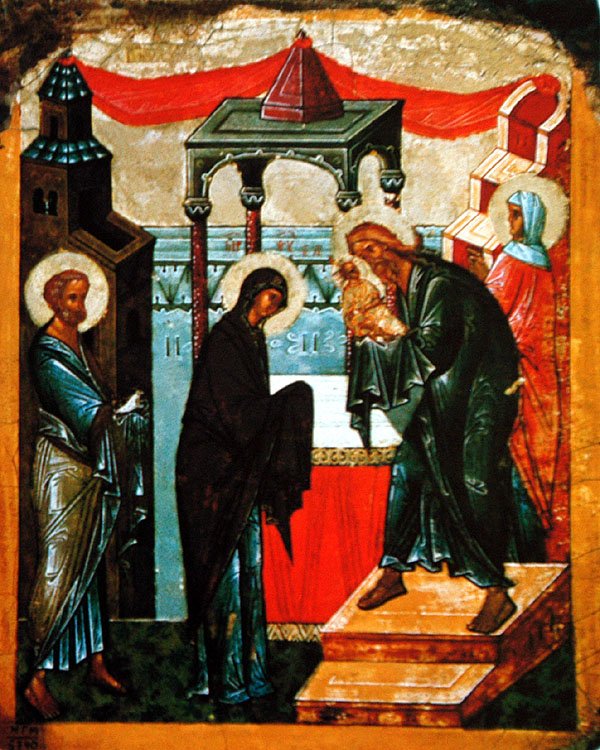
Leavetaking of Meeting
The Leavetaking of the Meeting of the Lord usually falls on February 9, but may be moved if the Feast falls during the period of the Triodion. In that case, the Typikon must be consulted for information on the Leavetaking.
Usually, the entire office of the Feast is repeated except for the Entrance, festal readings, and Litya at Vespers, and the Polyeleos and festal Gospel at Matins.
The Leavetaking of the Meeting of the Lord usually falls on February 9, but may be moved if the Feast falls during the period of the Triodion. In that case, the Typikon must be consulted for information on the Leavetaking.
Usually, the entire office of the Feast is repeated except for the Entrance, festal readings, and Litya at Vespers, and the Polyeleos and festal Gospel at Matins. The festal Antiphons are not sung at Liturgy, and the Epistle and Gospel of the day are read.
Troparion - Tone 1
Hail, Virgin Theotokos, full of grace; / for from you has shone forth the Sun of Righteousness, Christ our God, / giving light to those in darkness. / Be glad, O righteous Elder; / for you received in your arms the Redeemer of our souls, / Who bestows upon us the resurrection.
Kontakion - Tone 1
By Your birth, You sanctified a virginal womb, / and fittingly You blessed Simeon’s hands, O Christ God; / even now You have saved us by anticipation. / Grant peace to Your faithful people whom You have loved, O only Lover of mankind.
Martyr Nicephorus of Antioch
Sapricius the priest and the layman Nicephorus lived in Antioch of Syria. Though they were the closest of friends, a disagreement between them led to estrangement and then to outright enmity. In time, Nicephorus came to himself and realized that reconciliation and love among brethren are precious in the sight of the Lord, and he sent to Sapricius to ask his forgiveness for Christ’s sake. B
Sapricius the priest and the layman Nicephorus lived in Antioch of Syria. Though they were the closest of friends, a disagreement between them led to estrangement and then to outright enmity. In time, Nicephorus came to himself and realized that reconciliation and love among brethren are precious in the sight of the Lord, and he sent to Sapricius to ask his forgiveness for Christ’s sake. But his messengers were turned away, and Sapricius coldly refused any reconciliation. At the same time he violated the Lord’s commandment by continuing to serve at the altar without seeking to make peace. Nicephorus finally went in person and threw himself at Sapricius’ feet, but even this had no effect.
Soon, persecution of Christians broke out, and Sapricius was arrested. When he confessed Christ without fear or hesitation, and refused to make sacrifice to the idols even under torture, he was condemned to be beheaded. Nicephorus was distressed that Sapricius might give his life in Christ’s name while still at enmity with a brother; and that he himself would lose his chance to make peace. As Sapricius was being led to the place of execution, Nicephorus went on his knees before him and cried ‘Martyr of Christ, forgive me the offences for which you are angry with me!’ Still, Sapricius coldly spurned his former friend’s pleas. For this reason, as the executioner was raising his sword, and the crown of martyrdom was only seconds away, God withdrew his grace from the priest, who turned to the executioner and declared his readiness to adore the idols. Nicephorus, who was among the witnesses, begged him not to apostatise, but his words were of no effect. Nicephorus then turned to the executioner and shouted ‘I am a Christian! I believe in our Lord Jesus Christ whom he has just denied. Let him go and put me to death in his place!’
The Governor agreed, and ordered the release of Sapricius and the execution of Nicephorus. The Martyr laid his neck on the block joyfully and claimed the crown that Sapricius had thrown away. The Synaxarion concludes:
‘When he departed for heaven to receive the crown of glory, Saint Nicephorus left to us Christians a vivid illustration of these words uttered by the Holy Spirit: If I deliver my body to be burned but have no love, I gain nothing (1 Cor. 13:3). If you do not forgive men their trespasses neither will your heavenly Father forgive your trespasses… For the measure you give will be the measure you get (Matt. 6:15; 7:2).’
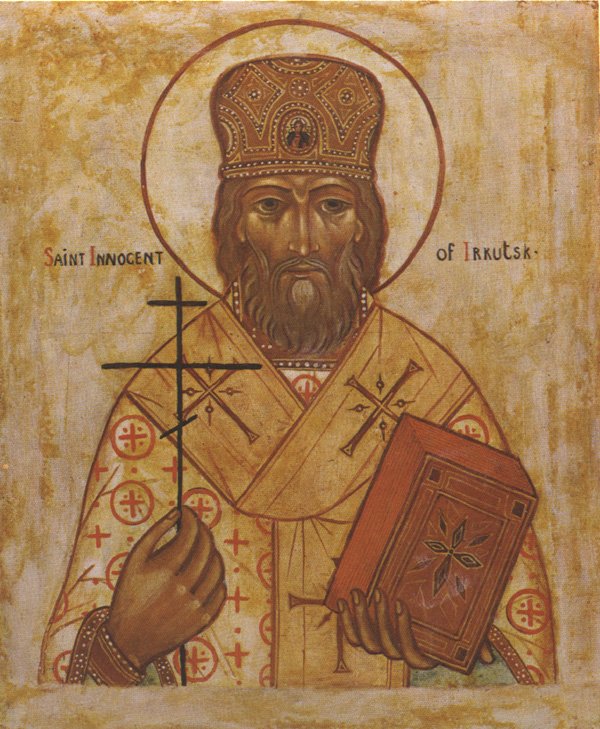
Relics of St Innocent of Irkutsk
Saint Innocent, the first Bishop of Irkutsk, reposed on November 27, 1731. But because the Kursk Root Icon of the Mother of God is commemorated on that day, his Feast Day is celebrated on November 26.
After the Saint's death, his persecutors received their just retribution. Archimandrite Anthony was discredited in Beijing as unorthodox.
Saint Innocent, the first Bishop of Irkutsk, reposed on November 27, 1731. But because the Kursk Root Icon of the Mother of God is commemorated on that day, his Feast Day is celebrated on November 26.
After the Saint's death, his persecutors received their just retribution. Archimandrite Anthony was discredited in Beijing as unorthodox. He was returned to St. Petersburg, deposed and imprisoned. Soon afterward, the Vice-Governor of Irkutsk was executed for his crimes.
In 1764, the body of Saint Innocent was discovered to be incorrupt during restoration work on the Ascension Monastery’s Tikhvin church. Many miracles occurred not only at Irkutsk, but also in the remote places of Siberia, for those who turned to the Saint in prayer.
In 1783, there was a great fire at Ascension Monastery. Everything that could burn was burnt. However, the old wooden temple, where the Saint's body rested, remained unharmed.
On February 9, 1805, the Most Holy Synod decided to uncover the Hierarch's relics and to number him among the Saints.
On February 2, 1831, the Feast of the Meeting of the Lord, His Grace Bishop Benjamin took Vladyka's holy relics from his tomb and placed them in the midst of the Tikhvin church, and then he served the Divine Liturgy before them. A week later, on February 9, the Hierarch's relics were solemnly transferred from the Tikhvin church to the Ascension Cathedral in a Cross Procession with the wonderworking Kazan Icon of the Mother of God.
In the twenties of the XX century, a period of persecution by the new godless authorities against Christians began. The Superior of Ascension Monastery was arrested, along with other hierarchs of Siberia. In 1921, the Saint's relics were subjected to a sacrilegious medical examination, after which they were taken from the orphaned Monastery, and then they disappeared for a long time.
In 1990, in one of the churches of the city of Yaroslavl, Saint Innocent's relics were discovered in a utility room. A medical examination showed that the body, which was not touched by decay, was that of Saint Innocent. His holy relics were returned to Irkutsk, and today they rest in Znamensky Monastery.
Saint Innocent, the first Bishop of Irkutsk is commemorated on November 26 (the day of his repose), February 9 (the discovery of his relics in 1805), June 10 (Synaxis of the Saints of Siberia), September 2 (the return of his relics to Irkutsk in 1990), on October 10 (Synaxis of the Saints of Volhynia), and on the third Sunday after Pentecost (Synaxis of the Saints of St. Petersburg).
Troparion - Tone 3
Most radiant luminary of the Church, you enlightened Siberia with the rays of your virtues, / and by healing a multitude of those who came to your shrine with faith, you glorified God. / We entreat you, O Hierarch and Father Innocent, / by your prayers preserve us from all misfortunes and sorrows.
Kontakion - Tone 2
Let us the faithful lovingly glorify the blameless1 shepherd / and preacher of faith among the peoples of Mongolia, / the glory and adornment of the flock of Irkutsk, / for he is the guardian of Siberia and intercessor for our souls.1 An allusion to the Saint's name. Непорочности means "blameless," or "irreproachable." In other words, "innocent."
Hieromartyr Peter of Damascus, bishop of Damascus (ca. 776)
“Saint Peter was Bishop of Damascus during the reign of Constantine Copronymus (c. 776) and a contemporary of Saint John of Damascus. He was arrested on the orders of the Caliph Walid for castigating the heretical doctrines of the Muslims and the Manichaeans. His tongue was cut out and he was exiled to South Arabia (Arabia Felix), where he c
“Saint Peter was Bishop of Damascus during the reign of Constantine Copronymus (c. 776) and a contemporary of Saint John of Damascus. He was arrested on the orders of the Caliph Walid for castigating the heretical doctrines of the Muslims and the Manichaeans. His tongue was cut out and he was exiled to South Arabia (Arabia Felix), where he continued to teach the true Faith and to serve the holy Mysteries until he entered into the reward of his labours in heaven.’ (Synaxarion)
Markellos, Philagrios, & Pankratios the Hieromartyrs
Peter of Damascus, Hesychast (12th c.)
Little is known of him except by his writings in the Philokalia . Saint Nikodemos, compiler of the Philokalia, writes that his work is ‘a recapitulation of holy watchfulness… a circle within a circle, a concentrated Philokalia within the more extendedPhilokalia.’
Scripture Readings
☩Epistle
James 3:1-10
1
My brethren, be not many masters, knowing that we shall receive the greater condemnation.
2
For in many things we offend all. If any man offend not in word, the same is a perfect man, and able also to bridle the whole body.
3
Behold, we put bits in the horses’ mouths, that they may obey us; and we turn about their whole body.
4
Behold also the ships, which though they be so great, and are driven of fierce winds, yet are they turned about with a very small helm, whithersoever the governor listeth.
5
Even so the tongue is a little member, and boasteth great things. Behold, how great a matter a little fire kindleth!
6
And the tongue is a fire, a world of iniquity: so is the tongue among our members, that it defileth the whole body, and setteth on fire the course of nature; and it is set on fire of hell.
7
For every kind of beasts, and of birds, and of serpents, and of things in the sea, is tamed, and hath been tamed of mankind:
8
But the tongue can no man tame; it is an unruly evil, full of deadly poison.
9
Therewith bless we God, even the Father; and therewith curse we men, which are made after the similitude of God.
10
Out of the same mouth proceedeth blessing and cursing. My brethren, these things ought not so to be.
☩Gospel
Mark 11:11-23
11
And Jesus entered into Jerusalem, and into the temple: and when he had looked round about upon all things, and now the eventide was come, he went out unto Bethany with the twelve.
12
And on the morrow, when they were come from Bethany, he was hungry:
13
And seeing a fig tree afar off having leaves, he came, if haply he might find any thing thereon: and when he came to it, he found nothing but leaves; for the time of figs was not yet.
14
And Jesus answered and said unto it, No man eat fruit of thee hereafter for ever. And his disciples heard it.
15
And they come to Jerusalem: and Jesus went into the temple, and began to cast out them that sold and bought in the temple, and overthrew the tables of the moneychangers, and the seats of them that sold doves;
16
And would not suffer that any man should carry any vessel through the temple.
17
And he taught, saying unto them, Is it not written, My house shall be called of all nations the house of prayer? but ye have made it a den of thieves.
18
And the scribes and chief priests heard it, and sought how they might destroy him: for they feared him, because all the people was astonished at his doctrine.
19
And when even was come, he went out of the city.
20
And in the morning, as they passed by, they saw the fig tree dried up from the roots.
21
And Peter calling to remembrance saith unto him, Master, behold, the fig tree which thou cursedst is withered away.
22
And Jesus answering saith unto them, Have faith in God.
23
For verily I say unto you, That whosoever shall say unto this mountain, Be thou removed, and be thou cast into the sea; and shall not doubt in his heart, but shall believe that those things which he saith shall come to pass; he shall have whatsoever he saith.
Liturgical data sourced from OCA.org and orthocal.info