Fasting Rules
 Meat
Allowed
 Fish
Allowed
 Dairy
Allowed
 Oil
Allowed
 Wine
Allowed
Saints & Commemorations
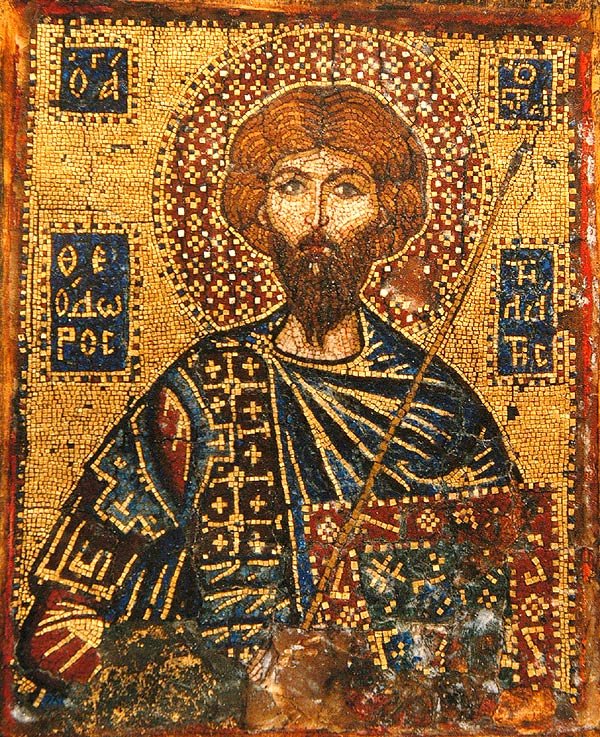
Great Martyr Theodore Stratelates
The Great Martyr Theodore Stratelates came from the city of Euchaita in Asia Minor. He was endowed with many talents, and was handsome in appearance. For his charity God enlightened him with the knowledge of Christian truth. The bravery of the saintly soldier was revealed after he, with the help of God, killed a giant serpent living on a precipice in the outskirts of Euchaita.
The Great Martyr Theodore Stratelates came from the city of Euchaita in Asia Minor. He was endowed with many talents, and was handsome in appearance. For his charity God enlightened him with the knowledge of Christian truth. The bravery of the saintly soldier was revealed after he, with the help of God, killed a giant serpent living on a precipice in the outskirts of Euchaita. The serpent had devoured many people and animals, terrorizing the countryside. Saint Theodore armed himself with a sword and vanquished it, glorifying the name of Christ among the people.
For his bravery Saint Theodore was appointed military commander [stratelatos] in the city of Heraclea, where he combined his military service with preaching the Gospel among the pagans subject to him. His gift of persuasion, reinforced by his personal example of Christian life, turned many from their false gods. Soon, nearly all of Heraclea had accepted Christianity.
During this time the emperor Licinius (311-324) began a fierce persecution against Christians. In an effort to stamp out the new faith, he persecuted the enlightened adherents of Christianity, who were perceived as a threat to paganism. Among these was Saint Theodore. Licinius tried to force Saint Theodore to offer sacrifice to the pagan gods. The saint invited Licinius to come to him with his idols so both of them could offer sacrifice before the people.
Blinded by his hatred for Christianity, Licinius trusted the words of the saint, but he was disappointed. Saint Theodore smashed the gold and silver statues into pieces, which he then distributed to the poor. Thus he demonstrated the vain faith in soulless idols, and also displayed Christian charity.
Saint Theodore was arrested and subjected to fierce and refined torture. He was dragged on the ground, beaten with iron rods, had his body pierced with sharp spikes, was burned with fire, and his eyes were plucked out. Finally, he was crucified. Varus, the servant of Saint Theodore, barely had the strength to write down the incredible torments of his master.
God, however, in His great mercy, willed that the death of Saint Theodore should be as fruitful for those near him as his life was. An angel healed the saint’s wounded body and took him down from the cross. In the morning, the imperial soldiers found him alive and unharmed. Seeing with their own eyes the infinite might of the Christian God, they were baptized not far from the place of the unsuccessful execution.
Thus Saint Theodore became “like a day of splendor” for those pagans dwelling in the darkness of idolatary, and he enlightened their souls “with the bright rays of his suffering.” Unwilling to escape martyrdom for Christ, Saint Theodore voluntarily surrendered himself to Licinius, and discouraged the Christians from rising up against the torturer, saying, “Beloved, halt! My Lord Jesus Christ, hanging upon the Cross, restrained the angels and did not permit them to take revenge on the race of man.”
Going to execution, the holy martyr opened up the prison doors with just a word and freed the prisoners from their bonds. People who touched his robe were healed instantly from sicknesses, and freed from demonic possession. By order of the emperor, Saint Theodore was beheaded by the sword. Before his death he told Varus, “ Do not fail to record the day of my death, and bury my body in Euchaita.” He also asked to be remembered each year on this date. Then he bent his neck beneath the sword, and received the crown of martyrdom which he had sought. This occurred on February 8, 319, on a Saturday, at the third hour of the day.
Saint Theodore is regarded as the patron saint of soldiers. He is also commemorated on June 8.
Troparion - Tone 4
Truly enlisted with the King of Heaven, / you became an outstanding general for Him, passion-bearer Theodore; / you armed yourself wisely with the weapons of faith / and conquered hordes of demons, revealing yourself as a victorious athlete. / Therefore, in faith we always call you blessed.
Kontakion - Tone 2
With the word of God as a spear in your hand, / in courage of soul and armed with faith, / you vanquished the enemy, Theodore, glory of martyrs, / with whom you unceasingly pray to Christ God for us all.
Holy Prophet Zechariah (6th c. BC)
He was among those who returned to Jerusalem from the Babylonian captivity, following the decree of Cyrus in 538 BC. With the Prophet Haggai (December 16) he began to prophesy in Jerusalem in 520, to encourage the Jews to return to their task of rebuilding the Temple, which they had given up in discouragement.
He was among those who returned to Jerusalem from the Babylonian captivity, following the decree of Cyrus in 538 BC. With the Prophet Haggai (December 16) he began to prophesy in Jerusalem in 520, to encourage the Jews to return to their task of rebuilding the Temple, which they had given up in discouragement. His prophetic ministry is described both in the Book of Ezra and in the Old Testament book that bears his name. His prophecies, in addition to speaking to the situation in which he lived, are replete with prophecies of the coming, and second coming, of Christ. His name means “The Lord is renowned.” Sozomen’s Ecclesiastical History reports that under the Emperor Honorius, Zacharias’ holy relics were discovered by divine revelation in Palestine, and were found to be incorrupt.
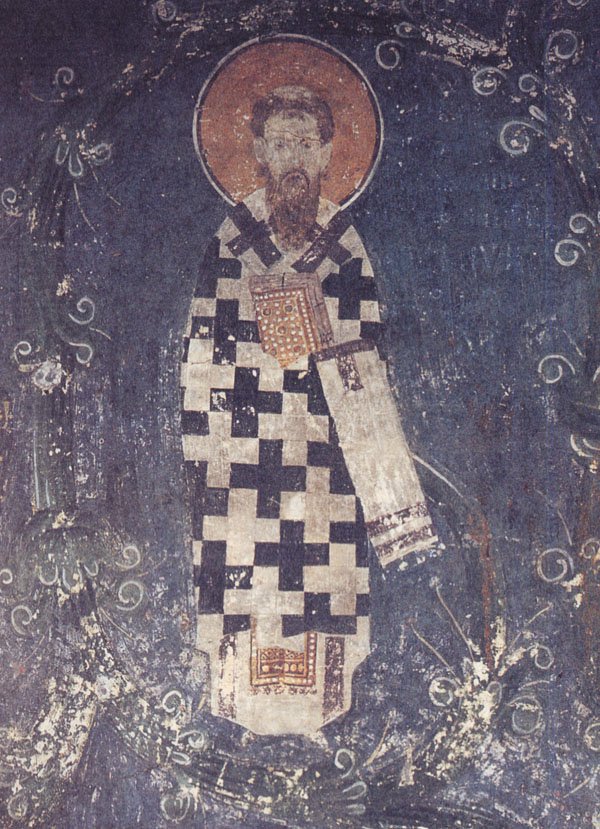
St Sabbas II, Archbishop of Serbia (1271)
Born Predislav Nemanjic, the son of Saint-King Stephen Prvovencani the First-Crowned (September 24) and the nephew of Saint Savva I, the first Archbishop of Serbia (January 14), Saint Savva II distinguished himself in monastic life by his ascetic practices, in imitation of his sainted uncle.
He succeeded Saint Arsenius (October 28) as Archbishop of Serbia in 1266.
Born Predislav Nemanjic, the son of Saint-King Stephen Prvovencani the First-Crowned (September 24) and the nephew of Saint Savva I, the first Archbishop of Serbia (January 14), Saint Savva II distinguished himself in monastic life by his ascetic practices, in imitation of his sainted uncle.
He succeeded Saint Arsenius (October 28) as Archbishop of Serbia in 1266. He guided the Church with great love and dedication until his repose, variously dated as 1268, 1269 and 1271. His holy relics are at Pec, the site of the ancient Serbian Patriarchate.
Troparion - Tone 4
In truth you were revealed to your flock as a rule of faith, / an image of humility and a teacher of abstinence; / your humility exalted you; / your poverty enriched you. / Hierarch Father Savva, / entreat Christ our God / that our souls may be saved.
Kontakion - Tone 2
O Hierarch Savva, divine thunder, spiritual trumpet, / planter of faith and pruner of heresies, great favorite of the Trinity, / while standing with the Angels before God, / pray unceasingly for us all.
Scripture Readings
☩Epistle
James 2:14-26
14
What doth it profit, my brethren, though a man say he hath faith, and have not works? can faith save him?
15
If a brother or sister be naked, and destitute of daily food,
16
And one of you say unto them, Depart in peace, be ye warmed and filled; notwithstanding ye give them not those things which are needful to the body; what doth it profit?
17
Even so faith, if it hath not works, is dead, being alone.
18
Yea, a man may say, Thou hast faith, and I have works: shew me thy faith without thy works, and I will shew thee my faith by my works.
19
Thou believest that there is one God; thou doest well: the devils also believe, and tremble.
20
But wilt thou know, O vain man, that faith without works is dead?
21
Was not Abraham our father justified by works, when he had offered Isaac his son upon the altar?
22
Seest thou how faith wrought with his works, and by works was faith made perfect?
23
And the scripture was fulfilled which saith, Abraham believed God, and it was imputed unto him for righteousness: and he was called the Friend of God.
24
Ye see then how that by works a man is justified, and not by faith only.
25
Likewise also was not Rahab the harlot justified by works, when she had received the messengers, and had sent them out another way?
26
For as the body without the spirit is dead, so faith without works is dead also.
☩Gospel
Mark 10:46-52
46
And they came to Jericho: and as he went out of Jericho with his disciples and a great number of people, blind Bartimeus, the son of Timeus, sat by the highway side begging.
47
And when he heard that it was Jesus of Nazareth, he began to cry out, and say, Jesus, thou Son of David, have mercy on me.
48
And many charged him that he should hold his peace: but he cried the more a great deal, Thou Son of David, have mercy on me.
49
And Jesus stood still, and commanded him to be called. And they call the blind man, saying unto him, Be of good comfort, rise; he calleth thee.
50
And he, casting away his garment, rose, and came to Jesus.
51
And Jesus answered and said unto him, What wilt thou that I should do unto thee? The blind man said unto him, Lord, that I might receive my sight.
52
And Jesus said unto him, Go thy way; thy faith hath made thee whole. And immediately he received his sight, and followed Jesus in the way.
Liturgical data sourced from OCA.org and orthocal.info