Fasting Rules
 Meat
Abstain
 Fish
Abstain
 Dairy
Abstain
 Oil
Abstain
 Wine
Abstain
Saints & Commemorations
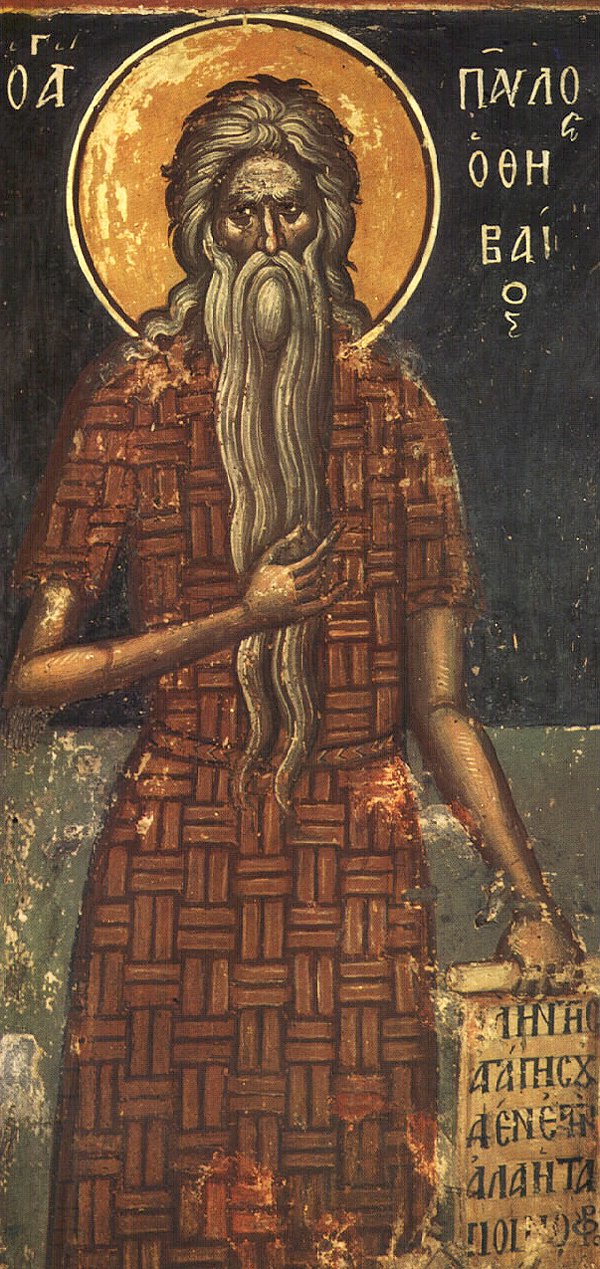
Ven. Paul of Thebes and John Calabytes
Saint Paul of Thebes was born in Egypt around 227 in the Thebaid of Egypt. Left orphaned, he suffered many things from a greedy relative over his inheritance. During the persecution against Christians under the emperor Decius (249-251), Saint Paul learned of his brother-in-law’s insidious plan to deliver him into the hands of the persecutors, and so he fled the city and fled into the wilderness.
Saint Paul of Thebes was born in Egypt around 227 in the Thebaid of Egypt. Left orphaned, he suffered many things from a greedy relative over his inheritance. During the persecution against Christians under the emperor Decius (249-251), Saint Paul learned of his brother-in-law’s insidious plan to deliver him into the hands of the persecutors, and so he fled the city and fled into the wilderness.
Settling into a mountain cave, Saint Paul dwelt there for ninety-one years, praying incessantly to God both day and night. He sustained himself on dates and bread, which a raven brought him, and he clothed himself with palm leaves.
Saint Anthony the Great (January 17), who also lived as an ascetic in the Thebaid desert, had a revelation from God concerning Saint Paul. Saint Anthony thought that there was no other desert dweller such as he. Then God said to him, “Anthony, there is a servant of God more excellent than you, and you should go and see him.”
Saint Anthony went into the desert and came to Saint Paul’s cave. Falling to the ground before the entrance to the cave, he asked to be admitted. The Elders introduced themselves, and then embraced one another. They conversed through the night, and Saint Anthony revealed how he had been led there by God. Saint Paul disclosed to Saint Anthony that for sixty years a bird had brought him half a loaf of bread each day. Now the Lord had sent a double portion in honor of Saint Anthony’s visit. The next morning, Saint Paul spoke to Anthony of his approaching death, and instructed him to bury him. He also asked Saint Anthony to return to his monastery and bring back the cloak he had received from Saint Athanasius. He did not really need a garment, but wished to depart from his body while Saint Anthony was absent.
As he was returning with the cloak, Saint Anthony beheld the soul of Saint Paul surrounded by angels, prophets, and apostles, shining like the sun and ascending to God. He entered the cave and found Abba Paul on his knees with his arms outstretched. Saint Anthony mourned for him, and wrapped him in the cloak. He wondered how he would bury the body, for he had not remembered to bring a shovel. Two lions came running from the wilderness and dug a grave with their claws.
Saint Anthony buried the holy Elder, and took his garment of palm leaves, then he returned to his own monastery. Saint Anthony kept this garb as a precious inheritance, and wore it only twice a year, on Pascha and Pentecost.
Saint Paul of Thebes died in the year 341, when he was 113 years old. He did not establish a single monastery, but soon after his end there were many imitators of his life, and they filled the desert with monasteries. Saint Paul is honored as the first desert-dweller and hermit.
In the twelfth century Saint Paul’s relics were transferred to Constantinople and placed in the Peribleptos monastery of the Mother of God, on orders of the emperor Manuel (1143-1180). Later, they were taken to Venice, and finally to Hungary, at Ofa. Part of his head is in Rome.
Saint Paul of Thebes, whose Life was written by Saint Jerome , is not to be confused with Saint Paul the Simple (October 4).
Troparion - Tone 3
Inspired by the Spirit, / you were the first to dwell in the desert in emulation of Elijah the zealot; / as one who imitated the angels, you were made known to the world by Saint Anthony the Great. / Righteous Paul, entreat Christ God to grant us His great mercy.
Kontakion - Tone 3
Today we gather and praise you with hymns as an unwaning ray of the spiritual Sun; / for you shine on those in the darkness of ignorance, / leading all mankind to the heights, venerable Paul, / adornment of Thebes and firm foundation of the fathers and ascetics.
Saint Ita of Kileedy, Ireland (570)
The gentle and motherly St. Ita was descended from the high kings of Tara. From her youth she loved God ardently and shone with the radiance of a soul that loves virtue. Because of her purity of heart she was able to hear the voice of God and communicate it to others. Despite her father’s opposition she embraced the monastic life in her youth. I
The gentle and motherly St. Ita was descended from the high kings of Tara. From her youth she loved God ardently and shone with the radiance of a soul that loves virtue. Because of her purity of heart she was able to hear the voice of God and communicate it to others. Despite her father’s opposition she embraced the monastic life in her youth. In obedience to the revelation of an angel she went to the people of Ui Conaill in the southwestern part of Ireland. While she was there, the foundation of a convent was laid. It soon grew into a monastic school for the education of boys, quickly becoming known for its high level of learning and moral purity. The most famous of her many students was St. Brendan of Clonfert (May 16). She went to the other world in great holiness to dwell forever with the risen Lord in the year 570.
—from the 2003 Saint Herman Calendar
Ven. Pansophius of Alexandria, the Martyr
The Monk Martyr Pansophius, was a son of the Alexandrian proconsul Nilus. After the death of his father, he distributed his inheritance to the poor and settled in the desert, where he lived in asceticism for twenty-seven years.
During the persecution by Decius (249-251) Saint Pansophius was brought to trial before the prefect of Alexandria.
The Monk Martyr Pansophius, was a son of the Alexandrian proconsul Nilus. After the death of his father, he distributed his inheritance to the poor and settled in the desert, where he lived in asceticism for twenty-seven years.
During the persecution by Decius (249-251) Saint Pansophius was brought to trial before the prefect of Alexandria. The monk boldly confessed his faith in Christ and denounced pagan errors, for which he was fiercely beaten with rods. He died from these beatings, thereby receiving a martyr’s crown (249-251).
Troparion - Tone 1
The image of God was truly preserved in you, O Father, / for you took up the Cross and followed Christ. / By so doing you taught us to disregard the flesh for it passes away / but to care instead for the soul, since it is immortal. / Therefore your spirit, venerable Pansophius, rejoices with the angels.
Our Holy Father John Kalyvites (the hut-dweller) (ca. 450)
He was the son of Eutropius, a prominent senator, and Theodora, who lived in Constantinople. At the age of twelve, he secretly fled his home, taking nothing but a Gospel book with him. Entering the Monastery of the Unsleeping Ones in the City, he gave himself up with fervor to a life of prayer, self-denial and obedience.
He was the son of Eutropius, a prominent senator, and Theodora, who lived in Constantinople. At the age of twelve, he secretly fled his home, taking nothing but a Gospel book with him. Entering the Monastery of the Unsleeping Ones in the City, he gave himself up with fervor to a life of prayer, self-denial and obedience. For three years he ate only on Sundays after taking communion, and became so thin and haggard that he bore no resemblance to the young nobleman who had entered the monastery.
Tormented by longing to see his parents, but unwilling to give up the ascetic struggle, he left the monastery with his Abbot’s blessing, dressed in beggar’s rags, and took up residence in a poor hut near the gate of his parents’ house. Here he lived, mocked by those who had once been his servants and despised by his own parents, who no longer recognized him.
After three years, Christ appeared to him and told him that his end was drawing near, and that in three days angels would come to take him home. John sent a message to his parents, asking them to visit his hut. In perplexity, they came, and John, showing them the Gospel book that they had given him as a child, revealed to them that he was their son, and that he was about to die. They embraced him, rejoicing at their reunion but weeping for his departure from this life. Immediately, he gave back his soul to God.
The whole City of Constantinople was stirred by the story, and great crowds came to John’s burial service. A church was later built on the site of his hut, and many miracles were wrought there through the Saint’s prayers.
Scripture Readings
☩Epistle
Titus 1:15-2:10
15
Unto the pure all things are pure: but unto them that are defiled and unbelieving is nothing pure; but even their mind and conscience is defiled.
16
They profess that they know God; but in works they deny him, being abominable, and disobedient, and unto every good work reprobate.
1
But speak thou the things which become sound doctrine:
2
That the aged men be sober, grave, temperate, sound in faith, in charity, in patience.
3
The aged women likewise, that they be in behaviour as becometh holiness, not false accusers, not given to much wine, teachers of good things;
4
That they may teach the young women to be sober, to love their husbands, to love their children,
5
To be discreet, chaste, keepers at home, good, obedient to their own husbands, that the word of God be not blasphemed.
6
Young men likewise exhort to be sober minded.
7
In all things shewing thyself a pattern of good works: in doctrine shewing uncorruptness, gravity, sincerity,
8
Sound speech, that cannot be condemned; that he that is of the contrary part may be ashamed, having no evil thing to say of you.
9
Exhort servants to be obedient unto their own masters, and to please them well in all things; not answering again;
10
Not purloining, but shewing all good fidelity; that they may adorn the doctrine of God our Saviour in all things.
☩Gospel
Luke 20:19-26
19
And the chief priests and the scribes the same hour sought to lay hands on him; and they feared the people: for they perceived that he had spoken this parable against them.
20
And they watched him, and sent forth spies, which should feign themselves just men, that they might take hold of his words, that so they might deliver him unto the power and authority of the governor.
21
And they asked him, saying, Master, we know that thou sayest and teachest rightly, neither acceptest thou the person of any, but teachest the way of God truly:
22
Is it lawful for us to give tribute unto Cesar, or no?
23
But he perceived their craftiness, and said unto them, Why tempt ye me?
24
Shew me a penny. Whose image and superscription hath it? They answered and said, Cesar’s.
25
And he said unto them, Render therefore unto Cesar the things which be Cesar’s, and unto God the things which be God’s.
26
And they could not take hold of his words before the people: and they marvelled at his answer, and held their peace.
Liturgical data sourced from OCA.org and orthocal.info