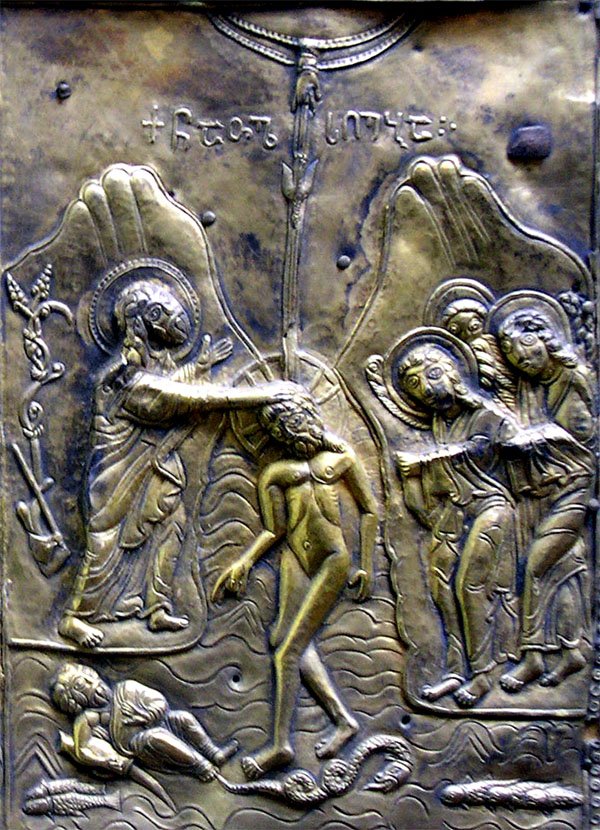
The Leavetaking of the Feast of Theophany takes place on January 14. The entire office of the Feast is repeated except for the Entrance, festal readings, Litya, Blessing of Loaves at Vespers, and the Polyeleos and festal Gospel at Matins. The festal Antiphons are not sung at Liturgy, and the Epistle and Gospel of the day are read.
Troparion - Tone 1
When You, O Lord were baptized in the Jordan / the worship of the Trinity was made manifest / for the voice of the Father bore witness to You / and called You His beloved Son. / And the Spirit, in the form of a dove, / confirmed the truthfulness of His word. / O Christ, our God, You have revealed Yourself / and have enlightened the world, glory to You!
Kontakion - Tone 4
Today You have shown forth to the world, O Lord, / and the light of Your countenance has been marked on us. / Knowing You, we sing Your praises. / You have come and revealed Yourself, / O unapproachable Light.
St Nino of Georgia
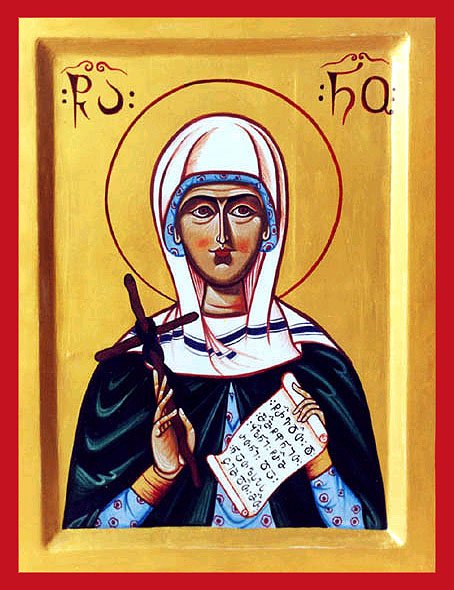
The virgin Nino of Cappadocia was a relative of Great-martyr George and the only daughter of a widely respected and honorable couple. Her father was a Roman army chief by the name of Zabulon, and her mother, Sosana, was the sister of Patriarch Juvenal of Jerusalem. When Nino reached the age of twelve, her parents sold all their possessions and moved to Jerusalem.
The virgin Nino of Cappadocia was a relative of Great-martyr George and the only daughter of a widely respected and honorable couple. Her father was a Roman army chief by the name of Zabulon, and her mother, Sosana, was the sister of Patriarch Juvenal of Jerusalem. When Nino reached the age of twelve, her parents sold all their possessions and moved to Jerusalem. Soon after, Nino’s father was tonsured a monk. He bid farewell to his family and went to labor in the wilderness of the Jordan.
After Sosana had been separated from her husband, Patriarch Juvenal ordained her a deaconess. She left her daughter Nino in the care of an old woman, Sara Niaphor, who raised her in the Christian Faith and related to her the stories of Christ’s life and His suffering on earth. It was from Sara that Nino learned how Christ’s Robe had arrived in Georgia, a country of pagans.
Soon Nino began to pray fervently to the Theotokos, asking for her blessing to travel to Georgia and be made worthy to venerate the Sacred Robe that she had woven for her beloved Son. The Most Holy Virgin heard her prayers and appeared to Nino in a dream, saying, “Go to the country that was assigned to me by lot and preach the Gospel of our Lord Jesus Christ. He will send down His grace upon you and I will be your protector.”
But the blessed Nino was overwhelmed at the thought of such a great responsibility and answered, “How can I, a fragile woman, perform such a momentous task, and how can I believe that this vision is real?” In response, the Most Holy Theotokos presented her with a cross of grapevines and proclaimed, “Receive this cross as a shield against visible and invisible enemies!”
When she awoke, Nino was holding the cross in her hands. She dampened it with tears of rejoicing and tied it securely with strands of her own hair. (According to another source, the Theotokos bound the grapevine cross with strands of her own hair.)
Nino related the vision to her uncle, Patriarch Juvenal, and revealed to him her desire to preach the Gospel in Georgia. Juvenal led her in front of the Royal Doors, laid his hands on her, and prayed, “O Lord, God of Eternity, I beseech Thee on behalf of my orphaned niece: Grant that, according to Thy will, she may go to preach and proclaim Thy Holy Resurrection. O Christ God, be Thou to her a guide, a refuge, and a spiritual father. And as Thou didst enlighten the Apostles and all those who feared Thy name, do Thou also enlighten her with the wisdom to proclaim Thy glad tidings.”
When Nino arrived in Rome, she met and baptized the princess Rhipsimia and her nurse, Gaiana. At that time the Roman emperor was Diocletian, a ruler infamous for persecuting Christians. Diocletian (284-305) fell in love with Rhipsimia and resolved to marry her, but Saint Nino, Rhipsimia, Gaiana, and fifty other virgins escaped to Armenia. The furious Diocletian ordered his soldiers to follow them and sent a messenger to Tiridates, the Armenian king (286-344), to put him on guard.
King Tiridates located the women and, following Diocletian’s example, was charmed by Rhipsimia’s beauty and resolved to marry her. But Saint Rhipsimia would not consent to wed him, and in his rage the king had her tortured to death with Gaiana and the fifty other virgins. Saint Nino, however, was being prepared for a different, greater task, and she succeeded in escaping King Tiridates’ persecutions by hiding among some rose bushes.
When she finally arrived in Georgia, Saint Nino was greeted by a group of Mtskhetan shepherds near Lake Paravani, and she received a blessing from God to preach to the pagans of this region.
With the help of her acquaintances Saint Nino soon reached the city of Urbnisi. She remained there a month, then traveled to Mtskheta with a group of Georgians who were making a pilgrimage to venerate the pagan idol Armazi. There she watched with great sadness as the Georgian people trembled before the idols. She was exceedingly sorrowful and prayed to the Lord, “O Lord, send down Thy mercy upon this nation...that all nations may glorify Thee alone, the One True God, through Thy Son, Jesus Christ.”
Suddenly a violent wind began to blow and hail fell from the sky, shattering the pagan statues. The terrified worshipers fled, scattering across the city.
Saint Nino made her home beneath a bramble bush in the garden of the king, with the family of the royal gardener. The gardener and his wife were childless, but through Saint Nino’s prayers God granted them a child. The couple rejoiced exceedingly, declared Christ to be the True God, and became disciples of Saint Nino. Wherever Saint Nino went, those who heard her preach converted to the Christian Faith in great numbers. Saint Nino even healed the terminally ill Queen Nana after she declared Christ to be the True God.
King Mirian, a pagan, was not at all pleased with the great impression Saint Nino’s preaching had made on the Georgian nation. One day while he was out hunting, he resolved to kill all those who followed Christ.
According to his wicked scheme, even his wife, Queen Nana, would face death for failing to renounce the Christian Faith. But in the midst of the hunt, it suddenly became very dark. All alone, King Mirian became greatly afraid and prayed in vain for the help of the pagan gods. When his prayers went unanswered, he finally lost hope and, miraculously, he turned to Christ: “God of Nino, illumine this night for me and guide my footsteps, and I will declare Thy Holy Name. I will erect a cross and venerate it and I will construct for Thee a temple. I vow to be obedient to Nino and to the Faith of the Roman people!”
Suddenly the night was transfigured, the sun shone radiantly, and King Mirian gave great thanks to the Creator. When he returned to the city, he immediately informed Saint Nino of his decision. As a result of the unceasing labors of Equal-to-the-Apostles Nino, Georgia was established as a nation solidly rooted in the Christian Faith.
Saint Nino reposed in the village of Bodbe in eastern Georgia and, according to her will, she was buried in the place where she took her last breath. King Mirian later erected a church in honor of Saint George over her grave.
Troparion - Tone 4
O handmaiden of the Word of God, / who equaled the first-called Apostle Andrew in preaching, / and emulated the other Apostles; / enlightener of Iberia and lyre of the Holy Spirit, / Holy equal of the Apostles Nina, pray to Christ God for the salvation of our souls.
Kontakion - Tone 2
Come, all of you, let us sing praises today to the one chosen by Christ, / the equal of the Apostles, the preacher of God's Word, / the wise bearer of good tidings, who brought the people of Kartli to the path of life and truth; / she is the disciple of the Mother of God, / our zealous intercessor and unsleeping guardian, / the all-praised Nina.
Our Holy Father Sava (Sabbas), Enlightener and first Archbishop of Serbia (1236)
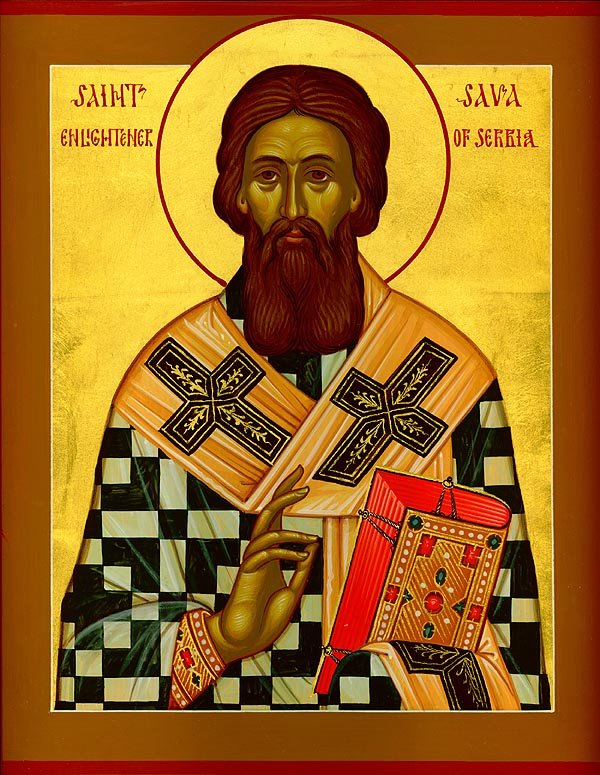
Saint Savva, First Archbishop of Serbia, in the world Rostislav (Rastko), was a son of the Serbian king Stephen Nemanya and Anna, daughter of the Byzantine Emperor Romanus. From his early years he fervently attended church services and had a special love for icons.
At seventeen years of age, Rostislav met a monk from Mount Athos, secretly left his father’s house and set off for the Saint Panteleimon monastery. (
Saint Savva, First Archbishop of Serbia, in the world Rostislav (Rastko), was a son of the Serbian king Stephen Nemanya and Anna, daughter of the Byzantine Emperor Romanus. From his early years he fervently attended church services and had a special love for icons.
At seventeen years of age, Rostislav met a monk from Mount Athos, secretly left his father’s house and set off for the Saint Panteleimon monastery. (By divine Providence in 1169, the year of the saint’s birth, the ancient monastery of the Great Martyr and healer Panteleimon was given to Russian monks.)
Knowing that his son was on Athos, his father mobilized his retainers headed by a faithful voevod and wrote to the governor of the district which included Athos, saying that if his son were not returned to him, he would go to war against the Greeks. When they arrived at the monastery, the voevod was ordered not to take his eyes off Rostislav. During the evening services, when the soldiers had fallen asleep under the influence of wine, Rostislav received monastic tonsure (in 1186) and sent to his parents his worldly clothes, his hair and a letter. Saint Savva sought to persuade his powerful parents to accept monasticism. The monk’s father ( in monasticism Simeon , commemorated on February 13) and his son pursued asceticism at the Vatopedi monastery. On Athos they established the Serbian Hilandar monastery, and this monastery received its name by imperial grant. At Hilandar monastery, Saint Savva was ordained to the diaconate and then presbyter. His mother Anna became a nun with the name Anastasia (June 21).
For his holy life and virtuous deeds on Mount Athos, the monk was made an archimandrite at Thessalonica. At Nicea in the year 1219 on the Feast of the Dormition of the Most Holy Theotokos, the Ecumenical Patriarch Germanus consecrated Archimandrite Savva as Archbishop of Serbia. The saint petitioned the Byzantine Emperor to grant permission for Serbian bishops to elect their own Archbishop in future. This was a very important consideration in a time of frequent wars between the eastern and western powers.
Having returned to the Holy Mountain from Nicea, the saint visited all the monasteries for the last time. He made prostrations in all the churches and, calling to mind the blessed lives of the wilderness Fathers, he made his farewells to the ascetics with deep remorse, “leaving the Holy Mountain, as if from Paradise.”
Saddened by his separation from the Holy Mountain, the saint went along the path from Athos just barely moving. The Most Holy Theotokos spoke to the saint in a dream, “Having My Patronage, why do you remain sorrowful?” These words roused him from despondency, changing his sorrow into joy. In memory of this appearance, the saint commissioned large icons of the Savior and of the Mother of God at Thessalonica, and put them in a church.
In Serbia, the activity of the Hierarch in organizing the work of his native Church was accompanied by numerous signs and miracles. During the Liturgy and the all-night Vigil, when the saint came to cense the grave of his father the monk Simeon, the holy relics exuded fragrant myrrh.
Being in charge of negotiations with King Vladislav, who had declared war on Serbia, the holy bishop not only brought about the desired peace for his country, but he also brought the monarch to Orthodoxy. Thus he facilitated the start of the historical existence of the autonomous Serbian Church. Saint Savva also contributed to strengthening the Serbian state. In order to insure the independence of the Serbian state, Archbishop Savva crowned his powerful brother Stephen as king. Upon the death of Stephen, his eldest son Radislav was crowned king, and Saint Savva set off to the Holy Land “to worship at the holy tomb of Christ and fearsome Golgotha.”
When he returned to his native land, the saint blessed and crowned Vladislav as king. To further strengthen the Serbian throne, he betrothed him to the daughter of the Bulgarian prince Asan. The holy hierarch visited churches all across Serbia, he reformed monastic rules on the model of Athos and Palestine, and he established and consecrated many churches, strengthening the Orthodox in their faith. Having finished his work in his native land, the saint appointed the hieromonk Arsenius as his successor, consecrating him bishop and giving his blessing to all.
He then set off on a journey of no return, desiring “to end his days as a wanderer in a foreign land.” He passed through Palestine, Syria and Persia, Babylon, Egypt and Anatolia, everywhere visiting the holy places, conversing with great ascetics, and collecting the holy relics of saints. The saint finished his wanderings at Trnovo in Bulgaria at the home of his kinsman Asan, where with spiritual joy he gave up his soul to the Lord (+ 1237).
At the time of transfer of the holy relics of Saint Savva to Serbia in 1237, there were so many healings that the Bulgarians began to complain about Asan, “because he had given up such a treasure.” In the saint’s own country, his venerable relics were placed in the Church of Mileshevo, bestowing healing on all who approached with faith. The inhabitants of Trnovo continued to receive healing from the remnants of the saint’s coffin, which Asan ordered to be gathered together and placed in a newly built sarcophagus.
The legacy of Saint Savva lives on in the Orthodox Church traditions of the Slavic nations. He is associated with the introduction of the Jerusalem Typikon as the basis for Slavic Monastic Rules. The Serbian Hilandar monastery on Mt. Athos lives by the Typikon of Saint Savva to this day. Editions of The Rudder (a collection of church canons) of Saint Savva, with commentary by Alexis Aristines, are the most widely disseminated in the Russian Church. In 1270 the first copy of The Rudder of Saint Savva was sent from Bulgaria to Metropolitan Cyril of Kiev. From this was copied one of the most ancient of the Russian Rudders, the Ryazan Rudder of 1284. It in turn was the source for a printed Rudder published in 1653, and since that time often reprinted by the Russian Church. Such was the legacy of Saint Savva to the canonical treasury of Orthodoxy.
Troparion - Tone 4
In truth you were revealed to your flock as a rule of faith, / an image of humility and a teacher of abstinence; / your humility exalted you; / your poverty enriched you. / Hierarch Father Savva, / entreat Christ our God / that our souls may be saved.
Kontakion - Tone 2
O Hierarch Savva, divine thunder, spiritual trumpet, / planter of faith and pruner of heresies, great favorite of the Trinity, / while standing with the Angels before God, / pray unceasingly for us all.
The Holy Fathers slain at Sinai and Raithu (4th – 5th c.)
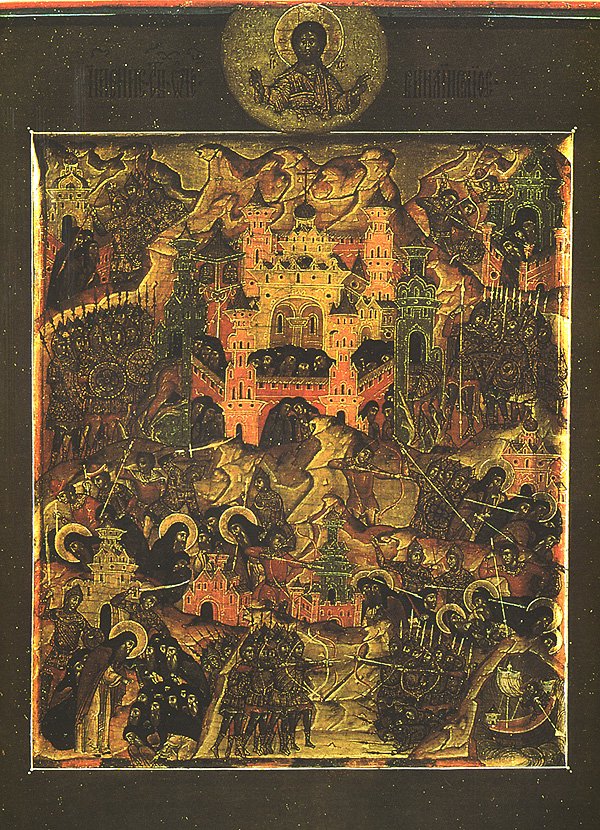
There were two occasions when the monks and hermits at Sinai and Raithu were murdered by the barbarians. The first took place in the fourth century when forty Fathers were killed at Mount Sinai, and thirty-nine were slain at Raithu on the same day.
Mount Sinai, where the Ten Commandments had been given to Moses, was also the site of another miracle.
There were two occasions when the monks and hermits at Sinai and Raithu were murdered by the barbarians. The first took place in the fourth century when forty Fathers were killed at Mount Sinai, and thirty-nine were slain at Raithu on the same day.
Mount Sinai, where the Ten Commandments had been given to Moses, was also the site of another miracle. Ammonios, an Egyptian monk, witnessed the murder of the forty holy Fathers at Sinai. He tells of how the Saracens attacked the monastery and would have killed them all, if God had not intervened. A fire appeared on the summit of the peak, and the whole mountain smoked. The barbarians were terrified, and fled, while the surviving monks thanked God for sparing them.
That day, the Blemmyes (an Arab tribe) killed thirty-nine Fathers at Raithu (on the shores of the Red Sea). Igumen Paul of Raithu exhorted his monks to endure their suffering with courage and a pure heart.
The second massacres occurred nearly a hundred years later, and was also recorded by an eyewitness who miraculously escaped: Saint Nilus the Faster (November 12). The Arabs permitted some of the monks to run for their lives. They crossed the valley and climbed up a mountain. From this vantage point, they saw the bedouin kill the monks and ransack their cells.
The Sinai and Raithu ascetics lived a particularly strict life: they spent the whole week at prayer in their cells. On Saturday they gathered for the all-night Vigil, and on Sunday they received the Holy Mysteries. Their only food was dates and water. Many of the ascetics of the desert were glorified by the gift of wonderworking: the Elders Moses, Joseph and others. Mentioned in the service to these monastic Fathers are: Isaiah, Savva, Moses and his disciple Moses, Jeremiah, Paul, Adam, Sergius, Domnus, Proclus, Hypatius, Isaac, Macarius, Mark, Benjamin, Eusebius and Elias.
Troparion - Tone 4
O God of our Fathers, / always act with kindness towards us; / do not take Your mercy from us, / but direct our lives in peace / through the prayers of these Saints.
Kontakion - Tone 2
Passing unharmed through a multitude of storms, and receiving the gift of miracles, / you drowned your bodiless Enemies in the streams of your tears, O Divinely-wise Monastic Martyrs, / now having received the gift of miracles, / pray unceasingly for all of us.
Scripture Readings
☩Epistle
Titus 1:5-2:1
5
For this cause left I thee in Crete, that thou shouldest set in order the things that are wanting, and ordain elders in every city, as I had appointed thee:
6
If any be blameless, the husband of one wife, having faithful children not accused of riot or unruly.
7
For a bishop must be blameless, as the steward of God; not selfwilled, not soon angry, not given to wine, no striker, not given to filthy lucre;
8
But a lover of hospitality, a lover of good men, sober, just, holy, temperate;
9
Holding fast the faithful word as he hath been taught, that he may be able by sound doctrine both to exhort and to convince the gainsayers.
10
For there are many unruly and vain talkers and deceivers, specially they of the circumcision:
11
Whose mouths must be stopped, who subvert whole houses, teaching things which they ought not, for filthy lucre’s sake.
12
One of themselves, even a prophet of their own, said, The Cretians are alway liars, evil beasts, slow bellies.
13
This witness is true. Wherefore rebuke them sharply, that they may be sound in the faith;
14
Not giving heed to Jewish fables, and commandments of men, that turn from the truth.
15
Unto the pure all things are pure: but unto them that are defiled and unbelieving is nothing pure; but even their mind and conscience is defiled.
16
They profess that they know God; but in works they deny him, being abominable, and disobedient, and unto every good work reprobate.
1
But speak thou the things which become sound doctrine:
☩Gospel
Luke 20:9-18
9
Then began he to speak to the people this parable; A certain man planted a vineyard, and let it forth to husbandmen, and went into a far country for a long time.
10
And at the season he sent a servant to the husbandmen, that they should give him of the fruit of the vineyard: but the husbandmen beat him, and sent him away empty.
11
And again he sent another servant: and they beat him also, and entreated him shamefully, and sent him away empty.
12
And again he sent a third: and they wounded him also, and cast him out.
13
Then said the lord of the vineyard, What shall I do? I will send my beloved son: it may be they will reverence him when they see him.
14
But when the husbandmen saw him, they reasoned among themselves, saying, This is the heir: come, let us kill him, that the inheritance may be ours.
15
So they cast him out of the vineyard, and killed him. What therefore shall the lord of the vineyard do unto them?
16
He shall come and destroy these husbandmen, and shall give the vineyard to others. And when they heard it, they said, God forbid.
17
And he beheld them, and said, What is this then that is written, The stone which the builders rejected, the same is become the head of the corner?
18
Whosoever shall fall upon that stone shall be broken; but on whomsoever it shall fall, it will grind him to powder.
 Meat
Allowed
 Fish
Allowed
 Dairy
Allowed
 Oil
Allowed
 Wine
Allowed