Fasting Rules
 Meat
Allowed
 Fish
Allowed
 Dairy
Allowed
 Oil
Allowed
 Wine
Allowed
Saints & Commemorations
St Sava, Archbishop of Serbia
Martyr Mertios
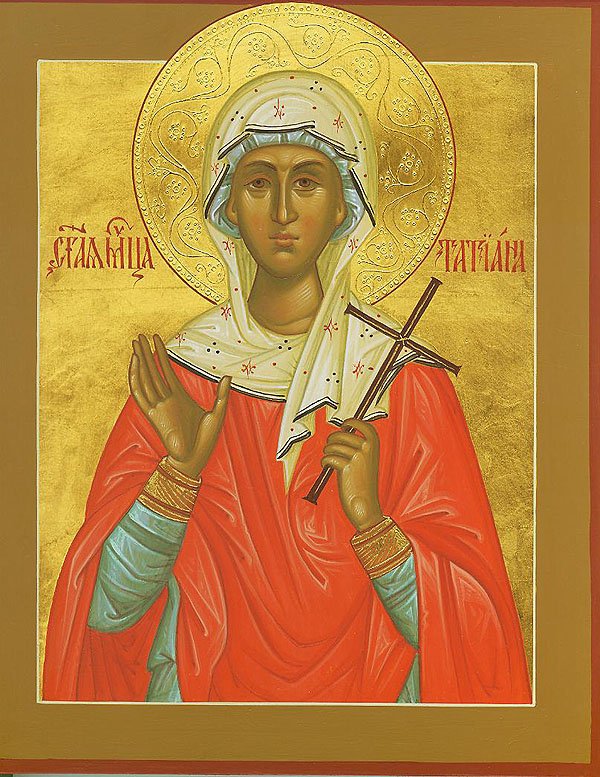
Holy Martyr Tatiana (ca. 230)
The Holy Virgin Martyr Tatiana was born into an illustrious Roman family, and her father was elected consul three times. He was secretly a Christian and raised his daughter to be devoted to God and the Church. When she reached the age of maturity, Tatiana decided to remain a virgin, betrothing herself to Christ.
The Holy Virgin Martyr Tatiana was born into an illustrious Roman family, and her father was elected consul three times. He was secretly a Christian and raised his daughter to be devoted to God and the Church. When she reached the age of maturity, Tatiana decided to remain a virgin, betrothing herself to Christ. Disdaining earthly riches, she sought instead the imperishable wealth of Heaven. She was made a deaconess in one of the Roman churches and served God in fasting and prayer, tending the sick and helping the needy.
When Rome was ruled by the sixteen-year-old Alexander Severus (222-235), all power was concentrated in the hands of the regent Ulpian, an evil enemy and persecutor of Christians. Christian blood flowed like water. Tatiana was also arrested, and they brought her into the temple of Apollo to force her to offer sacrifice to the idol. The saint began praying, and suddenly there was an earthquake. The idol was smashed into pieces, and part of the temple collapsed and fell down on the pagan priests and many pagans. The demon inhabiting the idol fled screeching from that place. Those present saw its shadow flying through the air.
Then they tore holy virgin’s eyes out with hooks, but she bravely endured everything, praying for her tormentors that the Lord would open their spiritual eyes. And the Lord heard the prayer of His servant. The executioners saw four angels encircle the saint and beat her tormentors. A voice was heard from the heavens speaking to the holy virgin. Eight men believed in Christ and fell on their knees before Saint Tatiana, begging them to forgive them their sin against her. For confessing themselves Christians they were tortured and executed, receiving Baptism by blood.
The next day Saint Tatiana was brought before the wicked judge. Seeing her completely healed of all her wounds, they stripped her and beat her, and slashed her body with razors. A wondrous fragrance then filled the air. Then she was stretched out on the ground and beaten for so long that the servants had to be replaced several times. The torturers became exhausted and said that an invisible power was beating them with iron rods. Indeed, the angels warded off the blows directed at her and turned them upon the tormentors, causing nine of them to fall dead. They then threw the saint in prison, where she prayed all night and sang praises to the Lord with the angels.
A new morning began, and they took Saint Tatiana to the tribunal once more. The torturers beheld with astonishment that after such terrible torments she appeared completely healthy and even more radiant and beautiful than before. They began to urge her to offer sacrifice to the goddess Diana. The saint seemed agreeable, and they took her to the heathen temple. Saint Tatiana made the Sign of the Cross and began to pray. Suddenly, there was a crash of deafening thunder, and lightning struck the idol, the sacrificial offerings and the pagan priests.
Once again, the martyr was fiercely tortured. She was hung up and scraped with iron claws, and her breasts were cut off. That night, angels appeared to her in prison and healed her wounds as before. On the following day, they took Saint Tatiana to the circus and loosed a hungry lion on her. The beast did not harm the saint, but meekly licked her feet.
As they were taking the lion back to its cage, it killed one of the torturers. They threw Tatiana into a fire, but the fire did not harm the martyr. The pagans, thinking that she was a sorceress, cut her hair to take away her magical powers, then locked her up in the temple of Zeus.
On the third day, pagan priests came to the temple intending to offer sacrifice to Zeus. They beheld the idol on the floor, shattered to pieces, and the holy martyr Tatiana joyously praising the Lord Jesus Christ. The judge then condemned the valiant sufferer to be beheaded with a sword. Her father was also executed with her, because he had raised her to love Christ.
The Relics of Saint Tatiana in Craiova
The honorable head of the Holy Martyr Tatiana was first brought to Romania in 1204, when members of the ruling family (Asanestan dynasty) placed it in a church in Tarnovo (Bulgaria) and then in Bucovat Monastery (near Craiova). Later, however, in 1393, the head of the Saint was taken to a church in the town of Nicaea (where the First Ecumenical Synod met), and then to Constantinople, and placed in the Church of the Holy Apostles.
In 1453, after the conquest of Constantinople by the Turks, during the reign of Neagoe Basarab, the Craioveşti boyars brought the head of the holy Martyr Tatiana to this country, as well as the entire body of Saint Gregory the Decapolite (November 20), which they placed in the church of Bistriţa Monastery. From that monastery, the relics of Saint Tatiana were taken by Saint Neagoe Basarab (September 15) and brought to the royal church at Curtea de Argeș. Later, with the reorganization of the Metropolitan Church of Oltenia (1950-1955), the honorable skull of Saint Tatiana was taken from Curtea de Argeș and brought to the Episcopal Cathedral of Râmnicu Vâlcea in 1955. Finally, the honored relics were permanently enshrined in the Metropolitan Cathedral of Craiova.
Today, the holy relics of Saint Tatiana are kept, with great honor, in the Metropolitan Cathedral of the Holy Great Martyr Demetrios in Craiova, in the same reliquary with the relics of Saint Niphon of Constantinople (August 11), and the Holy Martyrs Sergius and Bacchus (October 7).
Troparion - Tone 4
Your lamb Tatiana, / calls out to You, O Jesus, in a loud voice: / “I love You, my Bridegroom, / and in seeking You, I endure suffering. / In baptism I was crucified so that I might reign in You, / and I died so that I might live with You. / Accept me as a pure sacrifice, / for I have offered myself in love.” / Through her prayers save our souls, since You are merciful.
Kontakion - Tone 4
In your sufferings you shone brightly / in the royal purple of your blood, / and like a beautiful dove you flew to heaven, / passion-bearer Tatiana. / Therefore, always pray for those who honor you.
Venerable Benedict Biscop, Abbot of Wearmouth (689-690)
He came from a noble Northumbrian family in Britain, and was tonsured a monk in 653 at Lerins in Gaul. In 669 he was made Abbot of the Monastery of Saints Peter and Paul in Canterbury. He traveled to Rome in 671 to be instructed in monastic practice according to the Rule of Saint Benedict (of Nursia).
He came from a noble Northumbrian family in Britain, and was tonsured a monk in 653 at Lerins in Gaul. In 669 he was made Abbot of the Monastery of Saints Peter and Paul in Canterbury. He traveled to Rome in 671 to be instructed in monastic practice according to the Rule of Saint Benedict (of Nursia). Returning to Northumbria he established two new monasteries, the first to follow St Benedict’s Rule in the British Isles. He went to Rome once again in 678-679, this time bringing back the archcantor of St Peter’s, who taught the monks of St Benedict’s monasteries the chant and liturgical practices used in Rome.
Under the holy abbot’s guidance, these monasteries became flourishing centers of Christian worship, scholarship and art. The Venerable Bede (May 26) was one of his disciples. Saint Benedict reposed in peace in 689 or 690, having greatly strengthened the Church and the Christian faith in Britain.
Scripture Readings
☩Epistle
2 Timothy 3:16-4:4
16
All scripture is given by inspiration of God, and is profitable for doctrine, for reproof, for correction, for instruction in righteousness:
17
That the man of God may be perfect, throughly furnished unto all good works.
1
I charge thee therefore before God, and the Lord Jesus Christ, who shall judge the quick and the dead at his appearing and his kingdom;
2
Preach the word; be instant in season, out of season; reprove, rebuke, exhort with all longsuffering and doctrine.
3
For the time will come when they will not endure sound doctrine; but after their own lusts shall they heap to themselves teachers, having itching ears;
4
And they shall turn away their ears from the truth, and shall be turned unto fables.
☩Gospel
Luke 19:45-48
45
And he went into the temple, and began to cast out them that sold therein, and them that bought;
46
Saying unto them, It is written, My house is the house of prayer: but ye have made it a den of thieves.
47
And he taught daily in the temple. But the chief priests and the scribes and the chief of the people sought to destroy him,
48
And could not find what they might do: for all the people were very attentive to hear him.
Liturgical data sourced from OCA.org and orthocal.info