Fasting Rules
 Meat
Allowed
 Fish
Allowed
 Dairy
Allowed
 Oil
Allowed
 Wine
Allowed
Saints & Commemorations
Ven. Theodosius the Great
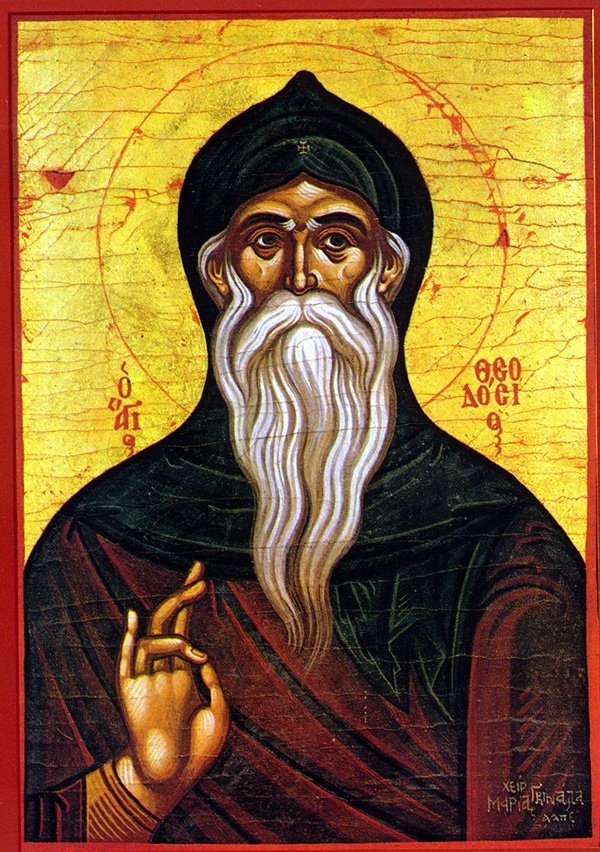
Our Holy Father Theodosius the Cenobiarch (519)
Saint Theodosius the Great lived during the fifth-sixth centuries, and was the founder of cenobitic monasticism. He was born in Cappadocia of pious parents. Endowed with a splendid voice, he zealously toiled at church reading and singing. Saint Theodosius prayed fervently that the Lord would guide him on the way to salvation.
Saint Theodosius the Great lived during the fifth-sixth centuries, and was the founder of cenobitic monasticism. He was born in Cappadocia of pious parents. Endowed with a splendid voice, he zealously toiled at church reading and singing. Saint Theodosius prayed fervently that the Lord would guide him on the way to salvation. In his early years he visited the Holy Land and met with Saint Simeon the Stylite (September 1), who blessed him and predicted future pastoral service for him.
Yearning for the solitary life, Saint Theodosius settled in Palestine into a desolate cave, in which, according to Tradition, the three Magi had spent the night, having come to worship the Savior after His Nativity. He lived there for thirty years in great abstinence and unceasing prayer. People flocked to the ascetic, wishing to live under his guidance. When the cave could no longer hold all the monks, Saint Theodosius prayed that the Lord Himself would indicate a place for the monks. Taking a censer with cold charcoal and incense, the monk started walking into the desert.
At a certain spot the charcoal ignited by itself and the incense smoke began to rise. Here the monk established the first cenobitic monastery, or Lavra (meaning “broad” or “populous”). Soon the Lavra of Saint Theodosius became renowned, and up to 700 monks gathered at it. According to the final testament of Saint Theodosius, the Lavra rendered service to neighbor, giving aid to the poor and providing shelter for wanderers.
Saint Theodosius was extremely compassionate. Once, when there was a famine in Palestine and a multitude of people gathered at the monastery, the monk gave orders to allow everyone into the monastery enclosure. His disciples were annoyed, knowing that the monastery did not have the means to feed all those who had come. But when they went into the bakery, they saw that through the prayers of the abba, it was filled with bread. This miracle was repeated every time Saint Theodosius wanted to help the destitute.
At the monastery, Saint Theodosius built a home for taking in strangers, separate infirmaries for monks and laymen, and also a shelter for the dying. Seeing that people from various lands gathered at the Lavra, the saint arranged for services in the various languages: Greek, Georgian and Armenian. All gathered to receive the Holy Mysteries in the large church, where divine services were chanted in Greek.
During the reign of the Byzantine Emperor Anastasius (491-518) there arose the heresy of Eutychius and Severus, which recognized neither the sacraments nor the clergy. The emperor accepted the false teaching, and the Orthodox began to suffer persecution. Saint Theodosius stood firmly in defense of Orthodoxy and wrote a letter to the emperor on behalf of the monks, in which they denounced him and refuted the heresy with the teachings of the Ecumenical Councils. He affirmed moreover, that the desert-dwellers and monks would firmly support the Orthodox teaching. The emperor showed restraint for a short while, but then he renewed his persecution of the Orthodox. The holy Elder then showed great zeal for the truth. Leaving the monastery, he came to Jerusalem and in the church, he stood at the high place and cried out for all to hear: “Whoever does not honor the four Ecumenical Councils, let him be anathema!” For this bold deed the monk was sent to prison, but soon returned after the death of the emperor.
Saint Theodosius accomplished many healings and other miracles during his life, coming to the aid of the needy. Through his prayers he once destroyed the locusts devastating the fields in Palestine. Also by his intercession, soldiers were saved from death, and he also saved those perishing in shipwrecks and those lost in the desert.
Once, the saint gave orders to strike the semandron (a piece of wood hit with a mallet), so that the brethren would gather at prayer. He told them, “The wrath of God draws near the East.” After several days it became known that a strong earthquake had destroyed the city of Antioch at the very hour when the saint had summoned the brethren to prayer.
Before his death, Saint Theodosius summoned to him three beloved bishops and revealed to them that he would soon depart to the Lord. After three days, he died at the age of 105. The saint’s body was buried with reverence in the cave in which he lived at the beginning of his ascetic deeds.
Troparion - Tone 8
By a flood of tears you made the desert fertile, / and your longing for God brought forth fruits in abundance. / By the radiance of miracles you illumined the whole universe! / Our Father Theodosius, pray to Christ God to save our souls!
Kontakion - Tone 8
Planted in the courts of your Lord, you blossomed beautifully with virtue, / and increased your children in the desert, showering them with streams of your tears, / O chief shepherd of the divine flock of God. / Therefore, we cry to you: “Rejoice, Father Theodosius.”
The Venerable Vitalis (5th c.)
He lived for many years as a monk in Palestine, then went to Alexandria to labor for the salvation of women living as prostitutes. He worked with his hands by day, keeping only a tenth of his earnings for himself. By night, he would take the rest of his earnings to the prostitutes’ quarter and offer his money to one of them, on condition that she would not give herself up to sin that night, but instead stay with him, praying all night for his salvation. W
He lived for many years as a monk in Palestine, then went to Alexandria to labor for the salvation of women living as prostitutes. He worked with his hands by day, keeping only a tenth of his earnings for himself. By night, he would take the rest of his earnings to the prostitutes’ quarter and offer his money to one of them, on condition that she would not give herself up to sin that night, but instead stay with him, praying all night for his salvation. When he left her, he would make her promise to tell no one of this arrangement. Not surprisingly, complaints soon reached the Patriarch, St John the Merciful (November 12) about this monk who was causing scandal by his immoral life; but the Patriarch, discerning Vitalis’ heart, did nothing. When St Vitalis died, a writing tablet was found near his body, on which was written: “Inhabitants of Alexandria, judge not before the time, until the coming of the Day of the Lord.” Then many women who had been converted from an immoral life by the Saint came forward and told of his good deeds. The people of Alexandria honored him with a lavish funeral.
Saint Vitalis shows us in at least two ways that the wisdom of the holy is foolishness to the world: He never sought to justify himself in the eyes of the world, but on the contrary did everything he could to hide his virtues; and, for all his holiness, he counted himself more sinful than the “fallen,” asking them to pray for his salvation.
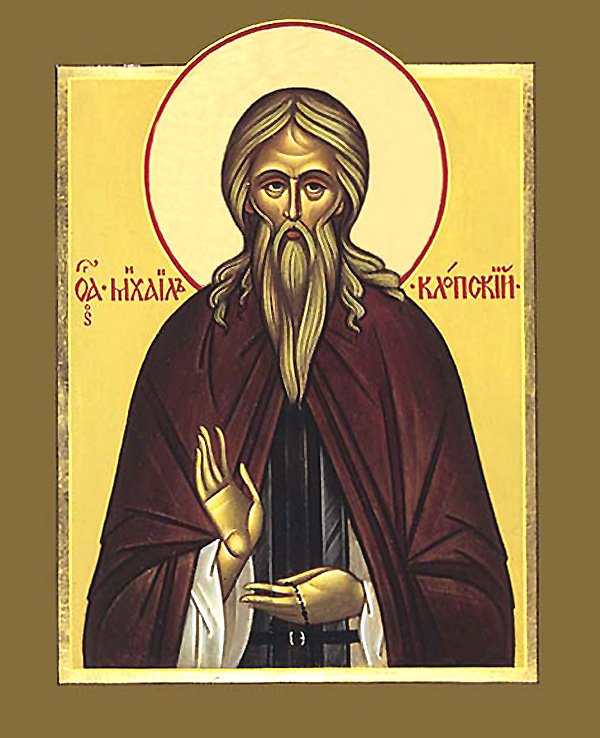
Venerable Michael of Klops, Fool for Christ (1456)
Blessed Michael of Klops was of noble lineage, and he was a relative of Great Prince Demetrius of the Don (1363-1389). He took upon himself the exploit of foolishness for Christ to avoid the praise of men. Leaving Moscow dressed in rags, he arrived at the Klops monastery, near Novgorod.
No one knew how he got into the locked cell of the hieromonk Macarius, who was going round the cell censing during the Ninth Ode of the Canon.
Blessed Michael of Klops was of noble lineage, and he was a relative of Great Prince Demetrius of the Don (1363-1389). He took upon himself the exploit of foolishness for Christ to avoid the praise of men. Leaving Moscow dressed in rags, he arrived at the Klops monastery, near Novgorod.
No one knew how he got into the locked cell of the hieromonk Macarius, who was going round the cell censing during the Ninth Ode of the Canon. A man in monastic garb sat there beneath a candle, copying out the Acts of the Holy Apostles. After the end of Matins the igumen came with some of the brethren and asked the stranger who he was, and what his name was. But he responded only by repeating the questions, and did not reveal his origin.
In church the stranger sang in the choir and read the Epistle, and he also read the Lives of the Saints at meals. All who listened were moved by the beauty and spirituality of his reading. On the Feast of the Transfiguration of the Lord, the Klops monastery was visited by Prince Constantine Dimitrievich (son of Great Prince Demetrius of the Don ).
After Communion he was in the trapeza with the princess, during which time the unknown stranger read from the Book of Job. Hearing the reading, the prince approached the reader and looked him over. Then he bowed down to him, calling his kinsman Michael Maximovich by name. The fool remarked, “Only the Creator knows me, and who I am,” but he confirmed that his name was Michael.
Saint Michael soon set an example for the brethren in all the monastic efforts. He lived at the Klops monastery for forty-four years, exhausting his body in work, vigils and various deprivations, and he received from the Lord the gift of clairvoyance.
He denounced the vices of people, not fearing the powerful of this world. He predicted the birth of Great Prince Ivan III on January 22, 1440, and his capture of Novgorod. He denounced Prince Demetrius Shemyaka for blinding his brother the Great Prince Basil the Dark (1425-1462).
On a sandy spot Saint Michael summoned forth a spring of water, having written upon the earth: “I will take the cup of salvation (Ps. 115/116:13), let the well-spring show forth on this spot.” And during a time of famine, the supplies of bread at the monastery granary did not diminish, though they distributed grain abundantly to the hungry.
Having indicated beforehand the place of his burial, the saint died on January 11, 1453.
Troparion - Tone 8
By a flood of tears you made the desert fertile, / and your longing for God brought forth fruits in abundance. / By the radiance of miracles you illumined the whole universe! / O our holy father Michael, pray to Christ our God to save our souls!
Scripture Readings
☩Epistle
2 Timothy 2:20-26
20
But in a great house there are not only vessels of gold and of silver, but also of wood and of earth; and some to honour, and some to dishonour.
21
If a man therefore purge himself from these, he shall be a vessel unto honour, sanctified, and meet for the master’s use, and prepared unto every good work.
22
Flee also youthful lusts: but follow righteousness, faith, charity, peace, with them that call on the Lord out of a pure heart.
23
But foolish and unlearned questions avoid, knowing that they do gender strifes.
24
And the servant of the Lord must not strive; but be gentle unto all men, apt to teach, patient,
25
In meekness instructing those that oppose themselves; if God peradventure will give them repentance to the acknowledging of the truth;
26
And that they may recover themselves out of the snare of the devil, who are taken captive by him at his will.
☩Gospel
Luke 19:37-44
37
And when he was come nigh, even now at the descent of the mount of Olives, the whole multitude of the disciples began to rejoice and praise God with a loud voice for all the mighty works that they had seen;
38
Saying, Blessed be the King that cometh in the name of the Lord: peace in heaven, and glory in the highest.
39
And some of the Pharisees from among the multitude said unto him, Master, rebuke thy disciples.
40
And he answered and said unto them, I tell you that, if these should hold their peace, the stones would immediately cry out.
41
And when he was come near, he beheld the city, and wept over it,
42
Saying, If thou hadst known, even thou, at least in this thy day, the things which belong unto thy peace! but now they are hid from thine eyes.
43
For the days shall come upon thee, that thine enemies shall cast a trench about thee, and compass thee round, and keep thee in on every side,
44
And shall lay thee even with the ground, and thy children within thee; and they shall not leave in thee one stone upon another; because thou knewest not the time of thy visitation.
Liturgical data sourced from OCA.org and orthocal.info