Fasting Rules
 Meat
Abstain
 Fish
Abstain
 Dairy
Abstain
 Oil
Allowed
 Wine
Allowed
Saints & Commemorations
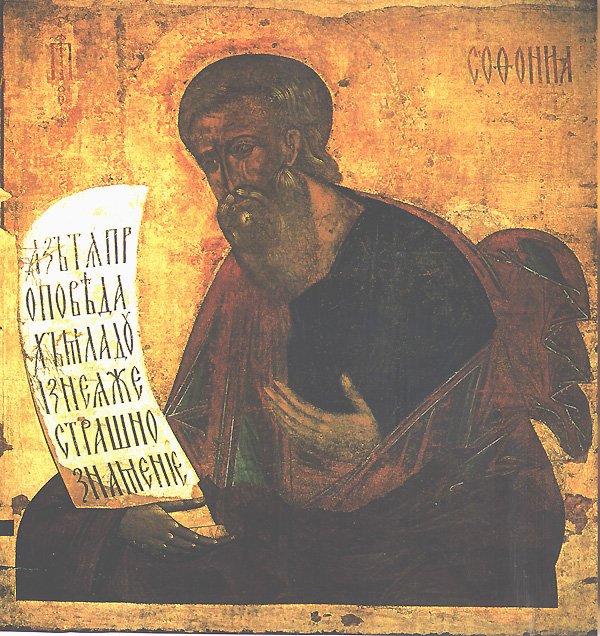
Prophet Zephaniah
The Prophet Zephaniah (Sophonias) was a contemporary of the Prophet Jeremiah and the Prophetess Oldama. He was from the tribe of Simeon, and was the ninth of the Twelve Minor Prophets of the Old Testament. The prophet lived at the royal court, where he preached repentance and helped King Josiah eliminate idol-worship.
The Prophet Zephaniah (Sophonias) was a contemporary of the Prophet Jeremiah and the Prophetess Oldama. He was from the tribe of Simeon, and was the ninth of the Twelve Minor Prophets of the Old Testament. The prophet lived at the royal court, where he preached repentance and helped King Josiah eliminate idol-worship.
He prophesied about the calamities that were to come for the people of Judea and the surrounding regions: Gaza, Ascalon, Crete, and against the Moabites, the Ammonites and the Ninevites.
Troparion - Tone 2
We celebrate the memory / of Your prophet Zephaniah, O Lord; / through him we entreat You, / save our souls.
Kontakion - Tone 4
You have been revealed by the Spirit of God to be brilliant, Prophet Zephaniah, / for you proclaimed the coming of God: / “Rejoice greatly, O Daughter of Zion! / Proclaim Him, O Jerusalem! / Behold, your King is coming to save mankind!”
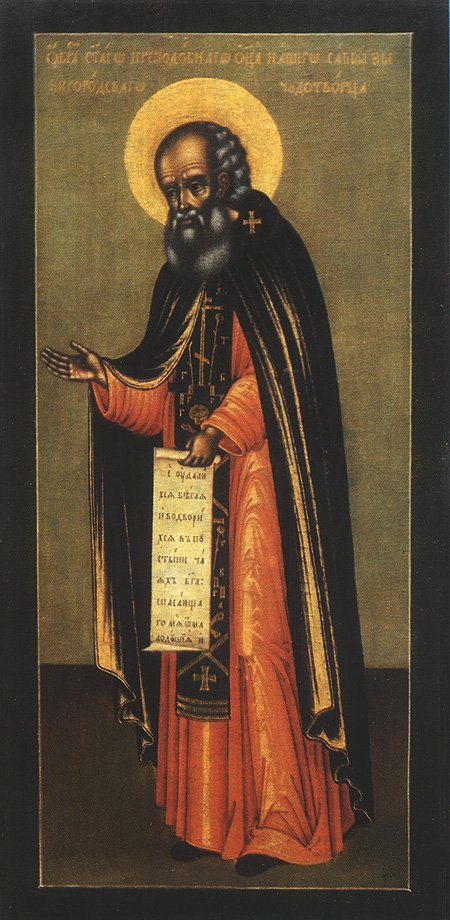
Ven. Savva of Zvenigorod
Saint Savva of Zvenigorod forsook the world in his early youth, and received the monastic tonsure from Saint Sergius of Radonezh (September 25 and July 5), and was his disciple and fellow-ascetic.
Saint Savva loved solitude, and avoided conversing with people. He lived in constant toil, lamenting the poverty of his soul, and trembling before the judgment of God.
Saint Savva of Zvenigorod forsook the world in his early youth, and received the monastic tonsure from Saint Sergius of Radonezh (September 25 and July 5), and was his disciple and fellow-ascetic.
Saint Savva loved solitude, and avoided conversing with people. He lived in constant toil, lamenting the poverty of his soul, and trembling before the judgment of God. He was a model of simplicity and humility, and he attained such a depth of spiritual wisdom that “in the Monastery of Saint Sergius he was the Father Confessor to all the brethren, a venerable and most learned Elder.”
When Great Prince Demetrios of the Don built the Monastery of the Dormition of the Mother of God at the Dubenka River, in gratitude for the victory over Mamai, Savva became the Igoumen, with the blessing of Saint Sergius. Maintaining the simple manner of his life of asceticism, he ate plants, wore coarse clothing and slept on the ground.
When their Igoumen Saint Nikon (November 17) left to go into the wilderness in 1392, the brethren of the Trinity-Saint Sergius Lavra asked Saint Savva to become the Igoumen of the Monastery. He shepherded the flock entrusted to him well, to the best of his ability, helped by the prayers of his Spiritual Father, Saint Sergius. According to Tradition, the well outside the Lavra walls was built while he was Igoumen.
Prince Yuri of Zvenigorod, a godson of Saint Sergius, regarded Saint Savva with much love and esteem. He chose Saint Savva as his Spiritual Father and begged him to come and bestow his blessing upon his entire household. The Saint had hoped to return to his Monastery, but the Prince begged him to stay and establish a new monastery in his homeland, near Zvenigorod, at a place called Storozhev.
Saint Savva acceded to Prince Yuri's request, and praying tearfully before an icon of the Mother of God, he entreated her protection for that site in the wilderness. At Storozhev he built a small wooden church in honor of the Nativity of the Most Holy Theotokos, and nearby a small cell for himself. Here he established a Monastery in 1399, and with paternal love, he accepted all who came seeking a life of quietude and seclusion.
Saint Savva worked very hard to build up the Monastery. He dug a well at the foot of the hill, from which he carried water on his own shoulders. He encircled the Monastery with a wooden palisade, and in a hollow above it, he dug a cell where he could live in solitude.
In 1399 Saint Savva blessed his spiritual son, Prince Yuri, to go on a military campaign, predicting that he would defeat his enemy. Through the prayers of the holy Elder, the Prince's army won a speedy victory. Through the efforts of Saint Savva, a stone church of the Nativity of the Most Holy Theotokos was built to replace the old wooden one.
After appointing his disciple, who was also named Savva, as his successor, Saint Savva went to the Lord at an advanced age on December 3, 1406. News of the holy God-pleaser's repose quickly spread throughout the vicinity, and all the Christ-loving citizens of Zvenigorod, both noble and commoners, gathered for the burial of the departed Saint, bringing with them the infirm and sick. After singing hymns over the deceased, they buried him with honor in the church of the Nativity of the Most Holy Theotokos, which he himself had built.
Veneration of the holy God-pleaser by the local people began immediately after his death. The miraculous curative power issuing from the Saint's grave and his numerous appearances convinced everyone that Igoumen Savva was a Saint. In a letter of 1539 Saint Savva was described as a wonderworker. Tsar Alexei Mikhailovich had a special veneration for him, frequently visiting the Monastery of Saint Savva on foot. Tradition has preserved a remarkable account of how Saint Savva was saved from a ferocious bear.
The Life of Saint Savva, compiled in the XVI century, relates that at the end of the XV century (1480-1490), the Saint appeared to Father Dionysios, the fourth Igoumen of Saint Savva Monastery and said: “Dionysios! Wake up and paint my icon.” When Father Dionysios asked who he was, he replied, “I am Savva, the founder of this abode.”
Father Dionysios had not known the Saint personally, so he summoned Elder Habakkuk, who had known Saint Savva in his youth, hoping to convince himself that his dream was not a delusion. He described the Saint's outward appearance, and Father Habakkuk assured him that the Saint looked exactly as the Igoumen had seen him in his dream. Then Father Dionysios obeyed Saint Savva's order and painted his icon.
Saint Savva was numbered among the Saints at the Moscow Council of 1547. His incorrupt relics were recovered on January 19, 1652.
The first uncovering of the Saint's relics occurred on January 19, 1652; and the second on August 10, 1998.
Troparion - Tone 8
You appeared as a beautiful growth in the wilderness, O Venerable one, / for from your youth you chose a life of purity. / Following your Spiritual Father, by his teaching your mind was turned to heavenly things, / and you appeared as a most wise shepherd of your flock. / Therefore, Christ, like a beautiful lamp, has enriched you with miracles. / O Savva, our Father, pray for the salvation of our souls.
Kontakion - Tone 2
Inflamed with love for the Lord, / you forsook bodily passions through abstinence and became an unwaning lamp of the Divine light, / enlightening with miraculous rays all who come to the shrine of your relics, / O Venerable Savva, our Father.
Our Venerable Father John the Silent, Bishop of Colonia (558)
Saint John the Silent was born around 454 in the city of Nicopolis, Armenia into the family of a military commander named Enkratius and his wife Euphemia. The boy began to study Holy Scripture, and he loved solitude and prayer with all his heart.
With the inheritance his parents left him, John built a church dedicated to the Most Holy Theotokos.
Saint John the Silent was born around 454 in the city of Nicopolis, Armenia into the family of a military commander named Enkratius and his wife Euphemia. The boy began to study Holy Scripture, and he loved solitude and prayer with all his heart.
With the inheritance his parents left him, John built a church dedicated to the Most Holy Theotokos. At eighteen years of age, John became a monk, living an ascetic life of fasting, prayer, and temperance with ten other monks at the church he had founded.
At the request of the citizens of Colonia, the Metropolitan of Sebaste consecrated the twenty-eight-year-old John as Bishop of Colonia. Having assumed the episcopal throne, the saint did not alter his strict ascetic manner of life. Under the influence of the saint his relatives, his brother Pergamios (an associate of the emperors Zeno and Anastasius) and his nephew Theodore (an associate of the emperor Justinian), also lived in a Christian manner.
In John’s tenth year as bishop, the governorship of Armenia was assumed by Pazinikos, the husband of the saint’s sister, Maria. The new governor began to interfere in spiritual and ecclesiastical matters, and there was unrest in the Church. Saint John then went to Constantinople, and through Archbishop Euthymius, he entreated the emperor Zeno to defend the Armenian Church from the evil Governor.
Overwhelmed by worldly quarrels, John secretly left his diocese and sailed to Jerusalem. With tears he besought God to show him a place where he might live and find salvation. A bright star appeared, which led Saint John to the Lavra of Saint Savva.
John, concealing his episcopal rank, was accepted in the community as a simple novice. Under the guidance of the igumen Saint Savva(December 5), Bishop John toiled obediently for more than four years at every task he was assigned. When a guesthouse was built at the Lavra, Saint John served the workers, serving their food and assisting in the construction of the building. When a cenobitic monastery for novices was being built, John was once again assigned to help the workers.
Seeing Saint John’s humility and love of labor, Saint Savva deemed him worthy of ordination to presbyter. Saint John was forced to reveal his rank to Patriarch Elias of Jerusalem (494-517), who told Saint Savva that John could not be ordained. Moreover, he said that John was to live in silence, and that no one should trouble him. Soon the Lord also revealed Saint John’s secret to Saint Savva. Saint John spent four years in his cell, receiving no one and not going out even for church.
Desiring ever greater solitude and increased abstinence, Saint John quit the Lavra and withdrew into the desert, where he spent more than nine years, eating plants and grass. He survived a devastating incursion of the Saracens and did not perish, only because the Lord sent him a defender: a ferocious lion. When the enemy tried to harm the saint, the lion attacked them and they scattered in fright. Tradition speaks of many miracles Saint John performed during this time in the desert.
When Saint Savva returned after an extended stay in Scythopolis, he persuaded Saint John to forsake the wilderness and to live at the monastery. After this, the Lord, in a miraculous way, revealed to everyone at the Lavra that the monk John was actually a bishop.
When Saint John reached age seventy, his holy and God-bearing spiritual Father Saint Savva died. The saint grieved deeply over this, since he was not present at the time. Saint Savva appeared to him in a vision, and having consoled him, he foretold that there would be much toil ahead in the struggle against heresy. Saint John even had to leave his solitude to strengthen the brethren in the struggle with the Origenists.
Saint John the Silent spent sixty-six years at the Lavra of Saint Savva the Sanctified. Through his constant ascetic efforts, by his untiring prayer and humble wisdom, Saint John acquired the grace of the Holy Spirit. At his prayers, many miracles took place, and he was able to discern the secret thoughts of people. He healed the sick and those possessed by demons. Even during his lifetime he saved those who invoked his name from certain destruction. Once, he scattered fig seeds on barren rock, and a beautiful and fruitful tree sprang up. In time, the tree grew so much that it overshadowed the saint’s cell.
Saint John the Silent departed to the Lord in peace at the age of 104.
Troparion - Tone 8
By a flood of tears you made the desert fertile, / and your longing for God brought forth fruits in abundance. / By the radiance of miracles you illumined the whole universe! / O our holy father John, pray to Christ our God to save our souls!
Theodore, Archbishop of Alexandria
The Hieromartyr Theodore, Bishop of Alexandria, was born in Egypt in the city of Alexandria. This city was famous for its many martyrs and confessors: from the holy Evangelist Mark, Protomartyr of Alexandria (April 25), to Saint Athanasius the Great (January 18 and May 2), a pillar and confessor of Orthodoxy.
The Hieromartyr Theodore, Bishop of Alexandria, was born in Egypt in the city of Alexandria. This city was famous for its many martyrs and confessors: from the holy Evangelist Mark, Protomartyr of Alexandria (April 25), to Saint Athanasius the Great (January 18 and May 2), a pillar and confessor of Orthodoxy.
Regrettably, historical records do not give us precise details of Saint Theodore’s life and deeds, but the Church of Christ has preserved the name of the hieromartyr in its diptychs for all time.
A fiery preacher, powerful of word and church activity, Bishop Theodore evoked an angry hatred in the boisterous pagans of Alexandria, who did not like his preaching. During one of his sermons they surrounded and seized the saint. They beat him and jeered at him, but he did not offer resistance. They placed a crown of thorns on his head, and led him through the city.
Then they led him to the seacoast and threw him from a cliff into the sea, but the wind and the waves carried him back to dry land. The astonished pagans brought Saint Theodore to the prefect of the city, who commanded that he be subjected to harsh tortures. Not a word did the torturers hear from the tortured confessor, except his prayer to the Lord. Then the holy martyr was handed over to Roman soldiers and executed in the manner of the Apostle Paul, he was beheaded with a sword.
Troparion - Tone 4
By sharing in the ways of the Apostles, / you became a successor to their throne. / Through the practice of virtue, you found the way to divine contemplation, O divinely-inspired one; by rightly dividing the word of truth without error, you defended the Faith, / even to the shedding of your blood. / O Hieromartyr Theodore, entreat Christ God to save our souls.
Kontakion - Tone 4
As one who lived piously among Hierarchs and who underwent martyrdom, / O divinely-wise one, / you abolished the sacrifices of idolatry and showed yourself to be a protector of your flock. / Therefore, we cry fervently to you: / “By your intercessions, deliver us from all misfortunes, O Theodore our Father.”
Angelis the New Martyr
Scripture Readings
☩Epistle
1 Timothy 6:17-21
17
Charge them that are rich in this world, that they be not highminded, nor trust in uncertain riches, but in the living God, who giveth us richly all things to enjoy;
18
That they do good, that they be rich in good works, ready to distribute, willing to communicate;
19
Laying up in store for themselves a good foundation against the time to come, that they may lay hold on eternal life.
20
O Timothy, keep that which is committed to thy trust, avoiding profane and vain babblings, and oppositions of science falsely so called:
21
Which some professing have erred concerning the faith. Grace be with thee. Amen. The first to Timothy was written from Laodicea, which is the chiefest city of Phrygia Pacatiana.
☩Gospel
Luke 20:9-18
9
Then began he to speak to the people this parable; A certain man planted a vineyard, and let it forth to husbandmen, and went into a far country for a long time.
10
And at the season he sent a servant to the husbandmen, that they should give him of the fruit of the vineyard: but the husbandmen beat him, and sent him away empty.
11
And again he sent another servant: and they beat him also, and entreated him shamefully, and sent him away empty.
12
And again he sent a third: and they wounded him also, and cast him out.
13
Then said the lord of the vineyard, What shall I do? I will send my beloved son: it may be they will reverence him when they see him.
14
But when the husbandmen saw him, they reasoned among themselves, saying, This is the heir: come, let us kill him, that the inheritance may be ours.
15
So they cast him out of the vineyard, and killed him. What therefore shall the lord of the vineyard do unto them?
16
He shall come and destroy these husbandmen, and shall give the vineyard to others. And when they heard it, they said, God forbid.
17
And he beheld them, and said, What is this then that is written, The stone which the builders rejected, the same is become the head of the corner?
18
Whosoever shall fall upon that stone shall be broken; but on whomsoever it shall fall, it will grind him to powder.
Liturgical data sourced from OCA.org and orthocal.info