Fasting Rules
 Meat
Abstain
 Fish
Abstain
 Dairy
Abstain
 Oil
Abstain
 Wine
Abstain
Saints & Commemorations
Prophet Habbakuk
He prophesied in the time of Joachim, just before the Jewish people were taken into captivity in Babylon. He himself escaped captivity, and after Jerusalem was destroyed, returned to his homeland. Once he was taking some food to his harvesters when an Angel transported him to Babylon to feed the Prophet Daniel in the lions’ den, then bore him back to Judea (this is told in the full version of the book of Daniel, ch. 6
He prophesied in the time of Joachim, just before the Jewish people were taken into captivity in Babylon. He himself escaped captivity, and after Jerusalem was destroyed, returned to his homeland. Once he was taking some food to his harvesters when an Angel transported him to Babylon to feed the Prophet Daniel in the lions’ den, then bore him back to Judea (this is told in the full version of the book of Daniel, ch. 6 LXX). The third chapter of his prophecy is used as the Fourth Ode of the Matins Canon(the Ode is usually sung in full only in monasteries during Lent, but the eirmos of the Fourth Ode, sung in many parishes, usually refers to the Prophet). His holy relics were found through a revelation in Palestine during the reign of Theodosius the Great, and a chapel built there. His name means “Father of the Resurrection.”
Joannicos the Monk of Devich
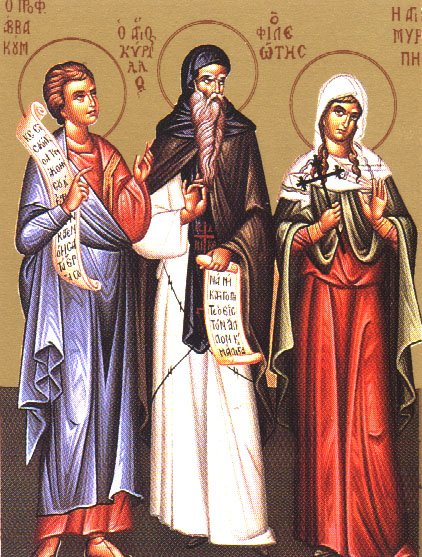
Holy Martyr Myrope (Myropea) of Chios (251)
The Holy Martyr Myrope was born in the city of Ephesus at the beginning of the third century. She lost her father at an early age, and her mother raised her in the Christian Faith. Saint Myrope frequently visited the grave of the Martyr Hermione (September 4), daughter of the holy Apostle Philip, took myrrh from her relics, and healed the sick with it.
The Holy Martyr Myrope was born in the city of Ephesus at the beginning of the third century. She lost her father at an early age, and her mother raised her in the Christian Faith. Saint Myrope frequently visited the grave of the Martyr Hermione (September 4), daughter of the holy Apostle Philip, took myrrh from her relics, and healed the sick with it.
During the persecution by Decius (249-251), Myrope went with her mother to the island of Chios, where they spent their time in fasting and prayer. Once, by order of the cruel governor of the island, the soldier Isidore (May 14), a man of deep faith and great piety, was martyred. Saint Myrope secretly removed the body of the martyr and buried it. The soldiers, who had been ordered not to allow the Christians to take Isidore’s body, were sentenced to death.
Saint Myrope took pity on the condemned, and she told the soldiers and then the governor what she had done. At the trial she confessed herself a Christian. For this they gave her a fierce beating and then threw her in prison. At midnight, while she was praying, a light shone in the prison. Saint Isidore appeared surrounded by angels, and Saint Myrope surrendered her soul to God. The prison was immediately filled with a sweet fragrance. The pagan guard, trembling at the vision, told this to a priest. Later, he accepted Baptism and a martyric death for his confession of Christ.
Troparion - Tone 4
Your lamb Myrope calls out to You, O Jesus, in a loud voice: / “I love You, my Bridegroom, and in seeking You I endure suffering. / In Baptism I was crucified so that I might reign in You, / and I died so that I might live with You. / Accept me as a pure sacrifice, / for I have offered myself in love.” / Through her prayers, save our souls, since You are merciful.
Our Holy Father Athanasius "the Resurrected," Recluse of the Kiev Caves (1176)
After many years of ascetic struggle, Athanasius died and was prepared for burial. After lying dead for two full days, he inexplicably came back to life: the monks who came to bury him were astonished to find him sitting up and weeping. The brethren gathered around him and asked him many questions about what he had seen of the next world, but he
After many years of ascetic struggle, Athanasius died and was prepared for burial. After lying dead for two full days, he inexplicably came back to life: the monks who came to bury him were astonished to find him sitting up and weeping. The brethren gathered around him and asked him many questions about what he had seen of the next world, but he would only answer ‘Save yourselves!’ When they pressed him further, he said ‘If I told you, you would not believe me or want to listen to me.’ His final reply was ‘Repent every moment, and pray to the Lord Jesus Christ and to His most pure Mother.’ He then shut himself in his cell and lived another twelve years, taking only bread and water and never speaking again to anyone.
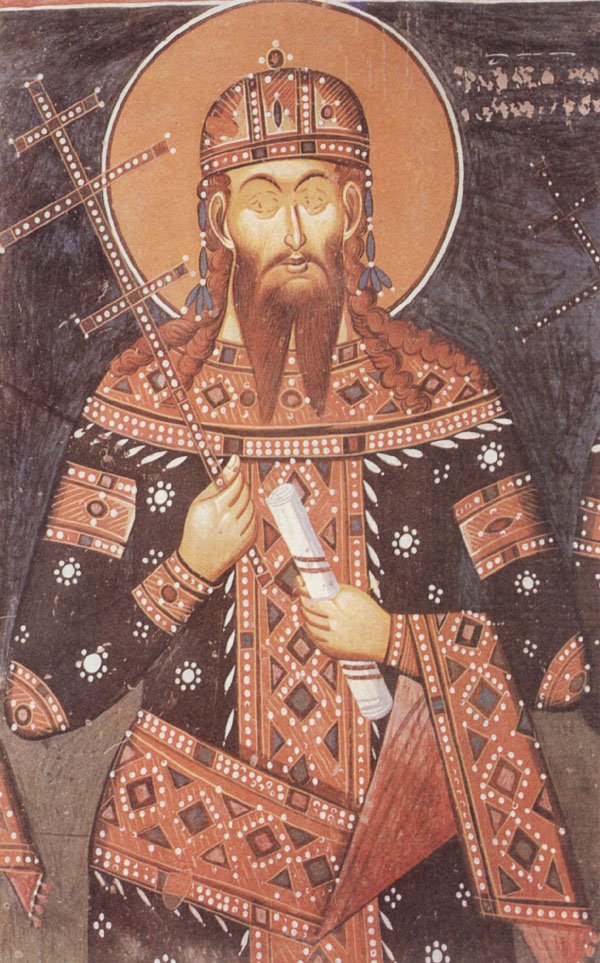
Saint (Stephen) Uroš, King of Serbia (1367)
Saint Stephen Urosh, King of Serbia, was son of King Dushan Nemany, and was born in the year 1337. In 1346 he was crowned king. Dushan sought the daughter of the French king for his son, but the Roman Pope insisted that the princess not change from the Latin confession. Dushan did not want to see a Catholic in his family, and because of this Saint Stephen Urosh entered into marriage with the daughter of Vlad, Prince of Walachia.
Saint Stephen Urosh, King of Serbia, was son of King Dushan Nemany, and was born in the year 1337. In 1346 he was crowned king. Dushan sought the daughter of the French king for his son, but the Roman Pope insisted that the princess not change from the Latin confession. Dushan did not want to see a Catholic in his family, and because of this Saint Stephen Urosh entered into marriage with the daughter of Vlad, Prince of Walachia.
Upon the death of his father (+ 1355), Saint Stephen Urosh became the independent and actual ruler of Serbia. He was faithful to the Lord; like a father he provided for widows and orphans, he pacified quarrels and maintained peace, he was charitable to the poor, and he defended the downtrodden.
In the interests of peace in Serbia and indeed for the preservation of his own life, Saint Stephen was obliged to flee to his kinsman, Prince Lazar. Saint Stephen’s uncle, Vulkashin, immediately seized the throne, but his fear of rivals gave him no peace. Through his sister, Saint Stephen’s mother, he invited his nephew to come to the city of Skopje, on the pretext of a reconciliation. Greeting him with honor, as Tsar, he invited him to go hunting. When Saint Stephen, weary from the hunt, went off with his horse to a well and bent over to take a sip of water, Vulkashin struck him a mortal blow on the head with a mace.
Saint Porphyrios of Kavsokalyvia (1991) (Nov. 19 OC)
One of the true God-bearing Elders of our own time, he was glorified by the Church in 2013.
Scripture Readings
☩Epistle
1 Timothy 5:22-6:11
22
Lay hands suddenly on no man, neither be partaker of other men’s sins: keep thyself pure.
23
Drink no longer water, but use a little wine for thy stomach’s sake and thine often infirmities.
24
Some men’s sins are open beforehand, going before to judgment; and some men they follow after.
25
Likewise also the good works of some are manifest beforehand; and they that are otherwise cannot be hid.
1
Let as many servants as are under the yoke count their own masters worthy of all honour, that the name of God and his doctrine be not blasphemed.
2
And they that have believing masters, let them not despise them, because they are brethren; but rather do them service, because they are faithful and beloved, partakers of the benefit. These things teach and exhort.
3
If any man teach otherwise, and consent not to wholesome words, even the words of our Lord Jesus Christ, and to the doctrine which is according to godliness;
4
He is proud, knowing nothing, but doting about questions and strifes of words, whereof cometh envy, strife, railings, evil surmisings,
5
Perverse disputings of men of corrupt minds, and destitute of the truth, supposing that gain is godliness: from such withdraw thyself.
6
But godliness with contentment is great gain.
7
For we brought nothing into this world, and it is certain we can carry nothing out.
8
And having food and raiment let us be therewith content.
9
But they that will be rich fall into temptation and a snare, and into many foolish and hurtful lusts, which drown men in destruction and perdition.
10
For the love of money is the root of all evil: which while some coveted after, they have erred from the faith, and pierced themselves through with many sorrows.
11
But thou, O man of God, flee these things; and follow after righteousness, godliness, faith, love, patience, meekness.
☩Gospel
Luke 20:1-8
1
And it came to pass, that on one of those days, as he taught the people in the temple, and preached the gospel, the chief priests and the scribes came upon him with the elders,
2
And spake unto him, saying, Tell us, by what authority doest thou these things? or who is he that gave thee this authority?
3
And he answered and said unto them, I will also ask you one thing; and answer me:
4
The baptism of John, was it from heaven, or of men?
5
And they reasoned with themselves, saying, If we shall say, From heaven; he will say, Why then believed ye him not?
6
But and if we say, Of men; all the people will stone us: for they be persuaded that John was a prophet.
7
And they answered, that they could not tell whence it was.
8
And Jesus said unto them, Neither tell I you by what authority I do these things.
Liturgical data sourced from OCA.org and orthocal.info