Fasting Rules
 Meat
Allowed
 Fish
Allowed
 Dairy
Allowed
 Oil
Allowed
 Wine
Allowed
Saints & Commemorations
Ven. Parasceva of Serbia
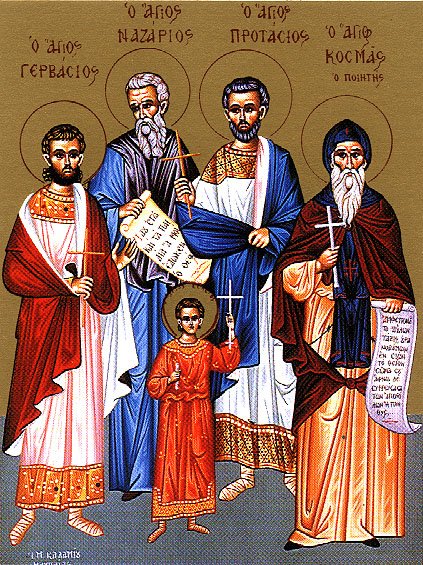
Holy Martyrs Nazarius, Gervasius, Protasius, and Celsus of Milan (1st c.)
The Holy Martyrs Nazarius, Gervasius, Protasius and Celsus of Milan suffered during the reign of the emperor Nero (54-68). Saint Nazarius (son of the Christian Perpetua and the Jew Africanus) was born at Rome and was baptized by Bishop Linus. From his youth Nazarius decided to devote his life to preaching Christ and to aid wandering Christians.
The Holy Martyrs Nazarius, Gervasius, Protasius and Celsus of Milan suffered during the reign of the emperor Nero (54-68). Saint Nazarius (son of the Christian Perpetua and the Jew Africanus) was born at Rome and was baptized by Bishop Linus. From his youth Nazarius decided to devote his life to preaching Christ and to aid wandering Christians. With this intent he left Rome and arrived in Mediolanum (Milan).
Saints Protasius and Gervasius were twin brothers from Mediolanum (Milan), the sons of wealthy Roman citizens, Vitalius and Valeria. When they received their inheritance from their parents, they distributed the money to the poor, freed their slaves, and occupied themselves with fasting and prayer. The pagans locked them up in prison because they were Christians. Saint Nazarius met Protasius and Gervasius when he was visiting Christians in the Mediolanum prison. He so loved the twins that he wanted to suffer and die with them. The ruler heard that he was visiting the prisoners, so he had Saint Nazarius beaten with rods, then driven from the city.
Saint Nazarius proceeded to Gaul (modern France), and there he successfully preached Christianity and converted many pagans. In the city of Kimel he baptized Celsus, the son of a Christian woman who entrusted her child to the saint. Nazarius raised the boy in piety, and acquired a faithful disciple and coworker in his missionary labors.
The pagans threw the saints to wild animals to be eaten, but the beasts would not touch them. Afterwards, they tried to drown the martyrs in the sea, but they walked upon the water as if on dry land. The soldiers who carried out the orders were so amazed that they themselves accepted Christianity and released the holy martyrs.
Saints Nazarius and Celsus went to Milan and visited Gervasius and Protasius in prison. For this, they were brought before Nero, who ordered that Saints Nazarius and Celsus be beheaded. Soon after this the holy brothers Gervasius and Protasius were also executed. The relics of all four martyrs were stolen by a Christian named Philip, and were buried in his house.
Many years later, during the reign of the holy Emperor Theodosius (408-450), Saint Ambrose, Bishop of Milan (December 7), discovered the relics of Saints Gervasius and Protasius through a revelation from God.
In the reign of Arcadius and Honorius, Saint Ambrose also discovered the relics of Saints Nazarius and Celsus. The holy relics, glorified by many healings, were solemnly transferred to the Milan cathedral.
Troparion - Tone 4
Let us praise the fourfold company of martyrs: / Nazarius, Protase, Gervase and Celsus. / For they preached the Trinity to all / and by their contest dispelled the worship of idols. / Through their prayers, O Christ God, have mercy on us all.
Saint Cosmas the Hymnographer (8th c.)
He was from Jerusalem. An orphan, he was adopted into the family of St John of Damascus (commemorated December 4). He became Bishop of Maiuma, a city on the coast of Palestine, which was later named Constantia. Like his adoptive brother he became a noted hymnographer: The Canon of the Cross (Sept. 14) and the Canon for Christ’s Nativity, “Christ is born, give ye glory…” are his compositions.
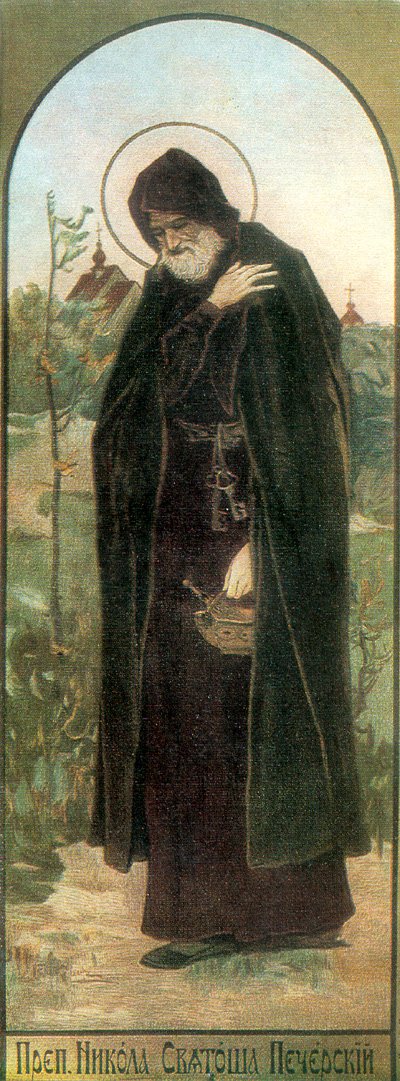
Saint Nicholas the Pious (Sviatosha), Prince of Chernigov (1143)
Saint Nicholas Sviatosha, Prince of Chernigov, and Wonderworker of the Kiev Caves, Near Caves, was a great-grandson of Great Prince Yaroslav the Wise and son of Prince David Svyatoslavich of Chernigov (+ 1123). Nicholas was the Prince of Lutsk, and he had a wife and children (his daughter was later married to the Novgorod prince Saint Vsevolod-Gabriel (February 11).
Saint Nicholas Sviatosha, Prince of Chernigov, and Wonderworker of the Kiev Caves, Near Caves, was a great-grandson of Great Prince Yaroslav the Wise and son of Prince David Svyatoslavich of Chernigov (+ 1123). Nicholas was the Prince of Lutsk, and he had a wife and children (his daughter was later married to the Novgorod prince Saint Vsevolod-Gabriel (February 11).
On February 17, 1106 the holy prince left his family and was tonsured at the Kiev Caves monastery. Nicholas Sviatosha carried out his obediences with great humility. For three years he worked in the kitchen, for which he chopped wood and carried water. For the next three years, he was gatekeeper at the monastery. The saint had a garden around his cell. Out of his own means he built at the monastery the temple of the Holy Trinity and the infirmary church in the name of Saint Nicholas, his patron saint.
Saint Nicholas was the first of the Russian princes to accept monasticism, patiently enduring the reproaches of his brothers for his decision to lead a life of humble obedience. The saint’s doctor, Peter, pointed out to the royal ascetic that such exploits of obedience had injured his health. But suddenly the doctor himself fell sick, and was healed only by the prayer of Saint Nicholas. Then Peter himself was tonsured.
After he had progressed through various obediences, Saint Nicholas took upon himself the vow of silence. When the saint received money, he used it to beautify the church and to procure books (because he loved reading), or he distributed it to the poor. Saint Nicholas was a zealous peacemaker; in 1142 he reconciled the Prince of Chernigov with the Great Prince Vsevolod.
Soon after the death of the saint, his brother Prince Izyaslav fell grievously ill. The igumen of the monastery sent the sick man the saint’s hairshirt. Izyaslav put it on and was healed.
Troparion - Tone 8
By a flood of tears you made the desert fertile, / and your longing for God brought forth fruits in abundance. / By the radiance of miracles you illumined the whole universe! / O our holy father Nicholas, pray to Christ our God to save our souls!
Scripture Readings
☩Epistle
Ephesians 4:14-19
14
That we henceforth be no more children, tossed to and fro, and carried about with every wind of doctrine, by the sleight of men, and cunning craftiness, whereby they lie in wait to deceive;
15
But speaking the truth in love, may grow up into him in all things, which is the head, even Christ:
16
From whom the whole body fitly joined together and compacted by that which every joint supplieth, according to the effectual working in the measure of every part, maketh increase of the body unto the edifying of itself in love.
17
This I say therefore, and testify in the Lord, that ye henceforth walk not as other Gentiles walk, in the vanity of their mind,
18
Having the understanding darkened, being alienated from the life of God through the ignorance that is in them, because of the blindness of their heart:
19
Who being past feeling have given themselves over unto lasciviousness, to work all uncleanness with greediness.
☩Gospel
Luke 9:7-11
7
Now Herod the tetrarch heard of all that was done by him: and he was perplexed, because that it was said of some, that John was risen from the dead;
8
And of some, that Elias had appeared; and of others, that one of the old prophets was risen again.
9
And Herod said, John have I beheaded: but who is this, of whom I hear such things? And he desired to see him.
10
And the apostles, when they were returned, told him all that they had done. And he took them, and went aside privately into a desert place belonging to the city called Bethsaida.
11
And the people, when they knew it, followed him: and he received them, and spake unto them of the kingdom of God, and healed them that had need of healing.
Liturgical data sourced from OCA.org and orthocal.info