Fasting Rules
 Meat
Allowed
 Fish
Allowed
 Dairy
Allowed
 Oil
Allowed
 Wine
Allowed
Saints & Commemorations
Ss Peter, Aleksy, Jonah, Philip, Germogen, Metrs. Moscow
This Feast of the Hierarchs of Moscow was established during the reign of Tsar Theodore and Patriarch Job in the year 1596. All of them are commemorated individually as well as on this day. Only Sts Peter, Alexis, Jonas and Philip are specifically mentioned in the Menaion service, but other holy hierarchs of Moscow have been added to the commemoration over the years.
Eudokimos the Unknown of Mount Athos
Nothing is known about the life and deeds of Venerable Eudokimos (Eudókimos) of Vatopedi.
On October 5, 1840, 1 the monks of the Athonite Monastery of Vatopedi were renovating the burial vault for the brethren. Suddenly, the roof collapsed, covering one of the corners of the vault. The monks began to clear the blocked corner and suddenly they smelled a wondrous fragrance.
After clearing the rubble from the vault, the monks found a human skeleton clothed in a cloth chiton. The skeleton was in a kneeling position, his hands were folded on his chest and held an icon of the Most Holy Theotokos. His holy relics exuded such a fragrance that it filled everything around. The brethren of the monastery considered this as a sign that the Saint had pleased the Lord. 2 Judging by his clothes, he reposed during the first half of the XVII century.
Archbishop Chrysanthos of Smyrna (who was living in retirement at the Monastery), addressed Metropolitan Gregory of Adrianople and the brethren, saying: "With the dissolution of the flesh, our very bones give a certain tribute to the earth with a stench; but the relics of this unknown Saint exude a paradisiacal fragrance. Should we not conclude from this that the Spirit of God, Who dwelt in this Saint during his lifetime, has not forsaken him after his death? Therefore, let us glorify God, Who is wondrous in His Saints, and let us honor His holy servant."
The fragrant relics were transferred to the katholikon on the evening of October 4, and soon healings took place from them. With the blessing of the Patriarch of Constantinople, the brethren gave the Saint the symbolic name of Eudokimos. it was decided that if he did not wish to be glorified with that name, he would appear to the monks and reveal his true name.
It remained a mystery exactly how the relics of the unknown monk got into the tomb, because a deceased monk is first buried; and after three years, only his bones are placed in the vault. According to one version, the Saint foresaw the hour of his death, but he said nothing to anyone and, taking an icon of the Mother of God, he hid in a remote place in the burial vault, where he departed quietly and humbly to the Lord.
Since then, the Venerable Newly-Appeared Eudokimos has been honored on Mount Athos. His relics continue to emit a fragrance, and they are renowned for their numerous miraculous healings. By praying to the Saint, one of the monks on the Holy Mountain, who suffered from consumption and was near death, was healed. Another monk, Gabriel, was also healed by praying to the Saint, and in gratitude he donated a precious silver reliquary for the venerable head of Venerable Eudokimos.
Some time after the discovery of the relics, a certain monk from Vatopedi had a vision, in which the Saint said that his true name was Savva. Monastic tradition continues to identify Saint Eudokimos with a monk who lived during the XIV century: Saint Savva of Vatopedi. However, doubts were expressed about this, and the Church did not pronounce its judgment on this occasion.
Through the prayers of our Venerable Father Eudokimos, may we all be delivered from the afflictions of body and soul which we may encounter, and may we also inherit the Heavenly Kingdom. Amen.
1 An article in Orthodox Life # 5, 1979 says that in September 1841 renovations were being carried out on the dilapidated burial vault at Vatopedi Monastery during the tenure of Archimandrite Philaret, where the bones of the Fathers and brethren were kept. When the workers started to dismantle the roof, it caved in, due to their negligence, and one corner of the vault was filled with rubble.
2 Greek, εὐδοκία: i.e., "good will, glorified, pleasant, or given by grace."
Troparion - Tone 8
In you, O Father, was preserved with exactness what was according to the image; / for you took up the Cross and followed Christ. / By so doing, you taught us to disregard the flesh, for it passes away; / but to care for the soul, since it is immortal. / Therefore, O Venerable Eudokimos your spirit rejoices with the Angels.
Kontakion - Tone 2
Having divinely armed yourself with purity of soul / and firmly grasping unceasing prayer as a spear, you slew the hordes of demons. / Therefore, we beseech you, O Father Eudokimos: / “Always intercede for those who honor you.”
Holy Martyr Charitina of Amissos (304)
She was the handmaid (according to the Great Horologion) or adopted daughter (according to the Prologue) of an eminent Roman citizen named Claudius, during the reign of Diocletian. She was betrayed as a Christian to the governor Dometian, before whom she fearlessly confessed her faith. After she had endured many cruel tortures, the governor sent some dissolute youths to rape her.
She was the handmaid (according to the Great Horologion) or adopted daughter (according to the Prologue) of an eminent Roman citizen named Claudius, during the reign of Diocletian. She was betrayed as a Christian to the governor Dometian, before whom she fearlessly confessed her faith. After she had endured many cruel tortures, the governor sent some dissolute youths to rape her. Having prayed to be spared this dishonor, she was permitted to give up her soul to God.
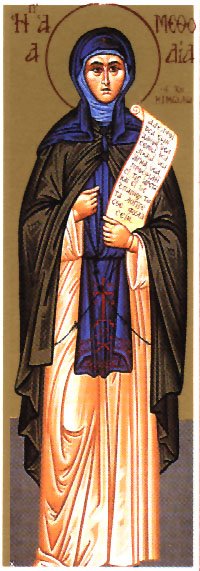
Our Holy Mother Methodia of Kimolos (1865)
Saint Methodίa was born on the island of Kίmolos on November 10, 1865, to devout parents. Her father's name was Jacob Sardēs, and her mother's name was Maria. They had three sons and five daughters, the second of whom was called Irene.
From childhood the Saint was drawn to divine things and always frequented the church. Wh
Saint Methodίa was born on the island of Kίmolos on November 10, 1865, to devout parents. Her father's name was Jacob Sardēs, and her mother's name was Maria. They had three sons and five daughters, the second of whom was called Irene.
From childhood the Saint was drawn to divine things and always frequented the church. When she reached a suitable age, she married a sailor, in order to please her parents. Although she was married, her zeal for the Church remained unabated. One day, however, while her husband was out on a voyage, he was shipwrecked and drowned near Asia Minor.
Later Irene was tonsured in the church of Panagia Hodēgḗtria on Kίmolos by Archbishop Methodios of Syros, who renamed her Methodίa. Her joy knew no bounds, and she followed the evangelic commandments of the Lord with all her soul. Her ascetical struggles were severe, and she was a living example for all. Therefore, Christ, Who dwells in pure hearts, also came to dwell in her, and she became a chosen vessel (Acts 9:15). The report of her great virtue spread everywhere and a multitude of women went to stay with her, in order to find a spiritual refuge and a safe harbor from the storms of life. The Saint's inspired words were a source of refreshment and healing for the afflicted souls of these women, and she guided them on the path of repentance. In addition to her other gifts, God gave Saint Methodίa the grace to work miracles.
Venerable Methodίa reposed peacefully on Sunday, October 5, 1908 at the age of 43. She was glorified as a Saint on October 5, 1991.
Troparion - Tone 1
Let us the faithful honor with hymns the Venerable Methodίa, the offspring of Kίmolos, / the treasury of virtues, and truly the peer of the Holy Ascetics of the earliest times, / imitating the deeds of her life, beloved by God, we cry out: / "Glory to Him Who gave you strength. / Glory to Him Who crowned you. / Glory to Him Who numbered you in the choir of the Saints, O Mother."
Kontakion - Tone 4
You lived a blameless life, / mystically gladdening the entire island of Kίmolos with the light of your virtues, / O God-inspired Methodίa.
Scripture Readings
☩Epistle
Galatians 5:11-21
11
And I, brethren, if I yet preach circumcision, why do I yet suffer persecution? then is the offence of the cross ceased.
12
I would they were even cut off which trouble you.
13
For, brethren, ye have been called unto liberty; only use not liberty for an occasion to the flesh, but by love serve one another.
14
For all the law is fulfilled in one word, even in this; Thou shalt love thy neighbour as thyself.
15
But if ye bite and devour one another, take heed that ye be not consumed one of another.
16
This I say then, Walk in the Spirit, and ye shall not fulfil the lust of the flesh.
17
For the flesh lusteth against the Spirit, and the Spirit against the flesh: and these are contrary the one to the other: so that ye cannot do the things that ye would.
18
But if ye be led of the Spirit, ye are not under the law.
19
Now the works of the flesh are manifest, which are these; Adultery, fornication, uncleanness, lasciviousness,
20
Idolatry, witchcraft, hatred, variance, emulations, wrath, strife, seditions, heresies,
21
Envyings, murders, drunkenness, revellings, and such like: of the which I tell you before, as I have also told you in time past, that they which do such things shall not inherit the kingdom of God.
☩Gospel
Luke 6:37-45
37
Judge not, and ye shall not be judged: condemn not, and ye shall not be condemned: forgive, and ye shall be forgiven:
38
Give, and it shall be given unto you; good measure, pressed down, and shaken together, and running over, shall men give into your bosom. For with the same measure that ye mete withal it shall be measured to you again.
39
And he spake a parable unto them, Can the blind lead the blind? shall they not both fall into the ditch?
40
The disciple is not above his master: but every one that is perfect shall be as his master.
41
And why beholdest thou the mote that is in thy brother’s eye, but perceivest not the beam that is in thine own eye?
42
Either how canst thou say to thy brother, Brother, let me pull out the mote that is in thine eye, when thou thyself beholdest not the beam that is in thine own eye? Thou hypocrite, cast out first the beam out of thine own eye, and then shalt thou see clearly to pull out the mote that is in thy brother’s eye.
43
For a good tree bringeth not forth corrupt fruit; neither doth a corrupt tree bring forth good fruit.
44
For every tree is known by his own fruit. For of thorns men do not gather figs, nor of a bramble bush gather they grapes.
45
A good man out of the good treasure of his heart bringeth forth that which is good; and an evil man out of the evil treasure of his heart bringeth forth that which is evil: for of the abundance of the heart his mouth speaketh.
Liturgical data sourced from OCA.org and orthocal.info