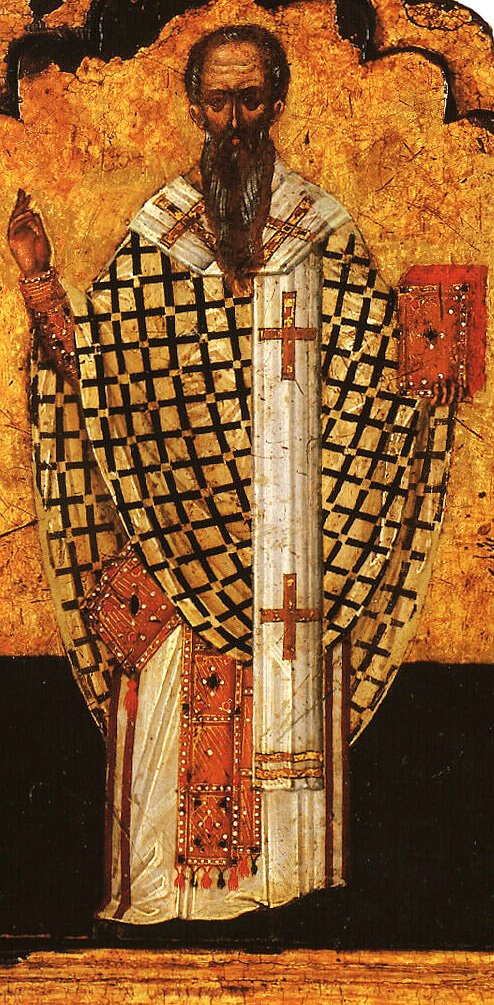
Saint Dionysius lived originally in the city of Athens. He was raised there and received a classical Greek education. He then went to Egypt, where he studied astronomy at the city of Heliopolis. It was in Heliopolis, along with his friend Apollophonos where he witnessed the solar eclipse that occurred at the moment of the death of the Lord Jesus Christ by Crucifixion.
Saint Dionysius lived originally in the city of Athens. He was raised there and received a classical Greek education. He then went to Egypt, where he studied astronomy at the city of Heliopolis. It was in Heliopolis, along with his friend Apollophonos where he witnessed the solar eclipse that occurred at the moment of the death of the Lord Jesus Christ by Crucifixion. “Either the Creator of all the world now suffers, or this visible world is coming to an end,” Dionysius said. Upon his return to Athens from Egypt, he was chosen to be a member of the Areopagus Council (Athenian high court).
When the holy Apostle Paul preached at the place on the Hill of Ares (Acts 17:16-34), Dionysius accepted his salvific proclamation and became a Christian. For three years Saint Dionysius remained a companion of the holy Apostle Paul in preaching the Word of God. Later on, the Apostle Paul selected him as bishop of the city of Athens. And in the year 57 Saint Dionysius was present at the repose of the Most Holy Theotokos.
During the lifetime of the Mother of God, Saint Dionysius had journeyed from Athens to Jerusalem to meet Her. He wrote to his teacher the Apostle Paul: “I witness by God, that besides the very God Himself, there is nothing else filled with such divine power and grace. No one can fully comprehend what I saw. I confess before God: when I was with John, who shone among the Apostles like the sun in the sky, when I was brought before the countenance of the Most Holy Virgin, I experienced an inexpressible sensation. Before me gleamed a sort of divine radiance which transfixed my spirit. I perceived the fragrance of indescribable aromas and was filled with such delight that my very body became faint, and my spirit could hardly endure these signs and marks of eternal majesty and heavenly power. The grace from her overwhelmed my heart and shook my very spirit. If I did not have in mind your instruction, I should have mistaken Her for the very God. It is impossible to stand before greater blessedness than this which I beheld.”
After the death of the Apostle Paul, Saint Dionysius wanted to continue with his work, and therefore went off preaching in the West, accompanied by the Presbyter Rusticus and Deacon Eleutherius. They converted many to Christ at Rome, and then in Germany, and then in Spain. In Gaul, during a persecution against Christians by the pagan authorities, all three confessors were arrested and thrown into prison. By night Saint Dionysius celebrated the Divine Liturgy with angels of the Lord. In the morning the martyrs were beheaded. According to an old tradition, Saint Dionysius took up his head, proceeded with it to the church and fell down dead there. A pious woman named Catulla buried the relics of the saint.
The writings of Saint Dionysius the Areopagite hold great significance for the Orthodox Church. Four books of his have survived to the present day:
On the Ecclesiastical Hierarchy
In additional, there are ten letters to various people.
The book On the Celestial Hierarchies was written actually in one of the countries of Western Europe, where Saint Dionysius was preaching. In it he speaks of the Christian teaching about the angelic world. The angelic (or Celestial-Heavenly) hierarchy comprises the nine angelic Ranks:
The account of the Synaxis of the Bodiless Powers of Heaven is located under November 8.
The purpose of the divinely-established Angelic Hierarchy is the ascent towards godliness through purification, enlightenment and perfection. The highest ranks are bearers of divine light and divine life for the lower ranks. And not only are the sentient, bodiless angelic hosts included in the spiritual light-bearing hierarchy, but also the human race, created anew and sanctified in the Church of Christ.
The book of Saint Dionysius On the Ecclesiastical Hierarchies is a continuation of his book On the Celestial Hierarchies. The Church of Christ, like the Angelic ranks, in its universal service is set upon the foundation of priestly principles established by God.
In the earthly world, for the children of the Church, divine grace comes down indescribably in the holy Mysteries of the Church, which are spiritual in nature, though perceptible to the senses in form. Few, even among the holy ascetics, were able to behold with their earthly eyes the fiery vision of the Holy Mysteries of God. But outside of the Church’s sacraments, outside of Baptism and the Eucharist, the light-bearing saving grace of God is not found, neither is divine knowledge nor theosis (deification).
The book On the Names of God expounds upon the way of divine knowledge through a progression of the Divine Names.
Saint Dionysius’ book On Mystical Theology also sets forth the teaching about divine knowledge. The theology of the Orthodox Church is totally based upon experience of divine knowledge. In order to know God it is necessary to be in proximity to Him, to have come near to Him in some measure, so as to attain communion with God and deification (theosis). This condition is accomplished through prayer. This is not because prayer in itself brings us close to the incomprehensible God, but rather that the purity of heart in true prayer brings us closer to God.
The written works of Saint Dionysius the Areopagite are of extraordinary significance in the theology of the Orthodox Church, and also for late Medieval Western theology. For almost four centuries, until the beginning of the sixth century, the works of this holy Father of the Church were preserved in an obscure manuscript tradition, primarily by theologians of the Alexandrian Church. The concepts in these works were known and utilized by Clement of Alexandria, Origen, Dionysius the Great, pre-eminent figures of the catechetical school in Alexandria, and also by Saint Gregory the Theologian. Saint Dionysius of Alexandria wrote to Saint Gregory the Theologian a Commentary on the “Areopagitum.” The works of Saint Dionysius the Areopagite received general Church recognition during the sixth-seventh centuries.
Particularly relevant are the Commentaries written by Saint Maximus the Confessor (January 21). (trans. note: although many scholars suggest that the “Areopagitum” was actually written by an anonymous sixth century figure who employed the common ancient device of piously borrowing an illustrious name, this in no way diminishes the profound theological significance of the works.)
In the Russian Orthodox Church the teachings of Saint Dionysius the Areopagite about the spiritual principles and deification were at first known through the writings of Saint John of Damascus (December 4). The first Slavonic translation of the “Areopagitum” was done on Mt. Athos in about the year 1371 by a monk named Isaiah. Copies of it were widely distributed in Russia. Many of them have been preserved to the present day in historic manuscript collections, among which is a parchment manuscript “Works of Saint Dionysius the Areopagite” belonging to Saint Cyprian, Metropolitan of Kiev and All Rus (September 16) in his own handwriting.
According to one tradition, he was killed at Lutetia (ancient name of Paris, France) in the year 96 during the persecution under the Roman emperor Dometian (81-96). Today most scholars and theologians believe that Saint Dionysius the Areopagite did not die in Gaul, and that Saint Dionysius (or Denys) of Paris is a different saint with the same name.
Saint Demetrius of Rostov says that the Hieromartyr Dionysius was beheaded in Athens, and that many miracles were worked at his grave.
Troparion - Tone 4
Having learned goodness and maintaining continence in all things, / you were arrayed with a good conscience as befits a priest. / From the chosen Vessel you drew ineffable mysteries; / you kept the faith, and finished a course equal to His. / Bishop martyr Dionysius, entreat Christ God that our souls may be saved.
Kontakion - Tone 8
As a disciple of the apostle caught up to the third heaven, / you spiritually entered the gate of heaven, Dionysius. / You were enriched with understanding of ineffable mysteries / and enlightened those who sat in the darkness of ignorance. / Therefore we cry to you: Rejoice, universal Father!
Martyrs Rusticus the Presbyter and Eleutherius the Deacon
Saints Rusticus and Eleutherius were disciples of Saint Dionysius the Areopagite. They suffered martyrdom in Athens during the persecution of the emperor Domitian (81-96).
Troparion - Tone 4
O God of our Fathers, / always act with kindness towards us; / take not Your mercy from us, / but guide our lives in peace / through the prayers of Rusticus and Eleutherius.
St John the Chozebite, Bishop of Caesarea
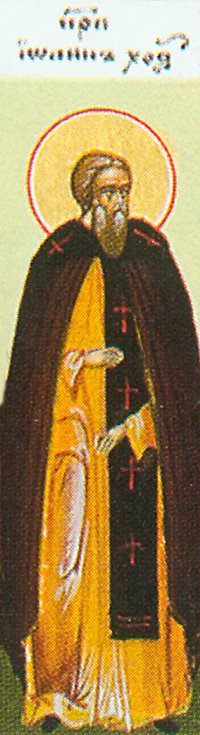
Saint John the Chozebite, Bishop of Caesarea in Palestine (587-596), was famed for his struggle against the Eutychian heresy, and also for his grace-filled gifts of discernment and wonderworking. He was born in the Egyptian city of Thebes and while still a youth he spent a long time in the Thebaid desert with his uncle, who was an ascetic.
Saint John the Chozebite, Bishop of Caesarea in Palestine (587-596), was famed for his struggle against the Eutychian heresy, and also for his grace-filled gifts of discernment and wonderworking. He was born in the Egyptian city of Thebes and while still a youth he spent a long time in the Thebaid desert with his uncle, who was an ascetic.
The emperor, who learned of John’s holy life, decided to make him bishop of the city of Caesarea. But the saint, yearning for solitude, left his cathedra and withdrew into the Chozeba wilderness (between Jerusalem and Jericho) where he struggled in asceticism until the end of his life.
Once, while on his way to visit some of the brethren, he met a woman on the road. She entreated him to follow her to her home so that he might bless it and sanctify it by his prayers. Once they entered the house, however, the vile woman locked the door and removed all her clothing, and tried to tempt the saint into sinning with her. He opened the door and fled from the place.
After this, he performed many miracles until he fell asleep in the Lord. It is said that whenever he served the Divine Liturgy, he would see a heavenly light in the altar.
Troparion - Tone 4
In truth you were revealed to your flock as a rule of faith, / an image of humility and a teacher of abstinence; / your humility exalted you; / your poverty enriched you. / Hierarch Father John, / entreat Christ our God / that our souls may be saved.
Holy Hieromartyr Dionysius, Bishop of Alexandria, and his disciples (258)
He was a disciple of Origen and became a priest in Alexandria. He became Bishop of Alexandria in 247, serving not only his own see but the whole Church with fervor and compassion. He traveled to Rome to fight the Novatian schisms that disturbed the Body of Christ at that time, and mediated in the dispute between St Cyprian (September 16) and the Pope.
He was a disciple of Origen and became a priest in Alexandria. He became Bishop of Alexandria in 247, serving not only his own see but the whole Church with fervor and compassion. He traveled to Rome to fight the Novatian schisms that disturbed the Body of Christ at that time, and mediated in the dispute between St Cyprian (September 16) and the Pope.
During the reign of Valerian, the new Governor of Alexandra, Emilianus, summoned St Dionysius, along with a group of his clergy, and demanded that they renounce Christ. When all stood firm in the Faith, he exiled them to the remote village of Kephro. But Christians flocked to the village to seek out the holy Bishop, and many pagans in the region were converted by him — so that soon the town was more nearly a Christian mission than a place of exile. When Emilianus learned of this, he exiled the Bishop and his disciples far into the wilderness, where they lived amidst terrible sufferings and hardships for more than twelve years. Saint Dionysius and his deacons Gaius and Faustus all died there; Eusebius the deacon and Maximus the priest eventually escaped. Eusebius became Bishop of Laodicea; Maximus, like his spiritual father, became Bishop of Alexandria.
Scripture Readings
☩Epistle
2 Corinthians 4:6-15
6
For God, who commanded the light to shine out of darkness, hath shined in our hearts, to give the light of the knowledge of the glory of God in the face of Jesus Christ.
7
But we have this treasure in earthen vessels, that the excellency of the power may be of God, and not of us.
8
We are troubled on every side, yet not distressed; we are perplexed, but not in despair;
9
Persecuted, but not forsaken; cast down, but not destroyed;
10
Always bearing about in the body the dying of the Lord Jesus, that the life also of Jesus might be made manifest in our body.
11
For we which live are alway delivered unto death for Jesus’ sake, that the life also of Jesus might be made manifest in our mortal flesh.
12
So then death worketh in us, but life in you.
13
We having the same spirit of faith, according as it is written, I believed, and therefore have I spoken; we also believe, and therefore speak;
14
Knowing that he which raised up the Lord Jesus shall raise up us also by Jesus, and shall present us with you.
15
For all things are for your sakes, that the abundant grace might through the thanksgiving of many redound to the glory of God.
☩Gospel
Luke 6:31-36
31
And as ye would that men should do to you, do ye also to them likewise.
32
For if ye love them which love you, what thank have ye? for sinners also love those that love them.
33
And if ye do good to them which do good to you, what thank have ye? for sinners also do even the same.
34
And if ye lend to them of whom ye hope to receive, what thank have ye? for sinners also lend to sinners, to receive as much again.
35
But love ye your enemies, and do good, and lend, hoping for nothing again; and your reward shall be great, and ye shall be the children of the Highest: for he is kind unto the unthankful and to the evil.
36
Be ye therefore merciful, as your Father also is merciful.
 Meat
Allowed
 Fish
Allowed
 Dairy
Allowed
 Oil
Allowed
 Wine
Allowed