Fasting Rules
 Meat
Abstain
 Fish
Abstain
 Dairy
Abstain
 Oil
Abstain
 Wine
Abstain
Saints & Commemorations
Ven. Cyriacos, Hermit of Palestine
He was born in Corinth of pious Christian parents. At the age of eighteen he went to Palestine, where, after studying under several holy fathers, he entered monastic life and became the disciple of St Gerasim of the Jordan. After St Gerasim’s death he lived in strict solitude, asceticism and silence for many years, finally entering the monastery of St Chariton, where he reposed in peace at the age of 109. D
He was born in Corinth of pious Christian parents. At the age of eighteen he went to Palestine, where, after studying under several holy fathers, he entered monastic life and became the disciple of St Gerasim of the Jordan. After St Gerasim’s death he lived in strict solitude, asceticism and silence for many years, finally entering the monastery of St Chariton, where he reposed in peace at the age of 109. Despite his very severe asceticism, he was large and strong, remaining so until the end of his life. According to the rule of St Chariton, he and his fellow-monks ate only once a day, after sunset. In the desert, he lived for years on nothing but the raw plants that he gathered there. He said of himself that, while he was a monk, the sun never saw him eat or be angry with any man.
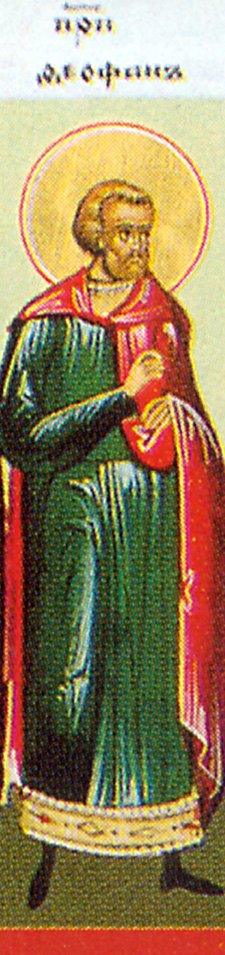
Theophanes the Merciful of Gaza
Saint Theophanes the Merciful was an inhabitant of the Syrian city of Gaza. He was very kind and merciful. He took in vagrants, he helped the poor and the sick, and he spent all his substance on help for the needy, while he himself remained in want.
Saint Theophanes did not grieve at all over the loss of his property, but he lost his health, and sickness caused him great suffering.
Saint Theophanes the Merciful was an inhabitant of the Syrian city of Gaza. He was very kind and merciful. He took in vagrants, he helped the poor and the sick, and he spent all his substance on help for the needy, while he himself remained in want.
Saint Theophanes did not grieve at all over the loss of his property, but he lost his health, and sickness caused him great suffering. His body began to swell up, to rot, and to give off a stench. This ordeal he also endured in good spirit, giving thanks to God for all things.
A fierce storm raged while he was dying, and his wife grieved that she would not be able to give him proper burial. The saint comforted her: “Weep not, woman, for up to now the trial has lasted, but here comes help from the Merciful God, since in the hour of my death the storm will cease, by the will of God.” So it occurred: just as he gave up his soul to God, calmness prevailed. After death the body of Saint Theophanes became completely cleansed of wounds and decay and became fragrant, giving forth abundant healing myrrh.
St Mary of Palestine (6th c.)
“She was at first a reader of the Psalter in the Church of the Resurrection in Jerusalem, but, being beautiful, she was a source of scandal to the sinful-minded. In order not to be a cause of sin in others, Mary withdrew to the wilderness of Souka with a basket of beans and a flask of water. She spent eighteen years in the desert and, by God’s power, never lacked either beans nor water. Dis
“She was at first a reader of the Psalter in the Church of the Resurrection in Jerusalem, but, being beautiful, she was a source of scandal to the sinful-minded. In order not to be a cause of sin in others, Mary withdrew to the wilderness of Souka with a basket of beans and a flask of water. She spent eighteen years in the desert and, by God’s power, never lacked either beans nor water. Disciples of St Cyriacus found her during her lifetime, and later buried her.” (Prologue)
Holy Martyrs Dada and those with them (4th c.)
Dada was a high Persian official serving in the court of King Shapur II, and secretly a Christian. When he was appointed governor of a province some way from the court, Dada began to worship and proclaim Christ openly. This came to the attention of the King, who sent one of his sons, Gubarlahas, to try and execute him.
Dada was a high Persian official serving in the court of King Shapur II, and secretly a Christian. When he was appointed governor of a province some way from the court, Dada began to worship and proclaim Christ openly. This came to the attention of the King, who sent one of his sons, Gubarlahas, to try and execute him. Dada was condemned and condemned to be thrown into a fiery furnace. But when Dada made the sign of the Cross, the fire went out, amazing the Prince and eventually leading him to convert to Christ.
The outraged King had his son thrown in prison and put to torture. Gubarlahas endured days of hideous torture without complaint and, though he had been subjected to horrible mutilations, emerged from his cell unscathed. This wonder led others, including two more of the King’s own children or kin, to embrace Christ. Kazoy, the King’s daughter, was allowed to enter into rest as soon as her tortures began. Gubarlahas was miraculously baptised in the midst of further tortures: A voice from on high pronounced the words of baptism, and a shower of water and oil fell on the Martyr. Not long afterward, he perished, along with Dada and Kasdios, one of Gubarlahas’ kinsmen who had been convinced of the Truth by the miracles he had seen.
Venerable Cyprian of Ustiug (1276)
Saint Cyprian of Ustiug was a wealthy landowner, but turning from the vanities of the world, he received the Angelic Schema with the name Cyprian at the monastery of the Holy Trinity at Gledeno.
The inhabitants of the newly-established city of Ustiug begged Saint Cyprian to build a monastery somewhere near the city.
Saint Cyprian of Ustiug was a wealthy landowner, but turning from the vanities of the world, he received the Angelic Schema with the name Cyprian at the monastery of the Holy Trinity at Gledeno.
The inhabitants of the newly-established city of Ustiug begged Saint Cyprian to build a monastery somewhere near the city. Saint Cyprian, went around the city and observed its layout, then chose a place near shallow lakes at the Ostrozh falls and he started building a cell.
By the year 1212, he had established a monastery in honor of the Entrance into the Temple of the Most Holy Theotokos, and a church dedicated to the Archangel Michael, the Chief Commander of the Heavenly Hosts. The inhabitants of Ustiug, seeing the godliness of the holy ascetic, brought him all the things he needed to build the monastery, and many came to live the ascetic life with Saint Cyprian, who received everyone with joy and with love.
The holy monastery grew, and according to the account in the Ustiug Chronicle, Saint Cyprian “was chosen as the Superior of the holy monastery, and pastor of the flock of Christ, but out of humility he would not agree to be ordained to the holy priesthood.” There was a stone by his bed, which he used to rest his head. During his night prayers, the ascetic held it in his hands in order to maintain vigilance and to be constantly at prayer.
Saint Cyprian went to the Lord at 6 o’clock in the afternoon on September 29, 1276, and his body was buried in the monastery which he founded. Later, a church was built over his holy relics and was dedicated to the Feast of Mid-Pentecost, which also had a chapel in honor of Saint Cyprian of Carthage (August 31).
Troparion - Tone 8
In you, O venerable Father Father Cyprian, the image of God shone forth, / for you carried your cross and followed Christ. / By so doing you taught us to disregard the flesh, for it passes away, / and to care instead for the soul since it is immortal. / Wherefore, your soul forever rejoices with the angels.
Kontakion - Tone 2
Having divinely armed yourself with the purity of your soul, / and firmly grasping unceasing prayer as a spear, you pierced the armies of demons. / Therefore, we beseech you, O our Father Cyprian, / always intercede for us who honor you.
Scripture Readings
☩Epistle
Galatians 3:15-22
15
Brethren, I speak after the manner of men; Though it be but a man’s covenant, yet if it be confirmed, no man disannulleth, or addeth thereto.
16
Now to Abraham and his seed were the promises made. He saith not, And to seeds, as of many; but as of one, And to thy seed, which is Christ.
17
And this I say, that the covenant, that was confirmed before of God in Christ, the law, which was four hundred and thirty years after, cannot disannul, that it should make the promise of none effect.
18
For if the inheritance be of the law, it is no more of promise: but God gave it to Abraham by promise.
19
Wherefore then serveth the law? It was added because of transgressions, till the seed should come to whom the promise was made; and it was ordained by angels in the hand of a mediator.
20
Now a mediator is not a mediator of one, but God is one.
21
Is the law then against the promises of God? God forbid: for if there had been a law given which could have given life, verily righteousness should have been by the law.
22
But the scripture hath concluded all under sin, that the promise by faith of Jesus Christ might be given to them that believe.
☩Gospel
Luke 5:33-39
33
And they said unto him, Why do the disciples of John fast often, and make prayers, and likewise the disciples of the Pharisees; but thine eat and drink?
34
And he said unto them, Can ye make the children of the bridechamber fast, while the bridegroom is with them?
35
But the days will come, when the bridegroom shall be taken away from them, and then shall they fast in those days.
36
And he spake also a parable unto them; No man putteth a piece of a new garment upon an old; if otherwise, then both the new maketh a rent, and the piece that was taken out of the new agreeth not with the old.
37
And no man putteth new wine into old bottles; else the new wine will burst the bottles, and be spilled, and the bottles shall perish.
38
But new wine must be put into new bottles; and both are preserved.
39
No man also having drunk old wine straightway desireth new: for he saith, The old is better.
Liturgical data sourced from OCA.org and orthocal.info