Fasting Rules
 Meat
Allowed
 Fish
Allowed
 Dairy
Allowed
 Oil
Allowed
 Wine
Allowed
Saints & Commemorations
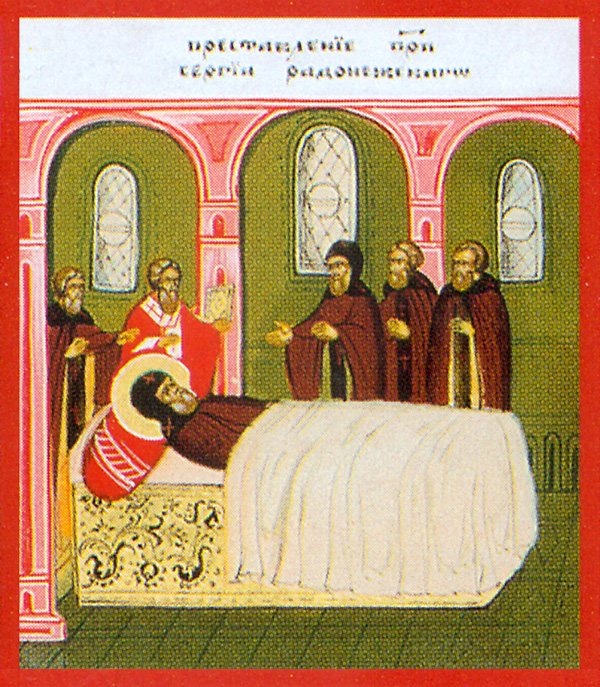
Repose of Ven. Sergius of Radonezh
Saint Sergius of Radonezh was born in the village of Varnitsa, near Rostov, on May 3, 1314. His parents were the pious and illustrious nobles Cyril and Maria (September 28). The Lord chose him while still in his mother’s womb. In the Life of Saint Sergius it is reported that even before the birth of her son, Saint Maria and those praying heard the thrice-repeated cry of the infant at the Divine Liturgy: before the reading of the Holy Gospel, during the Cherubic hymn, and when the priest pronounced: “Holy Things are for the Holy.”
God gave Cyril and Maria a son whom they named Bartholomew. From
Saint Sergius of Radonezh was born in the village of Varnitsa, near Rostov, on May 3, 1314. His parents were the pious and illustrious nobles Cyril and Maria (September 28). The Lord chose him while still in his mother’s womb. In the Life of Saint Sergius it is reported that even before the birth of her son, Saint Maria and those praying heard the thrice-repeated cry of the infant at the Divine Liturgy: before the reading of the Holy Gospel, during the Cherubic hymn, and when the priest pronounced: “Holy Things are for the Holy.”
God gave Cyril and Maria a son whom they named Bartholomew. From his very first days of life the infant amazed everyone by his fasting. On Wednesdays and Fridays he would not accept milk from his mother, and on other days, if Maria used oil in the food, the infant also refused the milk of his mother. Noticing this, Maria refrained altogether from food with oil.
At the age of seven, Bartholomew was sent to study together with his two brothers: his older brother Stephen, and his younger brother Peter. His brothers learned successfully, but Bartholomew fell behind in his studies, even though the teacher gave him much special attention. The parents scolded the child, the teacher chastised him, and his classmates made fun of his lack of comprehension. Finally, Bartholomew besought the Lord with tears to grant him the ability to read.
Once, his father sent Bartholomew out after the horses in the field. Along the way he met an angel sent by God under the appearance of a monk. The Elder stood at prayer beneath an oak in a field. Bartholomew approached him, and bowing, waited for the Elder to finish praying. The monk blessed him, gave him a kiss and asked what he wanted.
Bartholomew answered, “With all my soul I want to learn reading and writing. Holy Father, pray for me to God, that He may help me to become literate.” The monk fulfilled Bartholomew’s request, offering up his prayer to God. In blessing the child he said to him: “Henceforth, my child, God gives you to understand reading and writing, and in this you will surpass your brothers and peers” (See the famous M. Nesterov painting “Vision of Bartholomew”).
Then the Elder took a vessel and gave Bartholomew a piece of prosphora. “Take, child, and eat,” said he. “This is given to you as a sign of the grace of God, and for the understanding of Holy Scripture.” The Elder wanted to leave, but Bartholomew asked him to visit at the home of his parents. His parents received their guest with joy and offered him their hospitality.
The Elder replied that it was proper to partake of spiritual nourishment first, and he bade their son to read the Psalter. Bartholomew began to read, and his parents were amazed at the change that had occured with their son. In parting, the Elder prophetically said of Saint Sergius, “Your son shall be great before God and the people. He shall become a chosen habitation of the Holy Spirit.”
After this the holy child read without difficulty and understood the contents of books. He became immersed in prayer with a special fervor, not missing a single church service. Already in childhood he imposed upon himself a strict fast. He ate nothing on Wednesdays and Fridays, and on the other days he sustained himself on bread and water.
About the year 1328, the parents of Saint Sergius moved from Rostov to Radonezh. When their older sons married, Cyril and Maria received the monastic schema shortly before their death at the Khot’kov monastery of the Protection of the Most Holy Theotokos, not far from Radonezh.
Later on, the older brother Stephen was widowed and became a monk at this monastery. Having buried his parents, Bartholomew and his brother Stephen withdrew into the forest (12 versts from Radonezh) to live in the wilderness. At first they made cells, and then a small church, and with the blessing of Metropolitan Theognostus, it was consecrated in the name of the Most Holy Trinity. But soon, unable to bear the difficulties of life in the wilderness, Stephen left his brother and went on to the Moscow Theophany monastery, where he became close to Saint Alexis, afterwards Metropolitan of Moscow. (February 12).
On October 7,1337 Bartholomew was tonsured by Igumen Metrophanes, taking the name of the holy Martyr Sergius (October 7), and he started to build a new habitation to the glory of the Life-Creating Trinity. Suffering temptations and demonic apparitions, Saint Sergius advanced from strength to strength. Gradually he became known to other monks seeking his guidance. Saint Sergius accepted all with love, and soon a brotherhood of twelve monks were gathered in the small monastery.
Their experienced spiritual guide distinguished himself by an extraordinary love for work. With his own hands he built several cells, he carried water, he chopped wood, baked bread, sewed clothing, prepared food for the brethren and humbly took on other tasks. Saint Sergius combined the heavy work with prayer, vigil and fasting.
The brethren were amazed that with such severe exertion the health of their guide did not deteriorate, but rather became all the more hearty. It was not without difficulty that they implored Saint Sergius to accept the position of igumen of the monastery.
In 1354 Bishop Athanasius of Volyn ordained the saint a hieromonk and elevated him to the rank of igumen. Just as before, monastic obediences were strictly fulfilled at the monastery. With the expansion of the monastery, its needs also grew. Often the monks had only scant food, but through the prayers of Saint Sergius unknown people provided the necessities.
Reports of the exploits of Saint Sergius became known even at Constantinople, and Patriarch Philotheus sent to the monk a cross, a “paraman” (monastic clothing, a four-cornered cloth tied with cords to the chest and worn beneath other garb, and adorned with symbols of the Lord’s Passion) and schema-robe in blessing for new deeds, and a grammota of blessing, in which the Patriarch counselled the chosen of God to organize a cenobitic monastery. The monk set off with the patriarchal missive to Saint Alexis, and received from him the counsel to introduce a strict manner of cenobitic life. The monks began to grumble at the strictness of the monastic Rule, and Saint Sergius was compelled to forsake the monastery. At the River Kirzhach he founded a monastery in honor of the Annunciation of the Most Holy Theotokos. Matters at the former monastery went quickly into disarray, and the remaining monks recoursed to Saint Alexis that he should get the saint to return.
Saint Sergius unquestioningly obeyed the holy hierarch, and left in place of himself at the Kirzhachsk monastery his disciple, Saint Roman.
Already during his lifetime Saint Sergius had been vouchsafed the gift of wonderworking. He raised a lad, at a point when the despairing father had given up on his only son as lost. Reports about the miracles worked by Saint Sergius began quickly to spread about, and the sick began to come to him, both from the surrounding villages and also from remote places. And no one left from Saint Sergius without receiving healing of infirmities and edifying counsel. Everyone gave glory for Saint Sergius, and reverenced him on an equal with the ancient holy Fathers. But human glory did not hold allure for the great ascetic, and as before he remained the example of monastic humility.
One time Saint Stephen, Bishop of Perm (April 27), who deeply revered Saint Sergius, was on journey from his diocese to Moscow. The roadway passed eight versts distant from the Sergiev monastery. Intending to visit the monastery on his return trip, the saint stopped, and having recited a prayer, he bowed to Saint Sergius with the words: “Peace be to thee, spiritual brother.” At this instant Saint Sergius was sitting in the trapeza for a meal with the brethren. In reply to the blessing of the holy hierarch, Saint Sergius rose up, recited a prayer, and made a return blessing to Saint Stephen. Certain of the disciples, astonished at the extraordinary action of Saint Sergius, hastened off to the indicated place, and became convinced of the veracity of the vision.
Gradually the monks began to witness also other similar actions. Once, during Liturgy, an angel of the Lord served with the saint, but Saint Sergius in his humility forbade anyone to tell about this until after his death.
Saint Sergius was connected with Saint Alexis by close bonds of spiritual friendship and brotherly love. Saint Alexis in his declining years summoned Saint Sergius to him and besought him to accept to be Russian Metropolitan, but Saint Sergius humbly declined to be primate.
The Russian Land at this time suffered under the Mongol-Tatar Yoke. Having gathered an army, Great-prince Demetrius Ioannovich of the Don went to monastery of Saint Sergius to ask blessing in the pending struggle. Saint Sergius gave blessing to two monks of his monastery to render help to the great-prince: the Schemamonk Andrei [Oslyaba] and the Schemamonk Alexander [Peresvet], and he predicted the victory for prince Demetrius. The prophecy of Saint Sergius was fulfilled: on September 8, 1380, on the feastday of the Nativity of the Most Holy Theotokos, Russian soldiers gained a total victory over the Tatar hordes at Kulikovo Pole (Kulikovo Field), and set in place the beginning of the liberation of the Russian Land from the Mongol Yoke. During the fighting Saint Sergius and the brethren stood at prayer and besought God to grant victory to the Russian forces.
For his angelic manner of life Saint Sergius was granted a heavenly vision by God. One time by night Abba Sergius was reading the rule of prayer beneath an icon of the Most Holy Theotokos. Having completed the reading of the canon to the Mother of God, he sat down to rest, but suddenly he said to his disciple, Saint Mikhei (May 6), that there awaited them a wondrous visitation. After a moment the Mother of God appeared accompanied by the holy Apostles Peter and John the Theologian. Due to the extraordinary bright light Saint Sergius fell down, but the Most Holy Theotokos touched Her hands to him, and in blessing him promised always to be Protectress of his holy monastery.
Having reached old age, and foreseeing his own end six months beforehand, Saint Sergius summoned the brethren to him and designated his disciple Saint Nikon (November 17), who was experienced in the spiritual life and obedience, to be igumen. In tranquil solitude Saint Sergius fell asleep in the Lord on September 25, 1392. On the night before, the great saint of God summoned the brethren a final time to give them his final instruction: “Brethren, be attentive to yourselves. Have first the fear of God, purity of soul and unhypocritical love....”
Troparion - Tone 4
Athlete of virtues, / true warrior of Christ God, / you struggled mightily against the passions in this temporal life; / in psalmody, vigils, and fasting, you were an example to your disciples; / therefore, the most Holy Spirit dwelt in you, / and you were radiantly adorned by His activity. / Since you possess boldness before the Holy Trinity, / remember the flock which you gathered wisely, / and do not forget to visit your children as you promised, O Venerable Sergius our Father.
Kontakion - Tone 8
In the purity of your life, you combined the stream of your tears with later ascetical contests of faith, / thereby exuding a spiritual font, O Venerable Sergius, / in which you wash the spiritual and bodily impurity of all those who lovingly revere your memory. / Therefore, we your children cry out to you: “O Father, pray to the Holy Trinity for our souls.”
Paphnoutios the Martyr & his 546 Companions in Egypt
The Holy Martyr Paphnutius hailed from Egypt and struggled in the desert. During the persecution against Christians under Diocletian (284-305), the governor Hadrian commanded that Saint Paphnutius be brought to him. The ascetic, not waiting for those sent to bring him, appeared before the governor, confessed his faith in Christ, and was subjected to torture.
The Holy Martyr Paphnutius hailed from Egypt and struggled in the desert. During the persecution against Christians under Diocletian (284-305), the governor Hadrian commanded that Saint Paphnutius be brought to him. The ascetic, not waiting for those sent to bring him, appeared before the governor, confessed his faith in Christ, and was subjected to torture.
The soldiers involved in his torture, Dionysius and Callimachus, seeing how the power of God preserved the martyr, believed in Christ the Savior themselves, for which they were then beheaded. Cast into prison after the tortures, Saint Paphnutius converted forty prisoners to the Faith. They were all burned alive.
After a while Saint Paphnutius was set free, and a Christian named Nestorius gladly took him in. He and all his family, after spiritual guidance, became steadfast in the Faith, and ultimately endured martyrdom. The saint strengthened many other Christians to confess our Lord Jesus Christ, and they all died as martyrs. Some were cut with swords, others were burned. There were 546 men in all.
Saint Paphnutius himself was thrown by the torturers into a river with a stone about his neck, but he miraculously floated to shore with the stone. Finally, they sent the holy martyr to the emperor Diocletian himself, who commanded him to be crucified on a date tree.
Troparion - Tone 4
Your holy martyr Paphnutius and his companions, O Lord, / through their sufferings have received incorruptible crowns from You, our God. / For having Your strength, they laid low their adversaries, / and shattered the powerless boldness of demons. / Through their intercessions, save our souls!
Our Righteous Mother Euphrosyne (ca. 445)
She was the daughter of a wealthy Christian, Paphnutius, who with his wife brought up Euphrosyne in piety. Not wishing to marry, she secretly fled her home and its wealth, dressed herself in men’s clothing and entered a monastery using the name of Smaragdus. There she lived in asceticism for thirty-eight years. S
She was the daughter of a wealthy Christian, Paphnutius, who with his wife brought up Euphrosyne in piety. Not wishing to marry, she secretly fled her home and its wealth, dressed herself in men’s clothing and entered a monastery using the name of Smaragdus. There she lived in asceticism for thirty-eight years. She only revealed her identity on her death bed. Her father Paphnutius became a monk in the same monastery, and entered into repose ten years after his daughter.
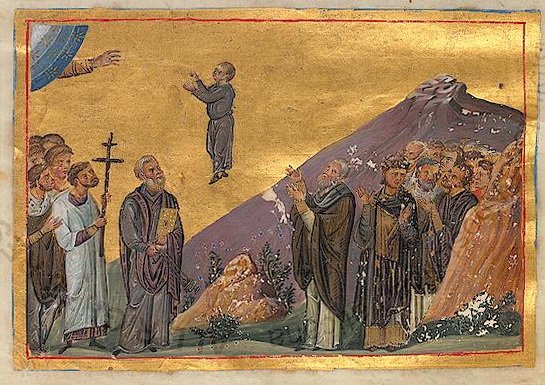
Commemoration of the Great Earthquake at Constantinople (447) and the Miracle of the Trisagion
During the reign of Emperor Theodsios II (402-450) the city of Constantinople was shaken by earthquakes
for nearly four months. At that time several churches, houses, and the city's stone walls collapsed and were
destroyed. All the inhabitants of the city were terrified. Patriarch Proclus (November 20) organized a barefoot Cross Procession and solemnly prayed for God to protect them. W
During the reign of Emperor Theodsios II (402-450) the city of Constantinople was shaken by earthquakes
for nearly four months. At that time several churches, houses, and the city's stone walls collapsed and were
destroyed. All the inhabitants of the city were terrified. Patriarch Proclus (November 20) organized a barefoot Cross Procession and solemnly prayed for God to protect them. While this was taking place, the tremors increased dramatically, and a young boy in the crowd was lifted up into Heaven by some invisible power, and the people, cried out, "Lord, have mercy."
After returning to earth, the boy told the people that he had heard the Angels glorifying God by singing "Holy God, Holy Mighty, Holy Immortal, have mercy on us," and that a voice had commanded him to tell Patriarch Proclus that henceforth the people should supplicate God in this way, without adding anything to it. The Patriarch instructed the people to sing this hymn, whereupon the ground stopped shaking and the child reposed.
From that time the hymn was inserted into the Divine Liturgy, just as it was sung by the people during the earthquake, and as it is still sung up to the present day.
Venerable Dosithea, recluse of the Kiev Caves (1776)
She was born to landed gentry of Riazan province in 1721. Her name in secular life is not recorded. For much of her childhood she was cared for by her grandmother the nun Porphyria, from whom she acquired a love for the ascetical struggle. When Porphyria took the Great Schema, the child returned home, but continued to live as much like a nun as she could.
She was born to landed gentry of Riazan province in 1721. Her name in secular life is not recorded. For much of her childhood she was cared for by her grandmother the nun Porphyria, from whom she acquired a love for the ascetical struggle. When Porphyria took the Great Schema, the child returned home, but continued to live as much like a nun as she could. Her parents were eager to marry her as soon as possible, but she foiled their plans by leaving home at the age of fifteen, dressed as a peasant boy and calling herself Dositheus. In this guise she entered the Lavra of St Sergius. Three years later she fled to avoid discovery by her parents, and went to the Lavra of Kiev. There she was turned away, since she had no passport; so she took up the hermit’s life in cave near Kitayev Skete, living only on bread, water and a few wild plants. Before long her gifts of prophecy became known, and the counsel of ‘Dositheus the Hermit’ was sought out by many of the faithful. She would speak to her many visitors through a small window that did not allow them to see her face. The Empress Elizabeth visited her in 1744, and at her request ‘Dositheus’ received monastic tonsure. When the young Prochor Moshnin — one day to be known as St Seraphim of Sarov (January 2) — visited her, she foresaw his holy future, blessed him and directed him to the Monastery of Sarov, instructing him to practice the Jesus Prayer ceaselessly.
Later, the eremitic life was banned in Russia by Imperial decree, so ‘Dositheus’ moved to the Kiev Caves Lavra, then to a remote cell at the Kitaya Skete. When she discerned that the time of her death was near, she left her cell and greeted the brethren of the Skete. The next day she was found on her knees in her cell before an icon, with a piece of paper in her hand reading ‘My body is ready for burial. I beg you not to touch it and to bury it in the usual way.’ Only in preparing her for burial was it discovered that she was a woman. ‘Dositheus the Hermit’ is counted as one of the revivers of the Orthodox hesychast tradition in Russia, where it had been almost forgotten even among monastics.
Scripture Readings
☩Epistle
1 Corinthians 4:1-5
1
Let a man so account of us, as of the ministers of Christ, and stewards of the mysteries of God.
2
Moreover it is required in stewards, that a man be found faithful.
3
But with me it is a very small thing that I should be judged of you, or of man’s judgment: yea, I judge not mine own self.
4
For I know nothing by myself; yet am I not hereby justified: but he that judgeth me is the Lord.
5
Therefore judge nothing before the time, until the Lord come, who both will bring to light the hidden things of darkness, and will make manifest the counsels of the hearts: and then shall every man have praise of God.
☩Gospel
Luke 4:31-36
31
And came down to Capernaum, a city of Galilee, and taught them on the sabbath days.
32
And they were astonished at his doctrine: for his word was with power.
33
And in the synagogue there was a man, which had a spirit of an unclean devil, and cried out with a loud voice,
34
Saying, Let us alone; what have we to do with thee, thou Jesus of Nazareth? art thou come to destroy us? I know thee who thou art; the Holy One of God.
35
And Jesus rebuked him, saying, Hold thy peace, and come out of him. And when the devil had thrown him in the midst, he came out of him, and hurt him not.
36
And they were all amazed, and spake among themselves, saying, What a word is this! for with authority and power he commandeth the unclean spirits, and they come out.
Liturgical data sourced from OCA.org and orthocal.info