Fasting Rules
 Meat
Allowed
 Fish
Allowed
 Dairy
Allowed
 Oil
Allowed
 Wine
Allowed
Saints & Commemorations
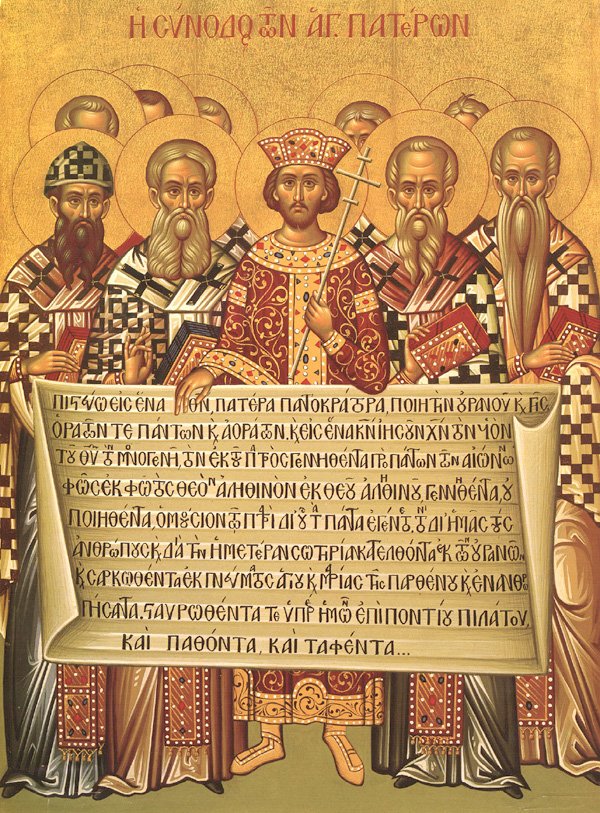
Holy Fathers of the First Ecumenical Council
On the seventh Sunday of Pascha, we commemorate the holy God-bearing Fathers of the First Ecumenical Council.
The Commemoration of the First Ecumenical Council has been celebrated by the Church of Christ from ancient times. The Lord Jesus Christ left the Church a great promise, “I will build My Church, and the gates of hell shall not prevail against it” (Mt. 16:
On the seventh Sunday of Pascha, we commemorate the holy God-bearing Fathers of the First Ecumenical Council.
The Commemoration of the First Ecumenical Council has been celebrated by the Church of Christ from ancient times. The Lord Jesus Christ left the Church a great promise, “I will build My Church, and the gates of hell shall not prevail against it” (Mt. 16:18). Although the Church of Christ on earth will pass through difficult struggles with the Enemy of salvation, it will emerge victorious. The holy martyrs bore witness to the truth of the Savior’s words, enduring suffering and death for confessing Christ, but the persecutor’s sword is shattered by the Cross of Christ.
Persecution of Christians ceased during the fourth century, but heresies arose within the Church itself. One of the most pernicious of these heresies was Arianism. Arius, a priest of Alexandria, was a man of immense pride and ambition. In denying the divine nature of Jesus Christ and His equality with God the Father, Arius falsely taught that the Savior is not consubstantial with the Father, but is only a created being.
A local Council, convened with Patriarch Alexander of Alexandria presiding, condemned the false teachings of Arius. However, Arius would not submit to the authority of the Church. He wrote to many bishops, denouncing the decrees of the local Council. He spread his false teaching throughout the East, receiving support from certain Eastern bishops.
Investigating these dissentions, the holy emperor Constantine (May 21) consulted Bishop Hosius of Cordova (Aug. 27), who assured him that the heresy of Arius was directed against the most fundamental dogma of Christ’s Church, and so he decided to convene an Ecumenical Council. In the year 325, 318 bishops representing Christian Churches from various lands gathered together at Nicea.
Among the assembled bishops were many confessors who had suffered during the persecutions, and who bore the marks of torture upon their bodies. Also participating in the Council were several great luminaries of the Church: Saint Nicholas, Archbishop of Myra in Lycia (December 6 and May 9), Saint Spyridon, Bishop of Tremithos (December 12), and others venerated by the Church as holy Fathers.
With Patriarch Alexander of Alexandria came his deacon, Athanasius [who later became Patriarch of Alexandria (May 2 and January 18)]. He is called “the Great,” for he was a zealous champion for the purity of Orthodoxy. In the Sixth Ode of the Canon for today’s Feast, he is referred to as “the thirteenth Apostle.”
The emperor Constantine presided over the sessions of the Council. In his speech, responding to the welcome by Bishop Eusebius of Caesarea, he said, “God has helped me cast down the impious might of the persecutors, but more distressful for me than any blood spilled in battle is for a soldier, is the internal strife in the Church of God, for it is more ruinous.”
Arius, with seventeen bishops among his supporters, remained arrogant, but his teaching was repudiated and he was excommunicated from the Church. In his speech, the holy deacon Athanasius conclusively refuted the blasphemous opinions of Arius. The heresiarch Arius is depicted in iconography sitting on Satan’s knees, or in the mouth of the Beast of the Deep (Rev. 13).
The Fathers of the Council declined to accept a Symbol of Faith (Creed) proposed by the Arians. Instead, they affirmed the Orthodox Symbol of Faith. Saint Constantine asked the Council to insert into the text of the Symbol of Faith the word “consubstantial,” which he had heard in the speeches of the bishops. The Fathers of the Council unanimously accepted this suggestion.
In the Nicean Creed, the holy Fathers set forth and confirmed the Apostolic teachings about Christ’s divine nature. The heresy of Arius was exposed and repudiated as an error of haughty reason. After resolving this chief dogmatic question, the Council also issued Twelve Canons on questions of churchly administration and discipline. Also decided was the date for the celebration of Holy Pascha. By decision of the Council, Holy Pascha should not be celebrated by Christians on the same day with the Jewish Passover, but on the first Sunday after the first full moon of the vernal equinox (which occured on March 22 in 325).
The First Ecumenical Council is also commemorated on May 29.
Troparion - Tone 8
You are most glorious, O Christ our God! / You have established the Holy Fathers as lights on the earth! / Through them you have guided us to the true faith! / O greatly Compassionate One, glory to You!
Kontakion - Tone 8
The Apostles’ preaching and the Fathers’ doctrines have established one faith for the Church. / Adorned with the robe of truth, woven from heavenly theology, / it defines and glorifies the great mystery of Orthodoxy!

Martyr Aquilina of Byblos
The Holy Martyr Aquilina, a native of the Phoenician city of Byblos, suffered under the emperor Diocletian (284-305). Her parents raised her in Christian piety. When the girl was only twelve years old, she persuaded a pagan friend to convert to Christ. One of the servants of the imperial governor Volusian accused her of teaching others not to follow the religion of their fathers.
The Holy Martyr Aquilina, a native of the Phoenician city of Byblos, suffered under the emperor Diocletian (284-305). Her parents raised her in Christian piety. When the girl was only twelve years old, she persuaded a pagan friend to convert to Christ. One of the servants of the imperial governor Volusian accused her of teaching others not to follow the religion of their fathers. The girl firmly confessed her faith in Christ before the governor and said that she would not renounce Him. Volusian tried to influence the young confessor through persuasion and by flattery, but seeing her confidence, he ordered her to be tortured.
They struck her upon the face, then they stripped her and beat her with whips. The torturer asked, “Where then is your God? Let Him come and take you out of my hands”.
The saint answered, “The Lord is here with me invisibly, and the more I suffer, the more strength and endurance will He give me.”
They drilled through the martyr’s ears with heated metal rods. The holy virgin fell down as if dead. The torturer thought that the girl had actually died, and he gave orders to throw her body outside the city to be eaten by dogs.
By night a holy angel appeared to Saint Aquilina, roused her and said, “Arise and be healed. Go and denounce Volusian, so that he and his plans may come to nothing.”
The martyr went to the court of the governor and stood before Volusian. Seeing Saint Aquilina, he called for his servants and ordered them to keep watch over her until morning.
In the morning he sentenced Saint Aquilina to death, saying that she was a sorceress who did not obey the imperial decrees. When they led the saint to execution, she prayed and gave thanks to God for allowing her to suffer for His Holy Name.
A voice was heard in answer to her prayer, summoning her to the heavenly Kingdom. Before the executioner could carry out the sentence, the martyr gave up her spirit to God (+ 293). The executioner feared to disobey the governor’s orders, so he cut off her head although she was already dead.
Christians piously buried the martyr’s body. Later, her relics were taken to Constantinople and placed in a church named for her.
Troparion - Tone 4
Your lamb Aquilina, calls out to You, O Jesus, in a loud voice: / “I love You, my Bridegroom, and in seeking You I endure suffering. / In baptism I was crucified so that I might reign in You, / and I died so that I might live with You. / Accept me as a pure sacrifice, / for I have offered myself in love.” / Through her prayers save our souls, since You are merciful.
Kontakion - Tone 3
You ascended to the heights through martyrdom, all-honorable Aquilina, / having purified your soul through the virtues of your virginity. / You were wounded with love for Christ your bridegroom, / before whom you stand rejoicing with the angels; / together with them unceasingly pray for us all.

Saint Triphyllius, bishop of Leucosia (Nicosia) in Cyprus (370)
Saint Tryphillius, Bishop of Leukosia, was born in Constantinople, and he received his education at Berit (Beirut, in Lebanon). He was very intelligent and eloquent. In spite of this, the saint chose as his guide a man neither bookish nor learned, but one of conspicuous holiness: Saint Spyridon of Tremithos (December 12).
Saint Tryphillius, Bishop of Leukosia, was born in Constantinople, and he received his education at Berit (Beirut, in Lebanon). He was very intelligent and eloquent. In spite of this, the saint chose as his guide a man neither bookish nor learned, but one of conspicuous holiness: Saint Spyridon of Tremithos (December 12).
The emperor Constantine II (337-340) fell grievously ill, and receiving no help from the doctors, he turned to God. In a dream he saw an angel, directing him to a group of hierarchs. Pointing out two of them, the angel said that only through them could he receive healing.
Constantine issued an imperial edict, commanding the bishops to assemble. Saint Spyridon also received this order, and went to the emperor with his disciple Saint Tryphillius. The sick one immediately recognized them as the healers indicated by the angel. He bowed to them and asked them to pray for his health. Saint Spyridon with a prayer touched the head of the emperor, and he became well.
Saint Tryphillius was charmed by the beautiful palace, the majestic figure of the emperor, and the pomp of palace life. Saint Spyridon said, “Why are you astonished? Does all this make the emperor any more righteous? All of them, emperors and dignitaries alike, will die and stand together with the very poorest before the judgment seat of God. One should seek eternal blessings and heavenly glory.”
Soon Saint Tryphillius was made Bishop of Leukosia on Cyprus. He often visited with Saint Spyridon. Once, they passed through an area of vineyards and gardens of special beauty and abundance, named Parimnos. Saint Tryphillius, attracted by the beauty of nature, considered how they might explore this land. Saint Spyridon discerned the thoughts of Saint Tryphillius and said, “Why do you always think about earthly and transitory blessings? Our habitation and riches are in Heaven, for which we ought to strive.” Thus did Saint Spyridon lead his disciple toward spiritual perfection, which Saint Tryphillius attained through the prayers of his instructor. Saint Tryphillius had a charitable soul, a heart without malice, right faith and love towards all, and many other virtues.
Once, a Council of bishops assembled on Cyprus. The Fathers of the Council requested that Saint Tryphillius, known for his erudition and eloquence, address the people. Speaking about the healing of the paralytic by the Lord (Mark 2:11), in place of the word “cot” he used the word “bed”. Impatient with the imprecise rendering of the Gospel text, Saint Spyridon said to Saint Tryphillius, “Are you better than He who said “cot”, that you should be ashamed of His wording?” and abruptly he left the church.
In this way Saint Spyridon gave Saint Tryphillius a lesson in humility, so that he would not become proud of his own eloquence. Saint Tryphillius wisely shepherded his flock. From the inheritance left him by his mother, he built a monastery at Leukosia. The saint died in old age in about the year 370.
The Russian pilgrim Igumen Daniel saw the relics of Saint Tryphillius on Cyprus at the beginning of the twelfth century.
Troparion - Tone 4
In truth you were revealed to your flock as a rule of faith, / an image of humility and a teacher of abstinence; / your humility exalted you; / your poverty enriched you. / Hierarch Father Triphyllius, / entreat Christ our God / that our souls may be saved.

St Anna and her son John (5h c.)
Saint Anna and her son Saint John lived in the ninth century. Saint Anna was the daughter of a deacon of the Blachernae church in Constantinople. After the death of her husband, she dressed in men’s clothing and called herself Euthymianus. She and her son Saint John lived in asceticism in one of the Bythinian monasteries near Olympus.
Saint Anna and her son Saint John lived in the ninth century. Saint Anna was the daughter of a deacon of the Blachernae church in Constantinople. After the death of her husband, she dressed in men’s clothing and called herself Euthymianus. She and her son Saint John lived in asceticism in one of the Bythinian monasteries near Olympus.
Saint Anna died in Constantinople in 826. Her memory is also celebrated on October 29.
Troparion - Tone 8
By a flood of tears you made the desert fertile, / and your longing for God brought forth fruits in abundance. / By the radiance of miracles you illumined the whole universe! / O holy Anna and John, pray to Christ our God to save our souls!
Scripture Readings
☩Epistle
Acts 20:16-18, 28-36
16
For Paul had determined to sail by Ephesus, because he would not spend the time in Asia: for he hasted, if it were possible for him, to be at Jerusalem the day of Pentecost.
17
And from Miletus he sent to Ephesus, and called the elders of the church.
18
And when they were come to him, he said unto them, Ye know, from the first day that I came into Asia, after what manner I have been with you at all seasons,
28
Take heed therefore unto yourselves, and to all the flock, over the which the Holy Ghost hath made you overseers, to feed the church of God, which he hath purchased with his own blood.
29
For I know this, that after my departing shall grievous wolves enter in among you, not sparing the flock.
30
Also of your own selves shall men arise, speaking perverse things, to draw away disciples after them.
31
Therefore watch, and remember, that by the space of three years I ceased not to warn every one night and day with tears.
32
And now, brethren, I commend you to God, and to the word of his grace, which is able to build you up, and to give you an inheritance among all them which are sanctified.
33
I have coveted no man’s silver, or gold, or apparel.
34
Yea, ye yourselves know, that these hands have ministered unto my necessities, and to them that were with me.
35
I have shewed you all things, how that so labouring ye ought to support the weak, and to remember the words of the Lord Jesus, how he said, It is more blessed to give than to receive.
36
And when he had thus spoken, he kneeled down, and prayed with them all.
☩Gospel
John 17:1-13
1
These words spake Jesus, and lifted up his eyes to heaven, and said, Father, the hour is come; glorify thy Son, that thy Son also may glorify thee:
2
As thou hast given him power over all flesh, that he should give eternal life to as many as thou hast given him.
3
And this is life eternal, that they might know thee the only true God, and Jesus Christ, whom thou hast sent.
4
I have glorified thee on the earth: I have finished the work which thou gavest me to do.
5
And now, O Father, glorify thou me with thine own self with the glory which I had with thee before the world was.
6
I have manifested thy name unto the men which thou gavest me out of the world: thine they were, and thou gavest them me; and they have kept thy word.
7
Now they have known that all things whatsoever thou hast given me are of thee.
8
For I have given unto them the words which thou gavest me; and they have received them, and have known surely that I came out from thee, and they have believed that thou didst send me.
9
I pray for them: I pray not for the world, but for them which thou hast given me; for they are thine.
10
And all mine are thine, and thine are mine; and I am glorified in them.
11
And now I am no more in the world, but these are in the world, and I come to thee. Holy Father, keep through thine own name those whom thou hast given me, that they may be one, as we are.
12
While I was with them in the world, I kept them in thy name: those that thou gavest me I have kept, and none of them is lost, but the son of perdition; that the scripture might be fulfilled.
13
And now come I to thee; and these things I speak in the world, that they might have my joy fulfilled in themselves.
Liturgical data sourced from OCA.org and orthocal.info