Fasting Rules
 Meat
Allowed
 Fish
Allowed
 Dairy
Allowed
 Oil
Allowed
 Wine
Allowed
Saints & Commemorations
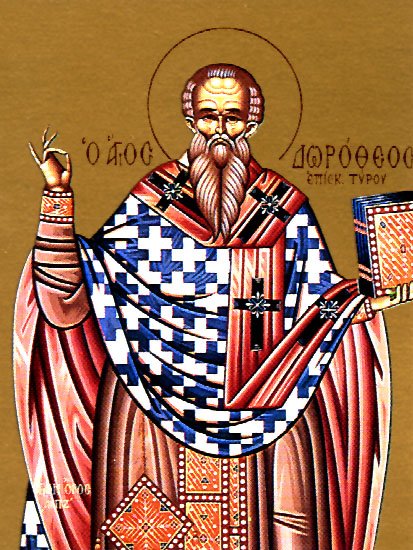
Hieromartyr Dorotheus, Bishop of Tyre
The Hieromartyr Dorotheus was bishop of the Phoenician city of Tyre, during the time of the persecution against Christians under the emperor Diocletian (284-305). Heeding the words of the Gospel (Mt.10:23), the saint withdrew from Tyre and hid from the persecutors. He returned to Tyre during the reign of Saint Constantine the Great (306-337, May 21), again occupying the bishop’s throne he guided his flock for more than fifty years, and converted many of the pagans to Christianity. W
The Hieromartyr Dorotheus was bishop of the Phoenician city of Tyre, during the time of the persecution against Christians under the emperor Diocletian (284-305). Heeding the words of the Gospel (Mt.10:23), the saint withdrew from Tyre and hid from the persecutors. He returned to Tyre during the reign of Saint Constantine the Great (306-337, May 21), again occupying the bishop’s throne he guided his flock for more than fifty years, and converted many of the pagans to Christianity. When the emperor Julian the Apostate (361-363) began openly to persecute Christians, Saint Dorotheus was already over 100 years old. He withdrew from Tyre to the Myzean city of Udum (present day Bulgarian Varna). Delegates of the emperor arrested him there for his refusal to offer sacrifice to idols. They began to torture the holy Elder, and under torture he surrendered his soul to the Lord (+ ca. 362) at the age of 107.
Some ascribe to Saint Dorotheus the compilation of a work, “The Synopsis”, a collection of sayings, and including lives of the holy prophets and apostles.
Troparion - Tone 4
O Dorotheus, wise hierarch of Christ, / you received the light of wisdom as a gift from the Father of lights. / You increased the talents given to you / and in your old age contested beyond the bounds of nature. / And now, O Hieromartyr, you even intercede for our souls!
Kontakion - Tone 3
By preaching Orthodox doctrine, O Hieromartyr, / you offered yourself as a godly and holy gift. / First you excelled in asceticism / and then in the contest of martyrdom, / attaining the victor’s prize from Christ our God!
Our Holy Father Theodore the Hermit and Wonderworker (583)
Saint Theodore the Wonderworker lived during the sixth century. In his youth he forsook the world in order to become a monk, withdrawing into the Jordanian wilderness. He lived a life of asceticism, and so he received from God the gift of wonderworking. Once, while he was journeying to Constantinople by ship, the ship went off course.
Saint Theodore the Wonderworker lived during the sixth century. In his youth he forsook the world in order to become a monk, withdrawing into the Jordanian wilderness. He lived a life of asceticism, and so he received from God the gift of wonderworking. Once, while he was journeying to Constantinople by ship, the ship went off course. Soon they ran out of drinking water, and the travelers were nearly dead from thirst. Saint Theodore prayed to God and made the Sign of the Cross over the sea. Then he told the sailors to draw some water from the sea and drink it. When they did so, they discovered that the water was fresh.
The passengers began to thank the saint and to honor him for saving them by providing fresh water. Saint Theodore said that they ought to thank God, who had performed this miracle because of His love for mankind. In his humility, he told them that it was not the result of his unworthy prayers.
Saint Theodore departed to the Lord in the year 583.
Troparion - Tone 8
By a flood of tears you made the desert fertile, / and your longing for God brought forth fruits in abundance. / By the radiance of miracles you illumined the whole universe! / O our holy father Theodore, pray to Christ our God to save our souls!
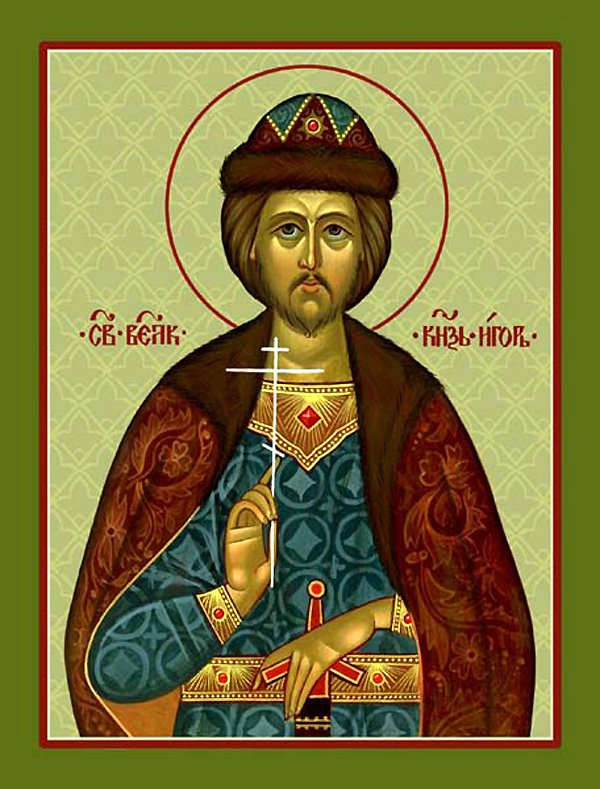
Blessed Igor-George, tonsured Gabriel, great prince of Chernigov and Kiev (1147)
The Transfer of Relics of Saint Igor, Great Prince of Kiev The Kievan Great Prince Igor Ol’govich, in holy Baptism George (September 19), in the year 1146 suffered defeat and was taken captive by prince Izyaslav, who imprisoned him in one of the monasteries of Russian or Southern Pereyaslavl’ (now Pereyaslavl’-Khmel’nitsk). Far rem
The Transfer of Relics of Saint Igor, Great Prince of Kiev The Kievan Great Prince Igor Ol’govich, in holy Baptism George (September 19), in the year 1146 suffered defeat and was taken captive by prince Izyaslav, who imprisoned him in one of the monasteries of Russian or Southern Pereyaslavl’ (now Pereyaslavl’-Khmel’nitsk). Far removed from the vanities of this world, and grievously ill, he began to repent of his sins and asked permission to be tonsured a monk. On January 5, 1147 Bishop Euthymius of Pereyaslavl’ tonsured him into monasticism with the name Gabriel. Soon he recovered his health and transferred to the Kiev Theodorov monastery, where he became a schemamonk with the name Ignatius, and devoted himself entirely to monastic efforts.
But a storm of fratricidal hatred raged over Kiev. The Chernigov princes, cousins of Igor, plotted to entice Izyaslav of Kiev into a joint campaign with the aim of capturing, or even killing him. The plot was uncovered when the prince was already on the way to Chernigov. The Kievans were in an uproar in learning of the ruse of the Chernigovichi, and they stormed into the place where the innocent Saint Igor was. Saint Igor was brutally murdered on September 19, 1147.
The Lord glorified the sufferer with miracles. With the blessing of Metropolitan Clement Smolyatich, Igumen Ananias of the Theodorov monastery buried the passion-bearer in the church of the Kiev Simonov monastery. On June 5, 1150, when the Kiev throne had become occupied by Yuri Dolgoruky, his confederate and the murdered Igor’s brother, the Chernigov prince Svyatoslav Ol’govich, solemnly transferred the holy relics of Saint Igor to Chernigov his native region, where they were placed into a reliquary in the Savior cathedral church. Then also the Feastday in memory of the saint was established.
Blessed Constantine, Metropolitan of Kiev (1159)
In 1147 Saint Igor Ol’govich (September 19, June 5) was defeated and captured by Izyaslav Mstislavich, the grandson of Saint Vladimir (July 15). Izyaslav then replaced Saint Igor as Great Prince.
The See of Kiev had been left vacant after the death of Metropolitan Michael in 1145, and Izyaslav chose the learned Schemamonk Clement of Smolensk to succeed him. H
In 1147 Saint Igor Ol’govich (September 19, June 5) was defeated and captured by Izyaslav Mstislavich, the grandson of Saint Vladimir (July 15). Izyaslav then replaced Saint Igor as Great Prince.
The See of Kiev had been left vacant after the death of Metropolitan Michael in 1145, and Izyaslav chose the learned Schemamonk Clement of Smolensk to succeed him. He wanted the candidate to be consecrated by bishops in Russia, instead of sending him to Constantinople for consecration. Because of the great distance between Kiev and Constantinople Izyaslav called a council of Russian bishops, and ordered them to consecrate Clement as Metropolitan of Kiev.
Not all of the bishops were in agreement with this plan, notably the holy Archbishop Niphon of Novgorod (April 8). Other hierarchs also refused to participate in the consecration without the blessing of the Patriarch of Constantinople. Clement’s consecration took place in spite of the objections that had been raised.
After Izyaslav’s reign, he was succeeded by Yuri (George) Dolgoruky. This Great Prince regarded the consecration as illegal and uncanonical, and so he sent Saint Constantine (Smolyatich) to Constantinople to be consecrated as Metropolitan of Kiev by the Patriarch. Upon his return to Kiev, Saint Constantine, by the authority of the Patriarch, deposed Clement from his rank, and also deposed those who had been ordained by him.
When the Great Prince Yuri completed the course of his life disputes arose over who should succeed him as Great Prince. There was also disagreement about who was the rightful Metropolitan of Kiev, and Izyaslav’s son Mstislav supported Clement. Therefore, the Russian princes decided that both Clement and Constantine should be deposed, and requested the Patriarch of Constantinople to send them a new Metropolitan for Kiev.
Hoping to put an end to the disputes among the princes, the Patriarch sent Theodore to Kiev as the new Metropolitan. Saint Constantine, wishing to avoid further tumult in the Church, stepped down as Metropolitan and went to Chernigov, where he became gravely ill.
Feeling that he was approaching the end of his life, Saint Constantine composed a Testament, which he entrusted to Bishop Anthony of Chernigov. He also made Bishop Anthony promise that he would fulfill all the directives contained in the Testament after Constantine’s death.
When Saint Constantine reposed in 1159, Bishop Anthony took the Testament to Prince Svyatoslav of Chernigov, broke the seal, and read the document aloud. One of the provisions of the Testament was that Saint Constantine’s body should not be buried, but dragged out of the city to be left as food for dogs. This was because he felt responsible for the discord in the Church.
Everyone who heard the reading of the Testament was filled with horror. Prince Svyatoslav told the bishop to do as he saw fit. Since he had given his promise to Saint Constantine to abide by the terms of the Testament, he did not dare to go back on his word. So the saint’s body was taken from the city and left in a field.
On that very day the sky grew dark over Kiev, and strong winds, earthquakes, thunder and lightning broke out. It is said that eight people were hit by lightning at the same time.
Prince Rostislav of Kiev was in Povari at Vyshgorod at the time. He had received news of the death of Metropolitan Constantine, so he sent messages to the Church of the Holy Wisdom and to other churches, asking for all-night vigils to be conducted throughout the city. He believed that the citizens of Kiev were being punished by the Lord for their sins.
While all of these things were taking place in Kiev, the sun shone brightly in Chernigov. However, three pillars of fire appeared at night over the body of Saint Constantine. Seeing this marvel, many were filled with fear. On the third day that the body lay in the field, Prince Svyatoslav ordered that the body of the Metropolitan be buried with all the honor befitting his rank.
The body of the saint was carried into the city and buried in the church of the Savior, where Saint Igor, who was killed by the inhabitants of Kiev, had also been interred. After the burial of Saint Constantine, peace returned to Kiev, and all the people glorified God.
Troparion - Tone 4
In truth you were revealed to your flock as a rule of faith, / an image of humility and a teacher of abstinence; / your humility exalted you; / your poverty enriched you. / Hierarch Father Constantine, / entreat Christ our God / that our souls may be saved.
Scripture Readings
☩Epistle
Acts 15:35-41
35
Paul also and Barnabas continued in Antioch, teaching and preaching the word of the Lord, with many others also.
36
And some days after Paul said unto Barnabas, Let us go again and visit our brethren in every city where we have preached the word of the Lord, and see how they do.
37
And Barnabas determined to take with them John, whose surname was Mark.
38
But Paul thought not good to take him with them, who departed from them from Pamphylia, and went not with them to the work.
39
And the contention was so sharp between them, that they departed asunder one from the other: and so Barnabas took Mark, and sailed unto Cyprus;
40
And Paul chose Silas, and departed, being recommended by the brethren unto the grace of God.
41
And he went through Syria and Cilicia, confirming the churches.
☩Gospel
John 10:27-38
27
My sheep hear my voice, and I know them, and they follow me:
28
And I give unto them eternal life; and they shall never perish, neither shall any man pluck them out of my hand.
29
My Father, which gave them me, is greater than all; and no man is able to pluck them out of my Father’s hand.
30
I and my Father are one.
31
Then the Jews took up stones again to stone him.
32
Jesus answered them, Many good works have I shewed you from my Father; for which of those works do ye stone me?
33
The Jews answered him, saying, For a good work we stone thee not; but for blasphemy; and because that thou, being a man, makest thyself God.
34
Jesus answered them, Is it not written in your law, I said, Ye are gods?
35
If he called them gods, unto whom the word of God came, and the scripture cannot be broken;
36
Say ye of him, whom the Father hath sanctified, and sent into the world, Thou blasphemest; because I said, I am the Son of God?
37
If I do not the works of my Father, believe me not.
38
But if I do, though ye believe not me, believe the works: that ye may know, and believe, that the Father is in me, and I in him.
Liturgical data sourced from OCA.org and orthocal.info