Fasting Rules
 Meat
Abstain
 Fish
Abstain
 Dairy
Abstain
 Oil
Allowed
 Wine
Allowed
Saints & Commemorations
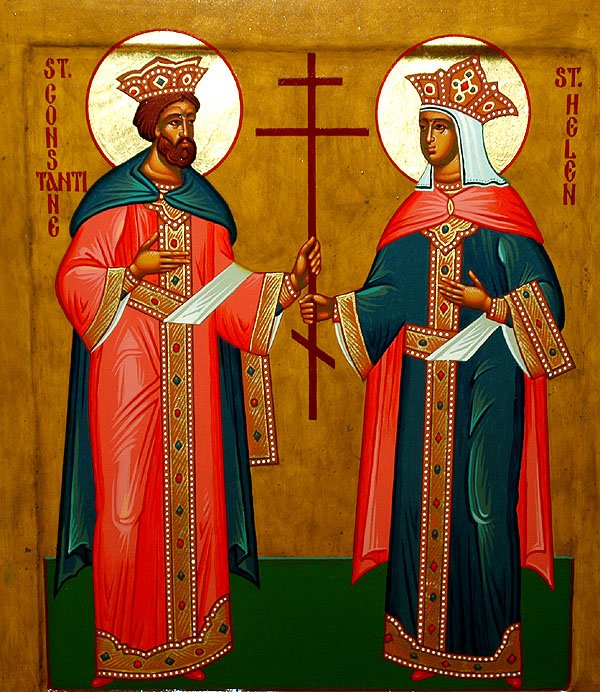
SS Constantine and Helen, Equals-to-the-Apostles
The Church calls Saint Constantine (306-337) “the Equal of the Apostles,” and historians call him “the Great.” He was the son of the Caesar Constantius Chlorus (305-306), who governed the lands of Gaul and Britain. His mother was Saint Helen, a Christian of humble birth.
At this time the immense Roman Empire was divided into Western and Eastern halves, governed by two independent emperors and their corulers called “Caesars.” Constantius Chlorus was Caesar in the Western Roman Empire. Saint Const
The Church calls Saint Constantine (306-337) “the Equal of the Apostles,” and historians call him “the Great.” He was the son of the Caesar Constantius Chlorus (305-306), who governed the lands of Gaul and Britain. His mother was Saint Helen, a Christian of humble birth.
At this time the immense Roman Empire was divided into Western and Eastern halves, governed by two independent emperors and their corulers called “Caesars.” Constantius Chlorus was Caesar in the Western Roman Empire. Saint Constantine was born in 274, possibly at Nish in Serbia. In 294, Constantius divorced Helen in order to further his political ambition by marrying a woman of noble rank. After he became emperor, Constantine showed his mother great honor and respect, granting her the imperial title “Augusta.”
Constantine, the future ruler of all the whole Roman Empire, was raised to respect Christianity. His father did not persecute Christians in the lands he governed. This was at a time when Christians were persecuted throughout the Roman Empire by the emperors Diocletian (284-305) and his corulers Maximian Galerius (305-311) in the East, and the emperor Maximian Hercules (284-305) in the West.
After the death of Constantius Chlorus in 306, Constantine was acclaimed by the army at York as emperor of Gaul and Britain. The first act of the new emperor was to grant the freedom to practice Christianity in the lands subject to him. The pagan Maximian Galerius in the East and the fierce tyrant Maxentius in the West hated Constantine and they plotted to overthrow and kill him, but Constantine bested them in a series of battles, defeating his opponents with the help of God. He prayed to God to give him a sign which would inspire his army to fight valiantly, and the Lord showed him a radiant Sign of the Cross in the heavens with the inscription “In this Sign, conquer.”
After Constantine became the sole ruler of the Western Roman Empire, he issued the Edict of Milan in 313 which guaranteed religious tolerance for Christians. Saint Helen, who was a Christian, may have influenced him in this decision. In 323, when he became the sole ruler of the entire Roman Empire, he extended the provisions of the Edict of Milan to the Eastern half of the Empire. After three hundred years of persecution, Christians could finally practice their faith without fear.
Renouncing paganism, the Emperor did not let his capital remain in ancient Rome, the former center of the pagan realm. He transferred his capital to the East, to the city of Byzantium, which was renamed Constantinople, the city of Constantine (May 11). Constantine was deeply convinced that only Christianity could unify the immense Roman Empire with its diverse peoples. He supported the Church in every way. He recalled Christian confessors from banishment, he built churches, and he showed concern for the clergy.
The emperor deeply revered the victory-bearing Sign of the Cross of the Lord, and also wanted to find the actual Cross upon which our Lord Jesus Christ was crucified. For this purpose he sent his own mother, the holy Empress Helen, to Jerusalem, granting her both power and money. Patriarch Macarius of Jerusalem and Saint Helen began the search, and through the will of God, the Life-Creating Cross was miraculously discovered in 326. (The account of the finding of the Cross of the Lord is found under the Feast of the Exaltation of the Cross, September 14). The Orthodox Church commemorates the Uncovering of the Precious Cross and the Precious Nails by the Holy Empress Helen on March 6.
While in Palestine, the holy empress did much of benefit for the Church. She ordered that all places connected with the earthly life of the Lord and His All-Pure Mother, should be freed of all traces of paganism, and she commanded that churches should be built at these places.
The emperor Constantine ordered a magnificent church in honor of Christ’s Resurrection to be built over His tomb. Saint Helen gave the Life-Creating Cross to the Patriarch for safe-keeping, and took part of the Cross with her for the emperor. After distributing generous alms at Jerusalem and feeding the needy (at times she even served them herself), the holy Empress Helen returned to Constantinople, where she died in the year 327.
Because of her great services to the Church and her efforts in finding the Life-Creating Cross, the empress Helen is called “the Equal of the Apostles.”
The peaceful state of the Christian Church was disturbed by quarrels, dissensions and heresies which had appeared within the Church. Already at the beginning of Saint Constantine’s reign the heresies of the Donatists and the Novatians had arisen in the West. They demanded a second baptism for those who lapsed during the persecutions against Christians. These heresies, repudiated by two local Church councils, were finally condemned at the Council of Milan in 316.
Particularly ruinous for the Church was the rise of the Arian heresy in the East, which denied the Divine Nature of the Son of God, and taught that Jesus Christ was a mere creature. By order of the emperor, the First Ecumenical Council was convened in the city of Nicea in 325.
318 bishops attended this Council. Among its participants were confessor-bishops from the period of the persecutions and many other luminaries of the Church, among whom was Saint Nicholas of Myra in Lycia. (The account about the Council is found under May 29). The emperor was present at the sessions of the Council. The heresy of Arius was condemned and a Symbol of Faith (Creed) composed, in which was included the term “consubstantial with the Father,” at the insistence of the Emperor, confirming the truth of the divinity of Jesus Christ, Who assumed human nature for the redemption of all the human race.
After the Council of Nicea, Saint Constantine continued with his active role in the welfare of the Church. He accepted holy Baptism on his deathbed, having prepared for it all his whole life. Saint Constantine died on the day of Pentecost in the year 337 and was buried in the church of the Holy Apostles, in a crypt he had prepared for himself.
A shoulder blade of Saint Constantine is located in the Monastery of Konstamonίtou on Mount Athos. Pieces of the Holy Relics of Saint Constantine are also found in Kykkos Monastery on Cyprus; in Moscow's Holy Trinity - Saint Sergius Lavra; and Saint Alexander Nevsky Lavra in Saint Petersburg.
Troparion - Tone 8
Having seen the image of Your Cross in the heavens, / like Paul you did not receive your call from men. / O Lord, Your Apostle among kings, the Emperor Constantine, / has placed the Imperial City in Your hand; / always preserve it in peace, through the intercessions of the Theotokos, O only lover of mankind.
Kontakion - Tone 3
Today Constantine and his mother Helen / reveal the precious Cross, / the weapon of the faithful / against their enemies. / For our sakes, it has been shown to be a great sign, and fearsome in battle.
Holy New Martyr Pachomius (1730)
Born in a village of Little Russia (now Belarus), he was kidnapped as a boy and sold to a Turkish tanner as a slave. He spent the next twenty-seven years in Usaki in Asia Minor, where he was forced to embrace Islam. After long years of servitude he escaped and, reclaiming his Christianity, went to the Holy Mountain, became a monk and lived for twelve years.
Born in a village of Little Russia (now Belarus), he was kidnapped as a boy and sold to a Turkish tanner as a slave. He spent the next twenty-seven years in Usaki in Asia Minor, where he was forced to embrace Islam. After long years of servitude he escaped and, reclaiming his Christianity, went to the Holy Mountain, became a monk and lived for twelve years. Tormented by his former apostasy, he determined to suffer martyrdom for Christ. With the permission of his elder, Joseph, he returned to Usaki and showed himself to his former owner wearing his monastic habit. He was tortured, thrown into prison, and finally beheaded on on Ascension Day of 1730. His relics are buried on the island of Patmos in the Church of St John the Theologian, where they work many miracles.
Scripture Readings
☩Epistle
Acts 8:40-9:19
40
But Philip was found at Azotus: and passing through he preached in all the cities, till he came to Cesarea.
1
And Saul, yet breathing out threatenings and slaughter against the disciples of the Lord, went unto the high priest,
2
And desired of him letters to Damascus to the synagogues, that if he found any of this way, whether they were men or women, he might bring them bound unto Jerusalem.
3
And as he journeyed, he came near Damascus: and suddenly there shined round about him a light from heaven:
4
And he fell to the earth, and heard a voice saying unto him, Saul, Saul, why persecutest thou me?
5
And he said, Who art thou, Lord? And the Lord said, I am Jesus whom thou persecutest: it is hard for thee to kick against the pricks.
6
And he trembling and astonished said, Lord, what wilt thou have me to do? And the Lord said unto him, Arise, and go into the city, and it shall be told thee what thou must do.
7
And the men which journeyed with him stood speechless, hearing a voice, but seeing no man.
8
And Saul arose from the earth; and when his eyes were opened, he saw no man: but they led him by the hand, and brought him into Damascus.
9
And he was three days without sight, and neither did eat nor drink.
10
And there was a certain disciple at Damascus, named Ananias; and to him said the Lord in a vision, Ananias. And he said, Behold, I am here, Lord.
11
And the Lord said unto him, Arise, and go into the street which is called Straight, and enquire in the house of Judas for one called Saul, of Tarsus: for, behold, he prayeth,
12
And hath seen in a vision a man named Ananias coming in, and putting his hand on him, that he might receive his sight.
13
Then Ananias answered, Lord, I have heard by many of this man, how much evil he hath done to thy saints at Jerusalem:
14
And here he hath authority from the chief priests to bind all that call on thy name.
15
But the Lord said unto him, Go thy way: for he is a chosen vessel unto me, to bear my name before the Gentiles, and kings, and the children of Israel:
16
For I will shew him how great things he must suffer for my name’s sake.
17
And Ananias went his way, and entered into the house; and putting his hands on him said, Brother Saul, the Lord, even Jesus, that appeared unto thee in the way as thou camest, hath sent me, that thou mightest receive thy sight, and be filled with the Holy Ghost.
18
And immediately there fell from his eyes as it had been scales: and he received sight forthwith, and arose, and was baptized.
19
And when he had received meat, he was strengthened. Then was Saul certain days with the disciples which were at Damascus.
☩Gospel
John 6:48-54
48
I am that bread of life.
49
Your fathers did eat manna in the wilderness, and are dead.
50
This is the bread which cometh down from heaven, that a man may eat thereof, and not die.
51
I am the living bread which came down from heaven: if any man eat of this bread, he shall live for ever: and the bread that I will give is my flesh, which I will give for the life of the world.
52
The Jews therefore strove among themselves, saying, How can this man give us his flesh to eat?
53
Then Jesus said unto them, Verily, verily, I say unto you, Except ye eat the flesh of the Son of man, and drink his blood, ye have no life in you.
54
Whoso eateth my flesh, and drinketh my blood, hath eternal life; and I will raise him up at the last day.
Liturgical data sourced from OCA.org and orthocal.info