Fasting Rules
 Meat
Abstain
 Fish
Abstain
 Dairy
Abstain
 Oil
Allowed
 Wine
Allowed
Saints & Commemorations
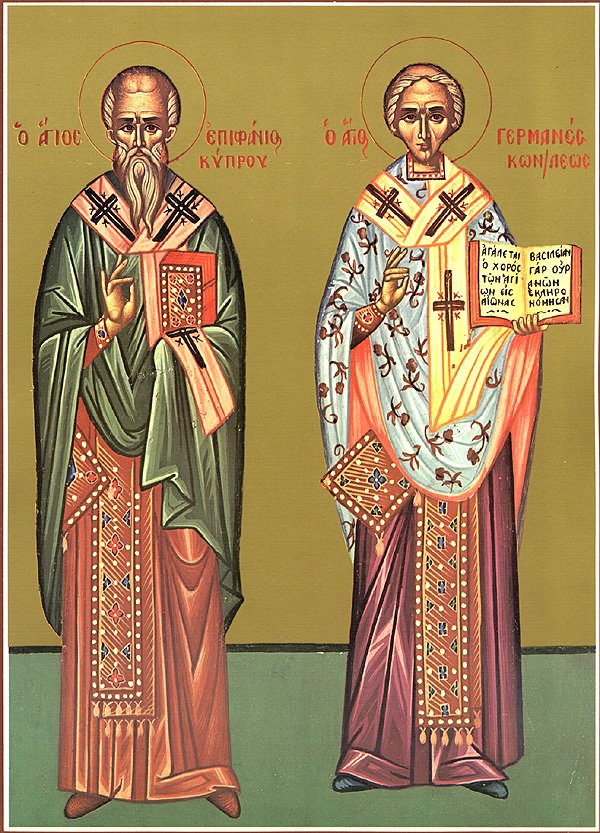
St Epiphanius, Bishop of Cyprus
Saint Epiphanius, Bishop of Cyprus, “a last relic of ancient piety,” as Saint Jerome calls him, lived during the fourth century in Phoenicia. The Roman empress Honoria was his sister. He was of Jewish descent, and in his youth he received a fine education. He was converted to Christianity after seeing how a certain monk named Lucian gave away his clothing to a poor person. Str
Saint Epiphanius, Bishop of Cyprus, “a last relic of ancient piety,” as Saint Jerome calls him, lived during the fourth century in Phoenicia. The Roman empress Honoria was his sister. He was of Jewish descent, and in his youth he received a fine education. He was converted to Christianity after seeing how a certain monk named Lucian gave away his clothing to a poor person. Struck by the monk’s compassion, Epiphanius asked to be instructed in Christianity.
He was baptized and became a disciple of Saint Hilarion the Great (October 21). Entering the monastery, he progressed in the monastic life under the guidance of the experienced Elder Hilarion, and he occupied himself with copying Greek books.
Because of his ascetic struggles and virtues, Saint Epiphanius was granted the gift of wonderworking. In order to avoid human glory, he left the monastery and went into the Spanidrion desert. Robbers caught him there and held him captive for three months. By speaking of repentance, the saint brought one of the robbers to faith in the true God. When they released the holy ascetic, the robber also went with him. Saint Epiphanius took him to his monastery and baptized him with the name John. From that time, he became a faithful disciple of Saint Epiphanius, and he carefully documented the life and miracles of his instructor.
Reports of the righteous life of Saint Epiphanius spread far beyond the monastery. The saint went a second time into the desert with his disciple John. Even in the wilderness disciples started to come to him, so he established a new monastery for them.
After a certain time, Saint Epiphanius made a pilgrimage to Jerusalem to venerate its holy shrines, and then returned to the Spanidrion monastery. The people of Lycia sent the monk Polybios to Saint Epiphanius asking him to take the place of their dead archpastor. When he learned of this intention, the clairvoyant ascetic secretly went into the Pathysian desert to the great ascetic Saint Hilarion (October 21), under whose guidance he had learned asceticism in his youth.
The saints spent two months in prayer, and then Hilarion sent Saint Epiphanius to Salamis. Bishops were gathered there to choose a new archpastor to replace one who recently died. The Lord revealed to the eldest of them, Bishop Papius, that Saint Epiphanius should be chosen bishop. When Epiphanius arrived, Saint Papius led him into the church, where in obedience to the will of the participants of the Council, Epiphanius agreed to be their bishop. Saint Epiphanius was consecrated as Bishop of Salamis in 367.
Saint Epiphanius won renown because of his great zeal for the Faith, his love and charity toward the poor, and his simplicity of character. He suffered much from the slander and enmity of some of his clergy. Because of the purity of his life, Saint Epiphanius was permitted to see the coming of the Holy Spirit upon the Gifts at Divine Liturgy. Once, when the saint was celebrating the Mystery, he did not see this vision. He then suspected this was caused by the spiritual state of one of the clergy and quietly said to him, “Depart, my son, for you are unworthy to participate in the celebration of the Mystery today.”
At this point, the writings of his disciple John break off, because he became sick and died. The further record of the life of Saint Epiphanius was continued by another of his disciples, Polybios (afterwards bishop of city of Rinocyreia).
Through the intrigues of the empress Eudoxia and the Patriarch Theophilos of Alexandria, towards the end of his life Saint Epiphanius was summoned to Constantinople to participate in the Synod of the Oak, which was convened to judge the great saint, John Chrysostom (September 14 and November 13). Once he realized that he was being manipulated by Chrysostom’s enemies, Saint Epiphanius left Constantinople, unwilling to take part in an unlawful council.
As he was sailing home on a ship, the saint sensed the approach of death, and he gave his disciples final instructions: to keep the commandments of God, and to preserve the mind from impure thoughts. He died two days later. The people of Salamis met the body of their archpastor with carriages, and on May 12, 403 they buried him in a new church which he himself had built.
The Seventh Ecumenical Council named Saint Epiphanius as a Father and Teacher of the Church. In the writings of Saint Epiphanius, the PANARIUM and the ANCHORATUS are refutations of Arianism and other heresies. In his other works are found valuable church traditions, and directives for the Greek translation of the Bible.
In his zeal to preserve the purity of the Orthodox Faith, Saint Epiphanius could sometimes be rash and tactless. In spite of any impetuous mistakes he may have made, we must admire Saint Epiphanius for his dedication in defending Orthodoxy against false teachings. After all, one of the bishop’s primary responsibilities is to protect his flock from those who might lead them astray.
We also honor Saint Epiphanius for his deep spirituality, and for his almsgiving. No one surpassed him in his tenderness and charity to the poor, and he gave vast sums of money to those in need.
Troparion - Tone 4
O God of our Fathers, / always act with kindness towards us; / take not Your mercy from us, / but guide our lives in peace / through the prayers of the hierarchs Epiphanius and Germanus.
Kontakion - Tone 4
With faith, let us praise the pair of wonderful hierarchs, / the divine Epiphanius and Germanus, / for they subdued the godless pagans / by proclaiming the wisest teachings to all, / ever chanting the great mystery of piety in an Orthodox manner.
Our Fathers among the Saints Epiphanios, bishop of Cyprus (403) and Germanos, Archbishop of Constantinople (740)
Saint Epiphanios was born a Jew in Palestine, but he and his sister came to faith in Christ and were baptized together. Epiphanios gave all his possessions to the poor and became a monk. He knew St Hilarion the great (October 31), and traveled among the monks of Egypt to learn their ways and wisdom. The fame of his virtue spread so widely that several attempts were made to make him bishop, first in Egypt, then in Cyprus.
Saint Epiphanios was born a Jew in Palestine, but he and his sister came to faith in Christ and were baptized together. Epiphanios gave all his possessions to the poor and became a monk. He knew St Hilarion the great (October 31), and traveled among the monks of Egypt to learn their ways and wisdom. The fame of his virtue spread so widely that several attempts were made to make him bishop, first in Egypt, then in Cyprus. Whenever Epiphanios heard of these plans, he fled the area. He was finally made bishop by means of a storm: told to go to Cyprus, he took ship instead for Gaza, but a contrary wind blew his ship directly to Cyprus, where “Epiphanios fell into the hands of bishops who had come together to elect a successor to the newly-departed Bishop of Constantia, and the venerable Epiphanios was at last constrained to be consecrated, about the year 367.” (Great Horologion). He guarded his flock faithfully for the remainder of his life, working many miracles, defending the Church against the Arian heresy, and composing several books, of which the best-loved is the Panarion (from the Latin for ‘bread-box’), an exposition of the Faith and an examination of eighty heresies. He was sometimes called the ‘Five-tongued’ because he was fluent in Hebrew, Egyptian, Syriac, Greek, and Latin.
Saint Germanos was the son of a prominent family, in Constantinople. He became Metropolitan of Cyzicus, then was elevated to the throne at Constantinople in 715. It was he who baptized the infant Constantine, who for his whole life was nicknamed “Copronymos” because he defecated in the baptismal font (though he was neither the first nor the last infant to do so). At this incident, Patriarch Germanos is said to have prophesied that the child would one day bring some foul heresy upon the Church, which he did, becoming a notorious iconoclast as emperor. Germanos openly opposed the decree of the Emperor Leo the Isaurian which began the persecution of the holy icons. For this he was deposed and driven into exile in 730. He lived the rest of his life in peace. Saint Germanos is the composer of many of the Church’s hymns, notably those for the Feast of the Meeting in the Temple.
These two Saints are always commemorated together.
Scripture Readings
☩Epistle
Acts 4:13-22
13
Now when they saw the boldness of Peter and John, and perceived that they were unlearned and ignorant men, they marvelled; and they took knowledge of them, that they had been with Jesus.
14
And beholding the man which was healed standing with them, they could say nothing against it.
15
But when they had commanded them to go aside out of the council, they conferred among themselves,
16
Saying, What shall we do to these men? for that indeed a notable miracle hath been done by them is manifest to all them that dwell in Jerusalem; and we cannot deny it.
17
But that it spread no further among the people, let us straitly threaten them, that they speak henceforth to no man in this name.
18
And they called them, and commanded them not to speak at all nor teach in the name of Jesus.
19
But Peter and John answered and said unto them, Whether it be right in the sight of God to hearken unto you more than unto God, judge ye.
20
For we cannot but speak the things which we have seen and heard.
21
So when they had further threatened them, they let them go, finding nothing how they might punish them, because of the people: for all men glorified God for that which was done.
22
For the man was above forty years old, on whom this miracle of healing was shewed.
☩Gospel
John 5:17-24
17
But Jesus answered them, My Father worketh hitherto, and I work.
18
Therefore the Jews sought the more to kill him, because he not only had broken the sabbath, but said also that God was his Father, making himself equal with God.
19
Then answered Jesus and said unto them, Verily, verily, I say unto you, The Son can do nothing of himself, but what he seeth the Father do: for what things soever he doeth, these also doeth the Son likewise.
20
For the Father loveth the Son, and sheweth him all things that himself doeth: and he will shew him greater works than these, that ye may marvel.
21
For as the Father raiseth up the dead, and quickeneth them; even so the Son quickeneth whom he will.
22
For the Father judgeth no man, but hath committed all judgment unto the Son:
23
That all men should honour the Son, even as they honour the Father. He that honoureth not the Son honoureth not the Father which hath sent him.
24
Verily, verily, I say unto you, He that heareth my word, and believeth on him that sent me, hath everlasting life, and shall not come into condemnation; but is passed from death unto life.
Liturgical data sourced from OCA.org and orthocal.info