Fasting Rules
 Meat
Allowed
 Fish
Allowed
 Dairy
Allowed
 Oil
Allowed
 Wine
Allowed
Saints & Commemorations
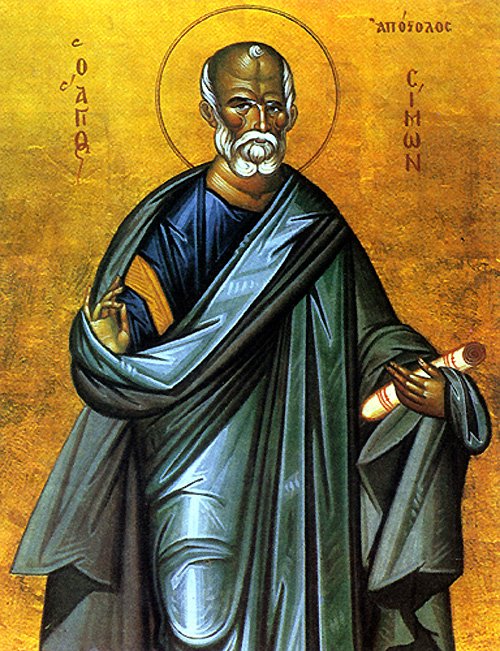
Apostle Simon the Zealot
Saint Simon was from Cana in Galilee, and was known to the Lord and His Mother. Tradition says that he was the bridegroom at the wedding where the Savior performed His first miracle. After witnessing the miracle of the water which had been turned into wine, he became a zealous follower of Christ. For this reason, he is known as Saint Simon the Zealot.
Saint Simon was from Cana in Galilee, and was known to the Lord and His Mother. Tradition says that he was the bridegroom at the wedding where the Savior performed His first miracle. After witnessing the miracle of the water which had been turned into wine, he became a zealous follower of Christ. For this reason, he is known as Saint Simon the Zealot.
Saint Simon was one of the twelve Apostles, and received the Holy Spirit with the others on Pentecost. He traveled to many places from Britain to the Black Sea, proclaiming the Gospel of Christ. After winning many pagans to the Lord, Saint Simon suffered martyrdom by crucifixion.
Saint Demetrius of Rostov says that this Saint Simon is to be distinguished from the Apostle Simon Peter, and from the Lord’s relative Simon (Mt.13:55), who was the second Bishop of Jerusalem.
Saint Simon is also commemorated on June 30 with the other Apostles.
Troparion - Tone 3
Holy Apostle Simon / entreat the merciful God / to grant our souls forgiveness of transgressions.
Kontakion - Tone 2
With praise let us all bless Simon, the herald of God, / who established the doctrines of wisdom securely in the souls of the pious. / Now he stands before the throne of glory, / and rejoicing with the angels, he unceasingly prays for us all.
Holy Martyrs Alphaeus, Philadelphus and Cyprinus of Sicily (251)
They were brothers living in southern Italy, of noble family and devout faith in Christ. (They were the sons of Vitalius, a pagan governor.) Arrested for their confession of Christ, they were taken before a series of judges, subjected to torture each time. Finally they were taken to Sicily and tortured to death there, during the reign of Licinius.
They were brothers living in southern Italy, of noble family and devout faith in Christ. (They were the sons of Vitalius, a pagan governor.) Arrested for their confession of Christ, they were taken before a series of judges, subjected to torture each time. Finally they were taken to Sicily and tortured to death there, during the reign of Licinius. Their incorrupt relics were found in 1517. They once appeared in a vision to St Euthalia (March 2).
St Isidora the Fool of Tabenna (Egypt) (4th c.)
Saint Isidora, Fool-for-Christ, struggled in the Tabenna monastery in Egypt during the sixth century. Taking upon herself the feat of folly, she acted like one insane, and did not eat food with the other sisters of the monastery. Many of them regarded her with contempt, but Isidora bore all this with great patience and meekness, blessing God for everything.
Saint Isidora, Fool-for-Christ, struggled in the Tabenna monastery in Egypt during the sixth century. Taking upon herself the feat of folly, she acted like one insane, and did not eat food with the other sisters of the monastery. Many of them regarded her with contempt, but Isidora bore all this with great patience and meekness, blessing God for everything.
She worked in the kitchen and fulfilled the dirtiest, most difficult tasks at the monastery, cleaning the monastery of every impurity. Isidora covered her head with a plain rag, and instead of cooked food she drank the dirty wash water from the pots and dishes. She never became angry, never insulted anyone with a word, never grumbled against God or the sisters, and was given to silence.
Once, a desert monk, Saint Pitirim, had a vision. An angel of God appeared to him and said, “Go to the Tabenna monastery. There you will see a sister wearing a rag on her head. She serves them all with love, and endures their contempt without complaint. Her heart and her thoughts rest always with God. You, on the other hand, sit in solitude, but your thoughts flit about all over the world.”
The Elder set out for the Tabenna monastery, but he did not see the one indicated to him in the vision among the sisters. Then they led Isidora to him, considering her a demoniac. Isidora fell down at the knees of the Elder, asking his blessing. Saint Pitirim bowed down to the ground to her and said, “Bless me first, venerable Mother!”
To the astonished questions of the sisters the Elder replied, “Before God, Isidora is higher than all of us!” Then the sisters began to repent, confessing their mistreatment of Isidora, and they asked her forgiveness. The saint, however, distressed over her fame, secretly hid herself away from the monastery, and her ultimate fate remained unknown. It is believed that she died around the year 365.
Troparion - Tone 8
In you the image was preserved with exactness, O Mother, / for taking up your cross, you followed after Christ. / By so doing, you taught us to disregard the flesh, for it passes away, / but to care instead for the soul, since it is immortal. / Therefore, most venerable Mother Isidora your spirit rejoices with the Angels.
Kontakion - Tone 2
Because of your love of God you forsook a bed for rest, O Mother Isidora, / you illumined your soul with fasting, thoroughly vanquishing your enemies; / but by your intercessions destroy the evil designs of our adversaries.
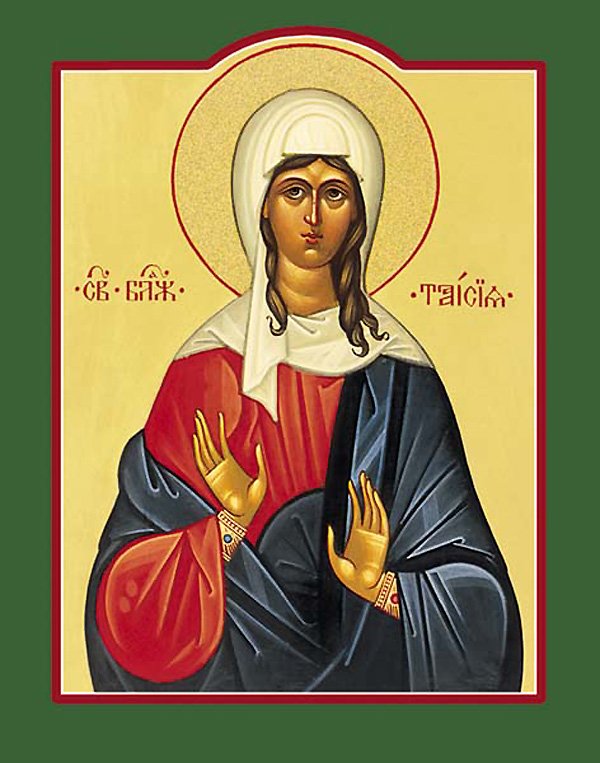
Blessed Thaïs (Taïsia) of Egypt (4th c.)
Saint Thais lived in Egypt in the fifth century. Left an orphan after the death of her wealthy parents, she led a pious life, distributing her wealth to the poor, and she gave shelter to pilgrims on her estate. She decided that she would never marry, but would devote her life to serving Christ.
After spending all her inheritance, Thais was tempted to acquire more money by any means, and began to lead a sinful life.
Saint Thais lived in Egypt in the fifth century. Left an orphan after the death of her wealthy parents, she led a pious life, distributing her wealth to the poor, and she gave shelter to pilgrims on her estate. She decided that she would never marry, but would devote her life to serving Christ.
After spending all her inheritance, Thais was tempted to acquire more money by any means, and began to lead a sinful life. The Elders of Sketis near Alexandria heard of her fall, and asked Saint John the Dwarf (November 9) to go to Thais and persuade her to repent. “She was kind to us,” they said, “now perhaps we can help her. You, Father, are wise. Go and try to save her soul, and we will pray that the Lord will help you.”
The Elder went to her home, but Thais’s servant did not want to allow him into the house. Saint John said, “Tell your mistress that I have brought her something very precious.” Thais, knowing that the monks sometimes found pearls at the shore, told her servant to admit the visitor. Saint John sat down and looked her in the face, and then began to weep. Thais asked him why he was crying. “How can I not weep,” he asked, “when you have forsaken your Bridegroom, the Lord Jesus Christ, and are pleasing Satan by your deeds?”
The Elder’s words pierced the soul of Thais like a fiery arrow, and at once she realized how sinful her present life had become. In fear, she asked him if God would accept the repentance of a sinner like her. Saint John replied that the Savior awaited her repentance. That is why He came, to seek and to save the perishing. “He will welcome you with love,” he said, “and the angels will rejoice over you. As the Savior said Himself, one repentant sinner causes the powers of Heaven to rejoice” (Luke 15:7).
A feeling of repentance enveloped her, and regarding the Elder’s words as a call from the Lord Himself to return to Him, Thais trembled and thought only of finding the path of salvation. She stood up and left her house without speaking to her servants, and without making any sort of disposition of her property, so that even Saint John was amazed.
Following Saint John into the wilderness, she hastened to return to God through penitence and prayer. Night fell, and the Elder prepared a place for Thais to lay down and sleep. He made a pillow for her from the sand, and he went off somewhat farther, and went to sleep after his evening prayers.
In the middle of the night, he was wakened by a light coming down from the heavens to the place where Thais was at rest. In the radiant light he saw holy angels bearing her soul to Paradise. When he went over to Thais, he found her dead.
Saint John prayed and asked God to reveal to him whether Thais had been saved. An angel of God appeared and told him, “Abba John, her one hour of repentance was equal to many years, because she repented with all her soul, and a compunctionate heart.”
After burying the body of the saint, Saint John returned to Sketis and told the monks what had happened. All offered thanks to God for His mercy toward Thais who, like the wise thief, repented in a single moment.
Troparion - Tone 8
By a flood of tears you made the desert fertile, / and your longing for God brought forth fruits in abundance. / By the radiance of miracles you illumined the whole universe! / O our holy mother Thais, pray to Christ our God to save our souls!
Kontakion - Tone 2
In you the image was preserved with exactness, O Mother, / for taking up your cross, you followed after Christ. / By so doing, you taught us to disregard the flesh, for it passes away, / but to care instead for the soul, since it is immortal. / Therefore, most venerable Mother Thais your spirit rejoices with the Angels.
Scripture Readings
☩Epistle
Acts 3:19-26
19
Repent ye therefore, and be converted, that your sins may be blotted out, when the times of refreshing shall come from the presence of the Lord;
20
And he shall send Jesus Christ, which before was preached unto you:
21
Whom the heaven must receive until the times of restitution of all things, which God hath spoken by the mouth of all his holy prophets since the world began.
22
For Moses truly said unto the fathers, A prophet shall the Lord your God raise up unto you of your brethren, like unto me; him shall ye hear in all things whatsoever he shall say unto you.
23
And it shall come to pass, that every soul, which will not hear that prophet, shall be destroyed from among the people.
24
Yea, and all the prophets from Samuel and those that follow after, as many as have spoken, have likewise foretold of these days.
25
Ye are the children of the prophets, and of the covenant which God made with our fathers, saying unto Abraham, And in thy seed shall all the kindreds of the earth be blessed.
26
Unto you first God, having raised up his Son Jesus, sent him to bless you, in turning away every one of you from his iniquities.
☩Gospel
John 2:1-11
1
And the third day there was a marriage in Cana of Galilee; and the mother of Jesus was there:
2
And both Jesus was called, and his disciples, to the marriage.
3
And when they wanted wine, the mother of Jesus saith unto him, They have no wine.
4
Jesus saith unto her, Woman, what have I to do with thee? mine hour is not yet come.
5
His mother saith unto the servants, Whatsoever he saith unto you, do it.
6
And there were set there six waterpots of stone, after the manner of the purifying of the Jews, containing two or three firkins apiece.
7
Jesus saith unto them, Fill the waterpots with water. And they filled them up to the brim.
8
And he saith unto them, Draw out now, and bear unto the governor of the feast. And they bare it.
9
When the ruler of the feast had tasted the water that was made wine, and knew not whence it was: (but the servants which drew the water knew;) the governor of the feast called the bridegroom,
10
And saith unto him, Every man at the beginning doth set forth good wine; and when men have well drunk, then that which is worse: but thou hast kept the good wine until now.
11
This beginning of miracles did Jesus in Cana of Galilee, and manifested forth his glory; and his disciples believed on him.
Liturgical data sourced from OCA.org and orthocal.info