Fasting Rules
 Meat
Allowed
 Fish
Allowed
 Dairy
Allowed
 Oil
Allowed
 Wine
Allowed
Saints & Commemorations
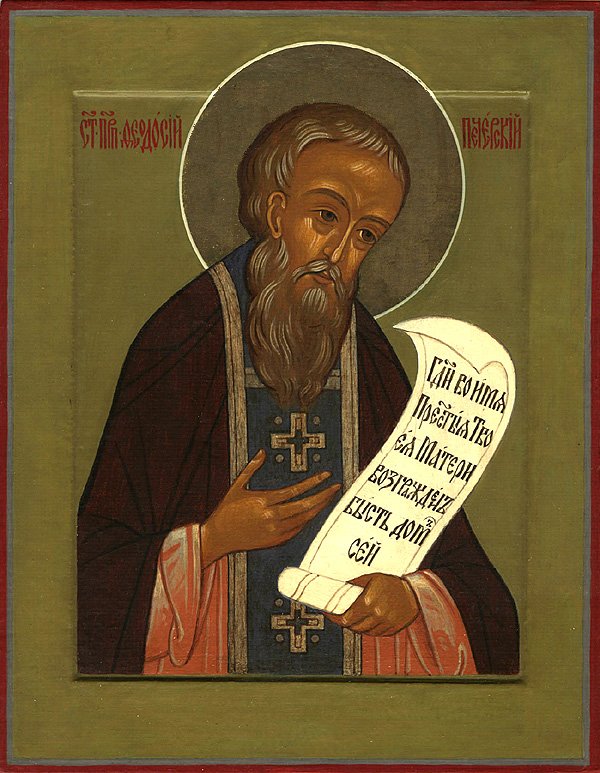
Ven. Theodosius, Abbot of the Kiev Caves
Saint Theodosius of the Caves, was the Father of monasticism in Russia. He was born at Vasilevo, not far from Kiev. From his youth he felt an irresistible attraction for the ascetic life, and led an ascetic lifestyle while still in his parental home. He disdained childish games and attractions, and constantly went to church.
Saint Theodosius of the Caves, was the Father of monasticism in Russia. He was born at Vasilevo, not far from Kiev. From his youth he felt an irresistible attraction for the ascetic life, and led an ascetic lifestyle while still in his parental home. He disdained childish games and attractions, and constantly went to church. He asked his parents to let him study the holy books, and through his ability and rare zeal, he quickly learned to read the books, so that everyone was amazed at his intellect.
When he was fourteen, he lost his father and remained under the supervision of his mother, a strict and domineering woman who loved her son very much. Many times she chastised her son for his yearning for asceticism, but he remained firmly committed to his path.
At the age of twenty-four, he secretly left his parents’ home and Saint Anthony at the Kiev Caves monastery blessed him to receive monastic tonsure with the name Theodosius. After four years his mother found him and with tearfully begged him to return home, but the saint persuaded her to remain in Kiev and to become a nun in the monastery of Saint Nicholas at the Askold cemetery.
Saint Theodosius toiled at the monastery more than others, and he often took upon himself some of the work of the other brethren. He carried water, chopped wood, ground up the grain, and carried the flour to each monk. On cold nights he uncovered his body and let it serve as food for gnats and mosquitoes. His blood flowed, but the saint occupied himself with handicrafts, and sang Psalms. He came to church before anyone else and, standing in one place, he did not leave it until the end of services. He also listened to the readings with particular attention.
In 1054 Saint Theodosius was ordained a hieromonk, and in 1057 he was chosen igumen. The fame of his deeds attracted a number of monks to the monastery, at which he built a new church and cells, and he introduced cenobitic rule of the Studion monastery, a copy of which he commissioned at Constantinople.
As igumen, Saint Theodosius continued his arduous duties at the monastery. He usually ate only dry bread and cooked greens without oil, and spent his nights in prayer without sleep. The brethren often noticed this, although the saint tried to conceal his efforts from others.
No one saw when Saint Theodosius dozed lightly, and usually he rested while sitting. During Great Lent the saint withdrew into a cave near the monastery, where he struggled unseen by anyone. His attire was a coarse hairshirt worn next to his body. He looked so much like a beggar that it was impossible to recognize in this old man the renowned igumen, deeply respected by all who knew him.
Once, Saint Theodosius was returning from visiting the Great Prince Izyaslav. The coachman, not recognizing him, said gruffly, “You, monk, are always on holiday, but I am constantly at work. Take my place, and let me ride in the carriage.” The holy Elder meekly complied and drove the servant. Seeing how nobles along the way bowed to the monk driving the horses, the servant took fright, but the holy ascetic calmed him, and gave him a meal at the monastery. Trusting in God’s help, the saint did not keep a large supply of food at the monastery, and therefore the brethren were in want of their daily bread. Through his prayers, however, unknown benefactors appeared at the monastery and furnished the necessities for the brethren.
The Great Princes, especially Izyaslav, loved to listen to the spiritual discourses of Saint Theodosius. The saint was not afraid to denounce the mighty of this world. Those unjustly condemned always found a defender in him, and judges would review matters at the request of the igumen. He was particularly concerned for the destitute. He built a special courtyard for them at the monastery where anyone in need could receive food and drink. Sensing the approach of death, Saint Theodosius peacefully fell asleep in the Lord in the year 1074. He was buried in a cave which he dug, where he secluded himself during fasting periods.
The relics of the ascetic were found incorrupt, and he was glorified as a saint in 1108. Of the written works of Saint Theodosius six discourses, two letters to Great Prince Izyaslav, and a prayer for all Christians have survived to our time.
The Life of Saint Theodosius was written by Saint Nestor the Chronicler (October 27), a disciple of the great Abba, only thirty years after his repose, and it was always one of the favorite readings of the Russian nation. Saint Theodosius is also commemorated on September 2 and 28.
Troparion - Tone 8
Having been raised on virtue, you loved the monastic life from your youth, / and having valiantly attained your desire, you lived in a cave; / you adorned your life with the radiance of fasting, persevering in prayer as though bodiless. / Like a bright lamp you illumined the Russian lands, Father Theodosius. / Entreat Christ God that our souls may be saved.
Kontakion - Tone 3
Today let us honor a star of Russia, / who shone forth from the East, and came to the West. / The entire world has been enriched by wonders and blessings, / and all of us by grace / and by the establishment of the monastic rule by Blessed Theodosius.
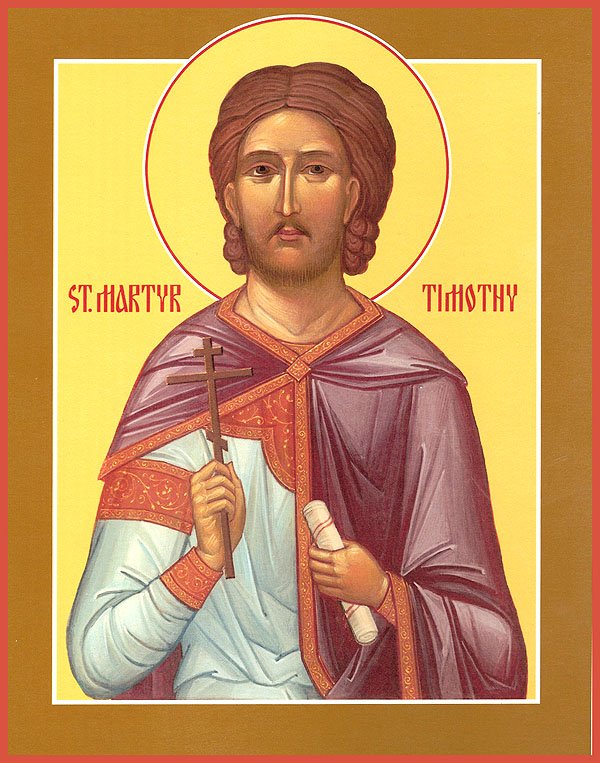
Martyrs Timothy the Reader and his wife Maura of Antinoe in Egypt (286)
Saints Timothy and Maura suffered for the faith during the persecution under the emperor Diocletian (284-305). Saint Timothy came from the village of Perapa (Egyptian Thebaid), and was the son of a priest named Pikolpossos. He was made a reader among the church clergy, and also a keeper and copyist of divine service books.
Saints Timothy and Maura suffered for the faith during the persecution under the emperor Diocletian (284-305). Saint Timothy came from the village of Perapa (Egyptian Thebaid), and was the son of a priest named Pikolpossos. He was made a reader among the church clergy, and also a keeper and copyist of divine service books. Saint Timothy was denounced as a keeper of Christian books, which the emperor ordered to be confiscated and burned. They brought Saint Timothy before the governor Arian, who demanded that he hand over the sacred books. They subjected the saint to horrible tortures for his refusal to obey the command. They shoved two red-hot iron rods into his ears, from which the sufferer lost his eyesight and became blind.
Saint Timothy bravely endured the pain and he gave thanks to God, for granting him to suffer for Him. The torturers hung the saint head downwards, putting a piece of wood in his mouth, and they tied a heavy stone to his neck. Saint Timothy’s suffering was so extreme, that even those who tortured him implored the governor to ease up on the torture.
About this time they informed Arian that Timothy had a young wife named Maura, whom he had married only twenty days before. Arian ordered Maura to be brought, hoping that with her present, they could break Saint Timothy’s will. Saint Timothy urged his wife not to fear the tortures, but to follow his path. Saint Maura answered, “I am prepared to die with you,” and she boldly confessed herself a Christian. Arian commanded that the hair be torn from her head, and to cut the fingers off her hands.
Saint Maura underwent the torment with joy and even thanked the governor for the torture, which she endured so that her sins might be forgiven. Then Arian gave orders to throw Saint Maura into a boiling cauldron, but she did not feel any pain, and she remained unharmed. Suspecting that the servants had filled the cauldron with cold water out of sympathy for the martyr, Arian went up and ordered the saint to splash him on the hand with water from the cauldron. When the martyr did this, Arian screamed with pain and drew back his scalded hand. Then, momentarily admitting the power of the miracle, Arian confessed God in Whom Maura believed as the True God, and he ordered her to be released. But the devil still held great power over the governor, and soon he again began to urge Saint Maura to offer sacrifice to the pagan gods. Having gotten nowhere, Arian was overcome all the more by a satanic rage and he came up with new tortures. Then the people began to murmur and demand a stop to the abuse of this innocent woman. But Saint Maura, turning to the people, said, “Let no one defend me. I have one Defender, God, in Whom I trust.”
Finally, after torturing them for a long time, Arian ordered the martyrs to be crucified. For ten days they hung on crosses facing each other.
On the tenth day of martyrdom the saints offered up their souls to the Lord. This occurred in the year 286. Later, a solemn celebration of the holy martyrs Timothy and Maura was instituted at Constantinople, and a church was built in their honor.
Saint Maura's skull is located in the church of Koilani, Limassol, Cyprus. Fragments of Saint Maura's relics are also located in Kykkos Monastery on Cyprus, and in the Greek church in Venice.
Troparion - Tone 4
Let us the faithful honor Timothy with Maura his faithful fellow-athlete, and bride of Christ, / and let us praise their bold endurance; / for being crucified they lovingly followed Him Who was slain / and Who has nailed all our sins to the Cross.
Kontakion - Tone 4
Having endured many wounds and receiving crowns from God, / O great Timothy and glorious Maura, / pray to God for us who celebrate your most sacred memory, / that He may grant peace to His flock and people; / for He is the affirmation of the faithful.
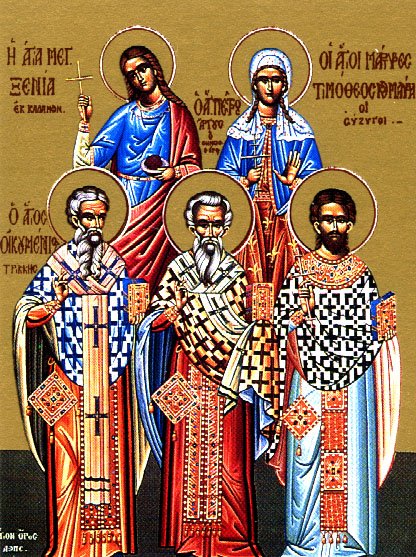
Peter the Wonderworker
Saint Peter the Wonderworker, Bishop of Argos in the Peloponnesos, lived during the ninth and early tenth centuries, and was raised by pious parents. Saint Peter’s parents, and later his brothers Paul, Dionysius, Platon and Saint Peter himself, all became monks. Saint Peter zealously devoted himself to monastic labors, and he excelled all his fellows. T
Saint Peter the Wonderworker, Bishop of Argos in the Peloponnesos, lived during the ninth and early tenth centuries, and was raised by pious parents. Saint Peter’s parents, and later his brothers Paul, Dionysius, Platon and Saint Peter himself, all became monks. Saint Peter zealously devoted himself to monastic labors, and he excelled all his fellows. This came to the attention of the Italian bishop Nicholas (who from 895 was Patriarch of Constantinople), who wanted to elevate him to the rank of bishop. Saint Peter declined, accounting himself unworthy of such honor.
Bishop Nicholas consecrated Paul, Saint Peter’s brother, as Bishop of Corinth, and Saint Peter went to his brother and lived with him, taking upon himself the spiritual struggle of silence. After a year emissaries came to Bishop Paul from the city of Argos, where the bishop had died, and they asked for Saint Peter as their bishop. After long and intense entreaties, Saint Peter finally gave his consent. As bishop, Saint Peter toiled zealously in guiding his flock. He was extraordinarily compassionate, concerning himself with those in need, especially orphans and widows.
The saint fed the hungry in years of crop failure. Through his prayers the food set aside for the hungry never ran out. The saint also ransomed captives, healed the sick and the afflicted, and possessed the gift of insight. The saint predicted the day of his death, and departed to the Lord at the age of seventy. His relics were transferred from Argos to Nauplos in 1421, exuding myrrh, and working miracles and healings.
Troparion - Tone 4
In truth you were revealed to your flock as a rule of faith, / an image of humility and a teacher of abstinence; / your humility exalted you; / your poverty enriched you. / Hierarch Father Peter, / entreat Christ our God / that our souls may be saved.
Xenia of Kalamata the Great Martyr
Saint Xenia (Xenίa) was born at Kalamata (Kalamáta) in the Peloponnesos (Pelopónnēsos) in the year 291. Her parents were named Nicholas and Despina (Déspina), who were devout Christians from the eastern part of Italy. However, due to the continuous and harsh
persecution against Christians during those years, they fled to Kalamata and settled on a farm outside the city, because her father was a farmer.
From
Saint Xenia (Xenίa) was born at Kalamata (Kalamáta) in the Peloponnesos (Pelopónnēsos) in the year 291. Her parents were named Nicholas and Despina (Déspina), who were devout Christians from the eastern part of Italy. However, due to the continuous and harsh
persecution against Christians during those years, they fled to Kalamata and settled on a farm outside the city, because her father was a farmer.
From a young age, instead of playing unseemly games and engaging in idle talk, Xenia stayed at home with her mother, and adorned her soul with fasting, self-control, silence, regular prayer, modesty of speech, tears and vigils. She also helped the poor, as well as widows and orphans with all her strength. She fasted in order to feed the hungry, a practice which befits her name. 1
She had curly blonde hair, and her brows framed her large and lively dark blue eyes. Though tall and statuesque, she remained humble, and she loved going to church to hear about Christ's miracles. Her conversation was pleasant and simple, filled with virtue and grace, and she never gossiped or condemned anyone. As she grew older, her virtuous qualities also increased.
When Xenia reached a marriageable age, Dometian, the brutal eparch of Kalamata, happened to pass near her farm and was dazzled by her beauty. He had the Saint brought before him and asked what her name was. She replied, "My name is Xenia, and my parents are Christians who live outside the city. I am the handmaiden of my Lord Jesus Christ, Who made the world and everything in it."
Those who were present were astonished by her answer. Her words, however, only served to enflame the tyrant's lustful desires. Concealing his anger, he said, "O Xenia, I marvel at your beauty, but I am struck by your effrontery. I want you to be my wife, and I will give you many gifts, untold wealth, honor, and glory which the gods bestow on those who worship them. If you refuse, you shall be tortured, and receive harsh punishments, and then a horrible death."
The Saint was not disturbed by his words. Instead, she told him, "You shall never separate me from Christ, nor is it possible for me to desire any other bridegroom but Christ. Do whatever you wish, but if you torture me, I hope to be glorified by Christ, and to inherit everlasting life. I am not sorry to lose my life, for one day all of us must die. Do not imagine that I shall ever change my mind, nor my belief in the only true God, Jesus Christ."
Saint Xenia adamantly refused to renounce her faith in order to become the wife of a pagan ruler. Then Dometian enlisted the help of a sorcerer in order to make Xenia love him, but she was guarded by the power of the honorable Cross. Dometian became furious, and had her confined in a dark chamber. There she prayed that the Lord would preserve her in her faith until the end.
The next day, Domitian went to the chamber to see if she had changed her mind, for he still desired to take her as his wife. Not only did Xenia refuse him, she also rebuked him for his behavior. The Holy Martyr was dragged out of the chamber by her hair. Then he ordered his guards to strip her and suspend her from a post. Furthermore, he commanded the guards to cut off her breasts and then burn her wounds with lit torches. They also did the same to her sides and to her entire body.
The Saint did not feel any pain, for an Angel of the Lord appeared to her and helped her, but only she could see him. After further torments, she was brought back to the chamber. During the night, Xenia prayed for the Lord to sustain her. At midnight she beheld a heavenly light which illumined the chamber. The Savior said: "Do not fear the torments, Xenia, for my grace shall be with you and deliver you from every temptation."
Then He healed all her wounds, and ascended into Heaven.
The next morning the soldiers brought her before the eparch. When he saw her unharmed, and without her injuries of the previous day he marveled and said, "Xenia, do you see how the gods love you? They have healed your wounds and restored your health. Therefore, do not be ungrateful, but enter the temple with me and bow down before them." Saint Xenia replied, "How is it possible for them to have power to heal me, since they are senseless, and fashioned by men's hands? It was not they who restored me, but Christ. But let us enter the temple of your gods, and let us see which of them you want me to adore."
Domitian was overjoyed, thinking that she had changed her mind. But as soon as she entered the temple and stood at its center, she knelt and prayed to the true God, "Lord Jesus Christ, my God, Creator of Heaven and earth, Who hears the supplications of the faithful, hear me now, and destroy these idols so that everyone will see that You alone are the true God."
Then there was an earthquake, and all the idols were shattered. Domitian, instead of worshiping the true God, subjected her to more torments, and she was healed as before. After many days had passed, Domitian realized that Saint Xenia would not change her mind. He sentenced her to be beheaded, and to have her heart cut out, and to chop her body into tiny pieces. and cast into a fire to be consumed. Then an ineffable fragrance came forth, demonstrating that her holy relics were filled with divine grace.
Saint Xenia received the incorruptible crown of martyrdom from Christ God on May 3, 318.
The eparch Domitian was punished for his inhumanity and ungodly deeds. He was struck by lightning and burnt to a cinder.
In 1993 a holy temple was built in her honor, which is located west of the city of Kalamata and belongs to the parish church of the Holy Trinity in Kalamata as a chapel.
Father George Nasis, the rector of Annunciation Greek Orthodox Church in New York City from 1942-1967 was praying one day when a beautiful woman appeared to him. She said her name was Xenίa, a martyr who had been forgotten for almost 1700 years. She asked him to paint an icon depicting her holding a cross.
At first Father George did not mention this to anyone, thinking that perhaps people would mock him. Then he decided to inform the Archbishop. Researchers tried to find references to Saint Xenίa of Kalamata, but they were not successful. Finally, they found her name in a list of Saints, where she is described as a young woman with blonde hair and blue eyes.
1 The Greek name Xenia means "hospitable."
Troparion - Tone 4
Reddened by your blood and radiantly adorned with it, O Xenίa, / as you stood before Christ as an unblemished bride, / you received grace to deliver (people) from sorcery, / to drive away demons, and to heal diseases; / therefore, intercede unceasingly with Him for our souls.
Kontakion - Tone 2
You appeared as a bright star announcing Christ with your radiance, / which is repulsive to this world, O Martyr Xenia; / extinguishing the allure of false gods, / you enlighten the faithful, / always interceding for us all.
Scripture Readings
☩Epistle
Acts 1:12-17, 21-26
12
Then returned they unto Jerusalem from the mount called Olivet, which is from Jerusalem a sabbath day’s journey.
13
And when they were come in, they went up into an upper room, where abode both Peter, and James, and John, and Andrew, Philip, and Thomas, Bartholomew, and Matthew, James the son of Alpheus, and Simon Zelotes, and Judas the brother of James.
14
These all continued with one accord in prayer and supplication, with the women, and Mary the mother of Jesus, and with his brethren.
15
And in those days Peter stood up in the midst of the disciples, and said, (the number of names together were about an hundred and twenty,)
16
Men and brethren, this scripture must needs have been fulfilled, which the Holy Ghost by the mouth of David spake before concerning Judas, which was guide to them that took Jesus.
17
For he was numbered with us, and had obtained part of this ministry.
21
Wherefore of these men which have companied with us all the time that the Lord Jesus went in and out among us,
22
Beginning from the baptism of John, unto that same day that he was taken up from us, must one be ordained to be a witness with us of his resurrection.
23
And they appointed two, Joseph called Barsabas, who was surnamed Justus, and Matthias.
24
And they prayed, and said, Thou, Lord, which knowest the hearts of all men, shew whether of these two thou hast chosen,
25
That he may take part of this ministry and apostleship, from which Judas by transgression fell, that he might go to his own place.
26
And they gave forth their lots; and the lot fell upon Matthias; and he was numbered with the eleven apostles.
☩Gospel
John 20:19-25
19
Then the same day at evening, being the first day of the week, when the doors were shut where the disciples were assembled for fear of the Jews, came Jesus and stood in the midst, and saith unto them, Peace be unto you.
20
And when he had so said, he shewed unto them his hands and his side. Then were the disciples glad, when they saw the Lord.
21
Then said Jesus to them again, Peace be unto you: as my Father hath sent me, even so send I you.
22
And when he had said this, he breathed on them, and saith unto them, Receive ye the Holy Ghost:
23
Whose soever sins ye remit, they are remitted unto them; and whose soever sins ye retain, they are retained.
24
But Thomas, one of the twelve, called Didymus, was not with them when Jesus came.
25
The other disciples therefore said unto him, We have seen the Lord. But he said unto them, Except I shall see in his hands the print of the nails, and put my finger into the print of the nails, and thrust my hand into his side, I will not believe.
Liturgical data sourced from OCA.org and orthocal.info