Fasting Rules
 Meat
Abstain
 Fish
Abstain
 Dairy
Abstain
 Oil
Abstain
 Wine
Abstain
Saints & Commemorations
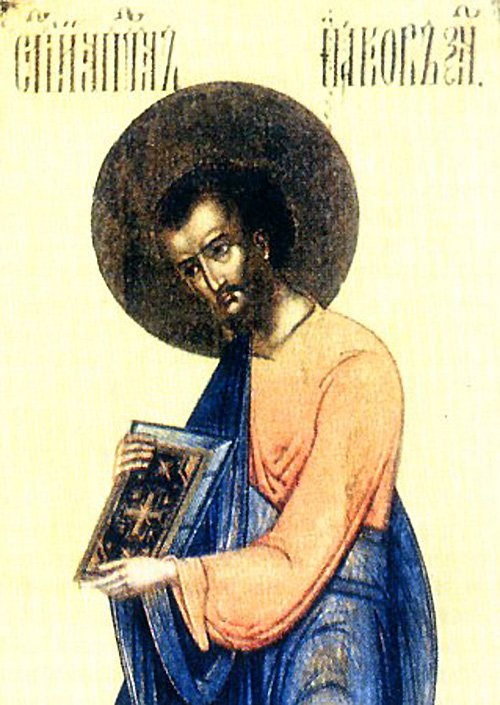
Holy Apostle James, Brother of St John
The Holy Apostle James, the son of Zebedee, was the brother of Saint John the Theologian, and one of the Twelve Apostles. He and his brother, Saint John, were called to be Apostles by our Lord Jesus Christ, Who called them the “Sons of Thunder” (Mark 3:17). It was this James, with John and Peter, who witnessed the Raising of the Daughter of Jairus, the Lord’s Transfiguration on Mount Tabor, and His agony in the Garden of Gethsemane.
Sain
The Holy Apostle James, the son of Zebedee, was the brother of Saint John the Theologian, and one of the Twelve Apostles. He and his brother, Saint John, were called to be Apostles by our Lord Jesus Christ, Who called them the “Sons of Thunder” (Mark 3:17). It was this James, with John and Peter, who witnessed the Raising of the Daughter of Jairus, the Lord’s Transfiguration on Mount Tabor, and His agony in the Garden of Gethsemane.
Saint James, after the Descent of the Holy Spirit, preached in Spain and in other lands, and then he returned to Jerusalem. He openly and boldly preached Jesus Christ as the Savior of the world, and he denounced the Pharisees and the Scribes with the words of Holy Scripture, reproaching them for their malice of heart and unbelief.
The Jews could not prevail against Saint James, and so they hired the sorcerer Hermogenes to dispute with the apostle and refute his arguments that Christ was the promised Messiah Who had come into the world. The sorcerer sent to the apostle his pupil Philip, who was converted to belief in Christ. Then Hermogenes himself became persuaded of the power of God, he burned his books of magic, accepted holy Baptism and became a true follower of Christ.
The Jews persuaded Herod Agrippa (40-44) to arrest the Apostle James and sentence him to death (Acts 12:1-2). Eusebius provides some of the details of the saint’s execution (CHURCH HISTORY II, 9). Saint James calmly heard the death sentence and continued to bear witness to Christ. One of the false witnesses, whose name was Josiah, was struck by the courage of Saint James. He came to believe in Jesus Christ as the Messiah. When they led the apostle forth to execution, Josiah fell at his feet, repenting of his sin and asking forgiveness. The apostle embraced him, gave him a kiss and said, “Peace and forgiveness to you.” Then Josiah confessed his faith in Christ before everyone, and he was beheaded with Saint James in the year 44 at Jerusalem.
Saint James was the first of the Apostles to die as a martyr.
Troparion - Tone 8
As a soldier of the Lord you were ranked among the choir of Apostles. / Together with your brother, O James, you clung wholeheartedly to the Savior. / Armed with the power of the Spirit you proclaimed Him to all, and were slain by the sword. / Therefore, we sing your praises.
Kontakion - Tone 2
You were a chosen Apostle of Christ / and the only brother of the beloved Theologian. / O most praised James, entreat Him to grant the remission of sins and great mercy / to those who sing hymns to you.
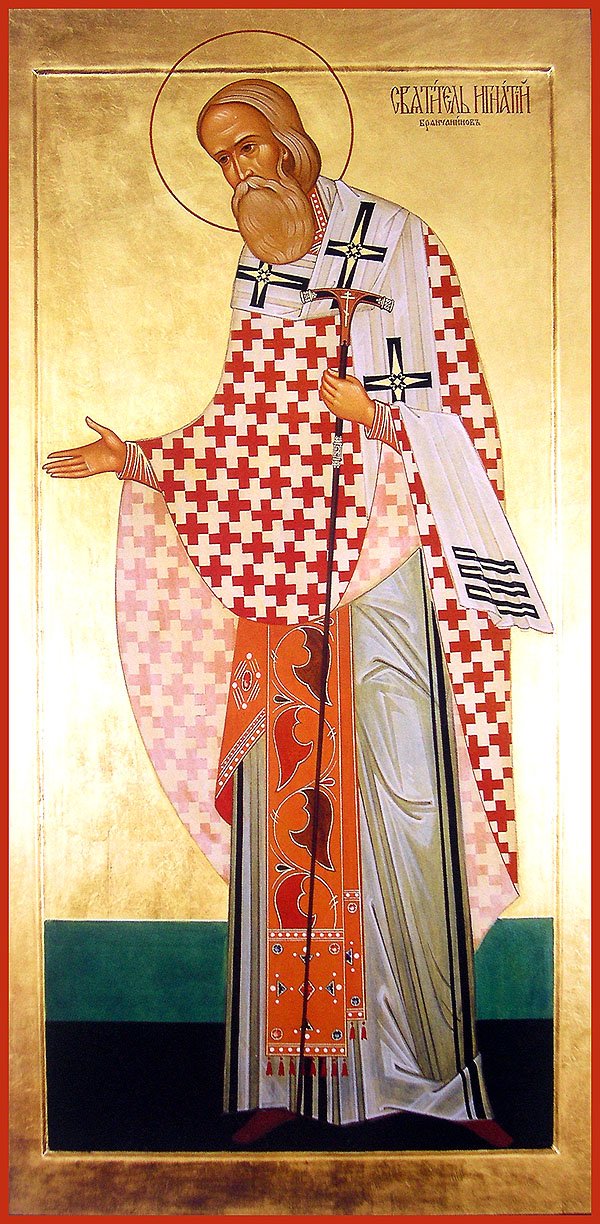
St Ignatius (Brianchaninov), Bishop of Stavropol and Kavkaz (1867)
The future hierarch, Saint Ignatius, was chosen for the service of God even before his birth on February 6, 1807. His father Alexander S. Brianchaninov was a wealthy provincial landowner in the large village of Pokrovskoe in Vologda Gubernia. The Saint's birth was the result of his devout mother's fervent prayers, for she had no children until then.
The future hierarch, Saint Ignatius, was chosen for the service of God even before his birth on February 6, 1807. His father Alexander S. Brianchaninov was a wealthy provincial landowner in the large village of Pokrovskoe in Vologda Gubernia. The Saint's birth was the result of his devout mother's fervent prayers, for she had no children until then. His mother Sophia (1786–1832) had been barren for a long time, and she visited the holy places in the area, asking God to give her a child. Finally, her prayers were answered, and she gave birth to a son. In Holy Baptism he received the name Demetrios, in honor of Saint Demetrios of Priluki (February 11).
Young Demetrios spent his childhood at Pokrovskoe in the natural surroundings of rural life. As he matured, he became quiet and reflective. He loved going to church and often attended the Services. In his spare time, the boy read spiritual books and he prayed. After the Holy Gospels, his favorite book was The Spiritual School , a very old collection of the Lives and sayings of the Saints in five volumes. Although he was drawn to the monastic life, his parents did not approve of this. Besides, it was quite unusual for a nobleman to follow such a path. Alexander Brianchaninov was from an old and respected family, and he was a worldly individual with ties to the palace. He planned a military career for his son.
When Demetrios reached the age of fifteen, his father entered him in the Imperial School of Military Engineers at St. Petersburg. He did so well in his entrance exam that he even attracted the notice of the Director of the school, Grand Duke Nicholas Pavlovich, the future Tsar Nicholas I. The Prince invited the young man to the palace, and introduced him to his wife, who suggested that he be given a stipend.
At the school he won the affection of the professors and administrators because of his excellent grades and exemplary conduct. Demetrios was even received at the home of Alexei N. Olenin, who was then President of the Academy of the Arts, Archaeology, and History, where he became acquainted with all the prominent literary figures of the day: K.N. Batyushkov, N.I. Gnedich, I.A. Krylov, and also A.S. Pushkin. These gatherings contributed to the development of the young man's literary talents.
However, the clamor of the capital and its worldly pleasures could not extinguish the fire in his soul which had been kindled by divine grace. His spirit was troubled by many thoughts: his mind was filled with doubts, and his heart seethed with passions. In this state Demetrios took refuge in prayer. He prayed constantly day and night. At the same time, he was no longer content to receive Holy Communion only once a year, as was the custom at school. Desiring to partake of this spiritual food (John 6:48-58), Demetrios went to confess to the school's priest, who was surprised by such a request. Not only did he refuse to permit Demetrios to receive Communion more frequently, he also reported what he heard in Confession to the school authorities, which was inexcusable.
Despite his excellent record, Demetrios grew more and more depressed at the thought of a career as a military officer, and he still wanted to become a monk. He and his friend Nicholas Chikhachev († January 16, 1873) decided to visit the Alexander Nevsky Lavra in St. Petersburg for Confession. Father Athanasios, the Father Confessor, was more sympathetic than the school's priest had been, and did not discourage them when they expressed a desire to become monks.
But there were still many obstacles and heavy trials which had to be overcome by the young ascetics before they could attain their goal, which was to take refuge behind the walls of a holy monastery. Of course, the greatest opposition to their plans came from their own relatives. When the elder Mr. Brianchaninov found out about his son's life and activities, he wrote at once to the Director of the school, Count Sivers, asking him to keep a very close watch over his son. He also wrote to Metropolitan Seraphim of St. Petersburg saying that the Father Confessor of the Lavra, Father Athanasios, was encouraging his son to become a monk. The Metropolitan, fearing trouble from the powerful people of this world, reprimanded Father Athanasios severely and forbade him to receive the two young men for Confession. This was very difficult for Demetrios, so he decided to discuss the matter with the Metropolitan in person. After seeing the young man, and listening to his sincere explanation, the Metropolitan blessed him to visit the Lavra and his Father Confessor once again. Meanwhile, the young man's decision to forsake the world came to a definite resolution, and he decided to follow the call of his inner voice. The main reason why Demetrios decided to fulfill his desire right away was his acquaintance with Elder Leonid of Optina, who was distinguished by his divine wisdom, holiness of life, and experience in the ascetical life of monasticism. After their first conversation, Demetrios told his friend Michael Chikhachev (Чихачев), "Father Leonid has captured my heart. Now it is definite. I am asking to be discharged, and I am going to follow the Elder."
Before Demetrios was able to find a quiet abode within the walls of the monastery, however, he had to endure some great trials; first with his family, and secondly with the powerful people of this world. Unable to obtain that which he desired, the grieving young man left home for the capital. There, another storm awaited him. As soon as he finished his last exam, he petitioned for a discharge from his military service (which he had not yet begun). When Tsar Nicholas I learned of this, he asked his brother, the Grand Duke, to talk the young man out of this. All of the powerful prince's kindnesses, discussions, and even threats, were in vain. The young man remained inflexible. Then the Grand Duke informed Demetrios that the Tsar had refused to release him, and that he has been assigned to Dinaburg Fortress. Bitterly, the young officer was forced to submit, but when he arrived at Dinaburg he became severely ill. When he visited the fortress in 1827, the Grand Duke could see for himself that Demetrios was unable to continue his military service, and he gave him his much-desired discharge. Thus, the secular life of young Demetrios came to an end.
After obtaining his discharge, Demetrios traveled via St. Petersburg to Svirsk Monastery and to Elder Leonid (who was living there at the time because he was persecuted at Valaam by the Superior, Father Innocent), in order to submit himself to this experienced spiritual guide and begin his monastic life. Arriving at St. Petersburg, and dressed as a peasant, Demetrios stayed at Chikhachev's apartment. His friend Michael also requested a discharge, but this was not granted. So he was obliged to remain in the service for a while longer. Demetrios left for Svirsk Monastery alone, where he began his asceticism of obedience. In the meantime, his angry parents cut off all ties with him, denying him any material assistance.
While he was a novice, the future instructor of monks was distinguished by his complete obedience and deep humility. Assigned to work in the kitchen, he obeyed all of the cook's orders with humility, (the cook happened to be his father's former servant), and the entire brotherhood began to respect and to love the young ascetic. Elder Leonid was the young novice's Spiritual Father. Demetrios, by his singular obedience, cemented his relationship with his instructor. This relationship resembled that of the ancient novices with their Elders. Demetrios did not take a single step without the knowledge of his Spiritual Father, and every day he revealed all his innermost thoughts and desires to him. In this case, the Elder was like a real instructor in the spirit of true monasticism, as exemplified by the ancient ascetics of early Christianity.
The novice lived this kind of life at Svirsk Monastery, and also at Ploschansk Hermitage, where his instructor was forced to transfer after a year with his disciples. Here Demetrios was comforted by the arrival of his close friend Michael Chikhachev. Reunited in the tranquil seclusion of the monastery, the friends began to practice the asceticism of piety, offering help to one another. They were blessed to do so by Father Leonid. However, the young ascetics were unable to remain for long at the quiet abode of Ploschansk Hermitage. Because of persecution by the Superior, Father Leonid was forced to move to Optina. His disciples were also ordered to leave and were told to go wherever they pleased.
Grief-stricken, because they admired the strict and quiet life of the two novices, the other monks watched them depart. The monks gave them five rubles, which they had collected for their travel expenses. First, the two friends went to White Bluff Hermitage but they were not accepted there. Then they went to Optina to be with their Elder, but Abbot Moses did not want to admit them for a long time. At long last, because of their constant pleading, he was compelled to accept these two brilliant former officers who had rejected all worldly vanity for the sake of Christ.
Their position at Optina was difficult. The Superior regarded them sternly, and the monks did not trust them. The coarse food and the climate both affected Demetrios, and he became very ill. Chikachev took care of his friend, but soon he too was stricken with a debilitating fever. In the meantime, Demetrios's parents softened their opinion of their son. His mother became ill, and this illness aroused her maternal instincts, and she wanted to see her son again. Even the stern father seemed to mellow somewhat, and he invited his son and his friend to come and visit. Demetrios and Michael went there right away, but their reunion was far from pleasant. His mother was feeling better, but as her illness abated, his father's tender feelings also disappeared, and Demetrios got a very cold reception. Alexander Brianchaninov still hoped to have his son pursue a brilliant career, so he tried to force him to abandon the monastic life and to enter into civil or military service. Therefore, the young man began to feel burdened by life in the world.
At the beginning of 1830, he and Michael entered the St. Cyril of White Lake Monastery. The Superior at that time was Father Arkadios, a saintly man, but simple of heart. Seeing true monks in these newcomers, he welcomed them with love. Almost as soon as the two friends began their life in that monastery, Demetrios was stricken once again with a terrible fever. The monastery was located on an island in a large lake, and the dampness made it impossible for him to remain there any longer. Chikhachev also became ill. Then Demetrios returned to Vologda in order to recover his health, while Chikhachev went back to his home in Pskov Province.
It was difficult for the young ascetic to live in the world once more after he had rejected it. His only happiness then were his talks with Bishop Stephen of Vologda, who came to love the young novice, and often invited him to visit. As soon as Demetrios was well, he blessed him to live in the Semigorod Hermitage of the Dormition. Here Demetrios devoted himself to his usual works of meditation and prayer. Meanwhile, his strict father kept insisting that he enter the service again. He did not leave his son in peace even when he transferred from Semigorod Hermitage to the far-off and secluded Glushitsa Sosnovetsk Monastery. For this reason Demetrios pleaded with Bishop Stephen to tonsure him as soon as possible. Since he was very familiar with Demetrios's spiritual state, he decided to do so. He obtained special permission from the Holy Synod, then summoned Demetrios to Vologda and ordered him to prepare himself for tonsure, but to conceal this from his relatives.
On June 20, 1831, the desire of his heart was fulfilled. He was tonsured by Bishop Stephen and renamed Ignatius, in honor of the Hieromartyr Ignatius the God-Bearer (December 20 & January 29). When his relatives arrived at the cathedral that day they were greatly astonished by this new ceremony which they had never seen before. They were even more upset by their son's action, which shattered all of their fondest hopes and plans. The newly-tonsured monk was not disturbed by this, however. He was ordained as a deacon on July 5 and then to the priesthood on July 20. In that rank he was appointed as Superior of the Grigoriev Pel'shemsk Lopotov Monastery.
Lopotov Monastery was almost completely in ruins. Everything had to be restored or rebuilt. The new Superior began his work with zeal, and soon the Lopotov Monastery became unrecognizable. Not only was it restored outwardly, but inwardly as well, in its spiritual life. This was all due to the new Superior. Father Ignatius did not spare himself in laboring for the good of the monastery. For
example, all during the winter of 1832 he lived in the poor, small cabin of the church watchman.
These labors of the young Hieromonk were done for the glory of God, but he was not left without his joys. His first joy was meeting
his dear friend Chikhachev, who also came to live at the Lopotov Monastery, and was the Superior's energetic helper. His second joy
was his peaceful reconciliation with his parents. He began to visit them again and, under his influence, they became more favorably
disposed toward him. His mother especially was changed, and thanked God for making her first-born His servant. She reposed soon after this, at the age of forty-six, and received Holy Communion for the last time from her son. He bore his grief with true Christian fortitude, and tried to overcome his sorrow with extra work in rebuilding the monastery. The young Hieromonk's efforts were noticed by Bishop Stephen, who elevated him to the rank of Igoumen in January of 1833.
His labors could not but affect his weakened and sickly body, especially since the Lopotov Monastery was in a swamp. All this made him very ill again until his friend Chikhachev tried to talk him into transferring elsewhere. Thanks to the help of Countess Anna Orlova-Chesmenskaya, Father Ignatius's condition was closely observed by the great Moscow hierarch Metropolitan Philaret, who offered him to be the Superior of the St. Nicholas-Ugreshsky Monastery in his diocese.
However, God's Providence was preparing Father Ignatius for much broader activities. Tsar Nicholas I remembered his beloved student and ordered that he not be sent to Moscow, but to St. Petersburg so that he could see him in person. The humble Igoumen set out for the northern capital, where he was presented to the Tsar, who was pleased to see him. After a few brief explanations, the Tsar said, "I love you as I did before! You still owe me for your education, which I gave you because of my love for you. You did not want to serve me in the place I offered you, and chose your own path. So, it is on that path that you must repay your debt to me. I am giving you the Holy Trinity-St. Sergius Hermitage near St. Petersburg. I want you to live there and make it a monastery which will serve as an example for the other monasteries in the capital."
Tsar Nicholas then presented him to his wife, who was kind to her former student, and asked him to bless her children. The Tsar then ordered the Secretary of the Synod to come, and told him of his wishes. Igoumen Ignatius was appointed as Superior of St. Sergius Hermitage, and was raised to the rank of Archimandrite. The new Superior assumed his duties at the Hermitage on January 5, 1834. Here, Father Ignatius encountered new labors and cares. Until that time, St. Sergius Hermitage had been ruled by vicar bishops, which, of course, was not good for the monastery. Its proximity to the city was also harmful for it. All the buildings in the Hermitage were in need of repair, and even major renovations. There were only thirty monks, and all of them fell far short of the monastic ideal. Moral laxity reigned here in full force. It was difficult for the sickly Superior, who was frequently ill, to perform his duties, which required constant care, bother, and work. It was especially difficult to combat the depravity of his monks. He said himself, "Jealousy, evil talk, and slander rose up against me and they hissed at me. I saw enemies who breathed unutterable malice, and who thirsted for my destruction." He overcame all of this with his iron will, which was hidden in the humble Superior's weakened body.
It was not even a year before St. Sergius Hermitage was given new life and beautified. Constant work, restoring churches, a new living quarters was built, and also a new trapeza, bakery, and shops. In the midst of all this construction, the Tsar and his family unexpectedly visited the monastery. When the Tsar arrived and entered the church at 6:00 P.M., he asked the first monk he met, "Is Father Archimandrite at home? Tell him that his old friend wishes to see him."
When the Superior hastened to receive the exalted guests, the Tsar greeted him and asked about his work. He inspected the construction sites, praised the work of Father Ignatius, and promised to send money from the Treasury.
Beautifying his monastery on the outside, with the Tsar's help, the zealous Superior also brought to it a sense of inner well-being. Everything was orderly now, the Divine Services were solemn and grand, and he formed a beautiful choir. He cared even more, however, for the spiritual nurture of the monks in his monastery. He examined the personal life of each monk, instructing them to use their free time in a way that would benefit their souls: in prayer, fasting, reading spiritual books, and manual labor. In a word, he tried to instill the spirit of true monasticism in them. His great experience, his unflagging zeal, and his knowledge of the human heart, all these produced such results that Father Ignatius soon attained his goals. Indeed, he had fulfilled the Tsar's wishes by making St. Sergius Hermitage a model for other monasteries.
In caring for the perfecting of others, Father Archimandrite himself progressed higher and higher toward spiritual perfection. He taught not only by word, but also by his own example. His fondest wish was that he himself might attain the spiritual beauty of the ancient monks of the Thebaïd and of Egypt, whose lofty example had captivated him from his childhood. In order to come closer to his ideal, he did not spare his health or his strength in his ascetical struggles. These caused him to become ill, which obliged him to request retirement from his position.
Instead of retirement, however, Archimandrite Ignatius received some time off in order to regain his health at Kostroma's St. Nicholas Babaev Monastery on the Volga River. After living there for about eleven months in complete seclusion, he returned once more to his duties as Superior of the St. Sergius Hermitage. Yet the thought of living as a hermit had never left Father Ignatius. After losing his benefactor, Tsar Nicholas, he decided to devote himself once again to a secluded life in a Skete. He even began making arrangements with Father Moses of Optina Hermitage to let him have a cell in the Skete. Then suddenly, he was elected as Bishop of Stavropol and the Caucasus.
Father Ignatius was consecrated as Bishop of the Caucasus on October 27, 1857 in the Kazan Cathedral in St. Petersburg. The new hierarch bade farewell to everyone in November, and put his financial affairs in order. He left for his new assignment, and arrived early in 1858. On the way, he was nearly killed in a severe blizzard. When he arrived at Stavropol, he began to carry out his new duties with zeal. His diocese required more from him than most others, since it had been established only a short time before. The bishop's residence had hardly anything on which to live. The clergy were very poor, and their relationship with their flocks was far from what it should be. Schools had to be reorganized, and the churches and the Divine Services needed improvement.
After seeing to the material means of existence in the bishop's residence, Saint Ignatius turned most of his attention to celebrating the Divine Services according to the Church Typikon, and to restoring a proper relationship between the clergy and the people. In his own dealings with the clergy, he was kind, simple, and straightforward. He was always concerned with improving their lives, education, and their relationship with one another. The Church Schools received his particular attention, and in general, how to raise the younger generation in a true Christian spirit. Thanks to the bishop's energy and love of his duties, the Diocese of the Caucasus was soon put into good order. Unfortunately, Bishop Ignatius was not able to rule the diocese for long. Smallpox, along with a terrible fever, completely exhausted his health. He had been weakened already by his former ascetical struggles and by his workload.
Desiring to complete the remainder of his life in the solitude for which he yearned, the bishop decided to petition the Tsar and the Synod
to retire him so that he might end his days in peace. His request was accepted and he received retirement with pay. He was also appointed as Superior of the St. Nicholas Babaev Monastery in the Diocese of Kostroma.
The bishop arrived at the monastery on October 13, 1861. He went there to be at peace, but being accustomed to constant work, he could not be at ease just doing nothing. Even now, he looked to improve the monastery which had been entrusted to him. The order of Divine Services, the monastery's Rule, the monks' trapeza, the living quarters, all these were improved. He rebuilt the Superior's living quarters; he also built a beautiful new church to replace the old one. He saw to the proper use of the monastery's land, and the monastery's finances increased. The inner life of the monks was also improved. The bishop was the same extraordinary instructor that he had been elsewhere.
In the midst of all his labors, the best consolation for him was the visits of various close friends and guests. So, in his first year at Babaev, and for the last time in their lives, his friend Father Michael Chikhachev arrived from St. Sergius Hermitage. In 1862, his retired
brother, the former governor of Stavropol Province, came to live in the monastery as "a pilgrim." In August of 1866, he was visited by
Tsar Alexander II and the Grand Duke, who listened kindly to the Elder's conversation about monasticism.
In addition to his talks with visitors, Bishop Ignatius loved his literary labors. He reread and rewrote his previous articles, and wrote new articles. In these labors, caring for the monastery, and his monastic struggles, Bishop Ignatius spent all of his time living in Babaev Monastery until the spring of 1867. No one knew, except the Elder himself, just how close the time of his death was. He had already been preparing for it for some time.
On the Bright Day of Christ's Resurrection, after Vespers, he suddenly announced that no one was to disturb him, because he needed to prepare for death in solitude. This was on April 16. The following day, the bishop began to say farewell to his close friends. When he bade his cell attendant farewell, he bowed to the ground before him and said, "Batushka, please forgive me." Such was the Elder's humility, and it moved the cell attendant to tears. During those days, he often said that it was difficult for him to bring his mind down to earthly matters.
His feelings did not deceive him. On April 30, 1867, he reposed quietly and in peace. Death found him in solitude and at prayer. No one knew when or how his soul departed his body. His body remained in his cell for three days, preserving on his face the imprint of unearthly peace and joy. Then it was taken to the monastery church and buried by Bishop Jonathan, the vicar of the Kostroma Diocese. The funeral service seemed more like a spiritual feast than a sad funeral.
Saint Ignatius was glorified by the Jubilee Council of the Moscow Patriarchate (June 6-9, 1988), during the millennial celebration of the Baptism of Rus. His holy relics are preserved at the Tolga Monastery on the Volga River, near Yaroslavl.
Troparion - Tone 8
You were shown as the chosen beloved of Christ, united to Him by many afflictions and unceasing prayer; / and having received the grace of the Holy Spirit, you were an exemplary teacher for the people. / Remember us, O holy hierarch Ignatius, God-bearer of Russia, / that by your teachings and prayers, we may find saving repentance, / and, with heartfelt love, be found in Christ.*
* Philippians 3:8
Kontakion - Tone 8
You were shown as the chosen beloved of Christ, united to Him by many afflictions and unceasing prayer; / and having received the grace of the Holy Spirit, you were an exemplary teacher for the people. / Remember us, O holy hierarch Ignatius, God-bearer of Russia, / that by your teachings and prayers, we may find saving repentance, / and, with heartfelt love, be found in Christ.*
Argyra the New Martyr
The holy New Martyr Argyra lived in Proussa, Bithynia, and came from a pious family. She was a beautiful and virtuous woman. When she was eighteen, she married a pious Christian, and they moved into a neighborhood inhabited by many Moslems.
After only a few days, she was approached by a Turkish neighbor, the son of the Cadi (magistrate).
The holy New Martyr Argyra lived in Proussa, Bithynia, and came from a pious family. She was a beautiful and virtuous woman. When she was eighteen, she married a pious Christian, and they moved into a neighborhood inhabited by many Moslems.
After only a few days, she was approached by a Turkish neighbor, the son of the Cadi (magistrate). He boldly declared his love for her, and tried to convert her to his religion. She rejected his advances, saying that she would rather die than be married to a Moslem. She did not tell her husband, fearing that he would go after the Turk and then be punished for it.
The Moslem brought her to trial and testified that she had assented to his advances, but then had laughed and said she was only joking. His lies were corroborated by false witnesses, and Argyra was sent to prison.
The saint’s husband, hoping to get her a fair trial, appealed to Constantinople. There the accuser repeated his lies before the judge. Saint Argyra said that she was a Christian, and that she would never deny Christ. The judge ordered her to be flogged, then sentenced her to life in prison.
She was often taken from her cell, interrogated, beaten, then returned to prison. This continued for seventeen years. The saint was also insulted and tormented by the Moslem women who were incarcerated for their evil deeds. The Evil One incited them to annoy Saint Argyra with these torments and afflictions, but she endured all these things with great courage and patience.
According to the testimony of many Christian women who were in prison with her, she humbled her body through fasting. Her heart was filled with such love for Christ that she regarded her hardships as comforts.
A pious Christian named Manolis Kiourtzibasis sent her word that he would try to have her released, but Saint Argyra would not consent to this. She completed her earthly pilgrimage in the prison, receiving the crown of martyrdom on April 5, 1721.
After a few years her body was exhumed, and was found to be whole and incorrupt, emitting an ineffable fragrance. Pious priests and laymen took her body to the church of Saint Paraskeve on April 30, 1735 with the permission of Patriarch Paisius II.
Her relics remain there to this day, where they are venerated by Orthodox Christians from all walks of life, to the glory of the Father, the Son, and the Holy Spirit.
Saint Argyra’s name comes from the Greek word for silver (argyre). THE NEW MARTYR ARGYRA 1688-1721 by P. Philippidou (which also contains a Service to the saint) was published in Constantinople in 1912.
Troparion - Tone 3
Your holy martyr Argyra, O Lord, / through her sufferings has received an incorruptible crown from You, our God. / For having Your strength, she laid low her adversaries, / and shattered the powerless boldness of demons. / Through her intercessions, save our souls!
Kontakion - Tone 2
You appeared as a bright star announcing Christ with your radiance, / which is repulsive to this world, O Martyr Argyra; / extinguishing the allure of false gods, / you enlighten the faithful, / always interceding for us all.
Scripture Readings
☩Epistle
1 Corinthians 1:18-2:2
18
For the preaching of the cross is to them that perish foolishness; but unto us which are saved it is the power of God.
19
For it is written, I will destroy the wisdom of the wise, and will bring to nothing the understanding of the prudent.
20
Where is the wise? where is the scribe? where is the disputer of this world? hath not God made foolish the wisdom of this world?
21
For after that in the wisdom of God the world by wisdom knew not God, it pleased God by the foolishness of preaching to save them that believe.
22
For the Jews require a sign, and the Greeks seek after wisdom:
23
But we preach Christ crucified, unto the Jews a stumblingblock, and unto the Greeks foolishness;
24
But unto them which are called, both Jews and Greeks, Christ the power of God, and the wisdom of God.
25
Because the foolishness of God is wiser than men; and the weakness of God is stronger than men.
26
For ye see your calling, brethren, how that not many wise men after the flesh, not many mighty, not many noble, are called:
27
But God hath chosen the foolish things of the world to confound the wise; and God hath chosen the weak things of the world to confound the things which are mighty;
28
And base things of the world, and things which are despised, hath God chosen, yea, and things which are not, to bring to nought things that are:
29
That no flesh should glory in his presence.
30
But of him are ye in Christ Jesus, who of God is made unto us wisdom, and righteousness, and sanctification, and redemption:
31
That, according as it is written, He that glorieth, let him glory in the Lord.
1
And I, brethren, when I came to you, came not with excellency of speech or of wisdom, declaring unto you the testimony of God.
2
For I determined not to know any thing among you, save Jesus Christ, and him crucified.
☩Gospel
John 13:31-18:1
31
Therefore, when he was gone out, Jesus said, Now is the Son of man glorified, and God is glorified in him.
32
If God be glorified in him, God shall also glorify him in himself, and shall straightway glorify him.
33
Little children, yet a little while I am with you. Ye shall seek me: and as I said unto the Jews, Whither I go, ye cannot come; so now I say to you.
34
A new commandment I give unto you, That ye love one another; as I have loved you, that ye also love one another.
35
By this shall all men know that ye are my disciples, if ye have love one to another.
36
Simon Peter said unto him, Lord, whither goest thou? Jesus answered him, Whither I go, thou canst not follow me now; but thou shalt follow me afterwards.
37
Peter said unto him, Lord, why cannot I follow thee now? I will lay down my life for thy sake.
38
Jesus answered him, Wilt thou lay down thy life for my sake? Verily, verily, I say unto thee, The cock shall not crow, till thou hast denied me thrice.
1
Let not your heart be troubled: ye believe in God, believe also in me.
2
In my Father’s house are many mansions: if it were not so, I would have told you. I go to prepare a place for you.
3
And if I go and prepare a place for you, I will come again, and receive you unto myself; that where I am, there ye may be also.
4
And whither I go ye know, and the way ye know.
5
Thomas saith unto him, Lord, we know not whither thou goest; and how can we know the way?
6
Jesus saith unto him, I am the way, the truth, and the life: no man cometh unto the Father, but by me.
7
If ye had known me, ye should have known my Father also: and from henceforth ye know him, and have seen him.
8
Philip saith unto him, Lord, shew us the Father, and it sufficeth us.
9
Jesus saith unto him, Have I been so long time with you, and yet hast thou not known me, Philip? he that hath seen me hath seen the Father; and how sayest thou then, Shew us the Father?
10
Believest thou not that I am in the Father, and the Father in me? the words that I speak unto you I speak not of myself: but the Father that dwelleth in me, he doeth the works.
11
Believe me that I am in the Father, and the Father in me: or else believe me for the very works’ sake.
12
Verily, verily, I say unto you, He that believeth on me, the works that I do shall he do also; and greater works than these shall he do; because I go unto my Father.
13
And whatsoever ye shall ask in my name, that will I do, that the Father may be glorified in the Son.
14
If ye shall ask any thing in my name, I will do it.
15
If ye love me, keep my commandments.
16
And I will pray the Father, and he shall give you another Comforter, that he may abide with you for ever;
17
Even the Spirit of truth; whom the world cannot receive, because it seeth him not, neither knoweth him: but ye know him; for he dwelleth with you, and shall be in you.
18
I will not leave you comfortless: I will come to you.
19
Yet a little while, and the world seeth me no more; but ye see me: because I live, ye shall live also.
20
At that day ye shall know that I am in my Father, and ye in me, and I in you.
21
He that hath my commandments, and keepeth them, he it is that loveth me: and he that loveth me shall be loved of my Father, and I will love him, and will manifest myself to him.
22
Judas saith unto him, not Iscariot, Lord, how is it that thou wilt manifest thyself unto us, and not unto the world?
23
Jesus answered and said unto him, If a man love me, he will keep my words: and my Father will love him, and we will come unto him, and make our abode with him.
24
He that loveth me not keepeth not my sayings: and the word which ye hear is not mine, but the Father’s which sent me.
25
These things have I spoken unto you, being yet present with you.
26
But the Comforter, which is the Holy Ghost, whom the Father will send in my name, he shall teach you all things, and bring all things to your remembrance, whatsoever I have said unto you.
27
Peace I leave with you, my peace I give unto you: not as the world giveth, give I unto you. Let not your heart be troubled, neither let it be afraid.
28
Ye have heard how I said unto you, I go away, and come again unto you. If ye loved me, ye would rejoice, because I said, I go unto the Father: for my Father is greater than I.
29
And now I have told you before it come to pass, that, when it is come to pass, ye might believe.
30
Hereafter I will not talk much with you: for the prince of this world cometh, and hath nothing in me.
31
But that the world may know that I love the Father; and as the Father gave me commandment, even so I do. Arise, let us go hence.
1
I am the true vine, and my Father is the husbandman.
2
Every branch in me that beareth not fruit he taketh away: and every branch that beareth fruit, he purgeth it, that it may bring forth more fruit.
3
Now ye are clean through the word which I have spoken unto you.
4
Abide in me, and I in you. As the branch cannot bear fruit of itself, except it abide in the vine; no more can ye, except ye abide in me.
5
I am the vine, ye are the branches: He that abideth in me, and I in him, the same bringeth forth much fruit: for without me ye can do nothing.
6
If a man abide not in me, he is cast forth as a branch, and is withered; and men gather them, and cast them into the fire, and they are burned.
7
If ye abide in me, and my words abide in you, ye shall ask what ye will, and it shall be done unto you.
8
Herein is my Father glorified, that ye bear much fruit; so shall ye be my disciples.
9
As the Father hath loved me, so have I loved you: continue ye in my love.
10
If ye keep my commandments, ye shall abide in my love; even as I have kept my Father’s commandments, and abide in his love.
11
These things have I spoken unto you, that my joy might remain in you, and that your joy might be full.
12
This is my commandment, That ye love one another, as I have loved you.
13
Greater love hath no man than this, that a man lay down his life for his friends.
14
Ye are my friends, if ye do whatsoever I command you.
15
Henceforth I call you not servants; for the servant knoweth not what his lord doeth: but I have called you friends; for all things that I have heard of my Father I have made known unto you.
16
Ye have not chosen me, but I have chosen you, and ordained you, that ye should go and bring forth fruit, and that your fruit should remain: that whatsoever ye shall ask of the Father in my name, he may give it you.
17
These things I command you, that ye love one another.
18
If the world hate you, ye know that it hated me before it hated you.
19
If ye were of the world, the world would love his own: but because ye are not of the world, but I have chosen you out of the world, therefore the world hateth you.
20
Remember the word that I said unto you, The servant is not greater than his lord. If they have persecuted me, they will also persecute you; if they have kept my saying, they will keep yours also.
21
But all these things will they do unto you for my name’s sake, because they know not him that sent me.
22
If I had not come and spoken unto them, they had not had sin: but now they have no cloke for their sin.
23
He that hateth me hateth my Father also.
24
If I had not done among them the works which none other man did, they had not had sin: but now have they both seen and hated both me and my Father.
25
But this cometh to pass, that the word might be fulfilled that is written in their law, They hated me without a cause.
26
But when the Comforter is come, whom I will send unto you from the Father, even the Spirit of truth, which proceedeth from the Father, he shall testify of me:
27
And ye also shall bear witness, because ye have been with me from the beginning.
1
These things have I spoken unto you, that ye should not be offended.
2
They shall put you out of the synagogues: yea, the time cometh, that whosoever killeth you will think that he doeth God service.
3
And these things will they do unto you, because they have not known the Father, nor me.
4
But these things have I told you, that when the time shall come, ye may remember that I told you of them. And these things I said not unto you at the beginning, because I was with you.
5
But now I go my way to him that sent me; and none of you asketh me, Whither goest thou?
6
But because I have said these things unto you, sorrow hath filled your heart.
7
Nevertheless I tell you the truth; It is expedient for you that I go away: for if I go not away, the Comforter will not come unto you; but if I depart, I will send him unto you.
8
And when he is come, he will reprove the world of sin, and of righteousness, and of judgment:
9
Of sin, because they believe not on me;
10
Of righteousness, because I go to my Father, and ye see me no more;
11
Of judgment, because the prince of this world is judged.
12
I have yet many things to say unto you, but ye cannot bear them now.
13
Howbeit when he, the Spirit of truth, is come, he will guide you into all truth: for he shall not speak of himself; but whatsoever he shall hear, that shall he speak: and he will shew you things to come.
14
He shall glorify me: for he shall receive of mine, and shall shew it unto you.
15
All things that the Father hath are mine: therefore said I, that he shall take of mine, and shall shew it unto you.
16
A little while, and ye shall not see me: and again, a little while, and ye shall see me, because I go to the Father.
17
Then said some of his disciples among themselves, What is this that he saith unto us, A little while, and ye shall not see me: and again, a little while, and ye shall see me: and, Because I go to the Father?
18
They said therefore, What is this that he saith, A little while? we cannot tell what he saith.
19
Now Jesus knew that they were desirous to ask him, and said unto them, Do ye enquire among yourselves of that I said, A little while, and ye shall not see me: and again, a little while, and ye shall see me?
20
Verily, verily, I say unto you, That ye shall weep and lament, but the world shall rejoice: and ye shall be sorrowful, but your sorrow shall be turned into joy.
21
A woman when she is in travail hath sorrow, because her hour is come: but as soon as she is delivered of the child, she remembereth no more the anguish, for joy that a man is born into the world.
22
And ye now therefore have sorrow: but I will see you again, and your heart shall rejoice, and your joy no man taketh from you.
23
And in that day ye shall ask me nothing. Verily, verily, I say unto you, Whatsoever ye shall ask the Father in my name, he will give it you.
24
Hitherto have ye asked nothing in my name: ask, and ye shall receive, that your joy may be full.
25
These things have I spoken unto you in proverbs: but the time cometh, when I shall no more speak unto you in proverbs, but I shall shew you plainly of the Father.
26
At that day ye shall ask in my name: and I say not unto you, that I will pray the Father for you:
27
For the Father himself loveth you, because ye have loved me, and have believed that I came out from God.
28
I came forth from the Father, and am come into the world: again, I leave the world, and go to the Father.
29
His disciples said unto him, Lo, now speakest thou plainly, and speakest no proverb.
30
Now are we sure that thou knowest all things, and needest not that any man should ask thee: by this we believe that thou camest forth from God.
31
Jesus answered them, Do ye now believe?
32
Behold, the hour cometh, yea, is now come, that ye shall be scattered, every man to his own, and shall leave me alone: and yet I am not alone, because the Father is with me.
33
These things I have spoken unto you, that in me ye might have peace. In the world ye shall have tribulation: but be of good cheer; I have overcome the world.
1
These words spake Jesus, and lifted up his eyes to heaven, and said, Father, the hour is come; glorify thy Son, that thy Son also may glorify thee:
2
As thou hast given him power over all flesh, that he should give eternal life to as many as thou hast given him.
3
And this is life eternal, that they might know thee the only true God, and Jesus Christ, whom thou hast sent.
4
I have glorified thee on the earth: I have finished the work which thou gavest me to do.
5
And now, O Father, glorify thou me with thine own self with the glory which I had with thee before the world was.
6
I have manifested thy name unto the men which thou gavest me out of the world: thine they were, and thou gavest them me; and they have kept thy word.
7
Now they have known that all things whatsoever thou hast given me are of thee.
8
For I have given unto them the words which thou gavest me; and they have received them, and have known surely that I came out from thee, and they have believed that thou didst send me.
9
I pray for them: I pray not for the world, but for them which thou hast given me; for they are thine.
10
And all mine are thine, and thine are mine; and I am glorified in them.
11
And now I am no more in the world, but these are in the world, and I come to thee. Holy Father, keep through thine own name those whom thou hast given me, that they may be one, as we are.
12
While I was with them in the world, I kept them in thy name: those that thou gavest me I have kept, and none of them is lost, but the son of perdition; that the scripture might be fulfilled.
13
And now come I to thee; and these things I speak in the world, that they might have my joy fulfilled in themselves.
14
I have given them thy word; and the world hath hated them, because they are not of the world, even as I am not of the world.
15
I pray not that thou shouldest take them out of the world, but that thou shouldest keep them from the evil.
16
They are not of the world, even as I am not of the world.
17
Sanctify them through thy truth: thy word is truth.
18
As thou hast sent me into the world, even so have I also sent them into the world.
19
And for their sakes I sanctify myself, that they also might be sanctified through the truth.
20
Neither pray I for these alone, but for them also which shall believe on me through their word;
21
That they all may be one; as thou, Father, art in me, and I in thee, that they also may be one in us: that the world may believe that thou hast sent me.
22
And the glory which thou gavest me I have given them; that they may be one, even as we are one:
23
I in them, and thou in me, that they may be made perfect in one; and that the world may know that thou hast sent me, and hast loved them, as thou hast loved me.
24
Father, I will that they also, whom thou hast given me, be with me where I am; that they may behold my glory, which thou hast given me: for thou lovedst me before the foundation of the world.
25
O righteous Father, the world hath not known thee: but I have known thee, and these have known that thou hast sent me.
26
And I have declared unto them thy name, and will declare it: that the love wherewith thou hast loved me may be in them, and I in them.
1
When Jesus had spoken these words, he went forth with his disciples over the brook Cedron, where was a garden, into the which he entered, and his disciples.
Liturgical data sourced from OCA.org and orthocal.info