Fasting Rules
 Meat
Abstain
 Fish
Abstain
 Dairy
Abstain
 Oil
Abstain
 Wine
Abstain
Saints & Commemorations
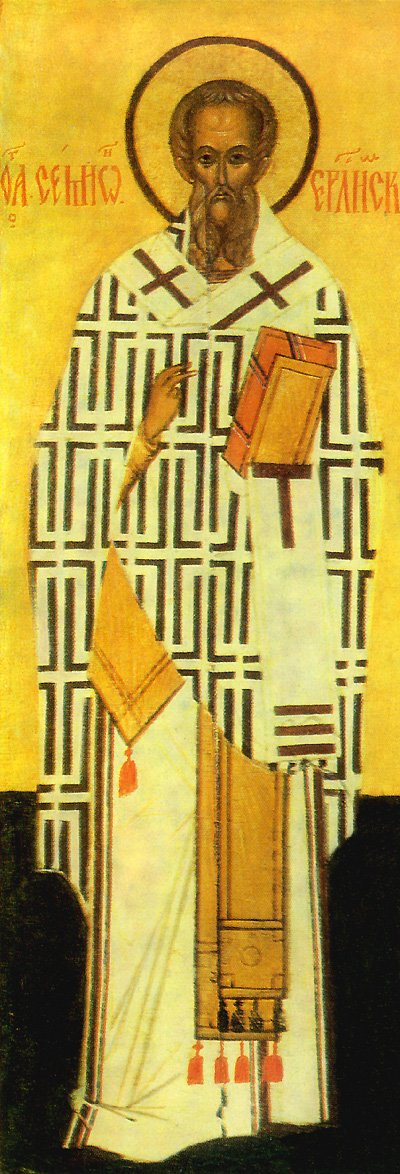
Hieromartyr Simeon, Kinsman of the Lord
The Holy Apostle and Hieromartyr Simeon, a kinsman of the Lord, was the son of Cleopas, who was the younger brother of Saint Joseph the Betrothed. Thus, Saint Simeon is Joseph's nephew, and a cousin of the Lord. As an adult, he witnessed the miracles of the Lord Jesus Christ, believed in Him, and became one of the 70 Apostles.
The Holy Apostle and Hieromartyr Simeon, a kinsman of the Lord, was the son of Cleopas, who was the younger brother of Saint Joseph the Betrothed. Thus, Saint Simeon is Joseph's nephew, and a cousin of the Lord. As an adult, he witnessed the miracles of the Lord Jesus Christ, believed in Him, and became one of the 70 Apostles. Saint Simeon proclaimed the teachings of Christ, was instructed in the truths of the holy Faith, and denounced idol worship. After the murder of the Holy Apostle James (October 23), the first Bishop of Jerusalem, Christians chose the Apostle Simeon to succeed him.
The Emperors Vespasian and Domitian had ordered that all descendants of King David be put to death. Emperor Trajan (98-117) renewed that decree, and certain heretics and some others denounced Saint Simeon as a descendant of King David, as well as a Christian.
The pagans arrested Saint Simeon, who at that time was more than one hundred and twenty years old. He astonished the judge and his attendants by enduring several days of torture, and then he was crucified in the year 107, during Trajan's reign, when Atticus was consul.
The Parisian Codices contain a Service in honor of Saint Simeon, the poem of the hymnographer Theophanēs. (Some Synaxaristes also commemorate him on September 18).
Troparion - Tone 1
The Church glorifies you as a kinsman of Christ, O Hierarch Simeon, / and as a steadfast martyr, for
courageously you destroyed all deceptions and preserved the Faith. / Therefore, we celebrate your
holy memory today, / and by your prayers, we receive the remission of our sins.
Kontakion - Tone 2
As one who has become a citizen of Zion on high, / you had been ordained to the throne of Zion below. / You guided your flock to the heavenly sheepfold, blessed Simeon, / and for the sake of Christ, you were crucified, / imitating His passion.
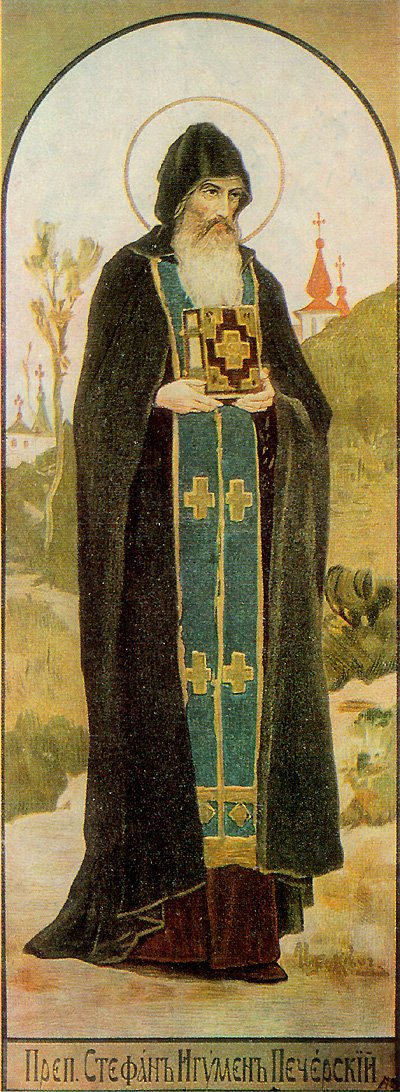
Our Holy Father Stephen, Abbot of the Kiev Caves and Bishop of Vladimir (1094)
Saint Stephen, Igumen of the Caves, Bishop of Vladimir in Volhynia, pursued asceticism at the Kiev Caves monastery under the guidance of Saint Theodosius (May 3). Saint Theodosius sometimes entrusted him to exhort the brethren with edifying words.
Before the death of Saint Theodosius the monks asked him to appoint Saint Stephen as Igumen, who was the domesticus (chief arranger for the choir).
Saint Stephen, Igumen of the Caves, Bishop of Vladimir in Volhynia, pursued asceticism at the Kiev Caves monastery under the guidance of Saint Theodosius (May 3). Saint Theodosius sometimes entrusted him to exhort the brethren with edifying words.
Before the death of Saint Theodosius the monks asked him to appoint Saint Stephen as Igumen, who was the domesticus (chief arranger for the choir). “He grew up under your instruction,” they said, “and he served you. Give him to us.” So Saint Theodosius transferred the guidance of the monastery to Saint Stephen.
During his tenure as Superior, he laid the foundations of a spacious church in honor of the Dormition of the Most Holy Theotokos, begun under Saint Theodosius. The cells of the brethren were moved near the new church. At the front of the place there were several cells for monks who were entrusted with burying the dead. They served the Divine Liturgy each day, and also commemorated the dead.
In 1078 Saint Stephen was removed from office and driven from the monastery through the malice of an evil monk. He endured this meekly and without bitterness, and continued to pray for those who had turned against him.
Saint Stephen learned that master builders had come from Greece with an icon of the Theotokos, and they told him of the appearance of the Heavenly Queen at Blachernae. Because of this, Saint Stephen also built a church at Klovo in honor of the Theotokos (in memory of the Placing of Her Robe at Blachernae). The monastery was founded in thanksgiving for solicitude of the Most Holy Theotokos for the Caves monastery.
In 1091 Saint Stephen was made Bishop of Vladimir in Volhynia, and he participated in the transfer of the relics of Saint Theodosius from the cave to the monastery (August 14). He also labored to convert the inhabitants of Volhynia to Christianity.
Saint Stephen died on April 27, 1094 during the sixth hour of the night.
Troparion - Tone 8
By a flood of tears you made the desert fertile, / and your longing for God brought forth fruits in abundance. / By the radiance of miracles you illumined the whole universe! / O our holy father Stephen, pray to Christ our God to save our souls!
Burning of the relics of St Sava I of Serbia by the Turks (1594)
After his death in Trnovo, Bulgaria on January 14, 1235 Saint Savva was buried in the
Cathedral of the Forty Martyrs. On May 6, 1237 his relics were carried in procession from Trnovo to Mileshevo Monastery in Serbia. When the casket was opened, the relics were found to be incorrupt, and produced an ineffable fragrance.
After his death in Trnovo, Bulgaria on January 14, 1235 Saint Savva was buried in the
Cathedral of the Forty Martyrs. On May 6, 1237 his relics were carried in procession from Trnovo to Mileshevo Monastery in Serbia. When the casket was opened, the relics were found to be incorrupt, and produced an ineffable fragrance. In 1253, the Serbian Orthodox Church glorified the holy hierarch Savva as a Saint.
Following the Battle of Kosovo on June 25, 1389, the Serbian nation fell under the Turkish Yoke. During this period the Serbs continued to visit the tomb of Saint Savva, asking him to give them the strength to endure the oppressive persecution they suffered at the hands of the Turks. His icon was placed on their flags, and the faithful turned to the Saint for encouragement, consolation, and healing.
The Serbs revolted in 1595, led by Patriarch John Kantul and others. Sinan Pasha, the Turkish military leader in Belgrade, sent soldiers to crush the rebellion. Sultan Mohammed II ordered that the relics of Saint Savva be burnt. On Great and Holy Friday, the Turks removed the Saint's relics from Mileshevo Monastery. The next day, April 27, they climbed Savinac Hill in the Vrachar district and set fire to the holy relics.
Instead of becoming despondent, the Serbs were inspired to even greater love for Christ, for Holy Orthodoxy, and for Saint Savva. Although the Saint's relics had been destroyed, the people continued to venerate him, and to remember the burning of his relics every year.
After national independence in 1879, there was a proposal to build a memorial church in honor of Saint Savva. In 1895, the three hundredth anniversary of the burning of Saint Savva's relics, plans were made to build a church on the site where his relics were burnt. A temporary chapel was constructed the following year, but it was not possible to build a large cathedral until after World War I. In 1927, Patriarch Barnabas announced a competition for architects to submit designs for the cathedral. In 1935, architects were chosen and construction began.
During World War II, work was halted when the Communists seized power. Only in 1984 did Patriarch German receive government approval to resume construction. On June 25, 1989, Patriarch German served the first Divine Liturgy in Saint Savva's Memorial Cathedral, which towers over the city of Belgrade.
There is a famous Serbian saying: "Sinan Pasha lit the flames, Savva's body burned, but Savva's memory and his glory did not burn."
Scripture Readings
☩Gospel
Matthew 22:15-23:39
15
Then went the Pharisees, and took counsel how they might entangle him in his talk.
16
And they sent out unto him their disciples with the Herodians, saying, Master, we know that thou art true, and teachest the way of God in truth, neither carest thou for any man: for thou regardest not the person of men.
17
Tell us therefore, What thinkest thou? Is it lawful to give tribute unto Cesar, or not?
18
But Jesus perceived their wickedness, and said, Why tempt ye me, ye hypocrites?
19
Shew me the tribute money. And they brought unto him a penny.
20
And he saith unto them, Whose is this image and superscription?
21
They say unto him, Cesar’s. Then saith he unto them, Render therefore unto Cesar the things which are Cesar’s; and unto God the things that are God’s.
22
When they had heard these words, they marvelled, and left him, and went their way.
23
The same day came to him the Sadducees, which say that there is no resurrection, and asked him,
24
Saying, Master, Moses said, If a man die, having no children, his brother shall marry his wife, and raise up seed unto his brother.
25
Now there were with us seven brethren: and the first, when he had married a wife, deceased, and, having no issue, left his wife unto his brother:
26
Likewise the second also, and the third, unto the seventh.
27
And last of all the woman died also.
28
Therefore in the resurrection whose wife shall she be of the seven? for they all had her.
29
Jesus answered and said unto them, Ye do err, not knowing the scriptures, nor the power of God.
30
For in the resurrection they neither marry, nor are given in marriage, but are as the angels of God in heaven.
31
But as touching the resurrection of the dead, have ye not read that which was spoken unto you by God, saying,
32
I am the God of Abraham, and the God of Isaac, and the God of Jacob? God is not the God of the dead, but of the living.
33
And when the multitude heard this, they were astonished at his doctrine.
34
But when the Pharisees had heard that he had put the Sadducees to silence, they were gathered together.
35
Then one of them, which was a lawyer, asked him a question, tempting him, and saying,
36
Master, which is the great commandment in the law?
37
Jesus said unto him, Thou shalt love the Lord thy God with all thy heart, and with all thy soul, and with all thy mind.
38
This is the first and great commandment.
39
And the second is like unto it, Thou shalt love thy neighbour as thyself.
40
On these two commandments hang all the law and the prophets.
41
While the Pharisees were gathered together, Jesus asked them,
42
Saying, What think ye of Christ? whose son is he? They say unto him, The Son of David.
43
He saith unto them, How then doth David in spirit call him Lord, saying,
44
The Lord said unto my Lord, Sit thou on my right hand, till I make thine enemies thy footstool?
45
If David then call him Lord, how is he his son?
46
And no man was able to answer him a word, neither durst any man from that day forth ask him any more questions.
1
Then spake Jesus to the multitude, and to his disciples,
2
Saying, The scribes and the Pharisees sit in Moses’ seat:
3
All therefore whatsoever they bid you observe, that observe and do; but do not ye after their works: for they say, and do not.
4
For they bind heavy burdens and grievous to be borne, and lay them on men’s shoulders; but they themselves will not move them with one of their fingers.
5
But all their works they do for to be seen of men: they make broad their phylacteries, and enlarge the borders of their garments,
6
And love the uppermost rooms at feasts, and the chief seats in the synagogues,
7
And greetings in the markets, and to be called of men, Rabbi, Rabbi.
8
But be not ye called Rabbi: for one is your Master, even Christ; and all ye are brethren.
9
And call no man your father upon the earth: for one is your Father, which is in heaven.
10
Neither be ye called masters: for one is your Master, even Christ.
11
But he that is greatest among you shall be your servant.
12
And whosoever shall exalt himself shall be abased; and he that shall humble himself shall be exalted.
13
But woe unto you, scribes and Pharisees, hypocrites! for ye shut up the kingdom of heaven against men: for ye neither go in yourselves, neither suffer ye them that are entering to go in.
14
Woe unto you, scribes and Pharisees, hypocrites! for ye devour widows’ houses, and for a pretence make long prayer: therefore ye shall receive the greater damnation.
15
Woe unto you, scribes and Pharisees, hypocrites! for ye compass sea and land to make one proselyte, and when he is made, ye make him twofold more the child of hell than yourselves.
16
Woe unto you, ye blind guides, which say, Whosoever shall swear by the temple, it is nothing; but whosoever shall swear by the gold of the temple, he is a debtor!
17
Ye fools and blind: for whether is greater, the gold, or the temple that sanctifieth the gold?
18
And, Whosoever shall swear by the altar, it is nothing; but whosoever sweareth by the gift that is upon it, he is guilty.
19
Ye fools and blind: for whether is greater, the gift, or the altar that sanctifieth the gift?
20
Whoso therefore shall swear by the altar, sweareth by it, and by all things thereon.
21
And whoso shall swear by the temple, sweareth by it, and by him that dwelleth therein.
22
And he that shall swear by heaven, sweareth by the throne of God, and by him that sitteth thereon.
23
Woe unto you, scribes and Pharisees, hypocrites! for ye pay tithe of mint and anise and cummin, and have omitted the weightier matters of the law, judgment, mercy, and faith: these ought ye to have done, and not to leave the other undone.
24
Ye blind guides, which strain at a gnat, and swallow a camel.
25
Woe unto you, scribes and Pharisees, hypocrites! for ye make clean the outside of the cup and of the platter, but within they are full of extortion and excess.
26
Thou blind Pharisee, cleanse first that which is within the cup and platter, that the outside of them may be clean also.
27
Woe unto you, scribes and Pharisees, hypocrites! for ye are like unto whited sepulchres, which indeed appear beautiful outward, but are within full of dead men’s bones, and of all uncleanness.
28
Even so ye also outwardly appear righteous unto men, but within ye are full of hypocrisy and iniquity.
29
Woe unto you, scribes and Pharisees, hypocrites! because ye build the tombs of the prophets, and garnish the sepulchres of the righteous,
30
And say, If we had been in the days of our fathers, we would not have been partakers with them in the blood of the prophets.
31
Wherefore ye be witnesses unto yourselves, that ye are the children of them which killed the prophets.
32
Fill ye up then the measure of your fathers.
33
Ye serpents, ye generation of vipers, how can ye escape the damnation of hell?
34
Wherefore, behold, I send unto you prophets, and wise men, and scribes: and some of them ye shall kill and crucify; and some of them shall ye scourge in your synagogues, and persecute them from city to city:
35
That upon you may come all the righteous blood shed upon the earth, from the blood of righteous Abel unto the blood of Zacharias son of Barachias, whom ye slew between the temple and the altar.
36
Verily I say unto you, All these things shall come upon this generation.
37
O Jerusalem, Jerusalem, thou that killest the prophets, and stonest them which are sent unto thee, how often would I have gathered thy children together, even as a hen gathereth her chickens under her wings, and ye would not!
38
Behold, your house is left unto you desolate.
39
For I say unto you, Ye shall not see me henceforth, till ye shall say, Blessed is he that cometh in the name of the Lord.
Notes
["Presanctified Liturgy"]
Liturgical data sourced from OCA.org and orthocal.info