Fasting Rules
 Meat
Abstain
 Fish
Abstain
 Dairy
Abstain
 Oil
Abstain
 Wine
Abstain
Saints & Commemorations
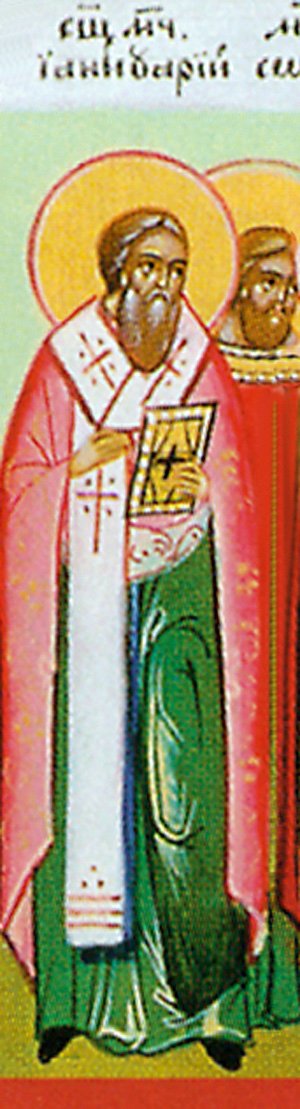
Hieromartyr Januarius and Companions
Hieromartyr Januarius Bishop of Benevento, and the deacons Proculus, Sossius and Faustus, Desiderius the Reader, Eutychius and Acution suffered martyrdom for Christ about the year 305 during the persecution ordered by the emperor Diocletian (284-305).
They arrested Saint Januarius and led him to trial before Menignus, the governor of Campagna (central Italy).
Hieromartyr Januarius Bishop of Benevento, and the deacons Proculus, Sossius and Faustus, Desiderius the Reader, Eutychius and Acution suffered martyrdom for Christ about the year 305 during the persecution ordered by the emperor Diocletian (284-305).
They arrested Saint Januarius and led him to trial before Menignus, the governor of Campagna (central Italy). Because of his firm confession of Christianity, they threw the saint into a red-hot furnace. But like the Babylonian youths, he came out unharmed. Then at Menignus’s command, they stretched him out on a bench and beat him with iron rods until his bones were exposed.
In the crowd were Deacon Faustus and the Reader Desiderius, who wept at the sight of their bishop’s suffering. The pagans surmised that they were Christians, and threw them into prison with the hieromartyr Januarius, in the city of Puteolum. At this prison were two deacons who had been jailed for confessing Christ: Saints Sossius and Proculus, and also two laymen, Saints Eutychius and Acution.
On the following morning they led out all the martyrs into the circus to be torn to pieces by wild beasts, but the beasts would not touch them. Menignus claimed that all the miracles were due to sorcery on the part of the Christians, and immediately he became blinded and cried out for help. The gentle hieromartyr Januarius prayed for his healing, and Menignus recovered his sight. The torturer’s blindness of soul, however, was not healed. He accused the Christians of sorcery, and ordered the martyrs beheaded before the walls of the city (+ 305).
Christians from surrounding cities took up the bodies of the holy martyrs for burial, and those of each city took one, in order to have an intercessor before God. The inhabitants of Neapolis (Naples) took the body of the hieromartyr Januarius. With the body, they also collected his dried blood.
Since the fifteenth century, the blood liquifies when the container is placed near another relic, believed to be the martyr’s head. Many miracles proceeded from the relics of the hieromartyr Januarius. During an eruption of Vesuvius around 431, the inhabitants of the city prayed to Saint Januarius to help them. The lava stopped, and did not reach the city.
Troparion - Tone 3
Consecrated through anointing with oil, / you became pastors for your godly wise people. / You were slain as honorable lambs / and offered to the Word and First Shepherd, / Who was Himself slain as His sheep, / O most laudable Hieromartyrs Januarius and Theodore, / beacons for all the world. / Therefore we all honor your holy memory in love, / as you intercede for our souls.
Kontakion - Tone 3
Naples has found you a champion in dangers, / O Januarius, our glorious father. / You delivered her from plague, famine and affliction, / and from the fire of Vesuvius. / With faith and love we venerate you and honor your holy relics!
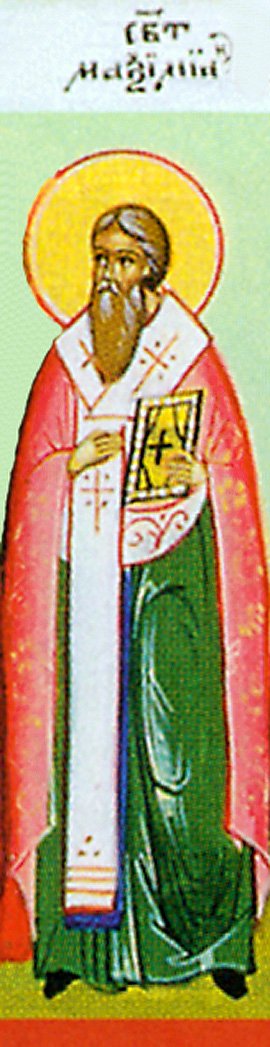
Our Holy Father Maximian, Patriarch of Constantinople
Saint Maximian (or Maximus) was born in Rome to wealthy and pious parents. He was a guiless man who preferred to live far from worldly vanity. He was also learned, intelligent, and was known for his many virtues, the integrity of his life, and his incomparable character. Because of his pure and holy life, Patriarch Sisinίos of Constantinople ordained him as a priest.
Saint Maximian (or Maximus) was born in Rome to wealthy and pious parents. He was a guiless man who preferred to live far from worldly vanity. He was also learned, intelligent, and was known for his many virtues, the integrity of his life, and his incomparable character. Because of his pure and holy life, Patriarch Sisinίos of Constantinople ordained him as a priest. At his own expense, Saint Maximian would pay for the burial of persons who were conspicuous for the holiness of their lives.
After the heresiarch Nestorios was deposed and exiled, Saint Maximian became Patriarch on October 25, 431, with the fervent support of both the reigning Emperor Theodosios the Younger (408-450), and the faithful people.
Saint Maximian reposed peacefully on April 21, 434 (Great and Holy Thursday).
Troparion - Tone 4
In truth you were revealed to your flock as a rule of faith, / an image of humility and a teacher of abstinence; / your humility exalted you; / your poverty enriched you. / Hierarch Father Maximian, / entreat Christ our God / that our souls may be saved.
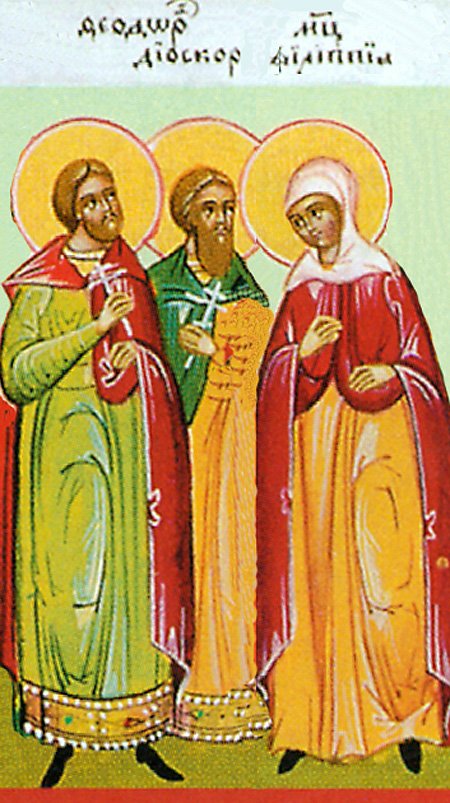
Theodore the Holy Martyr & his mother Philippa of Perge
The Holy Martyrs Theodore, his mother Philippa, Dioscorus, Socrates and Dionysius suffered during the reign of the emperor Antoninus Pius (138-161) in Perge, Pamphylia. When they were conscripting robust and healthy young men for military service, then they led the youth Theodore and the others to the military commander Theodotus.
The Holy Martyrs Theodore, his mother Philippa, Dioscorus, Socrates and Dionysius suffered during the reign of the emperor Antoninus Pius (138-161) in Perge, Pamphylia. When they were conscripting robust and healthy young men for military service, then they led the youth Theodore and the others to the military commander Theodotus.
The military commander ordered the youth to offer sacrifice to idols, but the martyr submitted neither to persuasion nor threats. Then the military commander had him placed on a red-hot plate and poured liquid tar on him. Suddenly, there was an earthquake, and a torrent of water gushed forth from the ground and extinguished the fire.
The martyr Theodore remained unharmed, and gave praise to God. The commander ascribed his deliverance to sorcery, so Saint Theodore suggested that he test the power of his gods by putting the pagan priest Dioscorus through the same trials.
The commander told Dioscorus to lie upon the red-hot plate, and call on the help of Zeus. Saint Dioscorus replied that he believed in Christ, and he was prepared to throw the idol of Zeus into the fire. Again the military commander commanded him to get on the heated plate. Saint Dioscorus fell at the knees of Saint Theodore, asking that he pray for him. Then he got onto the plate, crying out: “I thank You, Lord Jesus Christ, that You have numbered me among Your servants. Accept my soul in peace.” Then he died, having been delivered from terrible torment.
They continued to torture Saint Theodore. They tied him to wild horses, which began to run. But at the city walls the horses fell down and collapsed, and the martyr Theodore remained unharmed. Two soldiers, Socrates and Dionysius, saw how a fiery chariot came down from the heavens to Saint Theodore, on which the martyr was carried off.
The astonished soldiers shouted: “Great is the God of the Christians!” They seized them and on the next day threw them into a fiery furnace with the martyr Theodore. But a heavenly dew cooled the furnace, and the saints remained alive.
In the morning, the military commander ordered soldiers to look upon the burned bodies of the martyrs. The soldiers returned and reported that the three youths were unharmed. Saint Theodore’s mother, Philippa, encouraged the martyrs in their act.
The military commander told Saint Philippa to save her son, by urging him to offer sacrifice to the idols. Saint Philippa said that when her son was born it was revealed to her that he would be crucified for Christ. Hearing this, the military commander commanded them to crucify Saint Theodore, and to cut off the heads of the other martyrs. Saint Theodore hung on the cross for three days, offering prayers to God until he finally died.
Troparion - Tone 4
By sharing in the ways of the Apostles, / you became a successor to their throne. / Through the practice of virtue, you found the way to divine contemplation, O divinely-inspired one; by rightly dividing the word of truth without error, you defended the Faith, / even to the shedding of your blood. / O Hieromartyr Theodore, entreat Christ God to save our souls.
Kontakion - Tone 4
As one who lived piously among Hierarchs and who underwent martyrdom, O divinely-wise one, / you abolished the sacrifices of idolatry and showed yourself to be a protector of your flock. / Therefore, we cry fervently to you: / “By your intercessions, deliver us from all misfortunes, / O Theodore our Father.”
Scripture Readings
View scripture readings for this date on OCA.org.
View readings on OCA.orgNotes
["Presanctified Liturgy"]
Liturgical data sourced from OCA.org and orthocal.info