Fasting Rules
 Meat
Abstain
 Fish
Abstain
 Dairy
Abstain
 Oil
Abstain
 Wine
Abstain
Saints & Commemorations
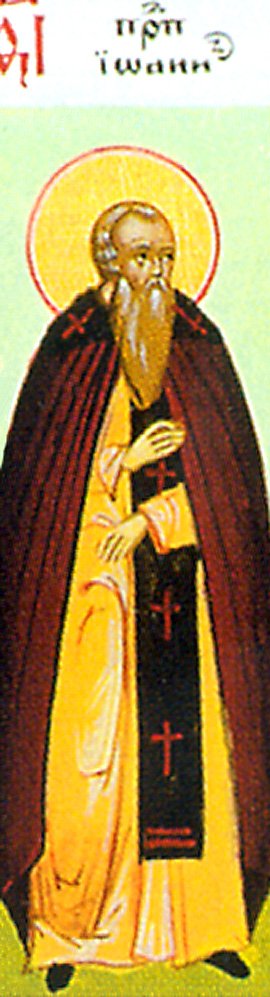
Ven. John of Ancient Caves in Palestine
Saint John of the Ancient Caves is so called because he lived during the eighth century in the Lavra of Saint Chariton (September 28). This was called the “Old,” or ancient cave, since it was one the oldest of the Palestinian monasteries. The Lavra was situated not far from Bethlehem, near the Dead Sea.
Sa
Saint John of the Ancient Caves is so called because he lived during the eighth century in the Lavra of Saint Chariton (September 28). This was called the “Old,” or ancient cave, since it was one the oldest of the Palestinian monasteries. The Lavra was situated not far from Bethlehem, near the Dead Sea.
Saint John in his early years left the world, went to venerate the holy places of Jerusalem, and settled at the Lavra, where he labored in fasting, vigil, and prayer. He was ordained to the holy priesthood, and glorified by his ascetic life.
Troparion - Tone 8
The image of God was truly preserved in you, O Father, / for you took up the Cross and followed Christ. / By so doing, you taught us to disregard the flesh, for it passes away, / but to care instead for the soul, since it is immortal. / Therefore your spirit, O holy Father John, rejoices with the angels.
Kontakion - Tone 2
Divinely arming yourself with purity of soul, / and wielding incessant prayer as a spear, / John, our father, you impaled hordes of demons. / Unceasingly pray for us all!
Our Holy Father Agathangelos (1819)
“From Thrace, his worldly name being Anastasios, he was a slave to some Turks, and they compelled him to embrace Islam in Smyrna. As a penitent, he was tonsured at the monastery of Esphigmenou on the Holy Mountain. Tormented by his conscience, he desired to wash his sins in his own blood, so he went to Smyrna, where he showed a Cross and an icon of Christ’s Resurrection to the Turks. He
“From Thrace, his worldly name being Anastasios, he was a slave to some Turks, and they compelled him to embrace Islam in Smyrna. As a penitent, he was tonsured at the monastery of Esphigmenou on the Holy Mountain. Tormented by his conscience, he desired to wash his sins in his own blood, so he went to Smyrna, where he showed a Cross and an icon of Christ’s Resurrection to the Turks. He was beheaded on April 19th, 1819, at the age of nineteen. He appeared to his spiritual father, Germanos, after his death.” (Prologue)
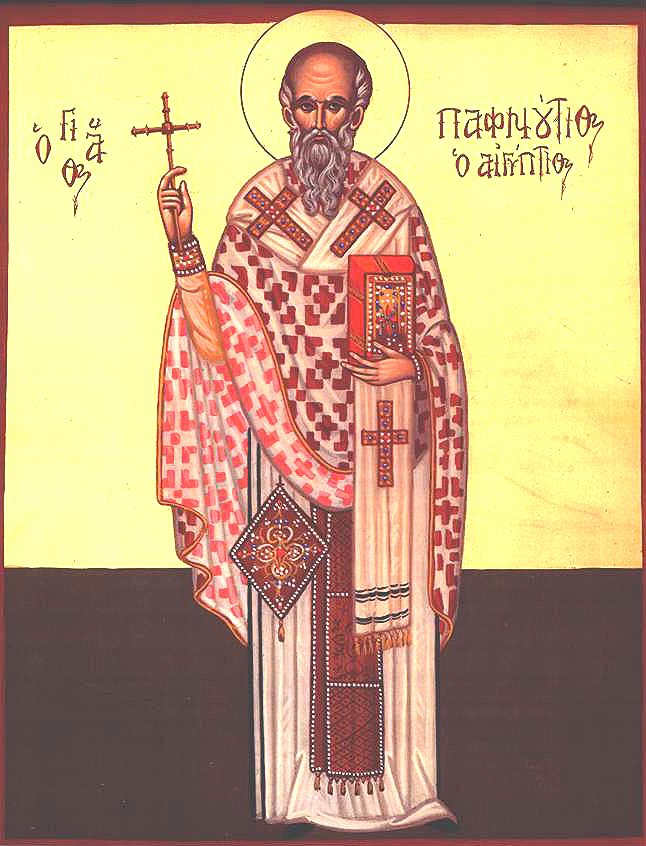
The Holy Hieromartyr Paphnutius
Hieromartyr Paphnutius of Jerusalem was a bishop. He underwent many sufferings from the pagans and was tortured by fire, wild beasts, and finally was beheaded by the sword.
Some suggest that the hieromartyr Paphnutius was an Egyptian bishop and suffered together with many other Egyptians, exiled to the Palestinian mines during the persecution by Diocletian (284-305).
The myrrh-streaming relics of the hieromartyr were glorified by miracles. The Canon in his honor was composed during the Iconoclast period (before 842). In the final Ode is a petition for the hieromartyr to put an end to the heresy disrupting the Church.
Troparion - Tone 4
As a Priest you offered the Holy Sacrifice, / and as a Martyr you yourself were a burnt offering. / O Hieromartyr Paphnoutios, / God's steadfast contestant and treasury of grace, / bestow grace on us who praise you.
Kontakion - Tone 2
You reddened your priestly vesture in the streams of your blood, / and ran joyously to the heavenly tabernacle, O blessed Paphnoutios, / and you cry out to the Savior: / “You are the Fountain of Life, pouring forth compassion upon us all.”
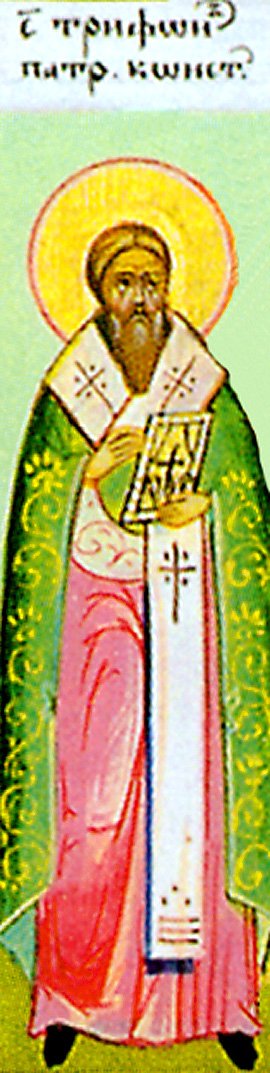
Tryphon, Patriarch of Constantinople
Saint Tryphon, Patriarch of Constantinople, was a monk from the time of his youth, distinguished by his meekness, lack of malice, full submission to the will of God, and his firm faith and love for the Church. At this time the emperor Romanus (919-944) ruled in Constantinople. He wanted to elevate his younger son Theophylactus to the patriarchal throne.
Saint Tryphon, Patriarch of Constantinople, was a monk from the time of his youth, distinguished by his meekness, lack of malice, full submission to the will of God, and his firm faith and love for the Church. At this time the emperor Romanus (919-944) ruled in Constantinople. He wanted to elevate his younger son Theophylactus to the patriarchal throne. When Patriarch Stephanos (925-928) died, Theophylactus was only sixteen years old. The emperor then suggested that Saint Tryphon be “locum tenens” of the patriarchal throne until Theophylactus came of age.
Saint Tryphon meekly accepted the burden of patriarchal service and for three years he wisely governed the Church. When Theophylactus turned twenty (931), the emperor told Saint Tryphon to resign the patriarchal throne. Saint Tryphon did not consider it proper to hand over the throne to an inexperienced youth, and he refused to do so. The emperor could not intimidate Saint Tryphon, since his life was blameless. Then Romanus employed the cunning counsels of Bishop Theophilus of Caesarea.
The deceitful bishop went to Saint Tryphon and urged him not to obey the emperor, and not to resign the patriarchal throne. Then Bishop Theophilus craftily obtained Saint Tryphon’s signature on a blank sheet of paper. Not suspecting any treachery, the guileless saint took a clean sheet of paper and wrote: “Tryphon, by the Mercy of God, Archbishop of Constantinople, the New Rome, and Ecumenical Patriarch.”
When they presented this paper to the emperor, he ordered them to write over the saint’s signature: “I hereby resign the position of Patriarch, because I consider myself unworthy of this office.” When this false document was read before the imperial dignitaries, servants removed Saint Tryphon from the patriarchal chambers.
Saint Tryphon patiently endured the injustice done to him, and returned to his own monastery. He lived there as a simple monk for a year before his death (+ 933). His body was taken to Constantinople and buried with the Patriarchs.
Troparion - Tone 4
In truth you were revealed to your flock as a rule of faith, / an image of humility and a teacher of abstinence; / your humility exalted you; / your poverty enriched you. / Hierarch Father Tryphon, / entreat Christ our God / that our souls may be saved.
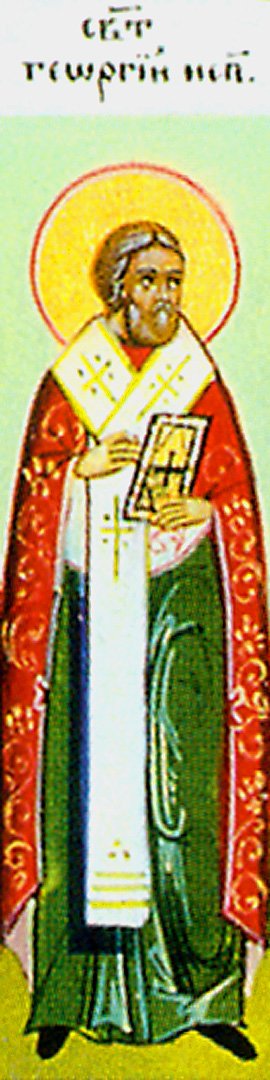
George the Confessor
Saint George the Confessor, Bishop of Antioch in Pisidia, lived during the Iconoclast period. In his youth he became a monk, was known for his holiness of life and was made bishop of Antioch in Pisidia.
Saint George was at Constantinople during the iconoclastic persecution under Emperor Leo the Armenian (813-820).
Saint George the Confessor, Bishop of Antioch in Pisidia, lived during the Iconoclast period. In his youth he became a monk, was known for his holiness of life and was made bishop of Antioch in Pisidia.
Saint George was at Constantinople during the iconoclastic persecution under Emperor Leo the Armenian (813-820). He denounced the Iconoclast heresy at a Council of bishops, calling on the emperor to abandon it. When Saint George refused to remove the icons from the church, as ordered by the emperor’s decree, he was exiled to imprisonment (813-820).
Troparion - Tone 8
Champion of Orthodoxy, teacher of purity and of true worship, / the enlightener of the universe and the adornment of hierarchs: / all-wise father George, your teachings have gleamed with light upon all things. / Intercede before Christ God to save our souls.
Scripture Readings
View scripture readings for this date on OCA.org.
View readings on OCA.orgLiturgical data sourced from OCA.org and orthocal.info