Fasting Rules
 Meat
Abstain
 Fish
Abstain
 Dairy
Abstain
 Oil
Allowed
 Wine
Allowed
Saints & Commemorations
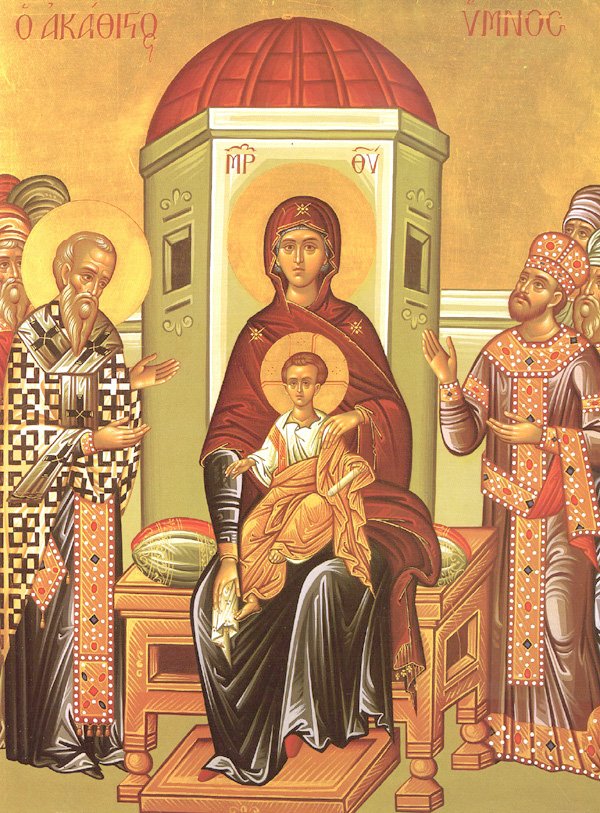
Saturday of the Akathist to the Most-Holy Theotokos
On the Fifth Saturday of Great Lent, the Saturday of the Akathist, we commemorate the “Laudation of the Virgin” Icon of the Most Holy Theotokos.
In 625, when the emperor Heraclius was fighting the Persians, the Khan sent forces to attack Constantinople by land and by sea. Patriarch Sergius urged the people not to lose heart, but to trust in God.
A
On the Fifth Saturday of Great Lent, the Saturday of the Akathist, we commemorate the “Laudation of the Virgin” Icon of the Most Holy Theotokos.
In 625, when the emperor Heraclius was fighting the Persians, the Khan sent forces to attack Constantinople by land and by sea. Patriarch Sergius urged the people not to lose heart, but to trust in God.
A procession was made around the city with the Cross of the Lord, the robe of the Virgin, the Icon of the Savior not made by hands, and the Hodēgḗtria Icon of the Mother of God. The Patriarch dipped the Virgin’s robe in the sea, and the city’s defenders beat back the Khan’s sea forces. The sea became very rough, and many boats sank. The invaders retreated, and the people of Constantinople gave thanks to God and to His Most Pure Mother.
On two other occasions, in 655 and 705, the Theotokos protected the city from Saracen invaders. A feastday dedicated to the Laudation of the Virgin was established to commemorate these victories. The Akathist to the Mother of God is believed to originate from this period, and its use has spread from Constantinople to other Orthodox lands.
The icon before which the Akathist was sung was given to the Dionysiou Monastery on Mt. Athos by Emperor Alexius Comnenos. There, it began to flow with myrrh. There were at least three wonderworking copies of this icon in Russia before the Revolution.
This icon shows the Mother of God seated on a throne, and surrounded by Prophets with scrolls.
Troparion - Tone 8
When the archangel understood the mysterious command, / he came to the house of Joseph with haste and proclaimed to the unwedded Lady: / The One Who bowed the heavens by His condescension / is contained wholly and without change in you! / As I behold Him in your womb, taking the form of a servant, I am frightened, but cry: / Rejoice, unwedded Bride!
Kontakion - Tone 8
Victorious leader of triumphant hosts, / we your servants, delivered from evil, sing our grateful thanks to you, Theotokos! / As you possess invincible might set us free from every calamity, / so that we may sing: Rejoice, unwedded Bride!
Ven. Zosima of Solovetsk
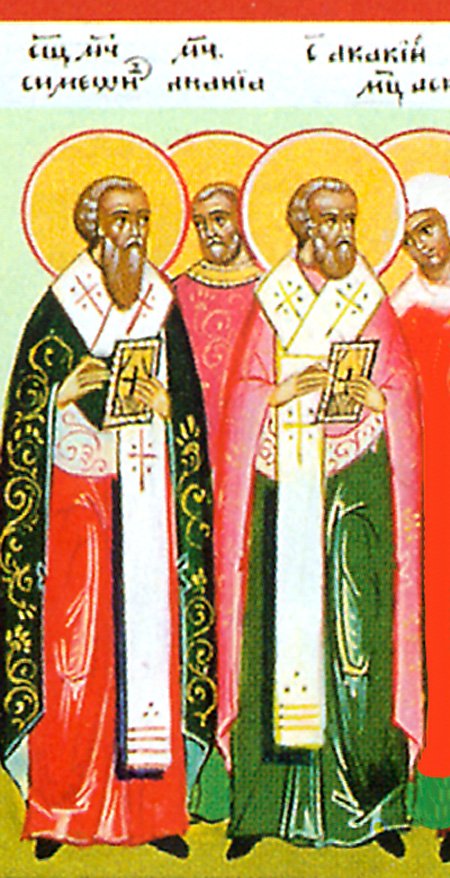
Hieromartyr Simeon of Persia
The Hieromartyr Simeon, Bishop of Persia, suffered during a persecution against Christians under the Persian emperor Sapor II (310-381). They accused the saint of collaborating with the Roman Empire and of subversive activities against the Persian emperor.
In the year 344, the emperor issued an edict which imposed a heavy tax upon Christians.
The Hieromartyr Simeon, Bishop of Persia, suffered during a persecution against Christians under the Persian emperor Sapor II (310-381). They accused the saint of collaborating with the Roman Empire and of subversive activities against the Persian emperor.
In the year 344, the emperor issued an edict which imposed a heavy tax upon Christians. When some of them refused to pay it, this was regarded as an act of rebellion, so the emperor began a fierce persecution against Christians.
Saint Simeon was brought to trial in iron fetters as a supposed enemy of the Persian realm, together with the two hieromartyrs Habdelai and Ananias. The holy bishop would not even bow to the emperor, who asked why he would not show him the proper respect. The saint answered, “Formerly, I bowed because of your rank, but now, when you ask me to renounce my God and abandon my faith, it is not proper for me to bow to you.”
The emperor urged him to worship the sun, and he threatened to eradicate Christianity in his land if he refused. But neither urgings nor threats could shake the steadfast saint, and they led him off to prison. Along the way the eunuch Usphazanes, a counsellor of the emperor, saw the saint. He stood up and bowed to the bishop, but the saint turned away from him because he, a former Christian, out of fear of the emperor, now worshipped the sun.
The eunuch repented with all his heart, he exchanged his fine attire for coarse garb, and sitting at the doors of the court, he cried out bitterly, “Woe to me, when I stand before my God, from Whom I am cut off. Here was Simeon, and he has turned his back on me!”
The emperor Sapor learned about the grief of his beloved tutor and asked him what had happened. He told the emperor that he bitterly regretted his apostasy and would no more worship the sun, but only the one true God. The emperor was surprised at the old man’s sudden decision, and he urged him not to abjure the gods whom their fathers had reverenced. But Usphazanes was unyielding, and they condemned him to death. Saint Usphazanes asked that the city heralds report that he died not for crimes against the emperor, but for being a Christian. The emperor granted his request.
Saint Simeon also learned about the death of Usphazanes, and he gave thanks to the Lord. When they brought him before the emperor a second time, Saint Simeon again refused to worship the pagan gods and confessed his faith in Christ. The enraged emperor gave orders to behead all the Christians in the prison before the saint’s eyes.
Without fear the Christians went to execution, blessed by the holy hierarch, and they bent their heads beneath the sword. Saint Simeon’s companion, the Priest Habdelai, was also beheaded. When they came to the Priest Ananias, he suddenly trembled. Then one of the dignitaries, Saint Phusicus (Pusicius), a secret Christian, was afraid that Ananias would renounce Christ, and he cried out, “Do not fear the sword, Elder, and you will see the divine light of our Lord Jesus Christ.”
Saint Phusicus betrayed himself by this outburst. The emperor gave orders to pluck out his tongue and to flay the skin off him. Along with Saint Phusicus, his daughter Askitrea was also martyred. Saint Simeon was the last to go before the executioner, and he placed his head on the chopping-block (April 13, 344). Executions continued all during Bright Week until April 23.
Saint Azates the Eunuch, a close official to the emperor, also received the crown of martyrdom, along with Saints Abdechalas, Usthazanes, and Azades. The sources indicate that 1,150 Martyrs perished because they refused to accept the Persian religion.
Troparion - Tone 4
As an instructor of divinely inspired doctrines / you trained martyrs for contest by your words and deeds. / You suffered with them, holy hierarch Simeon, / crying out to Christ while hastening to Him: / “We are counted as sheep for the slaughter out of love for You, O Savior.”
Kontakion - Tone 4
With your holy band of martyrs / you shone forth from Persia like radiant stars. / With them we praise you, O Simeon.
Hieromartyr Simeon, Bishop in Persia, and those with him (343)
The Holy Symeon was bishop of the royal cities of Seleucia and Ctesiphon in Persia, during a great persecution under King Sapor II. The king had been incited by (Zoroastrian) Magi jealous of the growth of the Faith in their territory, and by some Jews living in Persia. The king was already displeased with the holy bishop: his eunuch, Ustazan, a secret Christian, had denied Christ, but when reprimanded by Symeon, had confessed the Faith before the King, for which he was executed.
The Holy Symeon was bishop of the royal cities of Seleucia and Ctesiphon in Persia, during a great persecution under King Sapor II. The king had been incited by (Zoroastrian) Magi jealous of the growth of the Faith in their territory, and by some Jews living in Persia. The king was already displeased with the holy bishop: his eunuch, Ustazan, a secret Christian, had denied Christ, but when reprimanded by Symeon, had confessed the Faith before the King, for which he was executed. On Holy Friday of 343 Symeon, along with at least a hundred other servants of the Church, was sent out to be slain. Symeon exhorted each to be of good courage, and was himself slain last. One year later, again on Holy Friday, the King’s eunuch Azat was executed for Christ, along with a great number of the faithful. It is said that more than 1,000 Christians died as martyrs during this persecution.
The Zoroastrians still live in parts of Iran as a small, somewhat persecuted minority under the Islamic government.
Makarios, Bishop of Corinth
Scripture Readings
☩Epistle
Hebrews 9:24-28
24
For Christ is not entered into the holy places made with hands, which are the figures of the true; but into heaven itself, now to appear in the presence of God for us:
25
Nor yet that he should offer himself often, as the high priest entereth into the holy place every year with blood of others;
26
For then must he often have suffered since the foundation of the world: but now once in the end of the world hath he appeared to put away sin by the sacrifice of himself.
27
And as it is appointed unto men once to die, but after this the judgment:
28
So Christ was once offered to bear the sins of many; and unto them that look for him shall he appear the second time without sin unto salvation.
☩Gospel
Mark 8:27-31
27
And Jesus went out, and his disciples, into the towns of Cesarea Philippi: and by the way he asked his disciples, saying unto them, Whom do men say that I am?
28
And they answered, John the Baptist: but some say, Elias; and others, One of the prophets.
29
And he saith unto them, But whom say ye that I am? And Peter answereth and saith unto him, Thou art the Christ.
30
And he charged them that they should tell no man of him.
31
And he began to teach them, that the Son of man must suffer many things, and be rejected of the elders, and of the chief priests, and scribes, and be killed, and after three days rise again.
Liturgical data sourced from OCA.org and orthocal.info