Fasting Rules
 Meat
Abstain
 Fish
Abstain
 Dairy
Abstain
 Oil
Allowed
 Wine
Allowed
Saints & Commemorations
Memorial Saturday
Saturday is the day which the Church has set aside for the commemoration of faithful Orthodox Christians departed this life in the hope of resurrection to eternal life. Since the Divine Liturgy cannot be served on weekdays during Great Lent, the second, third, and fourth Saturdays of the Fast are appointed as Soul Saturdays when the departed are remembered at Liturgy.
Saturday is the day which the Church has set aside for the commemoration of faithful Orthodox Christians departed this life in the hope of resurrection to eternal life. Since the Divine Liturgy cannot be served on weekdays during Great Lent, the second, third, and fourth Saturdays of the Fast are appointed as Soul Saturdays when the departed are remembered at Liturgy.
In addition to the Liturgy, kollyva (wheat or rice cooked with honey and mixed with raisins, figs, nuts, sesame, etc.) is blessed in church on these Saturdays. The kollyva reminds us of the Lord’s words, “Unless a grain of wheat falls into the earth and dies, it remains alone; but if it dies, it bears much fruit” (John 12:24). The kollyva symbolizes the future resurrection of all the dead. As Saint Simeon of Thessalonica (September 15) says, man is also a seed which is planted in the ground after death, and will be raised up again by God’s power. Saint Paul also speaks of this (I Cor. 15:35-49).
It is customary to give alms in memory of the dead in addition to the prayers we offer for their souls. The angel who spoke to Cornelius testifies to the efficacy of almsgiving, “Your prayers and your alms have ascended as a memorial before God” (Acts 10:4).
Memorial services for the dead may be traced back to ancient times. Chapter 8 of the Apostolic Constitutions recommends memorial services with Psalms for the dead. It also contains a beautiful prayer for the departed, asking that their voluntary and involuntary sins be pardoned, that they be given rest with the Patriarchs, Prophets, and Apostles in a place where sorrow, suffering, and sighing have fled away (Isaiah 35:10). Saint John Chrysostom mentions the service for the dead in one of his homilies on Philippians, and says that it was established by the Apostles. Saint Cyprian of Carthage (Letter 37) also speaks of our duty to remember the martyrs.
The holy Fathers also testify to the benefit of offering prayers, memorial services, Liturgies, and alms for the dead (Saint John Chrysostom, Saint Cyril of Jerusalem, Saint John of Damascus, etc.). Although both the righteous and those who have not repented and corrected themselves may receive benefit and consolation from the Church’s prayer, it has not been revealed to what extent the unrighteous can receive this solace. It is not possible, however, for the Church’s prayer to transfer a soul from a state of evil and condemnation to a state of holiness and blessedness. Saint Basil the Great points out that the time for repentance and forgiveness of sins is during the present life, while the future life is a time for righteous judgment and retribution (Moralia 1). Saint John Chrysostom, Saint Gregory the Theologian, and other patristic writers concur with Saint Basil’s statement.
By praying for others, we bring benefit to them, and also to ourselves, because “God is not so unjust as to forget your work and the love which you showed for His sake in serving the saints...” (Heb. 6:10).
Troparion - Tone 8
Only Creator, with wisdom profound, You mercifully order all things, / and give that which is needed to all men: / Give rest, O Lord, to the souls of Your servants who have fallen asleep, / for they have placed their trust in You, our Maker and Fashioner, and our God.
Kontakion - Tone 8
With the saints give rest, O Christ, to the souls of Your servants, / where there is neither sickness nor sorrow, and no more sighing, / but life everlasting.
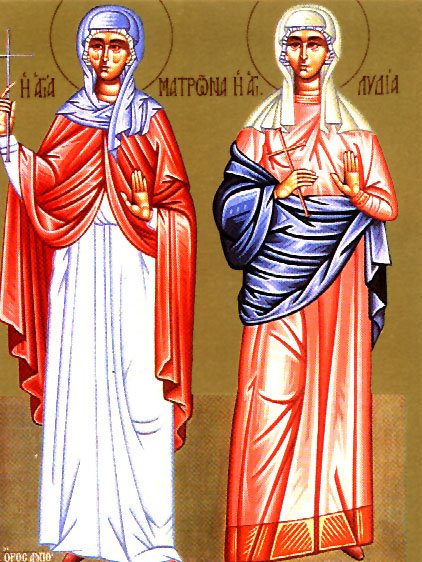
Martyr Matrona of Thessalonica
The Holy Martyr Matrona of Thessalonica suffered in the third or fourth century. She was a slave of the Jewish woman Pautila (or Pantilla), wife of one of the military commanders of Thessalonica. Pautila constantly mocked her slave for her faith in Christ, and tried to convert her to Judaism. Saint Matrona, who believed in Christ from her youth, still prayed to the Savior Christ, and secretly went to church unbeknownst to her vengeful mistress.
The Holy Martyr Matrona of Thessalonica suffered in the third or fourth century. She was a slave of the Jewish woman Pautila (or Pantilla), wife of one of the military commanders of Thessalonica. Pautila constantly mocked her slave for her faith in Christ, and tried to convert her to Judaism. Saint Matrona, who believed in Christ from her youth, still prayed to the Savior Christ, and secretly went to church unbeknownst to her vengeful mistress.
Pautila, learning that Saint Matrona had been to church, asked, “Why won’t you come to our synagogue, instead of attending the Christian church?” Saint Matrona boldly answered, “Because God is present in the Christian church, but He has departed from the Jewish synagogue.” Pautila went into a rage and mercilessly beat Saint Matrona, tied her up, and shut her in a dark closet. In the morning, Pautila discovered that Saint Matrona had been freed of her bonds by an unknown Power.
In a rage Pautila beat the martyr almost to death, then bound her even more tightly and locked her in the closet. The door was sealed so that no one could help the sufferer. The holy martyr remained there for four days without food or water, and when Pautila opened the door, she again found Saint Matrona free of her bonds, and standing at prayer.
Pautila flogged the holy martyr and left the skin hanging in strips from her body. The fierce woman locked her in the closet again, where Saint Matrona gave up her spirit to God.
Pautila had the holy martyr’s body thrown from the roof of her house. Christians took up the much-suffered body of the holy martyr and buried it. Later, Bishop Alexander of Thessalonica built a church dedicated to the holy martyr. Her holy relics, glorified by many miracles, were placed in this church.
The judgment of God soon overtook the evil Pautila. Standing on the roof at that very place where the body of Saint Matrona had been thrown, she stumbled and fell to the pavement. Her body was smashed, and so she received her just reward for her sin.
Troparion - Tone 3
With undaunted spirit you preserved the Faith, / and your soul, Matrona, was not enslaved by the cruelty of your torturers. / You excelled in contest, slaying the crafty one / and were mystically wedded to the Lord of creation. / Fervently entreat him to deliver us from all harm!
Kontakion - Tone 4
Filled with the light of the Spirit, O Matrona, / you regarded your prison cell as a bridal chamber; / and from it you hastened to your radiant dwelling in the heavens, crying out: / “In divine love for You, O Word, I gladly endured scourgings.”
Scripture Readings
☩Epistle
Hebrews 3:12-16
12
Take heed, brethren, lest there be in any of you an evil heart of unbelief, in departing from the living God.
13
But exhort one another daily, while it is called To day; lest any of you be hardened through the deceitfulness of sin.
14
For we are made partakers of Christ, if we hold the beginning of our confidence stedfast unto the end;
15
While it is said, To day if ye will hear his voice, harden not your hearts, as in the provocation.
16
For some, when they had heard, did provoke: howbeit not all that came out of Egypt by Moses.
☩Gospel
Mark 1:35-44
35
And in the morning, rising up a great while before day, he went out, and departed into a solitary place, and there prayed.
36
And Simon and they that were with him followed after him.
37
And when they had found him, they said unto him, All men seek for thee.
38
And he said unto them, Let us go into the next towns, that I may preach there also: for therefore came I forth.
39
And he preached in their synagogues throughout all Galilee, and cast out devils.
40
And there came a leper to him, beseeching him, and kneeling down to him, and saying unto him, If thou wilt, thou canst make me clean.
41
And Jesus, moved with compassion, put forth his hand, and touched him, and saith unto him, I will; be thou clean.
42
And as soon as he had spoken, immediately the leprosy departed from him, and he was cleansed.
43
And he straitly charged him, and forthwith sent him away;
44
And saith unto him, See thou say nothing to any man: but go thy way, shew thyself to the priest, and offer for thy cleansing those things which Moses commanded, for a testimony unto them.
Liturgical data sourced from OCA.org and orthocal.info