He was the administrator (we would say mayor) of the city of Hermopolis in Egypt. During a persecution, he and many other Christians fled to the mountains, where Sabinas shut himself in a hut and spent his days in fasting and prayer. But a poor man who brought him food (and whom Sabinas had helped in many ways) betrayed him to the authorities for two pieces of gold.
He was the administrator (we would say mayor) of the city of Hermopolis in Egypt. During a persecution, he and many other Christians fled to the mountains, where Sabinas shut himself in a hut and spent his days in fasting and prayer. But a poor man who brought him food (and whom Sabinas had helped in many ways) betrayed him to the authorities for two pieces of gold. Sabinas and six others were arrested, bound and brought before the governor Arian. After harsh torture, Sabinas was drowned in the Nile.
Julian the Martyr
The Hieromartyr Julian of Anazarbus suffered for Christ in Antioch, Syria under the emperor Maximian Galerius (305-311). His relics were glorified by miracles in the time of Saint John Chrysostom. Chrysostom mentions the martyr in his 47th homily.
Troparion - Tone 4
Your holy martyr Julian, O Lord, / through his sufferings has received an incorruptible crown from You, our God. / For having Your strength, he laid low his adversaries, / and shattered the powerless boldness of demons. / Through his intercessions, save our souls!
Kontakion - Tone 2
You appeared as a bright star announcing Christ with your radiance, / which is repulsive to this world, O Martyr Julian; / extinguishing the allure of false gods, / you enlighten the faithful, / always interceding for us all.
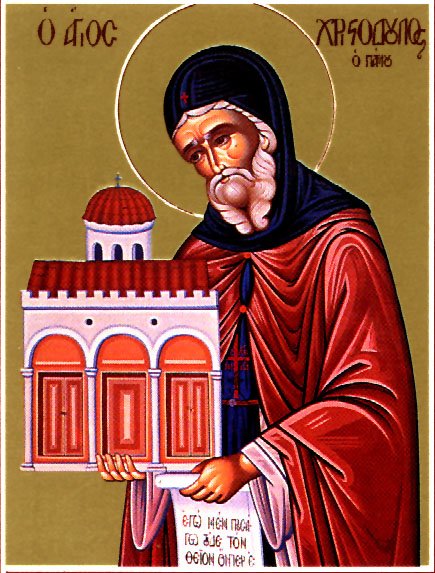
Our Holy Father Christodoulos, Wonderworker of Patmos (1111)
Our Venerable Father Christódoulos 1) was born near Nicaea of Bithynia circa 1020. His parents' names were Theodore and Anna, and their son received the name John in Holy Baptism. He was renowned as an ascetic and a physician throughout the Byzantine Empire.
In 1043 he was tonsured on Mount Olympus, where, under the guidance of the Elders, he received a broad education.
Our Venerable Father Christódoulos 1) was born near Nicaea of Bithynia circa 1020. His parents' names were Theodore and Anna, and their son received the name John in Holy Baptism. He was renowned as an ascetic and a physician throughout the Byzantine Empire.
In 1043 he was tonsured on Mount Olympus, where, under the guidance of the Elders, he received a broad education. After the death of his Spiritual Father, he made a pilgrimage to the holy places in 1045. He visited Rome and Palestine, and he lived in Asia Minor, and on some Greek islands, where he founded several monasteries.
After the Saracen invasion of Palestine, Father Christódoulos left the Holy Land and in 1070 settled on Mount Latmos, in the stavropegial Monastery of the Theotokos in northwestern Karia. Soon he was chosen as the Superior of that monastery. In 1076, Patriarch Cosmas I of Constantinople installed Father Christódoulos as Archimandrite over all the Latmian monasteries. From 1076–1079, he labored to build and fortify monasteries.
In 1079 the Latmian monasteries were destroyed by the Seljuk Turks. The Saint took refuge with his small community in the city of Strovilos on the Aegean coast, where the hermit Arsenios placed him in charge of his monastery. Father Christódoulos soon moved to the nearby island of Kos, the least affected by Muslim incursions. There Arsenios had several estates, and on Mount Pelion, at the latter's suggestion, Christódoulos founded the Kastrian Monastery of the Most Holy Theotokos in 1080.
In 1087, he founded a monastery on the neighboring island of Leros. In addition, during his stay on the island of Kos, Saint Christódoulos organized an expedition to Mount Latmos in order to rescue the books from the monastic community which he had abandoned. These books were sent to the library of the Hagia Sophia in Constantinople for safekeeping.
Seeking greater solitude and austerity, Saint Christódoulos turned his attention to the island of Patmos. He was so struck by the ascetic spirit of these places that he decided to establish a monastery on that island. In 1089, he submitted his first application to Emperor Alexios I Komnenos for a new monastic community on the island of Patmos, in place of the land on the island Kos and on the shores of Karia.
According to a Chrysobull issued in 1088, the Emperor gave the island of Patmos to Father Christódoulos as an eternal, inalienable property, exempting it from all taxes. It forbade government officials to act on the island. In fact, the island was withdrawn from the jurisdiction of the state's administration, and all judicial and administrative power on this island was concentrated in the hands of the Igoumen of the Monastery.
The Venerable one established a monastery on a mountain near the cave, where, according to Tradition, the Holy Apostle John the Theologian received a divine revelation and wrote his prophetic book in the years 68-69. The monastery was built on a rocky ledge, almost in the center of the island, and during the first three years, it had acquired the appearance of a fortress.
However, in the last years of his life, because of the raids of pirates, the Saint was forced to flee Patmos. He and his disciples went to the island of Euboea, where he reposed on March 16,1093. Shortly before his death, he gave his disciples instructions to bury him on the island of Patmos in the Monastery he founded. His disciples took his holy and incorrupt relics and transferred them to his own Monastery, where they remain for the sanctification of those who venerate them with faith.
Saint Christódoulos is also commemorated on October 21 (the transfer of his holy relics).
1 His name means "the servant of Christ."
Troparion - Tone 4
O brethren, let us honor the godly-minded Christódoulos with hymns, / the offspring of Nicaea, the boast of Patmos, and the glory of monks. / Let us venerate his relics, / and so receive healing of soul and body, crying out: / “Glory to Him Who strengthened you. / Glory to Him Who crowned you. / Glory to Him Who, through you, works healings for all.”
Kontakion - Tone 4
Since we possess your relics as a holy place of healing for all our diseases and afflictions, / we are delivered from them, and we cry aloud to you, / “Rejoice, O renowned Christódoulos.”
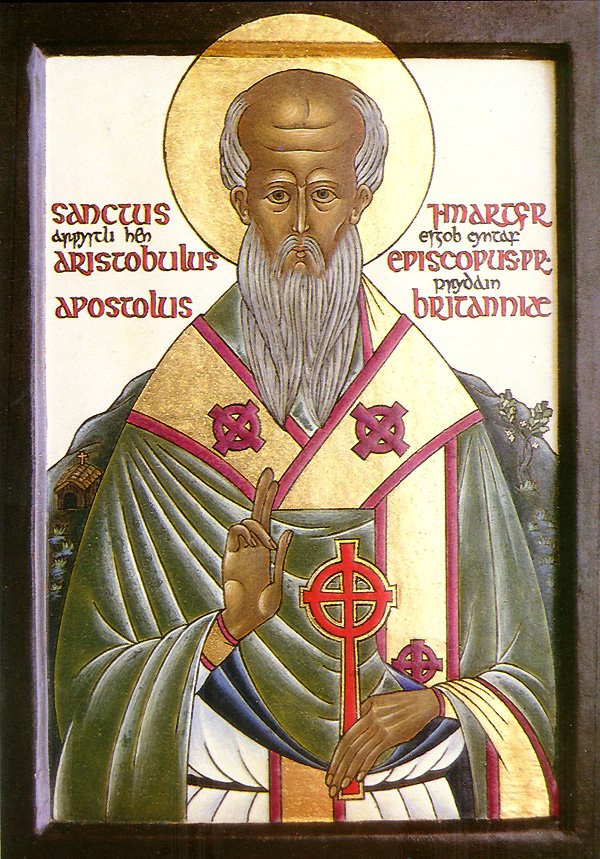
Holy Apostle Aristobulus of the Seventy, first Bishop of Britain (1st c.)
The Holy Apostle Aristóboulos of the Seventy was born on Cyprus. He and his brother, the Apostle Barnabas (June 11), accompanied Saint Paul on his missionary journeys. Saint Aristóboulos is mentioned by the Apostle Paul in his Epistle to the Romans (Romans 16:10).
There are several conflicting narratives about the hierarch's life before he went to Britain. S
The Holy Apostle Aristóboulos of the Seventy was born on Cyprus. He and his brother, the Apostle Barnabas (June 11), accompanied Saint Paul on his missionary journeys. Saint Aristóboulos is mentioned by the Apostle Paul in his Epistle to the Romans (Romans 16:10).
There are several conflicting narratives about the hierarch's life before he went to Britain. Some identify him with Zebedee, the father of the Apostles James and John. Others say that he was the father-in-law of the Apostle Peter. Most of these are unreliable, however.
Saint Paul made Aristóboulos a bishop and sent him to preach the Gospel in Britain, Scotland, and Hibernia (Ireland), where he converted many people to Christ. He also had to endure many torments and afflictions from hostile pagans, who beat him and mocked him. Eventually, he won them over and brought them to Christ as well.
Saint Aristóboulos reposed peacefully in Britain among the people he had evangelized. Some sources say he suffered a martyr's death in Wales at an advanced age.
Saint Aristóboulos is also commemorated on October 31 (with Saints Stachys, Apellēs, Amplias, Urban, and Narcissus), and also on the Synaxis of the Seventy Apostles (January 4). In Greek usage he is commemorated on March 15.
Troparion - Tone 3
Holy Apostle Aristobulus, / entreat the merciful God, / to grant our souls forgiveness of transgressions.
 Meat
Abstain
 Fish
Abstain
 Dairy
Abstain
 Oil
Abstain
 Wine
Abstain