Today

Fasting Rules

Meat not allowed Meat Abstain
Fish allowed Fish Allowed
Dairy allowed Dairy Allowed
Oil allowed Oil Allowed
Wine allowed Wine Allowed

☦ Saints & Commemorations

Forgiveness Sunday
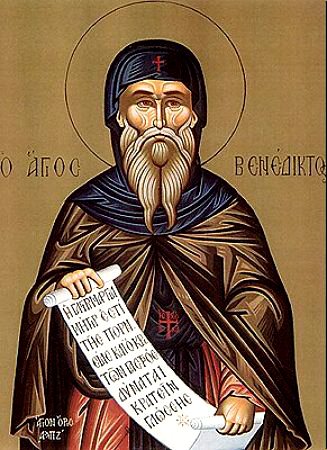
Ven. Benedict of Nursia

Ven. Benedict of Nursia

Saint Benedict, founder of Western monasticism, was born in the Italian city of Nursia in the year 480. When he was fourteen years of age, the saint’s parents sent him to Rome to study. Unsettled by the immorality around him, he decided to devote himself to a different sort of life. At first Saint Benedict settled near the church of the holy Apostle Peter in the village of Effedum, but news of his ascetic life compelled him to go farther into the mountains. T Saint Benedict, founder of Western monasticism, was born in the Italian city of Nursia in the year 480. When he was fourteen years of age, the saint’s parents sent him to Rome to study. Unsettled by the immorality around him, he decided to devote himself to a different sort of life. At first Saint Benedict settled near the church of the holy Apostle Peter in the village of Effedum, but news of his ascetic life compelled him to go farther into the mountains. There he encountered the hermit Romanus, who tonsured him into monasticism and directed him to live in a remote cave at Subiaco. From time to time, the hermit would bring him food. For three years the saint waged a harsh struggle with temptations and conquered them. People soon began to gather to him, thirsting to live under his guidance. The number of disciples grew so much, that the saint divided them into twelve communities. Each community was comprised of twelve monks and was a separate skete. The saint gave each skete an igumen from among his experienced disciples, and only the novice monks remained with Saint Benedict for instruction. The strict monastic Rule Saint Benedict established for the monks was not accepted by everyone, and more than once he was criticized and abused by dissenters. Finally he settled in Campagna and on Mount Cassino he founded the Monte Cassino monastery, which for a long time was a center of theological education for the Western Church. The monastery possessed a remarkable library. Saint Benedict wrote his Rule, based on the experience of life of the Eastern desert-dwellers and the precepts of Saint John Cassian the Roman (February 29). The Rule of Saint Benedict dominated Western monasticism for centuries (by the year 1595 it had appeared in more than 100 editions). The Rule prescribed the renunciation of personal possessions, as well as unconditional obedience, and constant work. It was considered the duty of older monks to teach the younger and to copy ancient manuscripts. This helped to preserve many memorable writings from the first centuries of Christianity. Every new monk was required to live as a novice for a year, to learn the monastic Rule and to become acclimated to monastic life. Every deed required a blessing. The head of this cenobitic monastery is the igumen. He discerns, teaches, and explains. The igumen solicits the advice of the older, experienced brethren, but he makes the final decisions. Keeping the monastic Rule was strictly binding for everyone and was regarded as an important step on the way to perfection. Saint Benedict was granted by the Lord the gift of foresight and wonderworking. He healed many by his prayers. The monk foretold the day of his death in 547. The main source for his Life is the second Dialogue of Saint Gregory. Saint Benedict’s sister, Saint Scholastica (February 10), also became famous for her strict ascetic life and was numbered among the saints.

Troparion - Tone 1

By your ascetical contests, O God-bearer Benedict, / you were true to the name that you bear; / for you blossomed as a son of benediction, / and became a Rule for all who desire to emulate your life. / Thus, with one voice we cry: / “Glory to Him Who strengthened you; / glory to Him Who crowned you; / glory to Him Who, through you, works healings for all.”

Kontakion - Tone 6

You were enriched with God’s grace; / your works agreed with your name, O Benedict, helpful servant of Christ God. / Through prayer and fasting you were revealed to be filled with the gifts of the Spirit of God! / You are a healer of the sick, the banisher of demons and speedy defender of our souls!
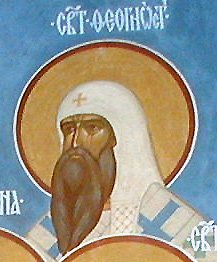
St Theognostus, Metropolitan of Kiev (1353)

St Theognostus, Metropolitan of Kiev (1353)

Saint Theognostus the Greek succeeded Saint Peter (August 25 and December 21) as Metropolitan of Moscow and All Russia, holding this office from 1327 until 1353. It was through his influence that the Grand Prince Simeon sent money to the Byzantine Emperor John Cantacuzene for repairs to the Great Church of Hagia Sophia.

Troparion - Tone 4

In truth you were revealed to your flock as a rule of faith, / an image of humility and a teacher of abstinence; / your humility exalted you; / your poverty enriched you. / Hierarch Father Theognostus, / entreat Christ our God / that our souls may be saved.

Scripture Readings

☩Epistle

Romans 13:11-14:4

11 And that, knowing the time, that now it is high time to awake out of sleep: for now is our salvation nearer than when we believed.
12 The night is far spent, the day is at hand: let us therefore cast off the works of darkness, and let us put on the armour of light.
13 Let us walk honestly, as in the day; not in rioting and drunkenness, not in chambering and wantonness, not in strife and envying.
14 But put ye on the Lord Jesus Christ, and make not provision for the flesh, to fulfil the lusts thereof.
1 Him that is weak in the faith receive ye, but not to doubtful disputations.
2 For one believeth that he may eat all things: another, who is weak, eateth herbs.
3 Let not him that eateth despise him that eateth not; and let not him which eateth not judge him that eateth: for God hath received him.
4 Who art thou that judgest another man’s servant? to his own master he standeth or falleth. Yea, he shall be holden up: for God is able to make him stand.

☩Gospel

Matthew 6:14-21

14 For if ye forgive men their trespasses, your heavenly Father will also forgive you:
15 But if ye forgive not men their trespasses, neither will your Father forgive your trespasses.
16 Moreover when ye fast, be not, as the hypocrites, of a sad countenance: for they disfigure their faces, that they may appear unto men to fast. Verily I say unto you, They have their reward.
17 But thou, when thou fastest, anoint thine head, and wash thy face;
18 That thou appear not unto men to fast, but unto thy Father which is in secret: and thy Father, which seeth in secret, shall reward thee openly.
19 Lay not up for yourselves treasures upon earth, where moth and rust doth corrupt, and where thieves break through and steal:
20 But lay up for yourselves treasures in heaven, where neither moth nor rust doth corrupt, and where thieves do not break through nor steal:
21 For where your treasure is, there will your heart be also.

Liturgical data sourced from OCA.org and orthocal.info