Fasting Rules
 Meat
Abstain
 Fish
Allowed
 Dairy
Allowed
 Oil
Allowed
 Wine
Allowed
Saints & Commemorations
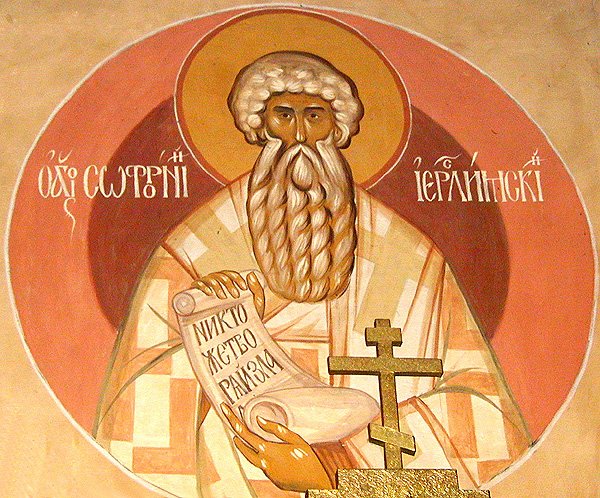
St. Sophronius, Patriarch of Jerusalem
Saint Sophronius, Patriarch of Jerusalem, was born in Damascus around 560. From his youth he was distinguished for his piety and his love for classical studies. He was especially proficient in philosophy, and so he was known as Sophronius the Wise. The future hierarch, however, sought the true philosophy of monasticism, and conversations with the desert-dwellers.
Saint Sophronius, Patriarch of Jerusalem, was born in Damascus around 560. From his youth he was distinguished for his piety and his love for classical studies. He was especially proficient in philosophy, and so he was known as Sophronius the Wise. The future hierarch, however, sought the true philosophy of monasticism, and conversations with the desert-dwellers.
He arrived in Jerusalem at the monastery of Saint Theodosius, and there he became close with the hieromonk John Moschus, becoming his spiritual son and submitting himself to him in obedience. They visited several monasteries, writing down the lives and spiritual wisdom of the ascetics they met. From these notes emerged their renowned book, the LEIMONARION or SPIRITUAL MEADOW, which was highly esteemed at the Seventh Ecumenical Council.
To save themselves from the devastating incursions of the Persians, Saints John and Sophronius left Palestine and went to Antioch, and from there they went to Egypt. In Egypt, Saint Sophronius became seriously ill. During this time he decided to become a monk and was tonsured by Saint John Moschus.
After Saint Sophronius recovered his health, they both decided to remain in Alexandria. There they were received by the holy Patriarch John the Merciful (November 12), to whom they rendered great aid in the struggle against the Monophysite heresy. At Alexandria Saint Sophronius had an affliction of the eyes, and he turned with prayer and faith to the holy Unmercenaries Cyrus and John (January 31), and he received healing in a church named for them. In gratitude, Saint Sophronius then wrote the Lives of these holy Unmercenaries.
When the barbarians began to threaten Alexandria, Patriarch John, accompanied by Saints Sophronius and John Moschus, set out for Constantinople, but he died along the way. Saints John Moschus and Sophronius then set out for Rome with eighteen other monks. Saint John Moschus died at Rome. His body was taken to Jerusalem by Saint Sophronius and buried at the monastery of Saint Theodosius.
In the year 628, Patriarch Zacharias of Jerusalem (609-633) returned from his captivity in Persia. After his death, the patriarchal throne was occupied for two years by Saint Modestus (December 18). After the death of Saint Modestus, Saint Sophronius was chosen Patriarch. Saint Sophronius toiled much for the welfare of the Jerusalem Church as its primate (634-644).
Toward the end of his life, Saint Sophronius and his flock lived through a two year siege of Jerusalem by the Moslems. Worn down by hunger, the Christians finally agreed to open the city gates, on the condition that the enemy spare the holy places. But this condition was not fulfilled, and Saint Sophronius died in grief over the desecration of the Christian holy places.
Written works by Patriarch Sophronius have come down to us in the area of dogmatics, and likewise his “Excursus on the Liturgy,” the Life of Saint Mary of Egypt (April 1), and also about 950 troparia and stikheras from Pascha to the Ascension.
While still a hieromonk, Saint Sophronius reviewed and made corrections to the Rule of the monastery of Saint Savva the Sanctified (December 5). The saint’s three Canons for the Holy Forty Day Great Fast are included in the contemporary Lenten Triodion.
Troparion - Tone 5
Patriarch Sophronius, you were glorious in the splendor of sobriety, / and through the radiance of your words you revealed ineffable enlightenment from heaven. / For by your life you attained wisdom / and now you confirm the Church / as an illustrious hierarch and intercessor for us with the Lord.
Kontakion - Tone 8
You were most wise among patriarchs, Sophronius of Jerusalem. / You struggled with divine zeal, spreading the commandments of truth with your lips. / You set right the foundations of the Church and firmly established the monastic order. / You brought to light wise sermons, and instructed by them, / therefore we cry out to you: “Rejoice, splendid boast of the Orthodox.”
St Euthymius, Bishop of Novgorod
Saint Euthymius, in Baptism John, was born in answer to the fervent prayers of the presbyter Micah and his wife Anna. For many years they had been childless, and they vowed that if they had a son, they would dedicate him to God. The boy read priestly books and frequently attended church services, often helping his father in the small church of Saint Theodore.
Saint Euthymius, in Baptism John, was born in answer to the fervent prayers of the presbyter Micah and his wife Anna. For many years they had been childless, and they vowed that if they had a son, they would dedicate him to God. The boy read priestly books and frequently attended church services, often helping his father in the small church of Saint Theodore. All this sanctified young John’s soul. In the year 1411, he left his parental home for a monastery at the age of fifteen.
Twelve versts from Novgorod, in a wilderness spot named Vyazhisch, three monks, Euphrosynus, Ignatius and Galacteon, settled in the forests and the swamps. They were soon joined by the priest Pimen, who was tonsured with the name Pachomius. Here they lived in complete solitude at a wooden chapel they built in honor of Saint Nicholas. They lived in unceasing prayer and struggled with the severe conditions of nature in the northern regions.
The young John also came to these ascetics seeking salvation. The igumen Pachomius accepted him fondly and tonsured him into monasticism with the name Euthymius. His tonsure at such a young age is an indication of the young ascetic’s outstanding spiritual traits.
During this time the See of Novgorod was occupied by Archbishop Simeon, a simple monk who became a hierarch. The virtuous life of Saint Euthymius became known to the archbishop. Saint Euthymius was summoned to Novgorod and after a long talk with Archbishop Simeon, he was appointed as the archbishop’s steward.
At that time the Archbishops of Novgorod occupied a unique position. Independent of princely authority, they were elected directly by the assembly and they assumed a large role in secular matters. Moreover, they administered vast land-holdings. Under these conditions, an archbishop’s steward had to combine administrative talent with the utmost non-covetousness and deep Christian humility. Saint Euthymius fervently entreated the archpastor to send him back to Vyazhisch, but then he agreed to stay.
Saint Euthymius evoked general astonishment and esteem, occupying such an important position, and being at the center of business life in a large city. As a monk he devoted himself to asceticism as fervently as he would have done in the deep forest.
Archbishop Simeon died in 1421. Under the new hierarch, Euthymius I, Saint Euthymius again withdrew to his monastery. Soon, however, the monks of a monastery on Lisich Hill chose the saint as their igumen. With the death of Archbishop Euthymius I in 1429, Saint Euthymius was then chosen as archbishop. On November 29, he entered into the temple of Saint Sophia. For four years the saint administered the Novgorod diocese, while putting off being installed as archbishop. Only on May 24, 1434 was he consecrated at Smolensk by Metropolitan Gerasimus.
Saint Euthymius wisely governed his diocese for twenty-nine years, zealous in fulfilling his archpastoral duty. Saint Euthymius labored in constructing and restoring churches, especially after the devastating fires of the years 1431 and 1442.
The Sophia cathedral was richly embellished by the saint, and several new churches were built in the Novgorod Kremlin. “If you wish to see a few of his great works,” writes Pachomius the Logothete, “go to the temple of Saint Sophia. There you will see the churches he built, standing like hillocks. They speak of their varied charm, not with words, but in deed. ‘This was given me by Archbishop Euthymius,’ proclaims one church. Another says, ‘He has adorned me so magnificently.’ A third exclaims, ‘He built me up from the very foundations.’
The church of Saint John Chrysostom, tall and beautiful, blesses with the hand of Chrysostom, and proclaims: “Since you have built me a temple, I in turn shall entreat the Creator to prepare a habitation in Heaven for you.”
The cathedral of the Wisdom of God, speaking across the years of its restoration by him, proclaims: “He has restored me to my original grandeur, he has adorned me with holy icons. He is my praise and beauty.”
Saint Euthymius built also a church in honor of his Guardian Angel [i.e. Russian idiom for “patron saint”], and in 1438 he built a stone church at Vyazhitsk monastery in honor of Saint Nicholas. The following year he built a stone church in honor of Saint John the Theologian with a trapeza and consistory.
Zealous for the glory of God, Saint Euthymius had more spiritual books printed. Many service books survive from this period, transcribed “under the authority of Archbishop Euthymius.” Despite his abundant works, the saint always promptly fulfilled the monastic Rule. Whatever he could not do by day he accomplished by night. An hour before Matins the saint rose up for his cell rule. He often spent the whole night without sleep, and he wore chains, but no one knew about them until his death. The saint spent the first week of Great Lent at Vyazhitsk monastery in silent prayer, eating nothing.
In 1446 the great-princely throne was usurped by Shemyaka, who established relations with Novgorod. The political situation in Novgorod was often quite strained. In 1451, Saint Jonah (March 31) in a special letter urged the people of Novgorod to cease their rowdiness and to heed their archpastor. “Heed our son and brother, your father and teacher, the God-beloved Archbishop Euthymius, in all things.”
Saint Euthymius, advanced in age, was troubled in soul that the actions of Shemyaka might cast a pall over his relations with the revered primate, and he sent a letter to Saint Jonah. Sensing the nearness of his death, Saint Euthymius asked his prayers and pardon.
In his reply, a letter of pardon, Saint Jonah wrote: “We remind you, my son, that you comported yourself too simply: you accepted one who was excommunicated for his transgressions by Our Humility, and found him worthy of your blessing. My son, offer repentance to God for this.”
Saint Jonah ordered that if the letter of pardon should arrive after the blessed end of Novgorod’s archpastor, then it should be read over his grave. Saint Euthymius reposed on March 10, 1458. The priest Eumenius, sent by Saint Jonah with the grammota of pardon, arrived in Novgorod sixteen days after the death of Saint Euthymius, whose grave was at the church of the Vyazhitsk monastery.
When they opened the grave in order to read the letter of pardon, they then saw that the body of the saint showed no sign of decay. Saint Euthymius lay there as though asleep, and his fingers were positioned for a blessing. “God preserve Novgorod, for which Saint Euthymius prays,” exclaimed Eumenius. Reading the letter of Saint Jonah, he placed it into the hand of the deceased hierarch.
Soon after the death of the saint, the Lord glorified him by working miracles for those who sought his prayerful intercession. Greatly revering the saint, the monks of the Vyazhitsk monastery built a church in honor of Saint Euthymius, which was noted in the census of 1500.
The commemoration of Saint Euthymius was established at the Moscow Council of 1549. The Life of Saint Euthymius was written by Pachomius the Logothete, having been commissioned by Saint Jonah, Archbishop of Novgorod (November 5)
Troparion - Tone 4
From from your youth you were chosen by God, O Hierarch Euthymios, / therefore you were honored with the episcopal rank, / and you directed the spiritual life of the people entrusted to you by God. / Therefore, even after your repose, you received from the Lord the gift of wondrously healing various infirmities. / Pray to God for us who celebrate your honorable memory and always glorify you.
Kontakion - Tone 8
Ruling together with the bishops and being an excellent champion with the hierarchs, Saint Euthymios. / Do not cease to protect your country, your city, and the people who revere you with faith and bow down before your relics, / that we may cry out to you: “Rejoice, O divinely-wise Hierarch.”
St Sophronios, patriarch of Jerusalem (638)
He was born in Damascus to an eminent family, and was well educated in his youth. Discontented with the wisdom of the world, he entered monastic life in the monastery of St Theodosius, where he became the lifelong friend and disciple of John Moschos. Together they visited the monasteries and hermitages of Egypt; they later wrote down their discoveries among the holy monks in the classic Spiritual Meadow.
He was born in Damascus to an eminent family, and was well educated in his youth. Discontented with the wisdom of the world, he entered monastic life in the monastery of St Theodosius, where he became the lifelong friend and disciple of John Moschos. Together they visited the monasteries and hermitages of Egypt; they later wrote down their discoveries among the holy monks in the classic Spiritual Meadow. After the death of his teacher, St Sophronius traveled to Jerusalem, which had just been liberated from the Persians. He was there to see the Precious Cross returned from Persia by the Emperor Heraclius, who carried it into Jerusalem on his back. A few years later, in 634, St Sophronius was elected Patriarch of Jerusalem, where he served his flock wisely for three years and three months. He was zealous in the defense of Orthodoxy against the Monothelite heresy: He convoked a Council in Jerusalem which condemned it before it was condemned at the Sixth Ecumenical Council. The holy Patriarch even traveled to Constantinople to rebuke the Patriarch Sergius and Emperor Heraclius, who had embraced the Monothelite error.
The years of peace were few for the Holy Land; for just as the Persian Empire was decisively defeated by Heraclius, the followers of Islam erupted out of Arabia, conquering most of North Africa and the Middle East in a few years. The Saint was so grieved by the capture of Jerusalem in 637 by the Caliph Omar that begged God to take him, so that he might not live to see the desecration of the holy places. His prayer was granted, and he reposed in peace less than a year later.
St Sophronios is the author of the Life of Saint Mary of Egypt, appointed to be read in the churches during every Great Lent. He also wrote the service of the Great Blessing of the Waters. Some have attributed the Vesperal hymn “Gladsome Light” to him, but we know that it dates from before the time of St Basil the Great, who mentions it in his writings. It seems though, that St Sophronios supplemented the hymn, and that its present form is due to him.
St John Moschos, author of the Spiritual Meadow (622)
He is commemorated today along with his disciple and friend St Sophronius (see above).
Holy Martyr Pionius (250)
The Hieromartyrs Pionius and Limnus, and the martyrs Sabina, Macedonia, and Asclepiades suffered during the persecution of Christians in the reign of Decius (249-251). They suffered at Smyrna, a mercantile city on the eastern shores of the Aegean Sea. The Church in Smyrna was founded by the holy Apostle John the Theologian (May 8 and September 26), and was made glorious by its martyrs and confessors.
The Hieromartyrs Pionius and Limnus, and the martyrs Sabina, Macedonia, and Asclepiades suffered during the persecution of Christians in the reign of Decius (249-251). They suffered at Smyrna, a mercantile city on the eastern shores of the Aegean Sea. The Church in Smyrna was founded by the holy Apostle John the Theologian (May 8 and September 26), and was made glorious by its martyrs and confessors.
Saint Pionius knew that he and his companions would be arrested on February 23, the anniversary of Saint Polycarp’s martyrdom, and a feastday for the Christians of Smyrna. The day before they were arrested, Saint Pionius entertained Asclepiades and Sabina in his house. Taking three lengths of woven chains, Saint Pionius placed them around his neck, and around the necks of the other two. He did this to show that they were all determined to be led off to prison rather than eat food sacrificed to idols.
The holy confessors were indeed arrested on February 23. After a brief interrogation they were dragged off by Polemon the verger in order to sacrifice to the idols and eat forbidden foods. They were brought to the forum, where a great crowd had gathered.
Saint Pionius addressed the people, chiding them for laughing and rejoicing at those Christians who had agreed to offer sacrifice. He quoted Homer to the pagans (Odyssey 22, 412) and said that it was shameful to gloat over those who were about to die. He reminded the Jews in the audience of the words of Solomon: “If your enemy falls, do not rejoice over him, and do not be glad when he stumbles” (Proverbs 24:17).
Polemon attempted once again to persuade Pionius to obey the law and offer sacrifice to the idols.
“If only I could persuade you to become Christians,” he replied.
The men laughed at him, saying that he did not have the power to do that, because they knew they would be burned alive if they converted.
Saint Pionius said, “It is far worse to burn after death.”
Saint Sabina laughed when she heard this. Then Polemon threatened to put her in a brothel, but she said she believed that God would protect her.
Under questioning, Saint Pionius stated repeatedly that he was a Christian, and could not sacrifice to the emperor or to the idols.
Before Polemon came to Sabina to question her, Saint Pionus told her to say that her name was Theodote. This he did so that she would not be returned to her former mistress Politta, an immoral woman. In an effort to turn her from Christ, Politta had bound Saint Sabina and cast her out on the mountains. She was secretly helped by the brethren, and hid in Saint Pionus’s house most of the time. That is how she came to be arrested.
Saints Sabina and Asclepiades were questioned, and they said they were Christians who worshiped Jesus Christ. Then they were thrown into jail.
In prison Saint Pionius and his companions met Limnus, a priest of the Church of Smyrna, and his wife Macedonia from the village of Karine. They had also been imprisoned for confessing Christ.
Many believers visited the holy confessors in prison, offering them whatever they could, but the saints did not accept it. The jailers were angry, because they used to keep a portion of the gifts given to prisoners for themselves.
The holy martyrs were brought to the marketplace, and were urged to offer sacrifice. When they refused, they were taken back to prison. On the way, they were beaten and mocked by the crowd. Someone said to Saint Sabina, “Why couldn’t you have died in your own city?”
Saint Sabina retorted, “What is my native city?”
Terentius, who was in charge of the gladiatorial games, said to Asclepiades, “After you are condemned, I shall ask that you compete in the games given by my son.”
“That does not scare me,” he said.
After many torments, the holy martyr was brought to the amphitheatre on March 11, 250. Since he still refused to offer sacrifice to the idols, Saint Pionius was sentenced to be burned alive. He was nailed to a cross, then they stacked wood around him and lit the fire. When the fire subsided, everyone saw the body of the saint was unharmed. Not even the hairs of his head had been singed. His face was radiant, and shone with divine grace. After his victory in the contest, Saint Pionius received an incorruptible crown of glory from the Savior Christ.
Saint Pionius transcribed the Martyrdom of Saint Polycarp of Smyrna (February 23) from an older copy made by Isocrates (or Socrates) in Corinth. This document in turn was transcribed from an earlier manuscript written by Gaius, and was based on the recollections of Saint Irenaeus of Lyons (August 23), who knew Saint Polycarp. Saint Polycarp appeared to Pionius in a vision, telling him to search for the text of Isocrates. Saint Pionius collected the material which was nearly worn out with age, thus preserving the account for later generations. Now Saint Pionius rejoices in the heavenly Kingdom, glorifying the Life-Creating Trinity, the Father, the Son, and the Holy Spirit, throughout all ages.
Troparion - Tone 4
Your holy martyrs O Lord, / through their sufferings have received incorruptible crowns from You, our God. / For having Your strength, they laid low their adversaries, / and shattered the powerless boldness of demons. / Through their intercessions, save our souls!
Scripture Readings
☩Epistle
Jude 11-25
11
Woe unto them! for they have gone in the way of Cain, and ran greedily after the error of Balaam for reward, and perished in the gainsaying of Core.
12
These are spots in your feasts of charity, when they feast with you, feeding themselves without fear: clouds they are without water, carried about of winds; trees whose fruit withereth, without fruit, twice dead, plucked up by the roots;
13
Raging waves of the sea, foaming out their own shame; wandering stars, to whom is reserved the blackness of darkness for ever.
14
And Enoch also, the seventh from Adam, prophesied of these, saying, Behold, the Lord cometh with ten thousands of his saints,
15
To execute judgment upon all, and to convince all that are ungodly among them of all their ungodly deeds which they have ungodly committed, and of all their hard speeches which ungodly sinners have spoken against him.
16
These are murmurers, complainers, walking after their own lusts; and their mouth speaketh great swelling words, having men’s persons in admiration because of advantage.
17
But, beloved, remember ye the words which were spoken before of the apostles of our Lord Jesus Christ;
18
How that they told you there should be mockers in the last time, who should walk after their own ungodly lusts.
19
These be they who separate themselves, sensual, having not the Spirit.
20
But ye, beloved, building up yourselves on your most holy faith, praying in the Holy Ghost,
21
Keep yourselves in the love of God, looking for the mercy of our Lord Jesus Christ unto eternal life.
22
And of some have compassion, making a difference:
23
And others save with fear, pulling them out of the fire; hating even the garment spotted by the flesh.
24
Now unto him that is able to keep you from falling, and to present you faultless before the presence of his glory with exceeding joy,
25
To the only wise God our Saviour, be glory and majesty, dominion and power, both now and ever. Amen.
☩Gospel
Luke 23:2-34, 44-56
2
And they began to accuse him, saying, We found this fellow perverting the nation, and forbidding to give tribute to Cesar, saying that he himself is Christ a King.
3
And Pilate asked him, saying, Art thou the King of the Jews? And he answered him and said, Thou sayest it.
4
Then said Pilate to the chief priests and to the people, I find no fault in this man.
5
And they were the more fierce, saying, He stirreth up the people, teaching throughout all Jewry, beginning from Galilee to this place.
6
When Pilate heard of Galilee, he asked whether the man were a Galilean.
7
And as soon as he knew that he belonged unto Herod’s jurisdiction, he sent him to Herod, who himself also was at Jerusalem at that time.
8
And when Herod saw Jesus, he was exceeding glad: for he was desirous to see him of a long season, because he had heard many things of him; and he hoped to have seen some miracle done by him.
9
Then he questioned with him in many words; but he answered him nothing.
10
And the chief priests and scribes stood and vehemently accused him.
11
And Herod with his men of war set him at nought, and mocked him, and arrayed him in a gorgeous robe, and sent him again to Pilate.
12
And the same day Pilate and Herod were made friends together: for before they were at enmity between themselves.
13
And Pilate, when he had called together the chief priests and the rulers and the people,
14
Said unto them, Ye have brought this man unto me, as one that perverteth the people: and, behold, I, having examined him before you, have found no fault in this man touching those things whereof ye accuse him:
15
No, nor yet Herod: for I sent you to him; and, lo, nothing worthy of death is done unto him.
16
I will therefore chastise him, and release him.
17
(For of necessity he must release one unto them at the feast.)
18
And they cried out all at once, saying, Away with this man, and release unto us Barabbas:
19
(Who for a certain sedition made in the city, and for murder, was cast into prison.)
20
Pilate therefore, willing to release Jesus, spake again to them.
21
But they cried, saying, Crucify him, crucify him.
22
And he said unto them the third time, Why, what evil hath he done? I have found no cause of death in him: I will therefore chastise him, and let him go.
23
And they were instant with loud voices, requiring that he might be crucified. And the voices of them and of the chief priests prevailed.
24
And Pilate gave sentence that it should be as they required.
25
And he released unto them him that for sedition and murder was cast into prison, whom they had desired; but he delivered Jesus to their will.
26
And as they led him away, they laid hold upon one Simon, a Cyrenian, coming out of the country, and on him they laid the cross, that he might bear it after Jesus.
27
And there followed him a great company of people, and of women, which also bewailed and lamented him.
28
But Jesus turning unto them said, Daughters of Jerusalem, weep not for me, but weep for yourselves, and for your children.
29
For, behold, the days are coming, in the which they shall say, Blessed are the barren, and the wombs that never bare, and the paps which never gave suck.
30
Then shall they begin to say to the mountains, Fall on us; and to the hills, Cover us.
31
For if they do these things in a green tree, what shall be done in the dry?
32
And there were also two other, malefactors, led with him to be put to death.
33
And when they were come to the place, which is called Calvary, there they crucified him, and the malefactors, one on the right hand, and the other on the left.
34
Then said Jesus, Father, forgive them; for they know not what they do. And they parted his raiment, and cast lots.
44
And it was about the sixth hour, and there was a darkness over all the earth until the ninth hour.
45
And the sun was darkened, and the veil of the temple was rent in the midst.
46
And when Jesus had cried with a loud voice, he said, Father, into thy hands I commend my spirit: and having said thus, he gave up the ghost.
47
Now when the centurion saw what was done, he glorified God, saying, Certainly this was a righteous man.
48
And all the people that came together to that sight, beholding the things which were done, smote their breasts, and returned.
49
And all his acquaintance, and the women that followed him from Galilee, stood afar off, beholding these things.
50
And, behold, there was a man named Joseph, a counsellor; and he was a good man, and a just:
51
(The same had not consented to the counsel and deed of them;) he was of Arimathea, a city of the Jews: who also himself waited for the kingdom of God.
52
This man went unto Pilate, and begged the body of Jesus.
53
And he took it down, and wrapped it in linen, and laid it in a sepulchre that was hewn in stone, wherein never man before was laid.
54
And that day was the preparation, and the sabbath drew on.
55
And the women also, which came with him from Galilee, followed after, and beheld the sepulchre, and how his body was laid.
56
And they returned, and prepared spices and ointments; and rested the sabbath day according to the commandment.
Liturgical data sourced from OCA.org and orthocal.info