Fasting Rules
 Meat
Abstain
 Fish
Allowed
 Dairy
Allowed
 Oil
Allowed
 Wine
Allowed
Saints & Commemorations
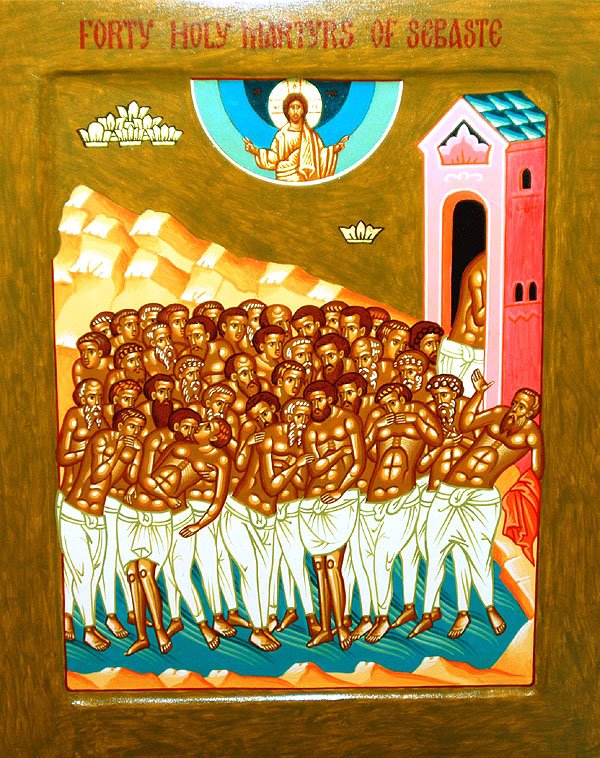
Holy Forty Martyrs of Sebaste
In the year 313 Saint Constantine the Great issued an edict granting Christians religious freedom, and officially recognizing Christianity as equal with paganism under the law. But his co-ruler Licinius was a pagan, and he decided to stamp out Christianity in his part of the Empire. As Licinius prepared his army to fight Constantine, he decided to remove Christians from his army, fearing mutiny.
In the year 313 Saint Constantine the Great issued an edict granting Christians religious freedom, and officially recognizing Christianity as equal with paganism under the law. But his co-ruler Licinius was a pagan, and he decided to stamp out Christianity in his part of the Empire. As Licinius prepared his army to fight Constantine, he decided to remove Christians from his army, fearing mutiny.
One of the military commanders of that time in the Armenian city of Sebaste was Agricola, a zealous champion of idolatry. Under his command was a company of forty Cappadocians, brave soldiers who had distinguished themselves in many battles. When these Christian soldiers refused to offer sacrifice to the pagan gods, Agricola locked them up in prison. The soldiers occupied themselves with prayer and psalmody, and during the night they heard a voice saying, “Persevere until the end, then you shall be saved.”
On the following morning, the soldiers were again taken to Agricola. This time the pagan tried flattery. He began to praise their valor, their youth and strength, and once more he urged them to renounce Christ and thereby win themselves the respect and favor of their emperor.
Seven days later, the renowned judge Licius arrived at Sebaste and put the soldiers on trial. The saints steadfastly answered, “Take not only our military insignia, but also our lives, since nothing is more precious to us than Christ God.” Licius then ordered his servants to stone the holy martyrs. But the stones missed the saints and returned to strike those who had thrown them. One stone thrown by Licius hit Agricola in the face, smashing his teeth. The torturers realized that the saints were guarded by some invisible power. In prison, the soldiers spent the night in prayer and again they heard the voice of the Lord comforting them: “He who believes in me, though he die, yet shall he live (John 11:25). Be brave and fear not, for you shall obtain imperishable crowns.”
On the following day the judge repeated the interrogation in front of the torturer, but the soldiers remained unyielding.
It was winter, and there was a severe frost. They lined up the holy soldiers, threw them into a lake near the city, and set a guard to prevent them from coming out of the water. In order to break the will of the martyrs, a warm bath-house was set up on the shore. During the first hour of the night, when the cold had become unbearable, one of the soldiers made a dash for the bath-house, but no sooner had he stepped over the threshold, then he fell down dead.
During the third hour of the night, the Lord sent consolation to the martyrs. Suddenly there was light, the ice melted away, and the water in the lake became warm. All the guards were asleep, except for Aglaius, who was keeping watch. Looking at the lake he saw that a radiant crown had appeared over the head of each martyr. Aglaius counted thirty-nine crowns and realized that the soldier who fled had lost his crown.
Aglaius then woke up the other guards, took off his uniform and said to them, “I too am a Christian,” and he joined the martyrs. Standing in the water he prayed, “Lord God, I believe in You, in Whom these soldiers believe. Add me to their number, and make me worthy to suffer with Your servants.” Then a fortieth crown appeared over his head.
In the morning, the torturers saw with surprise that the martyrs were still alive, and their guard Aglaius was glorifying Christ together with them. They led the soldiers out of the water and broke their legs. During this horrible execution the mother of the youngest of the soldiers, Meliton, pleaded with her son to persevere until death.
They put the bodies of the martyrs on a cart and committed them to fire. Young Meliton was still breathing, and they left him on the ground. His mother then picked up her son, and on her own shoulders she carried him behind the cart. When Meliton drew his last breath, his mother put him on the cart with the bodies of his fellow sufferers. The bodies of the saints were tossed in the fire, and their charred bones were thrown into the water, so that Christians would not gather them up.
Three days later the martyrs appeared in a dream to Saint Peter, Bishop of Sebaste, and commanded him to bury their remains. The bishop together with several clergy gathered up the relics of the glorious martyrs by night and buried them with honor.
There is a pious custom of baking “skylarks” (pastries shaped like skylarks) on this day, because people believed that birds sing at this time to announce the arrival of spring. Forty “skylarks” are prepared in honor of the Forty Martyrs.
The names of the forty martyrs are: Cyrion (or Quirio), Candidus, Domnus, Hesychius, Heraclius, Smaragdus, Eunocius (Or Eunicus), Valens, Vivianus, Claudius, Priscus, Theodulus, Eutychius, John, Xanthius, Helianus, Sisinius, Aglaius, Aetius, Flavius, Acacius, Ecdicius, Lysimachus, Alexander, Elias, Gorgonius, Theophilus, Dometian, Gaius, Leontius, Athanasius, Cyril, Sacerdon, Nicholas, Valerius, Philoctimon, Severian, Chudion, Aglaius, and Meliton.
Troparion - Tone 1
Let us honor those noble soldiers of the Master of all, / for they were united by their faith as they passed through fire and water; / and being enlisted by Christ, they entered into divine refreshment. / Now those pious warriors stand and intercede with Christ God for those who cry out: / “Glory to Him Who strengthened you. / Glory to Him Who crowned you. / Glory to Him Who made you wondrous, O Forty Martyrs.”
Kontakion - Tone 6
For the sake of the sufferings of Your Saints, / which they endured for You, O Lord, / we entreat You to heal all our infirmities, / O Lover of mankind.
St Caesarius (369)
Saint Caesarius was the son of Saint Gregory (January 1) and Saint Nonna (August 5), and the brother of Saint Gregory the Theologian (January 25). After studying oratory, philosophy, medicine and other subjects in Alexandria, he went to Constantinople, where he became one of the city's leading doctors.
Saint Caesarius was the son of Saint Gregory (January 1) and Saint Nonna (August 5), and the brother of Saint Gregory the Theologian (January 25). After studying oratory, philosophy, medicine and other subjects in Alexandria, he went to Constantinople, where he became one of the city's leading doctors. Such was his reputation that Emperor Constantius wanted to make him his personal physician. Saint Caesarius thanked him, but declined.
When his brother Saint Gregory completed his studies in Athens, he visited Constantinople (between 358 and 360), and there he met Caesarius. So the two brothers returned to Nazianzus together.
In 361, when Julian the Apostate became Emperor, Saint Caesarius was summoned to Constantinople to become his physician. Although the evil Emperor was a fierce persecutor of the Church and issued many edicts against Cheistians, he exempted Saint Caesarius from any punishment. Julian repeatedly tried to turn Saint Caesarius away from Christ, but he was unable to do so. Finally, at the urging of his father and his brother, Caesarius resigned his position and went back home to Nazianzus.
When Julian died in the year 363, Saint Caesarius returned to Constantinople once more. Under the Emperors Valentinian (364 – 374) and his brother Valens (364 – 378), he was appointed as treasurer of public funds at Nicaea in Bithynia.
On October 11, 368, Saint Caesarius was miraculously unharmed by an earthquake which struck Bithynia. He was baptized 1 and then gave away all his belongings to the poor and began to live a quiet, prayerful life. His righteous repose occurred later that same year (or early in 369). Saint Gregory the Theologian delivered a funeral oration for Saint Caesarius. In his writings he also mentions his brother's wisdom, and how respected he was in his lifetime.
1 At that time it was not uncommon for people to postpone Baptism until reaching maturity.
Troparion - Tone 4
You were meek, blameless, without malice, / and righteous, most wondrous Caesarius, / gracious and calm in spirit, / imposing upon yourself the most secret patience, / and you were a martyr without bloodshed. / Therefore, we entreat you: / “By your prayers, beseech Christ God to grant us healing and great mercy.”
Kontakion - Tone 6
Adorned with the true Faith, / you shone forth with almsgiving and a virtuous life, / with chastity and righteousness. / Therefore, we cry out: / “O most blessed Caesarius, / standing before Christ with your relatives, / pray for all of us.”
Scripture Readings
☩Epistle
Jude 1-10
1
Jude, the servant of Jesus Christ, and brother of James, to them that are sanctified by God the Father, and preserved in Jesus Christ, and called:
2
Mercy unto you, and peace, and love, be multiplied.
3
Beloved, when I gave all diligence to write unto you of the common salvation, it was needful for me to write unto you, and exhort you that ye should earnestly contend for the faith which was once delivered unto the saints.
4
For there are certain men crept in unawares, who were before of old ordained to this condemnation, ungodly men, turning the grace of our God into lasciviousness, and denying the only Lord God, and our Lord Jesus Christ.
5
I will therefore put you in remembrance, though ye once knew this, how that the Lord, having saved the people out of the land of Egypt, afterward destroyed them that believed not.
6
And the angels which kept not their first estate, but left their own habitation, he hath reserved in everlasting chains under darkness unto the judgment of the great day.
7
Even as Sodom and Gomorrha, and the cities about them in like manner, giving themselves over to fornication, and going after strange flesh, are set forth for an example, suffering the vengeance of eternal fire.
8
Likewise also these filthy dreamers defile the flesh, despise dominion, and speak evil of dignities.
9
Yet Michael the archangel, when contending with the devil he disputed about the body of Moses, durst not bring against him a railing accusation, but said, The Lord rebuke thee.
10
But these speak evil of those things which they know not: but what they know naturally, as brute beasts, in those things they corrupt themselves.
☩Gospel
Luke 22:39-42, 45-23:1
39
And he came out, and went, as he was wont, to the mount of Olives; and his disciples also followed him.
40
And when he was at the place, he said unto them, Pray that ye enter not into temptation.
41
And he was withdrawn from them about a stone’s cast, and kneeled down, and prayed,
42
Saying, Father, if thou be willing, remove this cup from me: nevertheless not my will, but thine, be done.
45
And when he rose up from prayer, and was come to his disciples, he found them sleeping for sorrow,
46
And said unto them, Why sleep ye? rise and pray, lest ye enter into temptation.
47
And while he yet spake, behold a multitude, and he that was called Judas, one of the twelve, went before them, and drew near unto Jesus to kiss him.
48
But Jesus said unto him, Judas, betrayest thou the Son of man with a kiss?
49
When they which were about him saw what would follow, they said unto him, Lord, shall we smite with the sword?
50
And one of them smote the servant of the high priest, and cut off his right ear.
51
And Jesus answered and said, Suffer ye thus far. And he touched his ear, and healed him.
52
Then Jesus said unto the chief priests, and captains of the temple, and the elders, which were come to him, Be ye come out, as against a thief, with swords and staves?
53
When I was daily with you in the temple, ye stretched forth no hands against me: but this is your hour, and the power of darkness.
54
Then took they him, and led him, and brought him into the high priest’s house. And Peter followed afar off.
55
And when they had kindled a fire in the midst of the hall, and were set down together, Peter sat down among them.
56
But a certain maid beheld him as he sat by the fire, and earnestly looked upon him, and said, This man was also with him.
57
And he denied him, saying, Woman, I know him not.
58
And after a little while another saw him, and said, Thou art also of them. And Peter said, Man, I am not.
59
And about the space of one hour after another confidently affirmed, saying, Of a truth this fellow also was with him: for he is a Galilean.
60
And Peter said, Man, I know not what thou sayest. And immediately, while he yet spake, the cock crew.
61
And the Lord turned, and looked upon Peter. And Peter remembered the word of the Lord, how he had said unto him, Before the cock crow, thou shalt deny me thrice.
62
And Peter went out, and wept bitterly.
63
And the men that held Jesus mocked him, and smote him.
64
And when they had blindfolded him, they struck him on the face, and asked him, saying, Prophesy, who is it that smote thee?
65
And many other things blasphemously spake they against him.
66
And as soon as it was day, the elders of the people and the chief priests and the scribes came together, and led him into their council, saying,
67
Art thou the Christ? tell us. And he said unto them, If I tell you, ye will not believe:
68
And if I also ask you, ye will not answer me, nor let me go.
69
Hereafter shall the Son of man sit on the right hand of the power of God.
70
Then said they all, Art thou then the Son of God? And he said unto them, Ye say that I am.
71
And they said, What need we any further witness? for we ourselves have heard of his own mouth.
1
And the whole multitude of them arose, and led him unto Pilate.
Liturgical data sourced from OCA.org and orthocal.info