Fasting Rules
 Meat
Allowed
 Fish
Allowed
 Dairy
Allowed
 Oil
Allowed
 Wine
Allowed
Saints & Commemorations
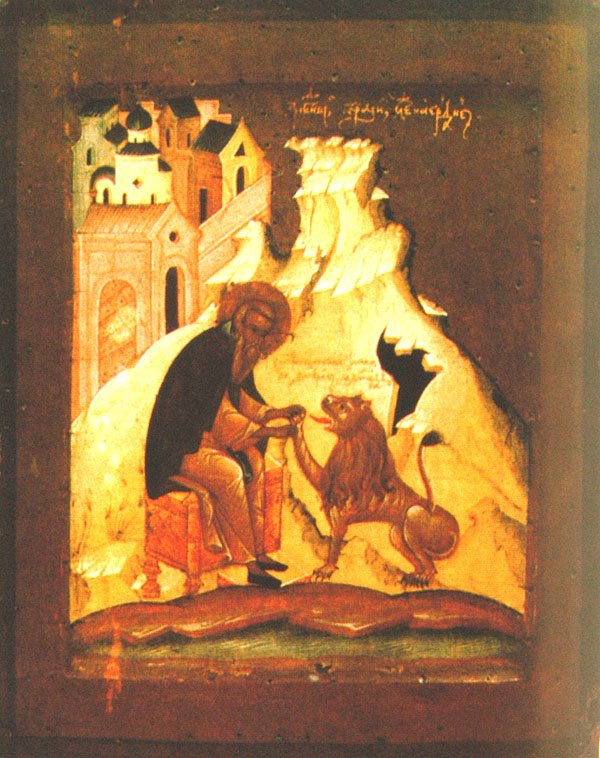
Ven. Gerasimus of the Jordan
Saint Gerasimus was a native of Lycia (Asia Minor). From his early years he was distinguished for his piety. Having received monastic tonsure, he withdrew into the desert of the Thebaid (in Egypt). Thereafter, in about the year 450, the monk arrived in Palestine and settled at the Jordan, where he founded a monastery.
Saint Gerasimus was a native of Lycia (Asia Minor). From his early years he was distinguished for his piety. Having received monastic tonsure, he withdrew into the desert of the Thebaid (in Egypt). Thereafter, in about the year 450, the monk arrived in Palestine and settled at the Jordan, where he founded a monastery.
For a certain while Saint Gerasimus was tempted by the heresy of Eutyches and Dioscorus, which acknowledged only the divine nature in Jesus Christ, but not His human nature (i.e. the Monophysite heresy). Saint Euthymius the Great (January 20) helped him to return to the true Faith.
Saint Gerasimus established a strict monastic Rule. He spent five days of the week in solitude, occupying himself with handicrafts and prayer. On these days the wilderness dwellers did not eat cooked food, nor did they kindle a fire, but ate only dry bread, roots and water.
On Saturday and Sunday all gathered at the monastery for Divine Liturgy and to partake of the Holy Mysteries of Christ. In the afternoon, taking a supply of bread, tubers, water and an armload of date-palm branches for weaving baskets, the desert-dwellers returned to their own cells. Each had only old clothes and a mat, upon which he slept. When they left their cells, the door was never locked, so that anyone could enter and rest, or take whatever he needed.
Saint Gerasimus himself attained a high level of asceticism. During Great Lent he ate nothing until the very day of the All-Radiant Resurrection of Christ, when he received the Holy Mysteries. Going out into the desert for all of Great Lent, Saint Gerasimus took with him his beloved disciple Saint Cyriacus (September 29), whom Saint Euthymius had sent to him.
When Saint Euthymius the Great died, Saint Gerasimus saw how angels carried the soul of the departed up to Heaven. Taking Cyriacus with him, the monk immediately set off to the monastery of Saint Euthymius and consigned his body to the earth.
Saint Gerasimus died peacefully, mourned by his brethren and disciples. Before his death, a lion had aided Saint Gerasimus in his tasks, and upon the death of the Elder it died at his grave and was buried nearby. Therefore the lion is depicted on icons of the saint, at his feet.
Troparion - Tone 1
O citizen of the desert and angel in the body, / you were shown to be a wonderworker, O God-bearing Gerasimos, our Father. / You received heavenly gifts through fasting, vigil, and prayer, / healing the sick, and the souls of those who run to you with faith. / Glory to Him Who strengthened you. / Glory to Him Who crowned you. / Glory to Him Who, through you, works healing for all.
Kontakion - Tone 4
Aflame with heavenly love, / you preferred the severity of the Jordanian desert to all worldly pleasures, / thus, a lion served you obediently and devotedly until your death, O Father; / and then, grief-stricken, it died on your grave. / Therefore, God has glorified you. / Pray to Him for us, and remember us, O Father Gerasimos.
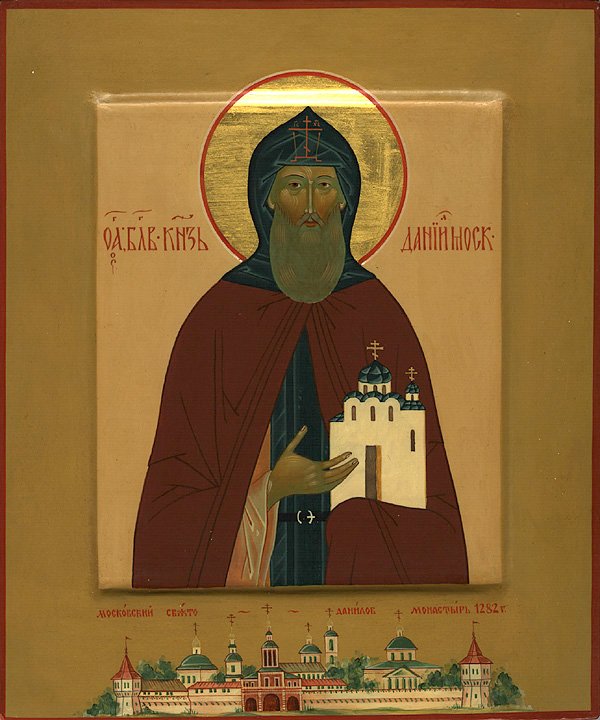
Rt. Blv. Prince Daniel of Moscow
Holy Prince Daniel of Moscow was born at Vladimir in the year 1261. He was the fourth son of Saint Alexander Nevsky (August 30 and November 23) and his second wife Bassa. When he was two years old he lost his father. The date of his mother’s repose is not indicated in the Chronicles; we know only that she was buried in the church of the Nativity of Christ at the Vladimir Dormition monastery (the Princess monastery), and the people in the surroundings venerated her as “Righteous.”
In 1272, Prince Daniel received as his allotted portion the city of Moscow and its adjacent lands. The h
Holy Prince Daniel of Moscow was born at Vladimir in the year 1261. He was the fourth son of Saint Alexander Nevsky (August 30 and November 23) and his second wife Bassa. When he was two years old he lost his father. The date of his mother’s repose is not indicated in the Chronicles; we know only that she was buried in the church of the Nativity of Christ at the Vladimir Dormition monastery (the Princess monastery), and the people in the surroundings venerated her as “Righteous.”
In 1272, Prince Daniel received as his allotted portion the city of Moscow and its adjacent lands. The holy prince built a church (and a monastery beside it) in honor of his patron saint, Saint Daniel the Stylite (December 11) on the banks of the River Moskva.
During this period, the Moscow principality was small and unobtrusive. While growing up, Prince Daniel strengthened and expanded it, not in unjust or coercive ways, but peacefully and with benevolence. It was a time of unrest. Fratricidal strife among the appanage princes was rife. Often bloodshed was averted, thanks to Prince Daniel and his incessant striving for unity and peace in the Russian Land.
In 1293 his brother, the Great Prince Alexander, with Tatars summoned from the Horde and headed by Diuden (“the Diudenev Host”), laid waste to Russian cities: Murom, Suzdal, Kolomna, Dmitrov, Mozhaisk, and Tver. Prince Daniel decided to join them to Moscow to save their people from perishing, for they were not strong enough to resist.
The prince braced himself for terrible destruction and pillaging. Standing up for his rights, Saint Daniel was compelled to come out against his brother near a place called Yurievo Tolchische (“Yurievo Threshing-Mill”), but his desire for peace prevailed, and bloodshed was averted.
In 1300, when the Ryazan prince Constantine was making secret preparations for a sudden assault on the Moscow principality, Prince Daniel went to Ryazan with an army. He defeated the enemy, took Constantine captive,and destroyed a multitude of Tatars. This was a first victory over the Tatars, though not a tremendous victory, but it was noteworthy as a first push towards freedom.
When he had beaten the Ryazan prince and scattered his confederates the Tatars, Prince Daniel did not take advantage of his victory to seize foreign lands or take booty, as was the accepted custom during these times. Instead, he displayed an example of true non-covetousness, love and fraternity. The holy prince never resorted to arms to seize the lands of others, nor did he ever take away the property of other princes either by force or by treachery. And so the Lord saw fit to expand the boundaries of his princely realm.
Prince John of Pereslavl-Zalessk, Daniel’s nephew, was gentle and pious and benevolent towards the poor, and he esteemed and loved his uncle. Dying childless in 1302, he bequeathed his principality to Saint Daniel. The Pereslavl lands together with Dmitrov, had the most inhabitants after Rostov, with the corresponding fortification befitting a major city. Pereslavl-Zalessk was well protected on all sides. But the holy prince remained faithful to Moscow and did not transfer the capital of his princedom to the stronger and more significant seat of Pereslavl. This annexation allowed Moscow to be considered as the most significant principality. Here the principle of the unification of the Russian Land into a single powerful realm was set in place.
Through the ages God’s providence concerning Russia and its destiny was clearly manifest!
Grateful for the constant blessings of the Hodēgḗtria (She who leads the Way) both in his personal life, and also in the life of the Russian realm, Saint Daniel’s father, Saint Alexander Nevsky said, “God is not in might, but in right!”
In 1303 Saint Daniel fell seriously ill. He assumed the great schema and commanded that he be buried at the Danilov monastery. In his deep humility he wanted to be buried not within the church, but in the common monastery cemetery. The holy prince died on March 4.
Less than thirty years after the repose of holy Prince Daniel, the Danilov monastery he founded was transformed into the Moscow Kremlin, the church was transformed into a parish church, and the cemetery became non-monastic.
At the time of Great Prince Ivan III (1462-1505), Saint Daniel gave reminders of himself to his forgetful descendents. He appeared as a stranger to a youth who attended the Great Prince and said: “Don’t be afraid of me. I was a Christian and the master of this place, my name is Daniel Prince of Moscow, and by the will of God I am here. Tell Great Prince John about me saying: you are enjoying yourself while you have forgotten me, but God has not forgotten me.”
After this, the Great Prince ordered panikhidas for his ancestral princes to be sung in the cathedral. During the time of Tsar Ivan the Terrible, the dying son of a barge merchant was healed at the grave of Saint Daniel. The Tsar, struck by the miracle, renovated the ancient Danilov monastery and established a yearly church procession. The Metropolitan led the way to the the holy prince’s tomb, and served a panikhida there.
In 1652 holy Prince Daniel was glorified by the uncovering of his incorrupt relics, which were transferred on August 30 to the church dedicated to the Holy Fathers of the Seventh Ecumenical Council.
The holy relics were placed in a reliquary “to the glory of the Holy Trinity and for the healing of the infirm.” Metropolitan Platon of Moscow (+ 1812), in the Life of the holy prince which he compiled, writes: “The founder laid the foundation of Moscow’s grandeur, modestly making only a small path to it. Just as any edifice, which is not built with excessive haste, but rather with great artistry and skill, receives a particular firmness and stands indestructible for a long time; like a tall tree that grows for many centuries after beginning as a small sapling, then slowly becomes sturdier, with its branches spreading about far around, so this city was to grow from small, but firm beginnings, so that its first sparkle would not bedazzle the eyes of the envious, and so it would not be shaken or felled early on, before it had attained its full height. Thus did this founder prepare the great city given him, giving it a modest but steady radiance, undisturbed by any gusts of the wind. He left the great glory of its rise to his son Great Prince John, called Kalita.”
Troparion - Tone 3
You have appeared to our land as a shining star / O faithful prince Daniel! / Your light illumined your city and monastery! / O champion of the Orthodox, / deliverer of captives, / advocate of the poor, / O sovereign of Russia pray to Christ God / to grant us peace and save our souls!
Paul & his sister Juliana and their Companions
The Holy Martyr Paul and his sister Juliana were executed under the emperor Aurelian (270-275) in the Phoenician city of Ptolemais. The emperor happened to visit Ptolemais, and among those who met him was Paul, who made the Sign of the Cross. They arrested him and threw him in prison.
On the following day, when they brought him to trial, he openly and boldly confessed his faith in Christ, for which he was subjected to fierce tortures.
The Holy Martyr Paul and his sister Juliana were executed under the emperor Aurelian (270-275) in the Phoenician city of Ptolemais. The emperor happened to visit Ptolemais, and among those who met him was Paul, who made the Sign of the Cross. They arrested him and threw him in prison.
On the following day, when they brought him to trial, he openly and boldly confessed his faith in Christ, for which he was subjected to fierce tortures. Juliana, seeing the suffering of her brother, began to denounce the emperor for his injustice and cruelty, for which she was also subjected to torture.
They beat the martyrs, tore their bodies with iron hooks, burned them over red-hot grates, but they were not able to break the wondrous endurance of the Lord’s confessors. Three soldiers torturing the saints were struck by the courageous spirit of the martyrs, and they in turn believed in Christ. These newly chosen of God were named Quadratus, Acacius and Stratonicus, and they were immediately executed.
The tormentor tried to seduce Saint Juliana with a promise to marry her, if she were to renounce Christ, but the saint refused the offer and remained steadfast. By order of the emperor they sent her to a brothel to be defiled. The Lord also preserved her there, and anyone who tried to touch the saint lost his sight. Then the enraged emperor commanded that they again burn the bodies of the saints. Those who saw the suffering of the saints began to murmur loudly, and Aurelian gave orders to behead the martyrs. With gladdened face the brother and sister went to execution singing, “For Thou hast saved us from those who afflicted us and hast shamed those who hated us” (Ps. 43/44:7).
Troparion - Tone 4
Your holy martyrs Paul and Juliana, O Lord, / through their sufferings have received incorruptible crowns from You, our God. / For having Your strength, they laid low their adversaries, / and shattered the powerless boldness of demons. / Through their intercessions, save our souls!
St James the Faster of Phoenecia (6th c.)
Saint James the Faster lived a life of asceticism near the Phoenician city of Porphyrion in the sixth century. For fifteen years, he lived in a cave devoting himself to monastic deeds, and he received the gift of wonderworking from the Lord. Under his influence many of the local inhabitants were converted to the Christian Faith.
Saint James the Faster lived a life of asceticism near the Phoenician city of Porphyrion in the sixth century. For fifteen years, he lived in a cave devoting himself to monastic deeds, and he received the gift of wonderworking from the Lord. Under his influence many of the local inhabitants were converted to the Christian Faith.
News of the ascetic spread everywhere, and so went to another place so that he would not fall into temptation. He found a new cave, and lived there for thirty years. The devil set terrible snares for the ascetic. James healed a young girl from demonic possession, but then fell into sin with her. In order to conceal his sin, he killed the girl and threw her into a river.
Distraught over this sin, he repented for what he had done. For a long time he hid himself away in the wilderness, bereft of shelter and peace, tormented by the pricks of conscience, and he was on the point of forsaking the monastic life and returning to the world. But the immeasurable mercy of God, against which the sins of this world cannot prevail, and which desires salvation for all mankind, would not permit the ruin of this monk who had toiled so many years for the Lord.
The Lord thwarted the devil’s intent to destroy the ascetic, and returned him through repentance to the path of salvation. Wandering about the wilderness, James saw a monastery, and entering it, he confessed his sin before the igumen and the brethren. The igumen urged him to remain with them, fearing that he would ultimately fall into despair. But James went off and again he wandered the wilderness for a long time.
Finally the All-Beneficent Providence of God brought him to a certain desert-dweller filled with grace and wisdom. Lifting the burden from him, the desert-dweller suggested that James remain with him. But James would not remain with the Elder, though encouraged and given hope by him, and he secluded himself in a cave and there for ten years offered repentance to God, weeping and wailing, and asking forgiveness for the sin he committed. The Lord heard the prayers of the penitent monk and granted him His mercy. James reacquired his gift of wonderworking. He remained in the cave until the time of his death. He was also buried there.
Troparion - Tone 8
By a flood of tears you made the desert fertile, / and your longing for God brought forth fruits in abundance. / By the radiance of miracles you illumined the whole universe! / O our holy father James, pray to Christ our God to save our souls!
Scripture Readings
☩Epistle
1 John 4:20-5:21
20
If a man say, I love God, and hateth his brother, he is a liar: for he that loveth not his brother whom he hath seen, how can he love God whom he hath not seen?
21
And this commandment have we from him, That he who loveth God love his brother also.
1
Whosoever believeth that Jesus is the Christ is born of God: and every one that loveth him that begat loveth him also that is begotten of him.
2
By this we know that we love the children of God, when we love God, and keep his commandments.
3
For this is the love of God, that we keep his commandments: and his commandments are not grievous.
4
For whatsoever is born of God overcometh the world: and this is the victory that overcometh the world, even our faith.
5
Who is he that overcometh the world, but he that believeth that Jesus is the Son of God?
6
This is he that came by water and blood, even Jesus Christ; not by water only, but by water and blood. And it is the Spirit that beareth witness, because the Spirit is truth.
7
For there are three that bear record in heaven, the Father, the Word, and the Holy Ghost: and these three are one.
8
And there are three that bear witness in earth, the spirit, and the water, and the blood: and these three agree in one.
9
If we receive the witness of men, the witness of God is greater: for this is the witness of God which he hath testified of his Son.
10
He that believeth on the Son of God hath the witness in himself: he that believeth not God hath made him a liar; because he believeth not the record that God gave of his Son.
11
And this is the record, that God hath given to us eternal life, and this life is in his Son.
12
He that hath the Son hath life; and he that hath not the Son of God hath not life.
13
These things have I written unto you that believe on the name of the Son of God; that ye may know that ye have eternal life, and that ye may believe on the name of the Son of God.
14
And this is the confidence that we have in him, that, if we ask any thing according to his will, he heareth us:
15
And if we know that he hear us, whatsoever we ask, we know that we have the petitions that we desired of him.
16
If any man see his brother sin a sin which is not unto death, he shall ask, and he shall give him life for them that sin not unto death. There is a sin unto death: I do not say that he shall pray for it.
17
All unrighteousness is sin: and there is a sin not unto death.
18
We know that whosoever is born of God sinneth not; but he that is begotten of God keepeth himself, and that wicked one toucheth him not.
19
And we know that we are of God, and the whole world lieth in wickedness.
20
And we know that the Son of God is come, and hath given us an understanding, that we may know him that is true, and we are in him that is true, even in his Son Jesus Christ. This is the true God, and eternal life.
21
Little children, keep yourselves from idols. Amen.
☩Gospel
Mark 15:1-15
1
And straightway in the morning the chief priests held a consultation with the elders and scribes and the whole council, and bound Jesus, and carried him away, and delivered him to Pilate.
2
And Pilate asked him, Art thou the King of the Jews? And he answering said unto him, Thou sayest it.
3
And the chief priests accused him of many things: but he answered nothing.
4
And Pilate asked him again, saying, Answerest thou nothing? behold how many things they witness against thee.
5
But Jesus yet answered nothing; so that Pilate marvelled.
6
Now at that feast he released unto them one prisoner, whomsoever they desired.
7
And there was one named Barabbas, which lay bound with them that had made insurrection with him, who had committed murder in the insurrection.
8
And the multitude crying aloud began to desire him to do as he had ever done unto them.
9
But Pilate answered them, saying, Will ye that I release unto you the King of the Jews?
10
For he knew that the chief priests had delivered him for envy.
11
But the chief priests moved the people, that he should rather release Barabbas unto them.
12
And Pilate answered and said again unto them, What will ye then that I shall do unto him whom ye call the King of the Jews?
13
And they cried out again, Crucify him.
14
Then Pilate said unto them, Why, what evil hath he done? And they cried out the more exceedingly, Crucify him.
15
And so Pilate, willing to content the people, released Barabbas unto them, and delivered Jesus, when he had scourged him, to be crucified.
Liturgical data sourced from OCA.org and orthocal.info