Fasting Rules
 Meat
Allowed
 Fish
Allowed
 Dairy
Allowed
 Oil
Allowed
 Wine
Allowed
Saints & Commemorations
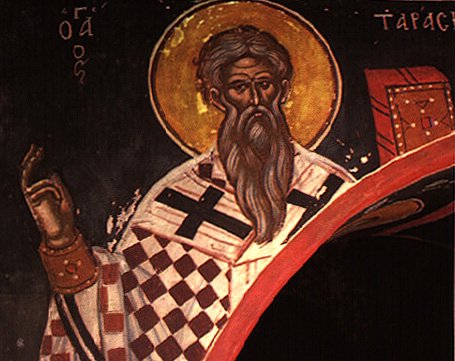
St Tarasius, Abp. of Constantinople
Saint Tarasius, Patriarch of Constantinople was of illustrious lineage. He was born and raised in Constantinople, where he received a fine education. He was rapidly promoted at the court of the emperor Constantine VI Porphyrogenitos (780-797) and Constantine’s mother, the holy Empress Irene (August 7), and the saint attained the rank of senator.
Saint Tarasius, Patriarch of Constantinople was of illustrious lineage. He was born and raised in Constantinople, where he received a fine education. He was rapidly promoted at the court of the emperor Constantine VI Porphyrogenitos (780-797) and Constantine’s mother, the holy Empress Irene (August 7), and the saint attained the rank of senator.
During these times the Church was agitated by the turmoil of the Iconoclast disturbances. The holy Patriarch Paul (August 30) although he had formerly supported Iconoclasm, later repented and resigned his office. He withdrew to a monastery, where he took the schema. When the holy Empress Irene and her son the emperor came to him, Saint Paul told them that the most worthy successor to him would be Saint Tarasius (who at this time was still a layman).
Tarasius refused for a long time, not considering himself worthy of such high office, but he then gave in to the common accord on the condition, that an Ecumenical Council be convened to address the Iconoclast heresy.
Proceeding through all the clerical ranks in a short while, Saint Tarasius was elevated to the patriarchal throne in the year 784. In the year 787 the Seventh Ecumenical Council was convened in the city of Nicea, with Patriarch Tarasius presiding, and 367 bishops attending. The veneration of holy icons was confirmed at the council. Those bishops who repented of their iconoclasm, were again received by the Church.
Saint Tarasius wisely governed the Church for twenty-two years. He led a strict ascetic life. He spent all his money on God-pleasing ends, feeding and giving comfort to the aged, to the impoverished, to widows and orphans, and on Holy Pascha he set out a meal for them, and he served them himself.
The holy Patriarch fearlessly denounced the emperor Constantine Porphyrigenitos when he slandered his spouse, the empress Maria, the granddaughter of Saint Philaretos the Merciful (December 1), so that he could send Maria to a monastery, thus freeing him to marry his own kinswoman. Saint Tarasius resolutely refused to dissolve the marriage of the emperor, for which the saint fell into disgrace. Soon, however, Constantine was deposed by his own mother, the Empress Irene.
Saint Tarasius died in the year 806. Before his death, devils examined his life from the time of his youth, and they tried to get the saint to admit to sins that he had not committed. “I am innocent of that of which you accuse me,” replied the saint, “and you falsely slander me. You have no power over me at all.”
Mourned by the Church, the saint was buried in a monastery he built on the Bosphorus. Many miracles took place at his tomb.
Troparion - Tone 3
You shone forth as a light of the Spirit, / adorned with an exemplary life and clothed in hierarchical vesture. / You stilled the turbulence of heresy / and became a pillar and foundation of the Church, / which praises your struggles, holy Father Tarasius.
Kontakion - Tone 3
You illumined the Church with Orthodox doctrine / and taught all to venerate and honor the precious image of Christ. / You vanquished the godless doctrine of the iconoclasts. / Therefore we cry to you: / “Rejoice, wise Father Tarasius.”
Scripture Readings
☩Epistle
1 John 1:8-2:6
8
If we say that we have no sin, we deceive ourselves, and the truth is not in us.
9
If we confess our sins, he is faithful and just to forgive us our sins, and to cleanse us from all unrighteousness.
10
If we say that we have not sinned, we make him a liar, and his word is not in us.
1
My little children, these things write I unto you, that ye sin not. And if any man sin, we have an advocate with the Father, Jesus Christ the righteous:
2
And he is the propitiation for our sins: and not for ours only, but also for the sins of the whole world.
3
And hereby we do know that we know him, if we keep his commandments.
4
He that saith, I know him, and keepeth not his commandments, is a liar, and the truth is not in him.
5
But whoso keepeth his word, in him verily is the love of God perfected: hereby know we that we are in him.
6
He that saith he abideth in him ought himself also so to walk, even as he walked.
☩Gospel
Mark 13:31-14:2
31
Heaven and earth shall pass away: but my words shall not pass away.
32
But of that day and that hour knoweth no man, no, not the angels which are in heaven, neither the Son, but the Father.
33
Take ye heed, watch and pray: for ye know not when the time is.
34
For the Son of man is as a man taking a far journey, who left his house, and gave authority to his servants, and to every man his work, and commanded the porter to watch.
35
Watch ye therefore: for ye know not when the master of the house cometh, at even, or at midnight, or at the cockcrowing, or in the morning:
36
Lest coming suddenly he find you sleeping.
37
And what I say unto you I say unto all, Watch.
1
After two days was the feast of the passover, and of unleavened bread: and the chief priests and the scribes sought how they might take him by craft, and put him to death.
2
But they said, Not on the feast day, lest there be an uproar of the people.
Liturgical data sourced from OCA.org and orthocal.info