Fasting Rules
 Meat
Allowed
 Fish
Allowed
 Dairy
Allowed
 Oil
Allowed
 Wine
Allowed
Saints & Commemorations
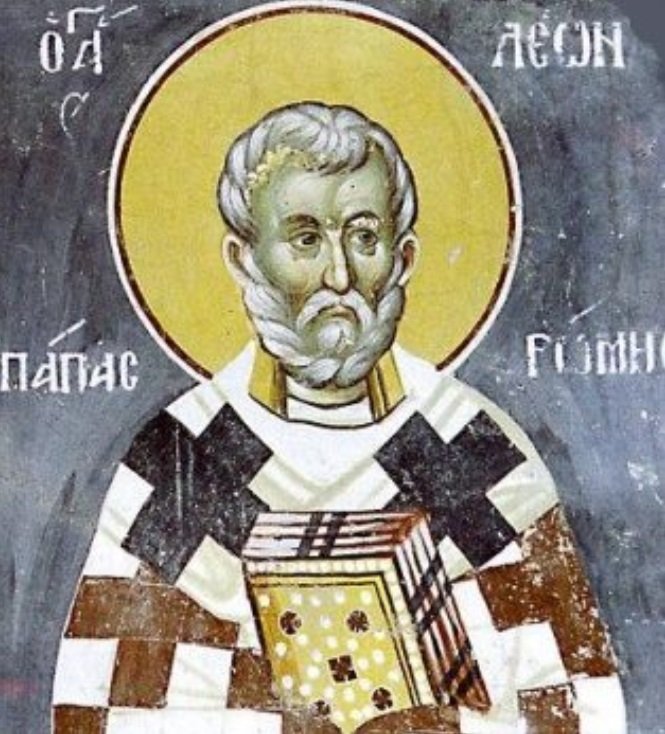
St Leo the Great, Pope of Rome
Saint Leo I the Great, Pope of Rome (440-461), received a fine and diverse education, which opened for him the possibility of an excellent worldly career. He yearned for the spiritual life, however, and so he chose the path of becoming an archdeacon under holy Pope Sixtus III (432-440), after whose death Saint Leo was chosen as Bishop of Rome in September 440.
Saint Leo I the Great, Pope of Rome (440-461), received a fine and diverse education, which opened for him the possibility of an excellent worldly career. He yearned for the spiritual life, however, and so he chose the path of becoming an archdeacon under holy Pope Sixtus III (432-440), after whose death Saint Leo was chosen as Bishop of Rome in September 440.
These were difficult times for the Church, when heretics assaulted Orthodoxy with their false teachings. Saint Leo combined pastoral solicitude and goodness with an unshakable firmness in the confession of the Faith. He was in particular one of the basic defenders of Orthodoxy against the heresies of Eutyches and Dioscorus, who taught that there was only one nature in the Lord Jesus Christ. He was also a defender against the heresy of Nestorius.
He exerted all his influence to put an end to the unrest by the heretics in the Church, and by his letters to the holy emperors Theodosius II (408-450) and Marcian (450-457), he actively promoted the convening of the Fourth Ecumenical Council, at Chalcedon in 451, to condemn the heresy of the Monophysites.
At the Council at Chalcedon, at which 630 bishops were present, a letter of Saint Leo to the deceased Saint Flavian, Patriarch of Constantinople (447-449) was read. Saint Flavian had suffered for Orthodoxy under the “Robber Council” of Ephesus in the year 449. In the letter of Saint Leo the Orthodox teaching about the two natures [the divine and the human] in the Lord Jesus Christ was set forth. All the bishops present at the Council were in agreement with this teaching, and so the heretics Eutyches and Dioscorus were excommunicated from the Church.
Saint Leo was also a defender of his country against the incursions of barbarians. In 452, by the persuasive power of his words, he stopped Attila the Hun from pillaging Italy. Again in the year 455, when the leader of the Vandals [a Germanic tribe], Henzerich, turned towards Rome, he persuaded him not to pillage the city, burn buildings, nor to spill blood.
He knew the time of his death beforehand, and he prepared himself, with forty days of fasting and prayer, to pass from this world into eternity.
He died in the year 461 and was buried at Rome. His literary and theological legacy is comprised of 96 sermons and 143 letters, of which the best known is his Epistle to Saint Flavian.
Troparion - Tone 3
You were the Church’s instrument / in strengthening the teaching of true doctrine; / you shone forth from the West like a sun dispelling the errors of the heretics. / Righteous Leo, entreat Christ God to grant us His great mercy.
Kontakion - Tone 3
O Champion of Orthodoxy, and teacher of holiness, / the enlightenment of the universe and the inspired glory of true believers. / O most wise Father Leo, your teachings are as music of the Holy Spirit for us! / Pray that Christ our God may save our souls!
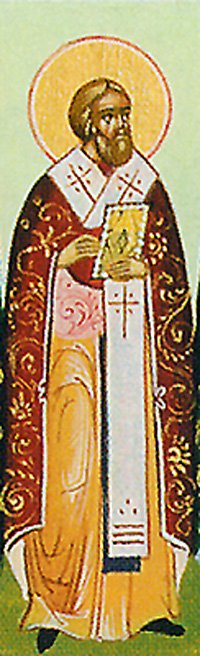
Flavian the Confessor, Patriarch of Constantinople
Saint Flavian the Confessor, Patriarch of Constantinople, occupied the patriarchal throne of Constantinople under the holy Emperor Theodosius the Younger (408-450) and his sister the holy Empress Pulcheria (September 10).
At first he was a presbyter and caretaker of church-vessels in the cathedral. He became Patriarch after the death of holy Patriarch Proclus (November 20).
Saint Flavian the Confessor, Patriarch of Constantinople, occupied the patriarchal throne of Constantinople under the holy Emperor Theodosius the Younger (408-450) and his sister the holy Empress Pulcheria (September 10).
At first he was a presbyter and caretaker of church-vessels in the cathedral. He became Patriarch after the death of holy Patriarch Proclus (November 20). During this time, various disturbances and heresies threatened church unity.
In the year 448, Saint Flavian convened a local Council at Constantinople to examine the heresy of Eutyches, which admitted only one nature (the divine) in the Lord Jesus Christ. Persisting in his error, the heretic Eutyches was excommunicated from the Church and deprived of dignity, but Eutyches had a powerful patron in the person of Chrysathios, a eunuch close to the emperor.
Through intrigue Chrysathios brought Bishop Dioscorus of Alexandria over to the side of Eutyches, and obtained permission from the emperor to convene a church council at Ephesus, afterwards known as the “Robber Council.”
Dioscorus presided at this council, gaining the acquittal of Eutyches and the condemnation of Patriarch Flavian by threats and force. Saint Flavian was fiercely beaten up during the sessions of this council by impudent monks led by a certain Barsumas.
Even the impious president of the Robber Council, the heretic Dioscorus, took part in these beatings. After this heavy chains were put upon Saint Flavian, and he was sentenced to banishment at Ephesus. The Lord, however, ended his further suffering, by sending him his death (+ August 449). The holy Empress Pulcheria withdrew from the imperial court. Soon the intrigues of Chrysathios were revealed. The emperor dismissed him, and restored his sister Saint Pulcheria. Through her efforts, the relics of holy Patriarch Flavian were reverently transferred from Ephesus to Constantinople.
Troparion - Tone 8
Champion of Orthodoxy, teacher of purity and of true worship, / the enlightener of the universe and the adornment of hierarchs: / all-wise father Flavian, your teachings have gleamed with light upon all things. / Intercede before Christ God to save our souls.
Scripture Readings
☩Epistle
1 Peter 4:12-5:5
12
Beloved, think it not strange concerning the fiery trial which is to try you, as though some strange thing happened unto you:
13
But rejoice, inasmuch as ye are partakers of Christ’s sufferings; that, when his glory shall be revealed, ye may be glad also with exceeding joy.
14
If ye be reproached for the name of Christ, happy are ye; for the spirit of glory and of God resteth upon you: on their part he is evil spoken of, but on your part he is glorified.
15
But let none of you suffer as a murderer, or as a thief, or as an evildoer, or as a busybody in other men’s matters.
16
Yet if any man suffer as a Christian, let him not be ashamed; but let him glorify God on this behalf.
17
For the time is come that judgment must begin at the house of God: and if it first begin at us, what shall the end be of them that obey not the gospel of God?
18
And if the righteous scarcely be saved, where shall the ungodly and the sinner appear?
19
Wherefore let them that suffer according to the will of God commit the keeping of their souls to him in well doing, as unto a faithful Creator.
1
The elders which are among you I exhort, who am also an elder, and a witness of the sufferings of Christ, and also a partaker of the glory that shall be revealed:
2
Feed the flock of God which is among you, taking the oversight thereof, not by constraint, but willingly; not for filthy lucre, but of a ready mind;
3
Neither as being lords over God’s heritage, but being ensamples to the flock.
4
And when the chief Shepherd shall appear, ye shall receive a crown of glory that fadeth not away.
5
Likewise, ye younger, submit yourselves unto the elder. Yea, all of you be subject one to another, and be clothed with humility: for God resisteth the proud, and giveth grace to the humble.
☩Gospel
Mark 12:38-44
38
And he said unto them in his doctrine, Beware of the scribes, which love to go in long clothing, and love salutations in the marketplaces,
39
And the chief seats in the synagogues, and the uppermost rooms at feasts:
40
Which devour widows’ houses, and for a pretence make long prayers: these shall receive greater damnation.
41
And Jesus sat over against the treasury, and beheld how the people cast money into the treasury: and many that were rich cast in much.
42
And there came a certain poor widow, and she threw in two mites, which make a farthing.
43
And he called unto him his disciples, and saith unto them, Verily I say unto you, That this poor widow hath cast more in, than all they which have cast into the treasury:
44
For all they did cast in of their abundance; but she of her want did cast in all that she had, even all her living.
Liturgical data sourced from OCA.org and orthocal.info