Fasting Rules
 Meat
Allowed
 Fish
Allowed
 Dairy
Allowed
 Oil
Allowed
 Wine
Allowed
Saints & Commemorations
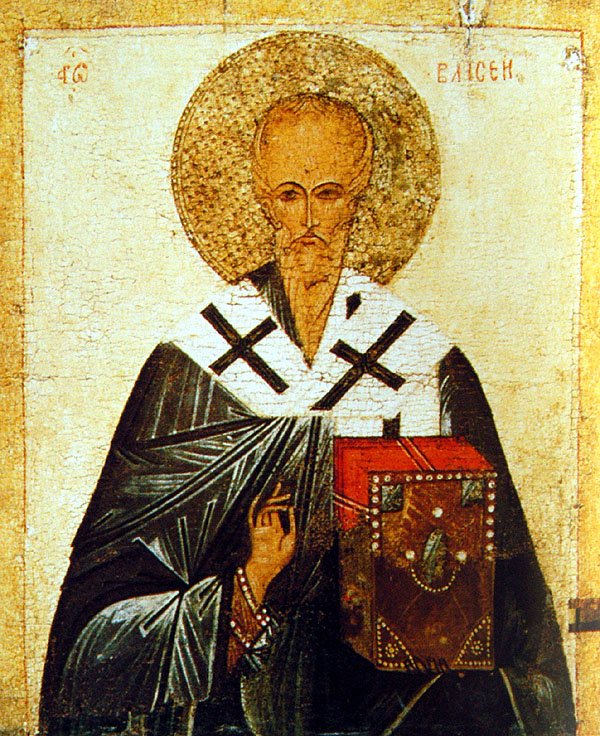
Hieromartyr Blaise of Sebaste
The Hieromartyr Blaise (Blasius), Bishop of Sebaste, was known for his righteous and devout life. Unanimously chosen by the people, he was consecrated Bishop of Sebaste. This occurred during the reign of the Roman emperors Diocletian (284-305) and Licinius (307-324), fierce persecutors of Christians.
The Hieromartyr Blaise (Blasius), Bishop of Sebaste, was known for his righteous and devout life. Unanimously chosen by the people, he was consecrated Bishop of Sebaste. This occurred during the reign of the Roman emperors Diocletian (284-305) and Licinius (307-324), fierce persecutors of Christians. Saint Blaise encouraged his flock, visited the imprisoned, and gave support to the martyrs.
Many hid themselves from the persecutors by going off to desolate and solitary places. Saint Blaise also hid himself away on Mount Argeos, where he lived in a cave. Wild beasts came up to him and meekly waited until the saint finished his prayer and blessed them. The saint also healed sick animals by laying his hands upon them.
The refuge of the saint was discovered by servants of the governor Agrilaus, who had come to capture wild beasts to loose on the Christian martyrs. The servants reported to their master that Christians were hiding on the mountain, and he gave orders to arrest them. But those sent out found there only the Bishop of Sebaste. Glorifying God Who had summoned him to this exploit, Saint Blaise followed the soldiers.
Along the way the saint healed the sick and worked other miracles. Thus, a destitute widow complained to him of her misfortune. A wolf had carried off a small pig, her only possession. The bishop smiled and said to her, “Do not weep, your pig will be returned to you...” To the astonishment of everyone, the wolf came running back and returned his prey unharmed.
Agrilaus, greeting the bishop with words of deceit, called him a companion of the gods. The saint answered the greeting, but he called the gods devils. Then they beat him and led him off to prison.
On the next day, they subjected the saint to tortures again. When they led him back to the prison, seven women followed behind and gathered up the drops of blood. They arrested them and tried to compel them to worship the idols. The women pretended to consent to this and said that first they needed to wash the idols in the waters of a lake. They took the idols and threw them in a very deep part of the lake, and after this the Christians were fiercely tortured. The saints stoically endured the torments, strengthened by the grace of God, their bodies were transformed and became white as snow. One of the women had two young sons, who implored their mother to help them attain the Kingdom of Heaven, and she entrusted them to the care of Saint Blaise. The seven holy women were beheaded.
Saint Blaise was again brought before Agrilaus, and again he unflinchingly confessed his faith in Christ. The governor ordered that the martyr be thrown into a lake. The saint, going down to the water, signed himself with the Sign of the Cross, and he walked on it as though on dry land.
Addressing the pagans standing about on shore, he challenged them to come to him while calling on the help of their gods. Sixty-eight men of the governor’s retinue entered the water, and immediately drowned. The saint, however, heeding the angel who had appeared to him, returned to shore.
Agrilaus was in a rage over losing his finest servants, and he gave orders to behead Saint Blaise, and the two sons of the woman martyr entrusted to him. Before his death, the martyr prayed for the whole world, and especially for those honoring his memory. This occurred in about the year 316.
The relics of the Hieromartyr Blaise were brought to the West during the time of the Crusades, and portions of the relics are preserved in many of the lands of Europe [and his memory traditionally honored there on February 3].
We pray to Saint Blaise for the health of domestic animals, and for protection from wild beasts.
Troparion - Tone 4
By sharing in the ways of the Apostles, / you became a successor to their throne. / Through the practice of virtue, you found the way to divine contemplation, O inspired one of God; / by teaching the word of truth without error, you defended the Faith, / even to the shedding of your blood. / Hieromartyr Blaise, entreat Christ God to save our souls.
Kontakion - Tone 2
Godly shoot, unfading flower, / most fruitful branch of Christ the Vine, God-bearing Blaise, / fill with joy those who in faith honor your memory / as you unceasingly intercede for us all.
Ven. Dimitry of Priluk
He entered monastic life as a youth and was a disciple of St Sergius of Radonezh. After years of monastic obedience he was ordained to the priesthood, then founded a monastery on the shores of Lake Priluki, whose rule followed that of the Lavra of St Sergius. Saint Demetrius, who was exceptionally handsome, always concealed his face behind his monastic veil and never conversed with women.
He entered monastic life as a youth and was a disciple of St Sergius of Radonezh. After years of monastic obedience he was ordained to the priesthood, then founded a monastery on the shores of Lake Priluki, whose rule followed that of the Lavra of St Sergius. Saint Demetrius, who was exceptionally handsome, always concealed his face behind his monastic veil and never conversed with women. Once a noblewoman, driven by curiosity, managed to catch sight of his face in church. She immediately fell paralyzed to the ground. The Saint asked her ‘My child, why did you want to gaze at the face of a sinner who has long been dead to the world?’ He then gave her some words of instruction in the spiritual life and sent her away healed.
In time St Demetrius became so renowned in Russia that the flow of visitors burdened him and he retreated to an uninhabited area to live as a hermit, until he was found out and made abbot of a nearby monastery. He kept a constant fast, living only on prosphora and water. In his own lifetime the Saint was known for his gift of prophecy, his care for the poor, and his healings. Once his brother sought his blessing to trade with the pagans in the far north. He made a good profit there and asked for a blessing to return. This time the Saint would not give his blessing, but his brother went anyway, and was killed by pagans.
Toward the end of his life St Demetrius withdrew into solitude in his cell. One day the brethren noticed a wonderful aroma of incense coming from his cell and knew that he had departed this life for heaven. After his repose he continued to work countless miracles, healing illnesses (especially the plague), and driving away invaders.
Hieromartyr Blaise, bishop of Sebaste (316)
He was born in the province of Armenia, and was a physician by profession. Such was his reputation for holiness that his fellow-citizens elected him Bishop of Sebaste in eastern Anatolia. Though there were few Christians in that pagan city, the bishop labored tirelessly for his flock, encouraging them to stand firm during the fierce persecutions then raging, and visiting the martyrs in prison.
He was born in the province of Armenia, and was a physician by profession. Such was his reputation for holiness that his fellow-citizens elected him Bishop of Sebaste in eastern Anatolia. Though there were few Christians in that pagan city, the bishop labored tirelessly for his flock, encouraging them to stand firm during the fierce persecutions then raging, and visiting the martyrs in prison.
When the city was stripped of Christians, all of whom had fled or been killed, the bishop, already an old man, withdrew to a cave on Mount Argea and devoted himself entirely to prayer. As they often do, the wild beasts sensed his sanctity, and gathered around the cave, waiting quietly for him to give his blessing or heal their injuries and ailments.
The persecutors, who had not stopped hunting for the bishop, eventually found his cave, and were amazed to find it like a second Eden, with lions, tigers, bears and wolves grazing peacefully around it. The Saint greeted them cheerfully and told them that he knew from a vision that they were coming for him.
As Blaise was taken back to Sebaste, the peace and gentleness that seemed to radiate from the Saint were enough in themselves to turn many pagan bystanders to faith in Christ. Diseases of men and animals were cured as he walked by. One mother brought him her child, who was choking on a fishbone. The Saint put his hand down the child’s throat, took out the fishbone, and prayed to the Lord to restore him to full health. (For this reason he is invoked in the West for the cure of throat ailments).
At his trial, the holy bishop fearlessly confessed Christ and scorned the idols, for which he was savagely beaten with rods and thrown into a dungeon. Seven women and two of their children were imprisoned with him. The women were slain first after many tortures. The Synaxarion continues, “Having failed in his efforts to break Saint Blaise’s resolve, Agricolaus [the governor] condemned him to be drowned in the lake. The holy Martyr made the sign of the Cross at the water’s edge and began walking across the surface of the lake as the Saviour had done on the Sea of Galilee. On reaching the middle, he invited the pagans to join him, if they believed they could trust themselves to their gods. Sixty-eight of them took up the challenge and drowned, while a bright angel appeared and invited the Saint to return to the shore in order to receive the crown of glory.” Then Blaise and the two young children were beheaded together.
Saint Blaise is one of the most-venerated holy healers in both the East and the West. He is called upon for protection from wild beasts, and for the healing of every kind of ailment. His head is kept at the Monastery of Konstamonitou on Mount Athos.
St Theodora the Empress (867)
Theodora was the wife of Emperor Theophilus the Iconoclast, but secretly revered the icons, and protected others who did, until the emperor’s death. Upon his death, she quickly restored veneration of icons to churches throughout the empire, the event celebrated on the upcoming Sunday of Orthodoxy, the first Sunday of the Great Fast. S
Theodora was the wife of Emperor Theophilus the Iconoclast, but secretly revered the icons, and protected others who did, until the emperor’s death. Upon his death, she quickly restored veneration of icons to churches throughout the empire, the event celebrated on the upcoming Sunday of Orthodoxy, the first Sunday of the Great Fast. She ruled wisely as regent for the young emperor Michael for fifteen years: she is said to have initiated the mission of Sts Cyril and Methodios to the Slavs. Before Michael III reached his majority, he was prevailed upon by Bardas, Theodora’s brother, to depose her and send her to a monastery, where she finished her life in peace and holiness.
When Constantinople fell, her incorrupt relics were taken to Corfu along with those of St Spyridon. They are still venerated there.
There is a much-debated story that, when Theophilus was dying, the Empress, moved by compassion for him, brought an icon of the Mother of God out of hiding and laid it on his face; and that Theophilus, coming to himself, kissed the holy icon and confessed the true Faith before giving up his soul. Other accounts say that the Emperor died in heresy. It seems possible that the holy Empress circulated the story to ensure that her departed husband would be remembered in the Church’s prayers.
Scripture Readings
☩Epistle
James 4:7-5:9
7
Submit yourselves therefore to God. Resist the devil, and he will flee from you.
8
Draw nigh to God, and he will draw nigh to you. Cleanse your hands, ye sinners; and purify your hearts, ye double minded.
9
Be afflicted, and mourn, and weep: let your laughter be turned to mourning, and your joy to heaviness.
10
Humble yourselves in the sight of the Lord, and he shall lift you up.
11
Speak not evil one of another, brethren. He that speaketh evil of his brother, and judgeth his brother, speaketh evil of the law, and judgeth the law: but if thou judge the law, thou art not a doer of the law, but a judge.
12
There is one lawgiver, who is able to save and to destroy: who art thou that judgest another?
13
Go to now, ye that say, To day or to morrow we will go into such a city, and continue there a year, and buy and sell, and get gain:
14
Whereas ye know not what shall be on the morrow. For what is your life? It is even a vapour, that appeareth for a little time, and then vanisheth away.
15
For that ye ought to say, If the Lord will, we shall live, and do this, or that.
16
But now ye rejoice in your boastings: all such rejoicing is evil.
17
Therefore to him that knoweth to do good, and doeth it not, to him it is sin.
1
Go to now, ye rich men, weep and howl for your miseries that shall come upon you.
2
Your riches are corrupted, and your garments are motheaten.
3
Your gold and silver is cankered; and the rust of them shall be a witness against you, and shall eat your flesh as it were fire. Ye have heaped treasure together for the last days.
4
Behold, the hire of the labourers who have reaped down your fields, which is of you kept back by fraud, crieth: and the cries of them which have reaped are entered into the ears of the Lord of sabaoth.
5
Ye have lived in pleasure on the earth, and been wanton; ye have nourished your hearts, as in a day of slaughter.
6
Ye have condemned and killed the just; and he doth not resist you.
7
Be patient therefore, brethren, unto the coming of the Lord. Behold, the husbandman waiteth for the precious fruit of the earth, and hath long patience for it, until he receive the early and latter rain.
8
Be ye also patient; stablish your hearts: for the coming of the Lord draweth nigh.
9
Grudge not one against another, brethren, lest ye be condemned: behold, the judge standeth before the door.
☩Gospel
Mark 11:27-33
27
And they come again to Jerusalem: and as he was walking in the temple, there come to him the chief priests, and the scribes, and the elders,
28
And say unto him, By what authority doest thou these things? and who gave thee this authority to do these things?
29
And Jesus answered and said unto them, I will also ask of you one question, and answer me, and I will tell you by what authority I do these things.
30
The baptism of John, was it from heaven, or of men? answer me.
31
And they reasoned with themselves, saying, If we shall say, From heaven; he will say, Why then did ye not believe him?
32
But if we shall say, Of men; they feared the people: for all men counted John, that he was a prophet indeed.
33
And they answered and said unto Jesus, We cannot tell. And Jesus answering saith unto them, Neither do I tell you by what authority I do these things.
Liturgical data sourced from OCA.org and orthocal.info