Fasting Rules
 Meat
Abstain
 Fish
Abstain
 Dairy
Abstain
 Oil
Abstain
 Wine
Abstain
Saints & Commemorations
Repose St Theodosius of Chernigov
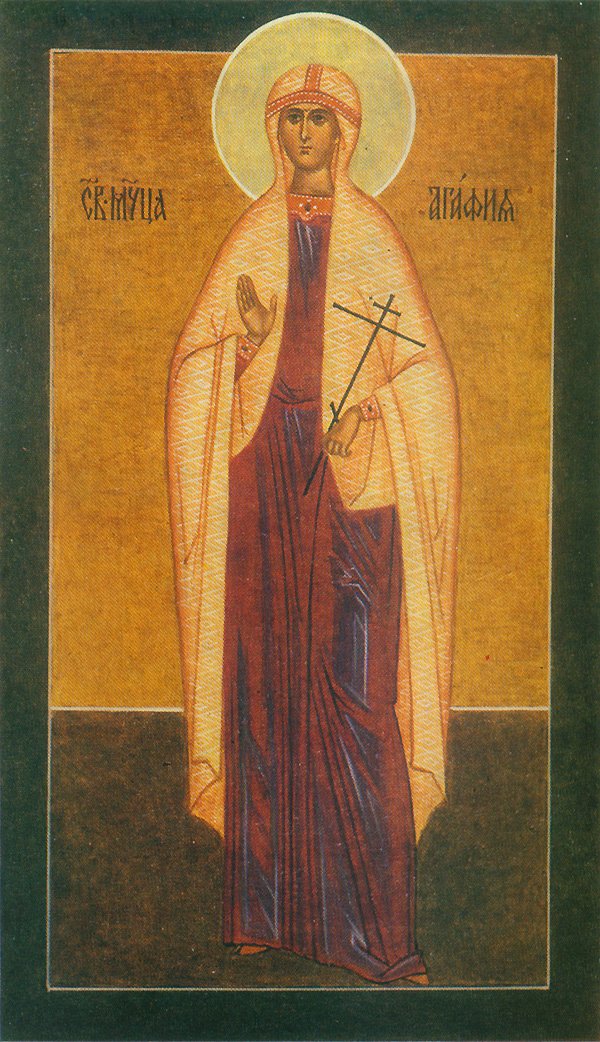
Holy Martyr Agatha of Palermo in Sicily (251)
The Holy Virgin Martyr Agatha was the fifteen-year-old daughter of rich and respected Christian parents from the city of Palermo (formerly Panormos) in Sicily. During the persecution under the emperor Decius (249-251), the city prefect of Catania, Quintianus, having heard about Agatha’s wealth and beauty, sent his soldiers after her to bring her to trial as a Christian.
The Holy Virgin Martyr Agatha was the fifteen-year-old daughter of rich and respected Christian parents from the city of Palermo (formerly Panormos) in Sicily. During the persecution under the emperor Decius (249-251), the city prefect of Catania, Quintianus, having heard about Agatha’s wealth and beauty, sent his soldiers after her to bring her to trial as a Christian.
At Catania they housed the saint with a certain rich woman, who had five daughters. They all attempted to tempt Saint Agatha with fine clothes, amusements and entertainment, urging her to offer sacrifice to the pagan gods, but the saint disdained all these things. The more they tried to move her, the more resolute she became. She prayed that she might soon face martyrdom.
During her interrogation under Quintianus, the holy martyr was swayed neither by the flattery, nor by the threats, and she was subjected to cruel torments. They also tried to remove her breasts with metal tongs, and when this failed, they used knives.
The holy Apostle Peter appeared to her in prison and healed her wounds. Saint Agatha was led to torture again, and Quintianus was astonished to see her completely healed, with no trace of cutting. Then the torture began once more.
At this moment an earthquake took place in the city, and many buildings were destroyed. Among those killed were two of Quintianus’s advisors. The terrified inhabitants rushed to Quintianus, demanding an end to Agatha’s tortures. Fearing a revolt by the people, Quintianus sent Saint Agatha back to prison. There the martyr, offering thanks to God, peacefully surrendered her soul to the Lord.
Troparion - Tone 4
Your lamb Agatha, calls out to You, O Jesus, in a loud voice: / “I love You, my Bridegroom, and in seeking You I endure suffering. / In baptism I was crucified so that I might reign in You, and I died so that I might live with You. / Accept me as a pure sacrifice, / for I have offered myself in love.” / Through her prayers save our souls, since You are merciful.
Kontakion - Tone 4
May the Church be robed today in a garment of glorious porphyry, / dyed by the pure blood of the martyr Agatha, / and let us cry out: “Rejoice, pride of Catania!”
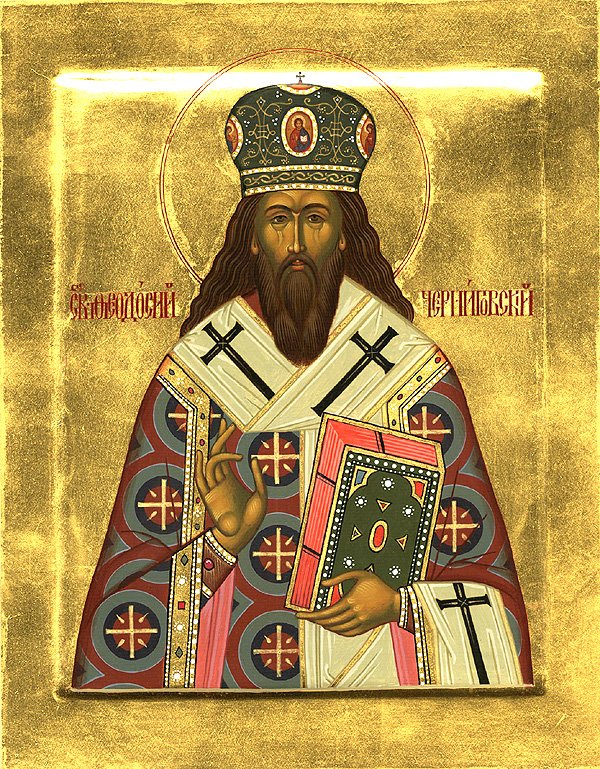
Repose of St Theodosius, Archbishop of Chernigov (1896)
Saint Theodosius, Archbishop of Chernigov, was born in the seventeenth century at the beginning of the decade of the thirties in Podolsk governance. He was descended from a noble family, the Polonitsky-Uglitskys. His parents were the priest Nikḗtas and Maria. The saint was taught Christian piety in his parents’ home, and this piety remained with him throughout his life.
Fr
Saint Theodosius, Archbishop of Chernigov, was born in the seventeenth century at the beginning of the decade of the thirties in Podolsk governance. He was descended from a noble family, the Polonitsky-Uglitskys. His parents were the priest Nikḗtas and Maria. The saint was taught Christian piety in his parents’ home, and this piety remained with him throughout his life.
From childhood he was distinguished by a fervent love for God and zeal for the Church. The innate abilities of the youth came to light in the Kiev Brotherhood school at Kiev’s Theophany monastery. The school was flourishing at the end of the 1640s, when its rectors were Archimandrite Innocent (Gizel), and Igumen Lazar (Baranovich), who later became Archbishop of Chernigov. Among its instructors were: Hieromonk Epiphanius (Slavinetsky), Hieromonk Arsenius (Satanovsky), Bishop Theodosius (Baevsky) of Belorus, Igumen Theodosius (Saphonovich) and Meletius Dzik. These were the enlightened men of those days. The comrades of Saint Theodosius at the school would become future outstanding pastors: Simeon Polotsky, Joannicius Golyatovsky, Anthony Radivillovsky, Barlaam Yasninsky. The Kiev Brotherhood Theophany school was the chief center in the struggle of Orthodoxy against the assaults of Catholic clergy, particularly the Jesuits.
Saint Theodosius grew to spiritual maturity near the relics of Saints Anthony and Theodosius and other God-pleasers of the Kiev Caves, and he tried to imitate their holy life as much as he could. He devoted all his free time to prayer, meditation on God, and the reading of Holy Scripture.
It might be surmised that the saint did not finish the full course of studies, since the school ceased its activity for several years following the devastation of Podolia by the Poles. All his life the saint had a deep regard for the Kiev Brotherhood monastery where he was educated. In the Synodikon of the Kiev-Vydubitsk monastery is the following comment about Saint Theodosius: “He was a man of fine intellect, and generous to the Kiev Brotherhood monastery.”
Upon receiving his education, the future hierarch received monastic tonsure at the Kiev Caves Lavra with the name Theodosius, in honor of Saint Theodosius of the Caves (May 3).
Metropolitan Dionysius (Balaban) of Kiev made him archdeacon of Kiev’s cathedral of Holy Wisdom (Hagia Sophia) , and then appointed him steward of the episcopal household. Soon he left Kiev and went to the distant Krupitsky monastery near Baturino (in the Chernigov diocese), which was famed for its strict monastic life. There he was ordained to the holy priesthood, but remained there only a short time.
In 1662, Saint Theodosius was appointed Igumen of the Korsun monastery in Kiev diocese, and in the year 1664 he was made head of the ancient Kiev-Vydubitsky monastery. This monastery had fallen into the hands of the Uniates and Poles at the beginning of the seventeenth century and was in complete ruin. Thanks to the energy and initiative of Saint Theodosius, the Vydubitsky Mikhailovsk monastery was quickly restored.
He was particularly concerned with the order of church services. He formed an excellent choir, which was famed not only in Little Russia, but also in Moscow. Saint Theodosius sent his singers to Moscow in 1685 to instruct their choirs in Kievan chant.
As a strict ascetic himself, Saint Theodosius was concerned with the spiritual growth of his monks. He founded a small skete on the island of Mikhailovschina, not far from the monastery, for brethren wishing to live in solitude. He appointed the hieromonk Job (Opalinsky), one of the most zealous monks of his monastery, to organize and administer the skete.
Saint Theodosius had to live through some quite difficult days, enduring many sorrows. He and other Igumens were accused by Bishop Methodius of Mstislav and Orshansk of betraying Russia in a supposed correspondence with the enemies of Russia.
On September 20, 1668 Saint Theodosius explained the matter. On November 17, 1668 the lie was exposed, and Saint Theodosius together with the other Igumens were vindicated. Archbishop Lazar (Baranovich) esteemed the high spiritual qualities of Saint Theodosius and befriended him. He called him “a sheep of the flock of Christ, teaching by humility,” and he prophetically expressed the wish that the name of Saint Theodosius might be inscribed in Heaven.
When Archbishop Lazar became locum tenens of Kiev’s Metropolitan See in 1689, he appointed Saint Theodosius as his vicar in Kiev, while he remained at Chernigov. In his capacity as vicar of the locum tenens of the Kiev Metropolitan See, Saint Theodosius had an active role in many churchly events. In 1685 he participated with the right of a decisive vote in the election of Bishop Gideon (Chetverinsky) as Metropolitan of Kiev, and he was sent to Moscow with news of this event with Igumen Jerome (Dubin) of Pereyaslavl . In Moscow, both representatives were received with honor and esteem. Indeed, the result of this delegation was the reuniting of the Kiev Metropolitan See with the Russian Orthodox Church.
In 1688 Saint Theodosius was appointed archimandrite of Chernigov’s Eletsy monastery, replacing the deceased Archimandrite Joannicius (Golyatovsky). In appointing Saint Theodosius, Archbishop Lazar told him to spare no effort in placing the Eletsy monastery in good order. This monastery had not yet been set aright after the expulsion of the Jesuits and Dominicans, and it was in great disorder.
Through the efforts of Saint Theodosius, in his two or three years as igumen, the monastery’s revenues and properties increased, the church of the Dormition was repaired, and the Elets Icon (February 5) was enshrined there.
In his new position, the saint also assisted Archbishop Lazar in many important matters. He participated in drafting a conciliar reply to Patriarch Joachim of Moscow in response to his questions about the attitude of the Kiev Metropolitan See to the Council of Florence, and its judgment on the question of the transformation of the Holy Gifts as accepted by this Florentine Council. When the Patriarch proved to be unsatisfied by these answers, the Baturino Igumen Saint Demetrius (the future Metropolitan of Rostov) was sent to him at the beginning of 1689. Saint Theodosius journeyed with him as the representative of Archbishop Lazar. He was entrusted with the delivery of a letter to the Patriarch, and to clear up the misunderstandings.
Because of his poor health, Archbishop Lazar wished to see Saint Theodosius consecrated to the episcopate, seeing in the saint a worthy successor to himself. On September 11, 1692 the election of Saint Theodosius as Archbishop of Chernigov was confirmed, and he was consecrated in the Dormition cathdral of the Moscow Kremlin two days later.
Little information regarding Saint Theodosius’s administration of the Chernigov diocese has been preserved. The saint worked incessantly to raise the level of true Christian piety in his flock. He also focused on maintaining old monasteries, and founding new communities.
At the very beginning of his episcopate, the the Pecheniksk women’s monastery was established with his blessing, and he himself consecrated the monastery church in honor of the Dormition of the Most Holy Theotokos.
In 1694, a skete was founded near Liubech. The same year, at the Domnitsky men’s monastery, the saint consecrated a temple in honor of the Nativity of the Most Holy Theotokos. In the summer of 1695, he consecrated a majestic temple in honor of the Most Holy Theotokos, on the summit of Boldino Hill, near the ancient monastery of Saint Elias. Under Saint Theodosius there was a special enthusiasm for and strengthening of monasticism in the Chernigov diocese.
The saint also devoted much attention to the clergy, and he tried to choose worthy candidates for the priesthood. He also encouraged the pastoral education of the Chernigov clergy. He invited learned monks from Kiev, among whom was Saint John (Maximovitch), the future Metropolitan of Tobolsk (June 10), and also a helper and successor of Saint Theodosius in organizing the Chernigov clergy school.
Strict uprightness in regard to clergy and flock, deep compassion, concern and Christian love of peace were distinguishing features in the activity of Saint Theodosius. Not only did the Orthodox turn to him for help and advice, but even persons of other confessions.
Saint Theodosius did not remain with his Chernigov flock very long. Sensing the approach of death, he summoned the administrator of the Briansk Svensk monastery, Saint John (Maximovitch), and appointed him Archimandrite of the Chernigov Elets monastery.
Saint Theodosius died on February 5, 1696, and was buried in Chernigov’s Saints Boris and Gleb cathedral church, in a special crypt near the right cleros. His successor Saint John (Maximovitch), who was healed of a grievous illness by Saint Theodosius, later placed a stone plaque over his grave with a poetic inscription in gratitude for the saint’s help. The special grace which Saint Theodosius attained is shown by his ascetic life and his assistance to all who turn to him in prayer.
The glorification of Saint Theodosius occurred on September 9, 1896.
Troparion - Tone 4
Holy Hierarch Theodosius, / you were found to be most worthy among bishops / and a light to your flock when translated to the eternal mansions. / Pray at the throne of the King of Glory / that we may be delivered from all present evil / and that our souls may be saved by your prayers.
Kontakion - Tone 4
Holy Hierarch Theodosius, / you labored for Christ by grazing your rational flock in spiritual pastures; / you received the gift of healing from Christ the Savior / to cure from bodily and spiritual infirmities all those who come to your relics. / Pray for those who call on your name, / that our souls may be saved from the enemy.
Our Holy Father Polyeuctus, Patriarch of Constantinople (970)
Born in Constantinople, he was made a eunuch in childhood by his parents, who hoped that he would go into the Byzantine civil service. But he became a monk, and so distinguished himself for his holiness and learning that in 956 he was made Patriarch of Constantinople by the Emperor Constantine VII Porphyrogenitos.
Born in Constantinople, he was made a eunuch in childhood by his parents, who hoped that he would go into the Byzantine civil service. But he became a monk, and so distinguished himself for his holiness and learning that in 956 he was made Patriarch of Constantinople by the Emperor Constantine VII Porphyrogenitos. In his own day he was called ‘the Second Chrysostom’ for the power of his preaching and his zeal for the Orthodox faith.
In 957, St Polyeuctus baptized the Russian princess St Olga (July 11) in Constantinople; at her baptism, he spoke these prophetic words: ‘Blessed are you among all the women of Russia, for you have rejected darkness and desired the light. Moreover, the children of the Russian land will bless you in every generation.’ He fell asleep in peace in 970.
Holy New Martyr Antony of Athens (1774)
‘Saint Antony was the son of poor Christians from Athens. In order to help his parents, he entered the service of an Albanian Muslim at the age of twelve. In 1770, during the repression which followed the Greek rising in the Peloponnese, his masters sold him to some Turks, who tried in vain to convert him. H
‘Saint Antony was the son of poor Christians from Athens. In order to help his parents, he entered the service of an Albanian Muslim at the age of twelve. In 1770, during the repression which followed the Greek rising in the Peloponnese, his masters sold him to some Turks, who tried in vain to convert him. He was then sold to a succession of five harsh, fanatical masters, but he remained unshaken in the Faith, and was bought at last by a Christian coppersmith in Constantinople. Having been warned one night in a dream that he would receive God’s help to obtain the glory of martyrdom, he was recognized next day in the street by one of his former masters, who began shouting to the passers-by that the young Christian was his runaway slave and an apostate from Islam. Antony was dragged to the court amid much commotion. He confessed that he was willing to die a thousand deaths for the love of Christ. “You would become a Christian more easily than you could make me deny my Christ,” he told the judge. Unable to persuade the Saint to feign conversion in order to save his life and under pressure from false witnesses, the judge reluctantly committed him to prison. Antony consoled the other Christian prisoners, gave away what little money he had to the poor, and wrote to thank his master for all his kindnesses and through him asked the forgiveness of all Christians and besought the prayers of the Church.
‘As the vizir delayed passing sentence, the Saint’s accusers made a complaint to the Sultan Abdul Hamid who, fearing a breach of the peace, ordered his immediate execution. The valiant sixteen-year-old went joyfully to the place of martyrdom. He offered his neck to the executioner, who struck him lightly three times to see if the pain would make him yield. Then, finding that he remained steady, he cut his throat like a slaughtered lamb.’ (Synaxarion)
Scripture Readings
☩Epistle
James 2:1-13
1
My brethren, have not the faith of our Lord Jesus Christ, the Lord of glory, with respect of persons.
2
For if there come unto your assembly a man with a gold ring, in goodly apparel, and there come in also a poor man in vile raiment;
3
And ye have respect to him that weareth the gay clothing, and say unto him, Sit thou here in a good place; and say to the poor, Stand thou there, or sit here under my footstool:
4
Are ye not then partial in yourselves, and are become judges of evil thoughts?
5
Hearken, my beloved brethren, Hath not God chosen the poor of this world rich in faith, and heirs of the kingdom which he hath promised to them that love him?
6
But ye have despised the poor. Do not rich men oppress you, and draw you before the judgment seats?
7
Do not they blaspheme that worthy name by the which ye are called?
8
If ye fulfil the royal law according to the scripture, Thou shalt love thy neighbour as thyself, ye do well:
9
But if ye have respect to persons, ye commit sin, and are convinced of the law as transgressors.
10
For whosoever shall keep the whole law, and yet offend in one point, he is guilty of all.
11
For he that said, Do not commit adultery, said also, Do not kill. Now if thou commit no adultery, yet if thou kill, thou art become a transgressor of the law.
12
So speak ye, and so do, as they that shall be judged by the law of liberty.
13
For he shall have judgment without mercy, that hath shewed no mercy; and mercy rejoiceth against judgment.
☩Gospel
Mark 10:23-32
23
And Jesus looked round about, and saith unto his disciples, How hardly shall they that have riches enter into the kingdom of God!
24
And the disciples were astonished at his words. But Jesus answereth again, and saith unto them, Children, how hard is it for them that trust in riches to enter into the kingdom of God!
25
It is easier for a camel to go through the eye of a needle, than for a rich man to enter into the kingdom of God.
26
And they were astonished out of measure, saying among themselves, Who then can be saved?
27
And Jesus looking upon them saith, With men it is impossible, but not with God: for with God all things are possible.
28
Then Peter began to say unto him, Lo, we have left all, and have followed thee.
29
And Jesus answered and said, Verily I say unto you, There is no man that hath left house, or brethren, or sisters, or father, or mother, or wife, or children, or lands, for my sake, and the gospel’s,
30
But he shall receive an hundredfold now in this time, houses, and brethren, and sisters, and mothers, and children, and lands, with persecutions; and in the world to come eternal life.
31
But many that are first shall be last; and the last first.
32
And they were in the way going up to Jerusalem; and Jesus went before them: and they were amazed; and as they followed, they were afraid. And he took again the twelve, and began to tell them what things should happen unto him,
Liturgical data sourced from OCA.org and orthocal.info