Fasting Rules
 Meat
Allowed
 Fish
Allowed
 Dairy
Allowed
 Oil
Allowed
 Wine
Allowed
Saints & Commemorations
Ven. Xenophon and Mary
Xenophon was a wealthy senator in Constantinople during the reign of Justinian. He and his wife Mary had two sons, Arcadius and John, to whom they gave every advantage of education. When they were of age, Xenophon sent them both to study law in Berytus (Beirut). But the ship on which they set out was wrecked in a storm, and the two brothers were cast ashore, alive but separated, neither knowing whether the other had survived.
Xenophon was a wealthy senator in Constantinople during the reign of Justinian. He and his wife Mary had two sons, Arcadius and John, to whom they gave every advantage of education. When they were of age, Xenophon sent them both to study law in Berytus (Beirut). But the ship on which they set out was wrecked in a storm, and the two brothers were cast ashore, alive but separated, neither knowing whether the other had survived.
Both brothers gave thanks to God for their salvation and, newly conscious of the vanity of earthly things, both became monks: John in Tyre and Arcadius in Jerusalem. Two years later, having heard no news from his sons, Xenophon made inquiries and found that they had never arrived at Beirut, and that they had seemingly perished in a shipwreck. Giving thanks to God, who gives and takes away, both Xenophon and his wife Mary put on coarse garments and went on pilgrimage to the Holy Land. In Jerusalem, they met the spiritual father of Arcadius, who told them that both their sons were alive and that they would soon see them.
By God’s providence, John and Arcadius met one another at Golgotha and, joyfully reunited, spent some time serving Arcadius’ holy Elder. Two days later Xenophon and Mary, visiting the Elder, spent time with their two sons but did not recognize them until the Elder revealed their identity. The parents wept for joy and decided immediately to take up the monastic life themselves. Giving away their considerable wealth, the two entered monasteries in the Holy Land. Both parents and sons went far in the life of prayer, being granted the power to work miracles and foreknow future events.
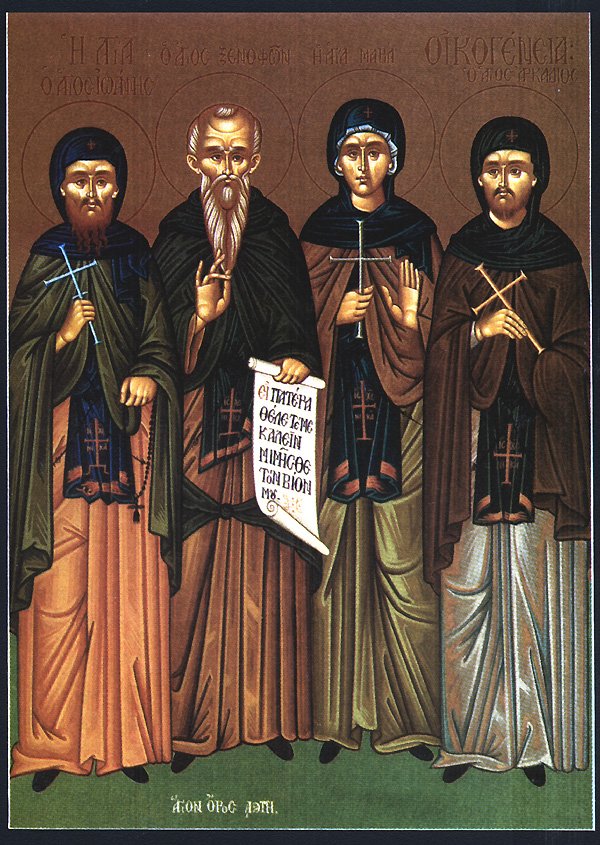
Ven. Xenophon, Mary, and their sons Arcadius and John
Saint Xenophon, his wife Maria, and their sons Arcadius and John, were noted citizens of Constantinople and lived in the fifth century. Despite their riches and position, they distinguished themselves by their simplicity of soul and goodness of heart. Wishing to give their sons John and Arcadius a more complete education, they sent them off to the Phoenician city of Beirut.
Saint Xenophon, his wife Maria, and their sons Arcadius and John, were noted citizens of Constantinople and lived in the fifth century. Despite their riches and position, they distinguished themselves by their simplicity of soul and goodness of heart. Wishing to give their sons John and Arcadius a more complete education, they sent them off to the Phoenician city of Beirut.
By divine Providence the ship on which both brothers sailed was wrecked. The waves tossed the brothers ashore at different places. Grieved at being separated, the brothers dedicated themselves to God and became monks. For a long time the parents had no news of their children and presumed them to be dead.
Xenophon, however, already quite old, maintained a firm hope in the Lord and consoled his wife Maria, telling her not to be sad, but to believe that the Lord watched over their children. After several years the couple made a pilgrimage to the holy places, and at Jerusalem they met their sons, living in asceticsm at different monasteries. The joyful parents gave thanks to the Lord for reuniting the family.
Saints Xenophon and Maria went to separate monasteries and dedicated themselves to God. The monks Arcadius and John, having taken leave of their parents, went out into the wilderness, where after long ascetic toil they were glorified by gifts of wonderworking and discernment. Saints Xenophon and Maria, laboring in silence and strict fasting, also received from God the gift of wonderworking.
Troparion - Tone 4
O God of our Fathers, / always act with kindness towards us; / take not Your mercy from us, / but guide our lives in peace / through the prayers of Venerable Xenophon and his family.
Kontakion - Tone 4
Having avoided the sea of life, / the righteous Xenophon and his august wife rejoice in Heaven along with their children, / magnifying Christ.
St Simeon the Elder of Mount Sinai
Saint Simeon the Elder was so named in order to distinguish him from Saint Simeon the Stylite (September 1). He practiced asceticism in Syria in the fifth century, and in his childhood years went out into the Syrian wilderness and lived in a cave in complete solitude.
Unceasing prayer, meditation, and contemplation of God were his constant occupation.
Saint Simeon the Elder was so named in order to distinguish him from Saint Simeon the Stylite (September 1). He practiced asceticism in Syria in the fifth century, and in his childhood years went out into the Syrian wilderness and lived in a cave in complete solitude.
Unceasing prayer, meditation, and contemplation of God were his constant occupation. The ascetic ate only the grass which grew about his cave. When people began to come to him to receive guidance, he wished to preserve his silence, so he left his cave and settled on one of the mountains of the Aman range. But here also his solitude was disturbed by many visitors. Saint Simeon withdrew to Mount Sinai, where formerly the Prophet Moses (September 4) received a revelation from God.
By divine Providence, the holy ascetic returned to Aman after a short stay on Sinai and founded two monasteries: one at the top of the mountain, the other at its base. As head of these monasteries, Saint Simeon guided the monks, warning them about the wiles of the Enemy of mankind, and he taught them how to struggle against temptations. He inspired and encouraged them in ascetic deeds, rousing them to think of their salvation. Because of the holiness of his life Saint Simeon received from God the gift of wonderworking.
After the many labors of his ascetic life, Saint Simeon departed to God around the year 390.
Troparion - Tone 8
By a flood of tears you made the desert fertile, / and your longing for God brought forth fruits in abundance. / By the radiance of miracles you illumined the whole universe! / O our holy father Simeon, pray to Christ our God to save our souls!
St Ammonas of Egypt, disciple of St Anthony the Great (350)
“Saint Ammonas was a disciple of Saint Antony the Great and became his successor at the head of the hermits of the outer mountain of Pispir, after having spent fourteen years at Scetis in ceaseless prayer to the Lord to be granted victory over anger. He was afterwards consecrated bishop, probably by Saint Athanasius the Great. H
“Saint Ammonas was a disciple of Saint Antony the Great and became his successor at the head of the hermits of the outer mountain of Pispir, after having spent fourteen years at Scetis in ceaseless prayer to the Lord to be granted victory over anger. He was afterwards consecrated bishop, probably by Saint Athanasius the Great. He possessed impassibility to the extent of being as though ignorant of the existence of evil, and incapable of passing judgment on anyone.
“One day some people came to ask him to settle a difference among them. The Saint responded by pretending to be insane, and answered a woman who treated him as a madman: ‘You don’t realize how much trouble I’ve given myself in the desert to acquire this madness and I have lost it today because of you!’ On another occasion when he was taken to visit a brother with a bad reputation, he sat on the barrel where [the erring brother’s] concubine was hiding while his accusers searched his cell in vain. Then, taking his leave of the unfortunate man, he simply said: ‘Brother, have a care for yourself!’
“When he was asked which deeds of ascesis are most pleasing to God, he replied: ‘Just sit in your cell and eat a little every day, always keeping the prayer of the Publican in your heart (Luke 18:13), and you can be saved.’ He also said that the fear of God begets moans and tears and these cause joy to arise in the soul, filling it with divine strength to do what is pleasing to God, and that this power from on high establishes us in the company of the Angels. Raised thus from height to height as we humbly pray to be delivered from sin, we shall (he said) receive as if of itself, revelation of the mysteries of God.” (Synaxarion)
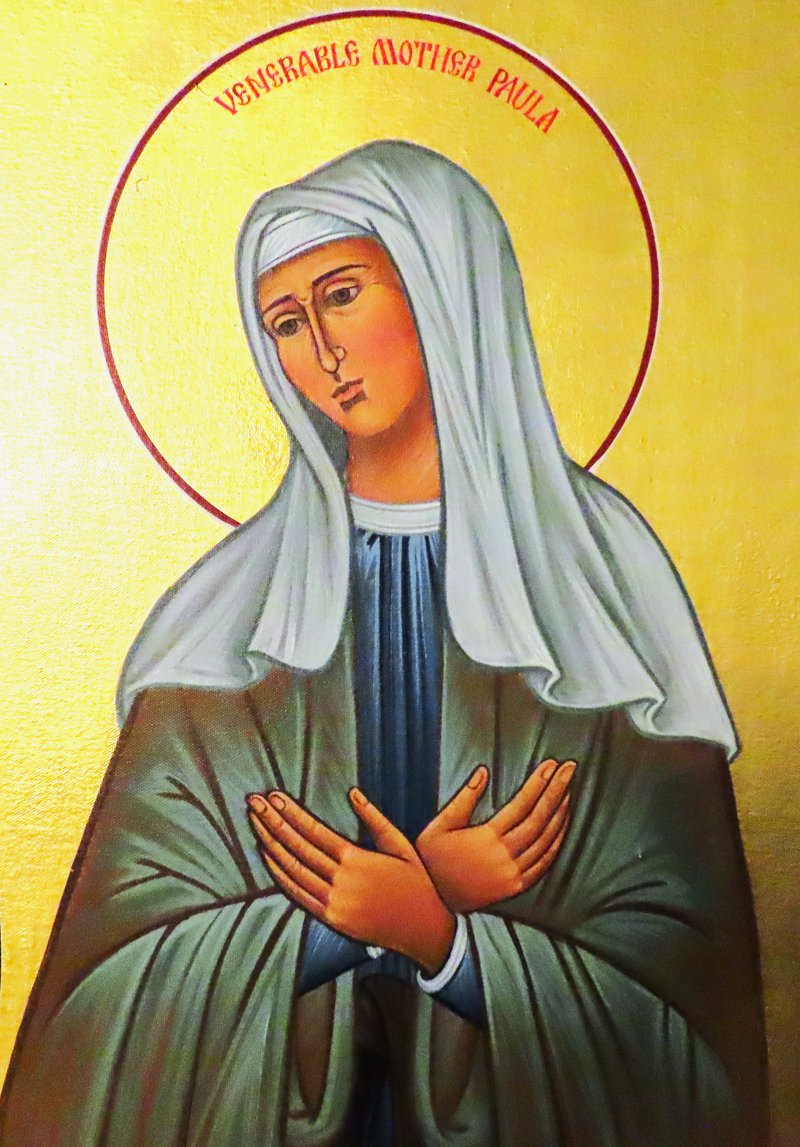
Our Holy Mother Paula of Rome (404)
Our Venerable Mother Paula was born on May 5, 347, and was the daughter of Rogatus and Blessilla, who belonged to the nobility. Her father was a Greek, and her mother was descended from two of the most illustrious families of Rome – the Gracchi, and the Scipios. She married a wealthy man by the name of Toxotius and bore him six children: Blesilla, Paulina, Eustochium, Julia, Rufina, and a son who was named for his father.
Our Venerable Mother Paula was born on May 5, 347, and was the daughter of Rogatus and Blessilla, who belonged to the nobility. Her father was a Greek, and her mother was descended from two of the most illustrious families of Rome – the Gracchi, and the Scipios. She married a wealthy man by the name of Toxotius and bore him six children: Blesilla, Paulina, Eustochium, Julia, Rufina, and a son who was named for his father.
The elder Toxotius died when Saint Paula was thirty-three years old, and she almost died of grief. As time passed, she realized the vanity of all earthly things and submitted herself to God’s will. Gradually she accustomed herself to plain food and inexpensive clothing. She would not sit down at the table with any man, not even with the bishops whom she hosted in her home, and whose advice she sought. While her husband was alive she strove to please him, but after his death she devoted herself to serving God.
She became a friend of Saint Marcella (January 31), another widow who had organized a sort of religious sisterhood at her home on Rome’s Aventine Hill. This group of Roman ladies, who were drawn to a life of study and asceticism, was led by Saint Jerome (September 30), that priest and biblical scholar who is renowned for his Latin translation of the Bible from Greek and Hebrew manuscripts. Saint Jerome left for the Holy Land in 385, and Saint Paula decided to follow him. All her children were nearly grown, and she was weary of Rome's business concerns and social life. Her unmarried daughter Eustochium accompanied her, for she also longed to see the Holy Land, and desired to consecrate her virginity to Christ. They arrived at Jerusalem and visited the holy sites, praying before the True Cross, walking the Via Dolorosa, and venerating the Life-giving tomb of Christ.
The holy women then traveled to Bethlehem, where the Lord was born of the Virgin Mary. Saint Jerome had settled in that vicinity, so she bought a small house where she could be near her teacher and Spiritual Father. Her wealth enabled her to establish a hospital for pilgrims, a monastery for Saint Jerome and his monks, three women’s monasteries, and a church large enough to accommodate the nuns from all three convents.
Saint Paula governed the affairs of her monastery in an efficient and loving manner. Despite her wealth and noble birth, she never refused to perform the most menial tasks. Thus she led others by her own example, indicating to them the path of humility which they should follow.
Since she had learned Greek from her father, Saint Paula decided to learn Hebrew so she could chant the Psalms in their original language. The entire Psalter was sung each day during Church Services, and every nun was required to learn it by heart. The sisters also performed manual labor, making clothing for themselves and for the poor.
Saint Paula reposed the age of fifty-six. Five years of her widowhood were spent at Rome, and almost twenty years at Bethlehem. In her last illness she repeated the Psalms almost incessantly, and the praises of God were ever on her lips. When she was no longer able to speak, she made the Sign of the Cross on her lips, and fell asleep in the Lord on January 26, 404. Two days later her body was carried in procession by certain bishops, and others held with lighted torches and tapers, and she was buried in the church of the Nativity in Bethlehem. Her tomb is still shown in that place, near that of Saint Jerome, but it is empty.
Saint Jerome composed a Latin epitaph in verse, which was engraved on her tomb, but it has been eradicated. The verse may be found the end of a letter (Epistle 86) which he addressed to her daughter.
By her holy prayers, may we also be made worthy of the heavenly Kingdom.
Troparion - Tone 8
In you, O Mother, was preserved with exactness what was according to the image; / for you took up the Cross and followed Christ. / By so doing, you taught us to disregard the flesh, for it passes away; / but to care for the soul, since it is immortal. / Therefore, O Venerable Paula, your spirit rejoices with the Angels.
Kontakion - Tone 2
Having divinely armed yourself with purity of soul / and firmly grasping unceasing prayer as a spear, you slew the hordes of demons. / Therefore, we beseech you, O Mother Paula: / “Always intercede for those who honor you.”
Scripture Readings
☩Epistle
Hebrews 9:8-10, 15-23
8
The Holy Ghost this signifying, that the way into the holiest of all was not yet made manifest, while as the first tabernacle was yet standing:
9
Which was a figure for the time then present, in which were offered both gifts and sacrifices, that could not make him that did the service perfect, as pertaining to the conscience;
10
Which stood only in meats and drinks, and divers washings, and carnal ordinances, imposed on them until the time of reformation.
15
And for this cause he is the mediator of the new testament, that by means of death, for the redemption of the transgressions that were under the first testament, they which are called might receive the promise of eternal inheritance.
16
For where a testament is, there must also of necessity be the death of the testator.
17
For a testament is of force after men are dead: otherwise it is of no strength at all while the testator liveth.
18
Whereupon neither the first testament was dedicated without blood.
19
For when Moses had spoken every precept to all the people according to the law, he took the blood of calves and of goats, with water, and scarlet wool, and hyssop, and sprinkled both the book, and all the people,
20
Saying, This is the blood of the testament which God hath enjoined unto you.
21
Moreover he sprinkled with blood both the tabernacle, and all the vessels of the ministry.
22
And almost all things are by the law purged with blood; and without shedding of blood is no remission.
23
It was therefore necessary that the patterns of things in the heavens should be purified with these; but the heavenly things themselves with better sacrifices than these.
☩Gospel
Mark 8:22-26
22
And he cometh to Bethsaida; and they bring a blind man unto him, and besought him to touch him.
23
And he took the blind man by the hand, and led him out of the town; and when he had spit on his eyes, and put his hands upon him, he asked him if he saw ought.
24
And he looked up, and said, I see men as trees, walking.
25
After that he put his hands again upon his eyes, and made him look up: and he was restored, and saw every man clearly.
26
And he sent him away to his house, saying, Neither go into the town, nor tell it to any in the town.
Liturgical data sourced from OCA.org and orthocal.info