Fasting Rules
 Meat
Abstain
 Fish
Abstain
 Dairy
Abstain
 Oil
Abstain
 Wine
Abstain
Saints & Commemorations
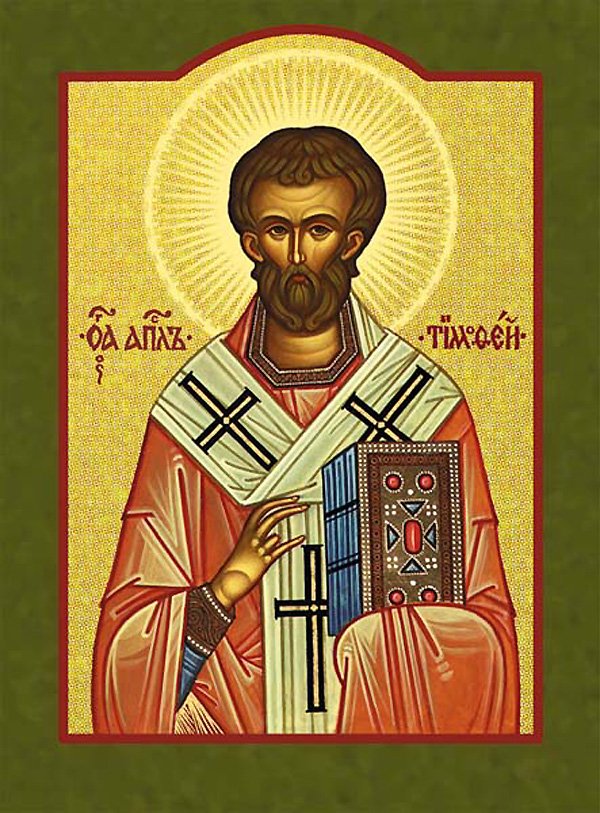
Apostle Timothy of the Seventy
The Holy Apostle Timothy was from the Lycaonian city of Lystra in Asia Minor. Saint Timothy was converted to Christ in the year 52 by the holy Apostle Paul (June 29). When the Apostles Paul and Barnabas first visited the cities of Lycaonia, Saint Paul healed one crippled from birth. Many of the inhabitants of Lystra then believed in Christ, and among them was the future Saint Timothy, his mother Eunice and grandmother Loida (Lois) (Acts 14:6-12; 2 Tim.
The Holy Apostle Timothy was from the Lycaonian city of Lystra in Asia Minor. Saint Timothy was converted to Christ in the year 52 by the holy Apostle Paul (June 29). When the Apostles Paul and Barnabas first visited the cities of Lycaonia, Saint Paul healed one crippled from birth. Many of the inhabitants of Lystra then believed in Christ, and among them was the future Saint Timothy, his mother Eunice and grandmother Loida (Lois) (Acts 14:6-12; 2 Tim. 1:5).
The seed of faith, planted in Saint Timothy’s soul by the Apostle Paul, brought forth abundant fruit. He became Saint Paul’s disciple, and later his constant companion and co-worker in the preaching of the Gospel. The Apostle Paul loved Saint Timothy and in his Epistles called him his beloved son, remembering his devotion and fidelity with gratitude.
He wrote to Timothy: “You have followed my teaching, way of life, purpose, faith, longsuffering, love, and patience” (2 Tim. 3:10-11). The Apostle Paul appointed Saint Timothy as Bishop of Ephesus, where the saint remained for fifteen years. Finally, when Saint Paul was in prison and awaiting martyrdom, he summoned his faithful friend, Saint Timothy, for a last farewell (2 Tim. 4:9).
Saint Timothy ended his life as a martyr. The pagans of Ephesus celebrated a festival in honor of their idols, and used to carry them through the city, accompanied by impious ceremonies and songs. Saint Timothy, zealous for the glory of God, attempted to halt the procession and reason with the spiritually blind idol-worshipping people, by preaching the true faith in Christ.
The pagans angrily fell upon the holy apostle, they beat him, dragged him along the ground, and finally, they stoned him. Saint Timothy’s martyrdom occurred in the year 93.
In the fourth century the holy relics of Saint Timothy were transferred to Constantinople and placed in the church of the Holy Apostles near the tombs of Saint Andrew (November 30) and Saint Luke (October 18). The Church honors Saint Timothy as one of the Apostles of the Seventy.
In Russian practice, the back of a priest’s cross is often inscribed with Saint Paul’s words to Saint Timothy: “Be an example to the believers in speech and conduct, in love, in faith, in purity” (1 Tim. 4:12).
Troparion - Tone 4
Having learned goodness and maintaining continence in all things, / you were arrayed with a good conscience as befits a priest. / From the chosen Vessel you drew ineffable mysteries; / you kept the faith, and finished a course equal to His. / Bishop martyr Timothy, entreat Christ God that our souls may be saved.
Kontakion - Tone 1
Let us the faithful praise the Holy Apostle Timothy, / the companion of Paul in his travels and together with him / let us honor the wise Anastasius, who came as a star from Persia / for the healing of the passions of our souls and the diseases of our bodies.
Holy Martyr Anastasius of Persia (628)
He was a Persian, the son of a Magus, a soldier in the Persian army under Chosroes II, who at that time was making inroads into the Christian Empire. His Persian name was Magundat. Chosroes captured Jerusalem in 614, and carried away the Precious Cross as a trophy. Magundat heard of this, and of all the miracles worked by the Cross; and he wondered why the ruins of an instrument of torture were so revered by the Christians.
He was a Persian, the son of a Magus, a soldier in the Persian army under Chosroes II, who at that time was making inroads into the Christian Empire. His Persian name was Magundat. Chosroes captured Jerusalem in 614, and carried away the Precious Cross as a trophy. Magundat heard of this, and of all the miracles worked by the Cross; and he wondered why the ruins of an instrument of torture were so revered by the Christians. Seeking out Christian elders to answer his questions, he learned of the Incarnation, life, Crucifixion and Resurrection of the Christ, and with joy embraced the Christian Faith as Truth. He was baptized by St Modestus, Patriarch of Jerusalem, and given the name of Anastasius. At the same time, he took monastic vows. For a time he lived in a monastery in Jerusalem, but then went forth, found some Persian Magi at Caesarea, and chastised them for embracing delusions. Since he was in Persian territory (as he well knew), he was taken to the Persian governor, interrogated, imprisoned, and finally taken with other captives to Persia. There, despite many severe tortures, he refused to return to his former error, and was hanged by one hand, strangled, then beheaded.
Scripture Readings
☩Epistle
Hebrews 7:18-25
18
For there is verily a disannulling of the commandment going before for the weakness and unprofitableness thereof.
19
For the law made nothing perfect, but the bringing in of a better hope did; by the which we draw nigh unto God.
20
And inasmuch as not without an oath he was made priest:
21
(For those priests were made without an oath; but this with an oath by him that said unto him, The Lord sware and will not repent, Thou art a priest for ever after the order of Melchisedec:)
22
By so much was Jesus made a surety of a better testament.
23
And they truly were many priests, because they were not suffered to continue by reason of death:
24
But this man, because he continueth ever, hath an unchangeable priesthood.
25
Wherefore he is able also to save them to the uttermost that come unto God by him, seeing he ever liveth to make intercession for them.
☩Gospel
Luke 21:37-22:8
37
And in the day time he was teaching in the temple; and at night he went out, and abode in the mount that is called the mount of Olives.
38
And all the people came early in the morning to him in the temple, for to hear him.
1
Now the feast of unleavened bread drew nigh, which is called the Passover.
2
And the chief priests and scribes sought how they might kill him; for they feared the people.
3
Then entered Satan into Judas surnamed Iscariot, being of the number of the twelve.
4
And he went his way, and communed with the chief priests and captains, how he might betray him unto them.
5
And they were glad, and covenanted to give him money.
6
And he promised, and sought opportunity to betray him unto them in the absence of the multitude.
7
Then came the day of unleavened bread, when the passover must be killed.
8
And he sent Peter and John, saying, Go and prepare us the passover, that we may eat.
Liturgical data sourced from OCA.org and orthocal.info