Fasting Rules
 Meat
Allowed
 Fish
Allowed
 Dairy
Allowed
 Oil
Allowed
 Wine
Allowed
Saints & Commemorations
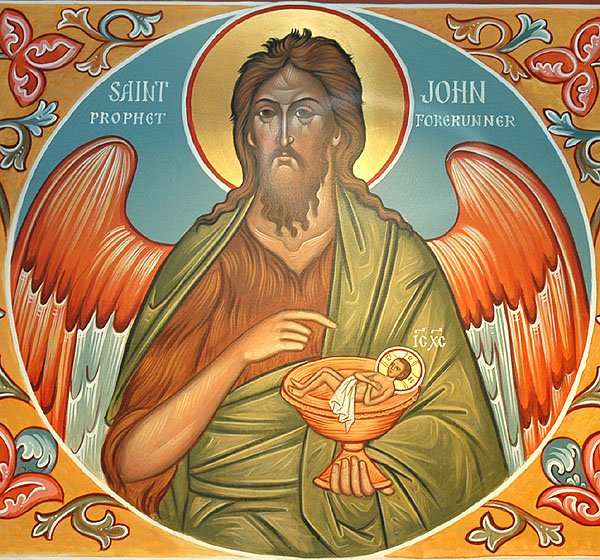
Synaxis of St John the Baptist
In the Orthodox Church it is customary, on the day following the Great Feasts of the Lord and the Mother of God, to remember those saints who participated directly in the sacred event. So, on the day following the Theophany of the Lord , the Church honors the one who participated directly in the Baptism of Christ, placing his own hand upon the head of the Savior.
In the Orthodox Church it is customary, on the day following the Great Feasts of the Lord and the Mother of God, to remember those saints who participated directly in the sacred event. So, on the day following the Theophany of the Lord , the Church honors the one who participated directly in the Baptism of Christ, placing his own hand upon the head of the Savior.
Saint John, the holy Forerunner and Baptist of the Lord, whom the Lord called the greatest of the prophets, concludes the history of the Old Testament and opens the era of the New Testament. The holy Prophet John bore witness to the Only-Begotten Son of God, incarnate in the flesh. Saint John was accounted worthy to baptize Him in the waters of the Jordan, and he was a witness of the Theophany of the Most Holy Trinity on the day of the Savior’s Baptism.
The holy Prophet John, the son of the Priest Zachariah and Righteous Elizabeth , was related to the Lord on His mother’s side. The holy Forerunner, John, was born six months before Christ. The Archangel Gabriel announced his birth in the Temple at Jerusalem, revealing to Zachariah that a son was to be born to him.
Through the prayers offered beforehand, the child was filled with the Holy Spirit. Saint John prepared himself in the wilds of the desert for his great service by a strict life, by fasting, prayer and sympathy for the fate of God’s people.
At the age of thirty, he came forth preaching repentance. He appeared on the banks of the Jordan, to prepare the people by his preaching to accept the Savior of the world. In church hymnology, Saint John is called a “bright morning star,” whose gleaming outshone the brilliance of all the other stars, announcing the coming dawn of the day of grace, illumined with the light of the spiritual Sun, our Lord Jesus Christ.
Having baptized the sinless Lamb of God, Saint John soon died a martyr’s death, beheaded by the sword on orders of King Herod at the request of his daughter Salome. (On Saint John the Baptist, see Mt.3:1-16, 11:1-19, 14:1-12; Mark 1:2-8, 6:14-29; Luke 1:5-25, 39-80, 3:1-20, 7:18-35, 9:7-9; John 1:19-34, 3:22-26).
The Transfer of the Right Hand of the holy Forerunner from Antioch to Constantinople (956) and the Miracle of Saint John the Forerunner against the Hagarenes (Moslems) at Chios:
The body of Saint John the Baptist was buried in the Samaritan city of Sebaste. The holy Evangelist Luke , who went preaching Christ in various cities and towns, came to Sebaste, where they gave him the right hand of the holy Prophet John, the very hand with which he had baptized the Savior. The Evangelist Luke took it with him to his native city of Antioch.
When the Moslems seized Antioch centuries later, a deacon named Job brought the holy hand of the Forerunner from Antioch to Chalcedon. From there, on the eve of the Theophany of the Lord, it was transferred to Constantinople (956) and kept thereafter.
In the year 1200, the Russian pilgrim Dobrynya, who later became Saint Anthony, Archbishop of Novgorod (February 10), saw the right hand of the Forerunner in the imperial palace. From the Lives of the Saints we learn that in the year 1263, during the capture of Constantinople by the Crusaders, the emperor Baldwin gave one bone from the wrist of Saint John the Baptist to Ottonus de Cichon, who then gave it to a Cistercian abbey in France.
The right hand continued to be kept in Constantinople. And at the end of the fourteenth to the beginning of the fifteenth centuries, the holy relic was seen at Constantinople in the Peribleptos monastery by the Russian pilgrims Stephen of Novgorod, the deacon Ignatius, the cantor Alexander and the deacon Zosimus. When Constantinople fell to the Turks in 1453, sacred objects were gathered up at the the conqueror’s orders and kept under lock in the imperial treasury.
In the Lives of the Saints is clear testimony that in the year 1484 the right hand of the holy Forerunner was given away by the son of the Moslem sultan Bayazet to the knights of Rhodes to gain their good will, since a dangerous rival for Bayazet, his own brother, had allied himself with them. A contemporary participant, the vice-chancellor of Rhodes, Wilhelm Gaorsan Gallo, also speaks of this event. The knights of Rhodes, having established their base on the island of Malta (in the Mediterranean Sea), then transferred the sacred relic they had received to Malta.
When the Russian Tsar Paul I (1796-1801) became Grand Master of the Maltese Order in honor of the holy Prophet John, the right hand of the Baptist, part of the Life-Creating Cross and the Philermos Icon (October 12) of the Mother of God (from Mt Philermos on the island of Rhodes) were transferred in 1799 from the island of Malta to Russia [because of the Napoleonic threat], to the chapel at Gatchina (October 12). In the same year these sacred items were transferred into the church dedicated to the Icon of the Savior Not Made by Hands at the Winter Palace. A special service was composed for this Feast.
Besides the Synaxis of the honorable, glorious Prophet, Forerunner and Baptist John, the Russian Orthodox Church celebrates his memory on the following days: September 23, his Conception ; June 24, his Nativity ; August 29, his Beheading ; February 24, the First and Second Finding of his Head ; May 25, the Third Finding of his Head ; October 12, the Transfer of his Right Hand from Malta to Gatchina (1799).
Troparion - Tone 2
The memory of the righteous is celebrated with hymns of praise, / but the Lord’s testimony is sufficient for you, O Forerunner. / You were shown in truth to be the most honorable of the prophets, / for you were deemed worthy to baptize in the streams of the Jordan Him whom they foretold. / Therefore, having suffered for the truth with joy, / you proclaimed to those in hell God who appeared in the flesh, / who takes away the sin of the world, and grants us great mercy.
Kontakion - Tone 6
The river Jordan trembled and was driven back filled with fear at Your coming in the flesh, / while John drew back in awe as he fulfilled the ministry of a prophet. / The ranks of angels stood amazed, / when they beheld You in the flesh being baptized in the streams. / And we, who were in darkness, are filled with light as we praise You, / who have appeared to enlighten all.
New Martyr Athanasius of Attalia (1700)
A native of Attalia, he lived in Smyrna. Once he unguardedly spoke the opening words of the Muslim confession of faith, “There is no god but God.” Hearing this, some Turks immediately surrounded him and took him to the court, claiming that he had embraced Islam. This he vehemently denied, assuring them that he was a Christian and that the words he had spoken would be unremarkable to any Christian. He
A native of Attalia, he lived in Smyrna. Once he unguardedly spoke the opening words of the Muslim confession of faith, “There is no god but God.” Hearing this, some Turks immediately surrounded him and took him to the court, claiming that he had embraced Islam. This he vehemently denied, assuring them that he was a Christian and that the words he had spoken would be unremarkable to any Christian. He was thrown into prison as an apostate and, after a sham trial, beheaded. His body was thrown to the dogs, but the usually voracious animals refused to touch his body, and it was removed by some pious Christians and given honorable burial.
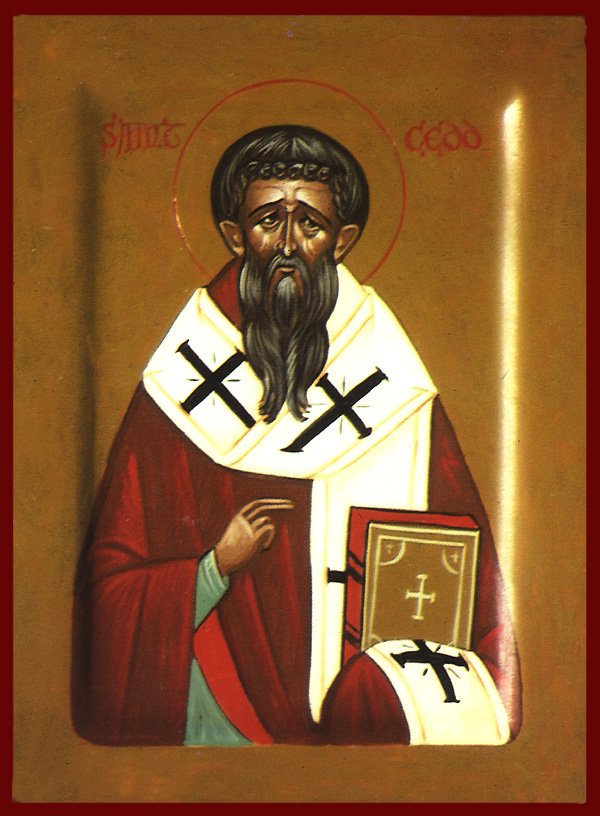
Our Venerable Father Cedd, Bishop of Essex and Abbot of Lastingham (664)
Saint Cedd was a missionary and bishop who spread the faith throughout England during the seventh century.
The eldest of four brothers, all of whom became priests, he was born in 620 AD into a noble Northumbrian family. At an early age, he began studies at the Lindisfarne Priory, where he became familiar with Irish monasticism.
Saint Cedd was a missionary and bishop who spread the faith throughout England during the seventh century.
The eldest of four brothers, all of whom became priests, he was born in 620 AD into a noble Northumbrian family. At an early age, he began studies at the Lindisfarne Priory, where he became familiar with Irish monasticism. After pursuing further studies in Ireland, he was sent by Bishop Finan of Lindisfarne to evangelize the people of Essex. He baptized many of the locals, built several churches, and founded monasteries in Bradwell-on-Sea and East Tilbury.
After his consecration to the episcopacy as Bishop of Essex, he reinstated Saint Paul's in London as the main seat of his diocese. He remained fond of his northern homeland and made regular visits there. On one such occasion in 658, he was approached by King Aethelwald of Deira who, finding Saint Cedd to be a good and wise man, pressed him to accept a parcel of land at Lastingham in Yorkshire on which to build a monastery. Saint Cedd eventually agreed, laying the foundation stones after the parcel had been cleansed through prayer and fasting. He became the first Abbot of Lastingham and remained so while still ministering to his flock in Essex.
Saint Cedd died in Lastingham during a great plague that also claimed the life of his brother Cynebil. Eventually, he was buried under the altar of a little stone church built at Lastingham in honor of the Mother of God. His relics were later transferred to the Litchfield Cathedral, which had been built by his brother Chad.
Troparion - Tone 4
The truth of things revealed you to your flock as a rule of faith, / a model of meekness, and a teacher of temperance. / Therefore, through humility, you attained the heights; / and through poverty, riches. / O Hierarch Cedd, our Father, entreat Christ God that our souls may be saved.
Kontakion - Tone 2
O Hierarch Cedd, divine thunder, spiritual trumpet, planter of faith, and pruner of heresies, / great favorite of the Trinity, / as you stand before God with the Angels, / pray unceasingly for all of us.
Scripture Readings
☩Epistle
James 4:7-5:9
7
Submit yourselves therefore to God. Resist the devil, and he will flee from you.
8
Draw nigh to God, and he will draw nigh to you. Cleanse your hands, ye sinners; and purify your hearts, ye double minded.
9
Be afflicted, and mourn, and weep: let your laughter be turned to mourning, and your joy to heaviness.
10
Humble yourselves in the sight of the Lord, and he shall lift you up.
11
Speak not evil one of another, brethren. He that speaketh evil of his brother, and judgeth his brother, speaketh evil of the law, and judgeth the law: but if thou judge the law, thou art not a doer of the law, but a judge.
12
There is one lawgiver, who is able to save and to destroy: who art thou that judgest another?
13
Go to now, ye that say, To day or to morrow we will go into such a city, and continue there a year, and buy and sell, and get gain:
14
Whereas ye know not what shall be on the morrow. For what is your life? It is even a vapour, that appeareth for a little time, and then vanisheth away.
15
For that ye ought to say, If the Lord will, we shall live, and do this, or that.
16
But now ye rejoice in your boastings: all such rejoicing is evil.
17
Therefore to him that knoweth to do good, and doeth it not, to him it is sin.
1
Go to now, ye rich men, weep and howl for your miseries that shall come upon you.
2
Your riches are corrupted, and your garments are motheaten.
3
Your gold and silver is cankered; and the rust of them shall be a witness against you, and shall eat your flesh as it were fire. Ye have heaped treasure together for the last days.
4
Behold, the hire of the labourers who have reaped down your fields, which is of you kept back by fraud, crieth: and the cries of them which have reaped are entered into the ears of the Lord of sabaoth.
5
Ye have lived in pleasure on the earth, and been wanton; ye have nourished your hearts, as in a day of slaughter.
6
Ye have condemned and killed the just; and he doth not resist you.
7
Be patient therefore, brethren, unto the coming of the Lord. Behold, the husbandman waiteth for the precious fruit of the earth, and hath long patience for it, until he receive the early and latter rain.
8
Be ye also patient; stablish your hearts: for the coming of the Lord draweth nigh.
9
Grudge not one against another, brethren, lest ye be condemned: behold, the judge standeth before the door.
☩Gospel
Luke 18:31-34
31
Then he took unto him the twelve, and said unto them, Behold, we go up to Jerusalem, and all things that are written by the prophets concerning the Son of man shall be accomplished.
32
For he shall be delivered unto the Gentiles, and shall be mocked, and spitefully entreated, and spitted on:
33
And they shall scourge him, and put him to death: and the third day he shall rise again.
34
And they understood none of these things: and this saying was hid from them, neither knew they the things which were spoken.
Liturgical data sourced from OCA.org and orthocal.info