Fasting Rules
 Meat
Abstain
 Fish
Abstain
 Dairy
Abstain
 Oil
Abstain
 Wine
Abstain
Saints & Commemorations
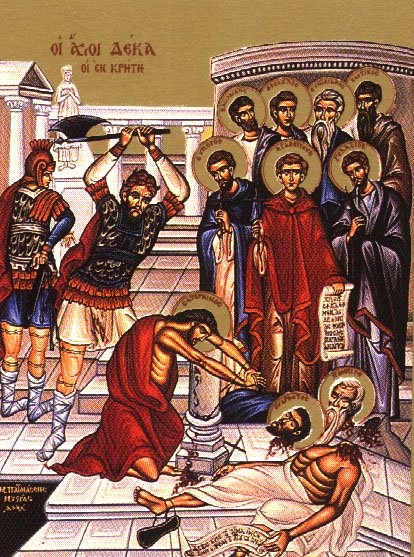
Holy Ten Martyrs of Crete
The Ten Holy Martyrs of Crete: Theodulus, Saturninus, Euporus, Gelasius, Eunician, Zoticus, Pompius, Agathopus, Basilides and Evaristus suffered for Christ during the third century under the emperor Decius (249-251). The governor of Crete, also named Decius, fiercely persecuted the Church, and arrested anyone who believed in Christ.
The Ten Holy Martyrs of Crete: Theodulus, Saturninus, Euporus, Gelasius, Eunician, Zoticus, Pompius, Agathopus, Basilides and Evaristus suffered for Christ during the third century under the emperor Decius (249-251). The governor of Crete, also named Decius, fiercely persecuted the Church, and arrested anyone who believed in Christ. Once, ten Christians were brought before him from various cities of Crete, who at the trial steadfastly confessed their faith in Christ and refused to worship idols.
For thirty days they were subjected to cruel tortures, and with the help of God they all persevered, glorifying God. Before their death they prayed that the Lord would enlighten their torturers with the light of the true Faith. Since pain did not influence them, the saints were beheaded.
Saint Paul of Constantinople (November 6) visited Crete about a hundred years later. He took the relics of the holy martyrs to Constantinople to serve as a protection for the city, and a source of blessings for the faithful.
Troparion - Tone 3
Let us show forth our great praise of Crete / that brought forth these precious Christians: the pearls of Christ! / And these blessed ten, the offspring of martyrs, / who though few in number, overcame all the deceits of powerful demons. / Therefore these martyrs of Christ have been crowned with victory!
Kontakion - Tone 3
The noble struggle of the martyrs / shines forth as the morning star, / shedding brilliant light for us / on the One who was born in the cave / to whom the Virgin gave birth without human seed.
Our Venerable Father Paul, Archbishop of Neocaesarea (4th c.)
Saint Paul, Bishop of Neocaesarea, suffered under the emperor Licinius (311-324). At his trial he firmly confessed his faith, and was subjected to beatings. They tortured him also with hunger, but he remained steadfast. Then they scorched his hands with red-hot iron and locked him in a prison at the banks of the Euphrates.
Saint Paul, Bishop of Neocaesarea, suffered under the emperor Licinius (311-324). At his trial he firmly confessed his faith, and was subjected to beatings. They tortured him also with hunger, but he remained steadfast. Then they scorched his hands with red-hot iron and locked him in a prison at the banks of the Euphrates.
After Licinius was executed in the year 324, when Saint Constantine became the sole ruler of the Roman Empire, and Christians in prison received their freedom, Saint Paul returned to his flock. He was a participant at the First Ecmenical Council at Nicea, convened in the year 325, at which the Arian heresy was condemned and the Symbol of Faith adopted. At the end of the Council, the Emperor Constantine solemnly received the Council participants and kissed Saint Paul’s burned hand. After long years of guiding his flock, Saint Paul peacefully fell asleep in the Lord.
Troparion - Tone 4
In truth you were revealed to your flock as a rule of faith, / an image of humility and a teacher of abstinence; / your humility exalted you; / your poverty enriched you. / Hierarch Father Paul, / entreat Christ our God / that our souls may be saved.
Our Holy Father Nahum of Ochrid, Wonderworker and Enlightener of the Slavs (ca. 900)
He was a disciple of Saints Cyril and Methodius (May 11), and traveled with them on their missionary journey to the Slavs. With them and their other companions, he endured many trials, including several imprisonments at the hands of the Latin Franks, who were seeking to seize control of the region of Moravia in order to impose the Latin language and to spread the heresy of the filioque.
He was a disciple of Saints Cyril and Methodius (May 11), and traveled with them on their missionary journey to the Slavs. With them and their other companions, he endured many trials, including several imprisonments at the hands of the Latin Franks, who were seeking to seize control of the region of Moravia in order to impose the Latin language and to spread the heresy of the filioque. For a time their troubles were relieved by Pope Hadrian II, who supported the mission and made St Methodius Archbishop of Pannonia, with jurisdiction over the Eastern European Slav lands. But when St Methodius died, St Nahum and his companions were imprisoned once more, then sent into exile, where they finally found shelter in the Orthodox Kingdom of Bulgaria. There they were able to continue their work of evangelization in the Slavonic language. Saint Nahum founded the Monastery that bears his name on the shore of Lake Ochrid. After his repose his relics were brought there for burial, and are venerated there today.
Scripture Readings
☩Epistle
Hebrews 10:1-18
1
For the law having a shadow of good things to come, and not the very image of the things, can never with those sacrifices which they offered year by year continually make the comers thereunto perfect.
2
For then would they not have ceased to be offered? because that the worshippers once purged should have had no more conscience of sins.
3
But in those sacrifices there is a remembrance again made of sins every year.
4
For it is not possible that the blood of bulls and of goats should take away sins.
5
Wherefore when he cometh into the world, he saith, Sacrifice and offering thou wouldest not, but a body hast thou prepared me:
6
In burnt offerings and sacrifices for sin thou hast had no pleasure.
7
Then said I, Lo, I come (in the volume of the book it is written of me,) to do thy will, O God.
8
Above when he said, Sacrifice and offering and burnt offerings and offering for sin thou wouldest not, neither hadst pleasure therein; which are offered by the law;
9
Then said he, Lo, I come to do thy will, O God. He taketh away the first, that he may establish the second.
10
By the which will we are sanctified through the offering of the body of Jesus Christ once for all.
11
And every priest standeth daily ministering and offering oftentimes the same sacrifices, which can never take away sins:
12
But this man, after he had offered one sacrifice for sins for ever, sat down on the right hand of God;
13
From henceforth expecting till his enemies be made his footstool.
14
For by one offering he hath perfected for ever them that are sanctified.
15
Whereof the Holy Ghost also is a witness to us: for after that he had said before,
16
This is the covenant that I will make with them after those days, saith the Lord, I will put my laws into their hearts, and in their minds will I write them;
17
And their sins and iniquities will I remember no more.
18
Now where remission of these is, there is no more offering for sin.
☩Gospel
Mark 10:11-16
11
And he saith unto them, Whosoever shall put away his wife, and marry another, committeth adultery against her.
12
And if a woman shall put away her husband, and be married to another, she committeth adultery.
13
And they brought young children to him, that he should touch them: and his disciples rebuked those that brought them.
14
But when Jesus saw it, he was much displeased, and said unto them, Suffer the little children to come unto me, and forbid them not: for of such is the kingdom of God.
15
Verily I say unto you, Whosoever shall not receive the kingdom of God as a little child, he shall not enter therein.
16
And he took them up in his arms, put his hands upon them, and blessed them.
Liturgical data sourced from OCA.org and orthocal.info